How to Use Fable 5, Opus 4.8 and GPT under GDPR

Foreign LLMs under GDPR: privacy gateway, CIS cloud, or your own hardware. Scope first for personal data, compare three deployment options, GPU only if the setup requires it.

  • A foreign model and GDPR are not an either-or choice
  • Scope-first: what actually falls under GDPR
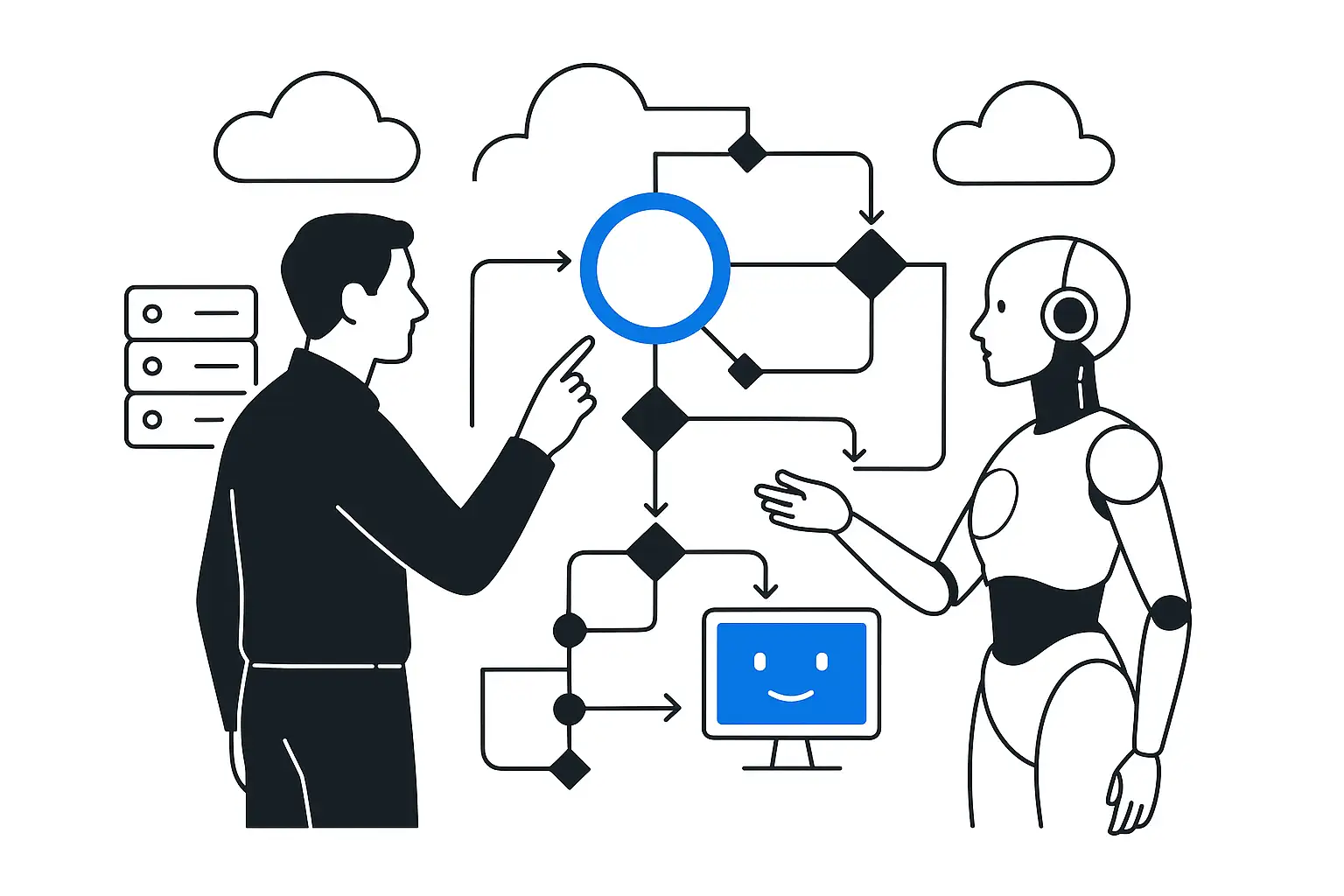
  • Privacy gateway: detect -> pseudonymize -> re-hydrate
  • Three setups under GDPR - choose by data, not by fashion

A foreign model and GDPR are not an either-or choice

"Fable 5 / Opus 4.8 / GPT are stronger, but they run in someone else's cloud, so we cannot use them" is a common conclusion, and it is wrong for two reasons. First, GDPR regulates neither the workflow nor the model, but personal data - those that identify a person.

Most of the text you send to an LLM does not contain personal data. Second: between "everything in a foreign cloud as-is"

between "everything on your own hardware" there is an intermediate setup - a privacy gateway that anonymizes data before sending and restores it in the response. GPU for self-hosted inference is the most expensive and latest step, not the first. Start with what is cheaper and faster: a privacy gateway in front of a foreign model or CIS cloud. Buy hardware only if the setup truly requires it - and that decision should be calculated in the calculator for your configuration, not guessed.


Scope-first: what actually falls under GDPR

GDPR protects personal data - information that directly or indirectly identifies an individual: full name, phone, email, passport, taxpayer ID, social insurance number, card number, account number, IP when linked with other attributes. That is the regulatory boundary. Anonymized, aggregated, synthetic, and purely corporate data (SKUs, policy texts, anonymized statistics) are outside 152-

are not covered by the federal law. So the right first question is not "can we use a foreign model"

, and "which exact fields in this process count as personal data"

Usually there are only a few: the customer's name and contact in a ticket, a policy number, a patient identifier. If these fields are removed or replaced with placeholders before sending, the model receives text that is no longer personal data, and the cross-border picture changes. The privacy gateway automates exactly this step.

Privacy gateway: detect -> pseudonymize -> re-hydrate

Personal data does not leave for the LLM API in raw form

Detect

Find personal datafull name, phone, email, taxpayer ID, social insurance number, card, IP

Classify

Classifyentity type and confidence threshold

Pseudonymize

ReplaceNAME_1, PHONE_2 (or BLOCK)

LLM API

ProcessFable 5 / Opus 4.8 / GPT see only anonymized text

Re-hydrate

Restore valuesalignment table in the CIS environment
Reversible pseudonymization: real full names, phone numbers, email addresses, taxpayer IDs, social insurance numbers, passports, cards, accounts, and IPs are replaced with placeholders before the cloud, the mapping table stays inside the customer's perimeter, and the proxy inserts the originals back into the response. A reference implementation using open tools: AI-gateway (LiteLLM) with Presidio in pre-call mode - MASK or BLOCK actions by entity type, confidence thresholds to reduce false positives, and output_parse_pii to restore values. Detection uses Microsoft Presidio (MIT) plus spaCy (MIT) with custom NER for CIS personal-data formats. Important caveat: Presidio documentation explicitly warns that the tool does not guarantee finding all sensitive data, so detector recall must be measured on the customer's data, not taken on faith. Pseudonymization is reversible, which means these data still count as personal data under the law: "anonymized" must not become false protection.

Three setups under GDPR - choose by data, not by fashion

There are three mutually exclusive setups for the same task, and the sensible sequence is from cheap and fast to expensive. (A)

Foreign frontier via a privacy gateway - maximum reasoning, minimum capex, fast start; cross-border transfer remains in anonymized form. (B) On-prem open-weight (DeepSeek V4, Qwen3, Gemma 4) on your own hardware - data never leaves the perimeter, but GPU capex appears and you depend on the open-weight release pipeline. (C) CIS cloud (GigaChat, YandexGPT) - processing in CIS data centers under GDPR, with no own hardware and no VPN, at the cost of a lower ceiling in model capability versus global leaders.

Below are the pros and cons of each setup.

This is what the buyer screenshots for security and legal.

If the model operates inside an AI agent with access to CRM data and transcripts, the article covers data-leak channels and a launch checklist on AI Agents and Federal Law GDPR.

Setup A. Foreign frontier via a privacy gateway

When to adopt

  • you need maximum reasoning (Fable 5, Opus 4.8, GPT) with minimal capex and a fast start
  • Personal data in the process are local and easy to detect (full name, phone, email, numbers)
  • the mapping table stays within the CIS perimeter - provable to security and legal

When not to use it

  • cross-border transfer remains even for anonymized text - prior notice to Roskomnadzor is required under Article 12
  • you need measured detector recall and sign-off from security/legal: missing personal data is an incident
  • not suitable where the data leaving the perimeter is itself prohibited by regulation

Setup B. On-prem open-weight on your own hardware

When to adopt

  • strict personal-data mode: data never leaves the company perimeter
  • a consistently high and steady inference volume at which GPUs pay for themselves
  • you need full control over the setup, model versions, and logs

When not to use it

  • small or uneven request volume - the cloud API is cheaper per request
  • the best 2026 models are closed; on-prem relies on open-weight models, whose release cadence can lag behind the leaders
  • GPU capex and operating costs are calculated for the configuration, not guessed

Setup C. CIS cloud (GigaChat / YandexGPT)

When to adopt

  • GDPR without your own hardware: processing in CIS data centers, a GDPR contract, no VPN required
  • corporate no-training mode and certifications (U3 at YandexGPT, FSTEC certification at GigaChat)
  • you need a fast compliance start without your own infrastructure

When not to use it

  • a ceiling on model capability compared with global frontier leaders on complex reasoning
  • dependency on a specific provider and its pricing policy
  • some tasks will still require a frontier model through the gateway (setup A)

Assess where AI can deliver impact in your process

You do not buy your own hardware for the token price

Preliminary estimate

Calculator: which setup pays off and when

The main parameters are visible immediately. The model is deterministic: every number comes from a visible mechanism.

Company size

A preset seeds the starting values; every field stays editable.

Back office

How many roles and processes there are, and what they cost today.

Workload

How many tokens a single process consumes per month.

Your estimate

Order of magnitude for your parameters

Transparent model

How this is calculated

All figures are order-of-magnitude estimates, not a commercial offer.

  • Inference is modeled at the Opus 4.8 price as a frontier-model benchmark, using the same token volume for every deployment contour. Prices come from the 2026 LLM comparison as of 2026-06-27; calculator amounts are displayed in USD at a fixed rate of 1 USD = 80 RUB.
  • Implementation cost is modeled only per process: 300,000 RUB per process at a 60% automatable share. If the share is lower or higher, process cost scales proportionally. The calculator has no one-off launch fee.
  • Processes with high variability or strict legal responsibility are automated partially. That is normal.

Two pricing models

Two commercial models: fixed price for a working process, or an outstaff contract for a dedicated ai-native team. The inference contour (cloud, on-premise, or your perimeter) is selected separately. More detail: pricing approach.

The cost of mistakes in 2025-2026: why scope is defined in advance

Estimating the setup by eye is costly not only in infrastructure, but also in regulatory risk.

The 2025 amendment package moved personal-data violations into the realm of turnover-based fines and criminal liability, with cross-border transfer as a separate aggravating factor.

Law No. 420-FZ of 30/11/2024 (effective 30/05/2025) introduced turnover-based fines into Article 13.11 of the Administrative Code: for a repeat breach, 1-3% of annual revenue, minimum RUB 20 million, maximum RUB 500 million. In the same package: failure to notify

to Roskomnadzor about the incident - RUB 100-300 thousand

RUB; missing the breach notification deadline: RUB 1-3 million; major breach (over 100,000 individuals or biometrics): up to RUB 15-20 million.

Law No. 421-FZ of 30/11/2024 (in force from 11/12/2024) introduced Article 272.1 of the Criminal Code: for unlawful collection, storage, and transfer of personal data, up to 10 years in prison under aggravating circumstances, and cross-border transfer is explicitly named as an aggravating factor.

Separately, the cross-border transfer regime: under Art.

12 of GDPR, the controller must file a notice with Roskomnadzor before transmission begins. From 01/07/2025, a restriction on initial collection also applies: personal data of CIS citizens must first be stored in a CIS database, and only then may cross-border transfer take place (the exact law number should be verified - state the rule and date, not the citation).

Practical takeaway: which fields in the process count as personal data and in which environment they are processed must be documented before the pilot, not after the first incident.

Model behavior can also be tuned - but that is soft control, not a boundary

A useful analogy from the agent world: just as a system prompt and skills set the model's style and role before any user input, behavior can also be constrained for personal data - for example, with an instruction never to output personal data.

Privacy behavior is already being packaged into installable skills: the open repository `mukul975/Privacy-Data-Protection-Skills` (Apache-2.0) collects 282+ compliance procedures for GDPR, CCPA, EU AI Act, HIPAA, LGPD, PIPL, and DPDP - but this is a compliance-procedure library for agents, not a personal-data redaction engine. The distinction is critical.

A system prompt or skill is soft behavior control: it reduces the chance of error, but does not guarantee its absence. The gateway provides a strict, verifiable boundary: detect -> mask before the cloud.

So a skill is policy, while a gateway is enforcement.

You cannot rely on a single instruction instead of anonymization under GDPR.

How to deploy in order - from cheap to expensive

  1. 01

    Identify personal data

    Go through the process field by field and mark what exactly identifies a person. Everything else is outside GDPR.

  2. 02

    Set up the gateway

    Detect -> pseudonymize -> re-hydrate before the foreign model; the mapping table stays in the CIS perimeter.

  3. 03

    Measure recall

    Run the detector on the customer's real data: missing personal data is an incident, not a statistic.

  4. 04

    Calculate the setup

    Compare the gateway, CIS cloud, and on-prem in the calculator for your volume and payback - not by guesswork.

  5. 05

    GPU - only if needed

    Your own hardware comes last: when strict personal-data requirements or inference volume justify it.

PII pipeline acceptance checklist

KT.Team service

LLM Gateway: foreign models under GDPR

Security gate / API proxy before Fable 5, Opus 4.8, and GPT: detect → pseudonymize → re-hydrate pipeline (see diagram above), with the mapping table staying inside the CIS jurisdictional boundary - a condition under which the customer's legal and security teams approve use of the advanced model.

  • Detect → pseudonymize → re-hydrate
  • Alignment table in the customer's environment
  • Provable to security and the regulator
LLM Gateway: models under GDPR →

FAQ

FAQ

Can you legally send data to Fable 5, Opus 4.8, or GPT under GDPR at all?

Yes, if non-personal data is sent to the model. The privacy gateway anonymizes fields that identify a person before sending and restores them in the response; cross-border transfer in this case still requires prior notice to Roskomnadzor under Article 12. The canonical mechanism is shown above.

Should you buy GPUs and deploy everything on your own right away?

No. Your own hardware is the most expensive and latest step. Start with a privacy gateway or CIS cloud; buy GPUs only if strict personal-data requirements or a consistently high inference volume justify it, and calculate that in the calculator.

Are all our data personal?

No. GDPR is about data that identifies a person. Anonymized, aggregated, synthetic, and purely corporate data are outside its scope. The first step is to determine which fields in the process count as personal data.

Why is a gateway more reliable than just asking the model not to output personal data?

An instruction or skill is soft behavior control and does not guarantee the result. A gateway provides a verifiable boundary: personal data are masked before the cloud, and detector recall is measured on your data.

Sources

Checked on: 28.06.2026

Discuss the article: How to Use Fable 5, Opus 4.8 and GPT...

Send via: