Sources
Transactions, cash register, acquiring, SBP, and bank statements.

How to Set Up AI Revenue Reconciliation Across Branches, Banks, and Payment Methods: architecture, exception control, pilot timeline, economics, and 2025-2026 case studies.
Process map
The agent connects operational systems, payment sources, and accounting, resolves standard matches, and passes explained discrepancies to the accountant.
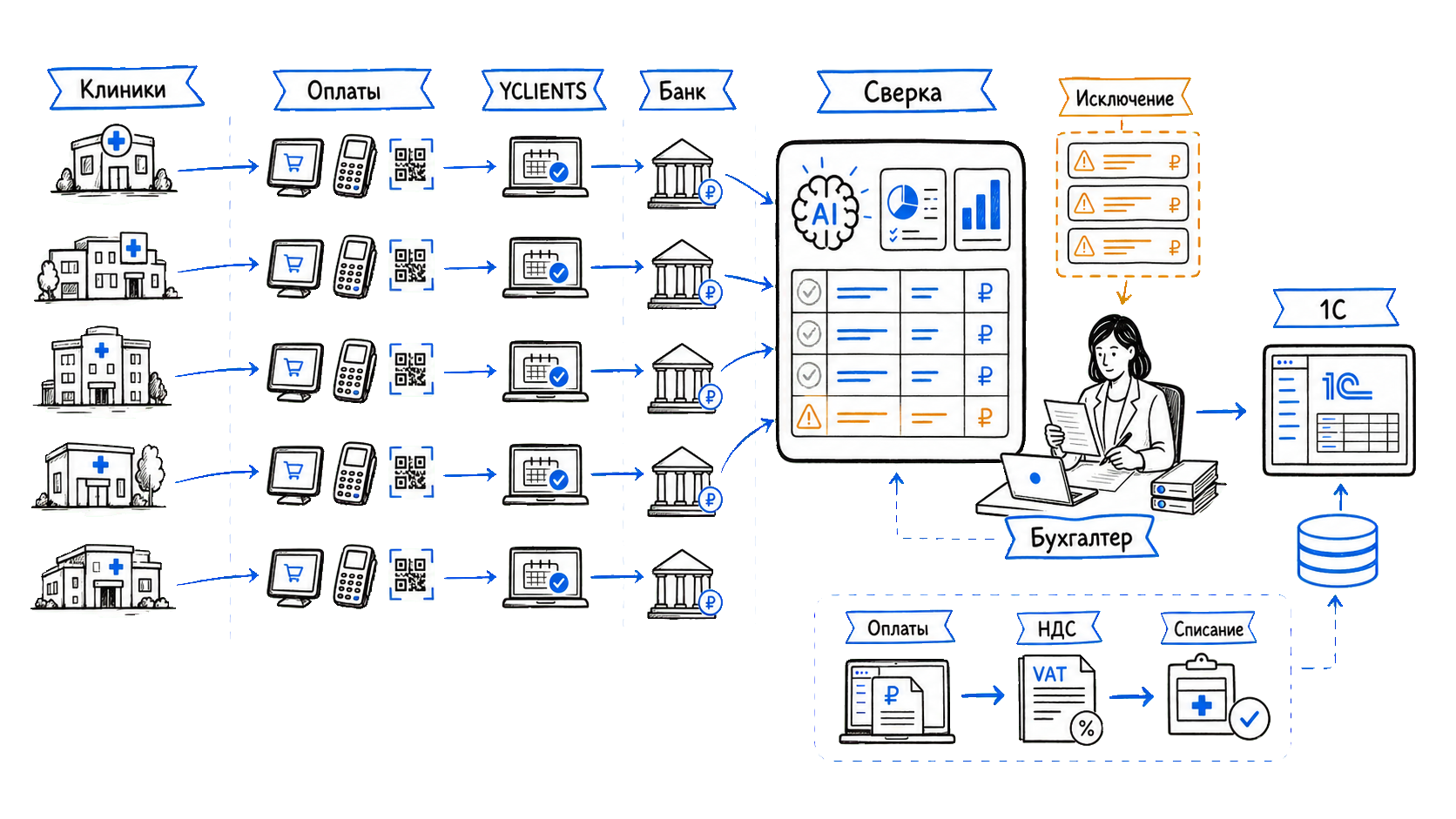
Transactions, cash register, acquiring, SBP, and bank statements.
Exact rules close standard matches.
AI gathers context and explains the discrepancy.
The accountant confirms the material action.
In a network of clinics, restaurants, stores, or service locations, accounting reconciles several versions of the same revenue every day: the record or order in the industry system, the cash receipt, card acquiring, SBP, the bank statement, and the final result in 1C.
When there are only a few units, discrepancies are found manually.
When there are more than a hundred, the spreadsheet turns into a control room: the accountant checks not accounting, but the money routes between systems. In such a setup, the AI accountant is neither a conversational partner nor an autonomous replacement for a specialist.
This is an agent that pulls data from approved sources, applies deterministic rules, explains deviations, and passes only exceptions to the accountant. Posting, classification changes, and other material actions remain under human control.
| Research | What it showed | Practical takeaway |
|---|---|---|
| Gartner, 2025 | 59% of finance functions use AI; the figure has changed little since 2024. | Implementation itself is no longer an advantage. Process maturity matters more: advanced teams are 2-3 times more likely to see a meaningful impact. |
| McKinsey, 2025 | 44% of surveyed CFOs used GenAI in more than five use cases, up from 7% the year before. | Finance teams are moving from standalone assistants to orchestration of end-to-end processes, including period close. |
| Deloitte, 2025 | 80.5% of finance and accounting professionals believe AI agents and GenAI will become standard tools within the next five years. | The main barrier is trust: without explainability, access rights, and exception control, scaling slows down. |
| KPMG, 2026 | 93% of U.S. companies plan to adopt or scale AI in finance over the next 18 months; half are considering multi-agent setups. | The architecture should be designed around roles, data, and accountability, not around a single model. |
In a single unit, revenue can already have five views: the rendered service, the receipt, the payment provider transaction, the bank deposit, and the accounting entry. In a chain, different legal entities, settlement delays, refunds, fees, certificate payments, advances, and payment-method selection errors are added.
Traditional automation matches rows well using exact keys.
But the real tail consists of ambiguous cases: the payment arrived the next day, the purpose was filled in as free text, the amount arrived net of fees, or the refund is tied to another shift.
Here, the agent is useful as an interpretation layer.
It does not invent an accounting solution; it gathers evidence around the transaction and offers the accountant a verifiable hypothesis.
From unit transactions to a confirmed result in accounting
Sources
Normalization
Reconciliation agent
Control
Result
Agent checked
Amounts across sources match. Refunds and fees are accounted for according to approved rules. There are no material discrepancies.
Suggested action
Confirm day close and record the result in the report
After confirmation: 1C / management report · awaiting confirmation
Next: transactions + cash register + bank + reference data + rule version
Agent checked
The transaction is confirmed in the industry system and cash register flow, but is missing from today's bank statement. Similar transactions from this provider were credited on the next banking day.
Suggested action
Move to next-day control without an accounting entry
After confirmation: exception queue · auto-posting blocked
Next: CRM + receipt + statement + credit history + window rule
Integrations and rules form the core of the setup: they pull data, normalize reference data, and calculate control sums. AI connects to unstructured context and ambiguous exceptions such as payment purpose, correspondence, documents, and the history of similar decisions. This separation is fundamental.
Arithmetic and allowed deviations are safer to handle deterministically.
The model must not guess VAT or execute a payment.
Its task is to find links, formulate an explanation, and show which sources it is based on.
The human-led, agent-operated approach matches the direction KPMG identifies in its 2026 finance functions study.
Microsoft's finance agent was configured in four weeks.
Willmott Dixon: from two days to one hour. The Financial Reconciliation Agent extracts data, generates reconciliation rules, a report, and an explanation of deviations. The Very Group: up to 44% auto-close. Oracle Account Reconciliation automated rules and the audit trail for 500+ monthly reconciliations.
A unified AI-ready data model reduced reconciliation effort by 25-30% and accelerated actions by 30-40%. Amazon Finance: regulatory analysis 92% faster. In the tax domain, generative AI reduced the time to get analytics on VAT changes from 26 minutes to 2 minutes per update.
The cases differ in data quality, ERP maturity, transaction volume, and automation boundaries.
But one pattern repeats:
That is why the baseline is fixed before the pilot:
Without these metrics, all that remains after launch is the impression that it is easier to use.
We describe the current process, sources, roles, discrepancy types, and control points. We choose one flow with sufficient data volume.
We assemble integrations in a test environment, matching rules, the exception queue, and the activity log. We test on historical data and then on fresh data.
Accountants work in parallel with the old process. We compare results, refine thresholds and permissions, and train process owners.
We connect the remaining units and banks, then in separate iterations add statement processing, VAT control, and inventory write-offs.
| Metric | How to calculate | Why |
|---|---|---|
| Day-close time | From the end of the operating day to confirmed reconciliation | Shows how quickly reliable revenue is obtained |
| Share of automatic matching | Lines without manual decision / all lines | Separates real automation from a polished interface |
| Manual touches | Open items, carryovers, and corrections per transaction | Shows the hidden cost of the process |
| Recurring exceptions | Same causes recurring | Shows whether the process learns from decisions |
| Processing cost | Labor costs + infrastructure / number of transactions | Allows comparison of the pilot with the original process |
| Errors after approval | Corrections in a closed period | Prevents speed at the expense of quality |
The minimum viable impact model is built bottom-up.
First, they calculate freed-up hours: transaction volume x reduction in manual touches x average touch time.
Then multiply by the fully loaded hourly rate for the role.
They separately account for the cost of prevented errors, faster access to management data, and the cost of the setup itself - integrations, models, monitoring, and support.
In most finance functions, the impact comes from higher volume without hiring, earlier day close, and shifting accountants' focus to exceptions and control.
That is why the financial model must be aligned with the process owner before development, not filled in after the pilot.
For a chain business, the first candidate is daily revenue reconciliation by unit and payment method.
It repeats every day, has a clear input and a verifiable outcome, and most exceptions can be built from history.
This kind of pilot creates the foundation for the next tasks: automatic processing of bank statements, finding the owners of payments and documents, and controlling revenue and VAT classification - this is the workflow we are assembling as AI assistant for accountants.
Inventory write-offs for closed procedures are better handled in a separate stage.
It has a different accounting object, its own regulations, and its own cost of error.
The integration layer, reference data, activity log, and exception interface will remain shared, so the first reconciliation becomes not a one-off robot, but a check of the architecture of the future setup.
FAQ
Traditional automation matches rows well using exact keys. AI comes in where there is no exact key: free-text payment references, amounts net of fees, next-day deposits, or reversals from another shift. It does not make an accounting decision; it gathers evidence around the transaction and offers the accountant a testable hypothesis.
No. Posting, reclassification, and any other material action remain under human control. The agent prepares the explanation and shows which sources it is based on, while the accountant approves it.
For a chain business, the first candidate is daily revenue reconciliation by unit and payment method. It repeats every day, has a clear input and a verifiable outcome, and most exceptions can be built from history.
Before the pilot, establish a baseline: how many hours reconciliation takes, what share of lines matches without human involvement, how many exceptions come back again, and when management receives confirmed revenue. Then calculate impact bottom-up: transaction volume, reduction in manual touches, average touch time, and the fully loaded hourly cost of the role.
Freeing up time does not mean cutting staff. In most finance functions, the benefit comes from handling more volume without hiring, closing earlier, and shifting accountants' focus to exceptions and controls.
1. Gartner: Finance AI Adoption Remains Steady in 2025, 18.11.2025. 2. McKinsey: How finance teams are putting AI to work today, 2025.
3. Deloitte: Trust Emerges as Main Barrier to Agentic AI Adoption in Finance and Accounting, 2025. 4. KPMG: AI in Finance - The Decision Advantage, 11.05.2026. 5. AICPA & CPA.com: 2025 AI in Accounting Report, 10.06.2025. 6.
Public cases from Microsoft, Oracle, and AWS are listed above; the metrics belong to the respective companies and solution providers.