Industries
IT solutions for development
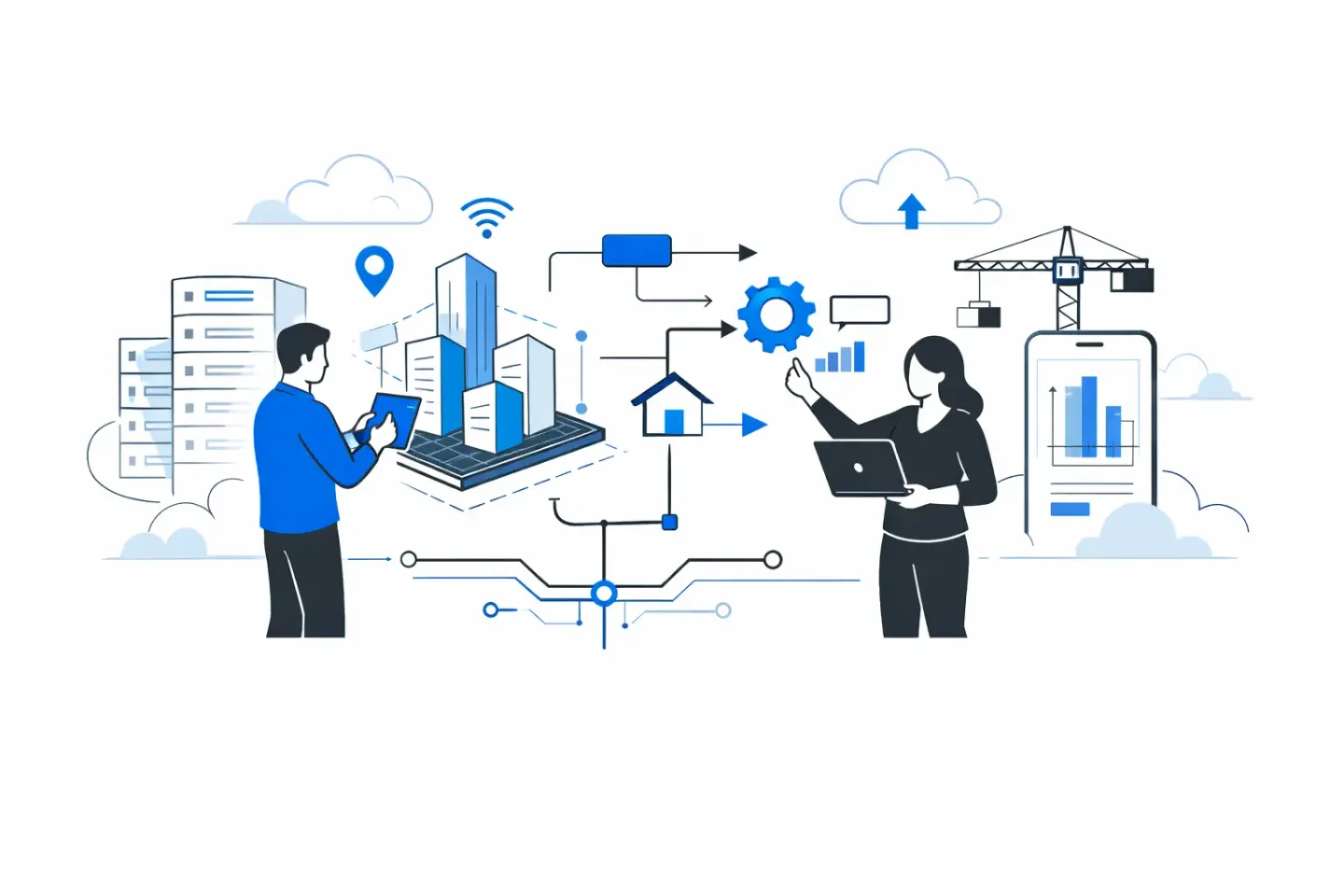
Looking for what to implement in development — a buyer portal, sales CRM, claims processing or property checks? Build what you need from a ready-made solution cluster for developers. We run enterprise projects with small strong teams and integrate CRM, 1C, BIM/TIM, EDI and BI into a managed workflow. Below are three routes: sales and revenue, buyer services and property risk checks.
Industry Clients
Developers and PropTech teams for whom we built digital operating models
What we change in development
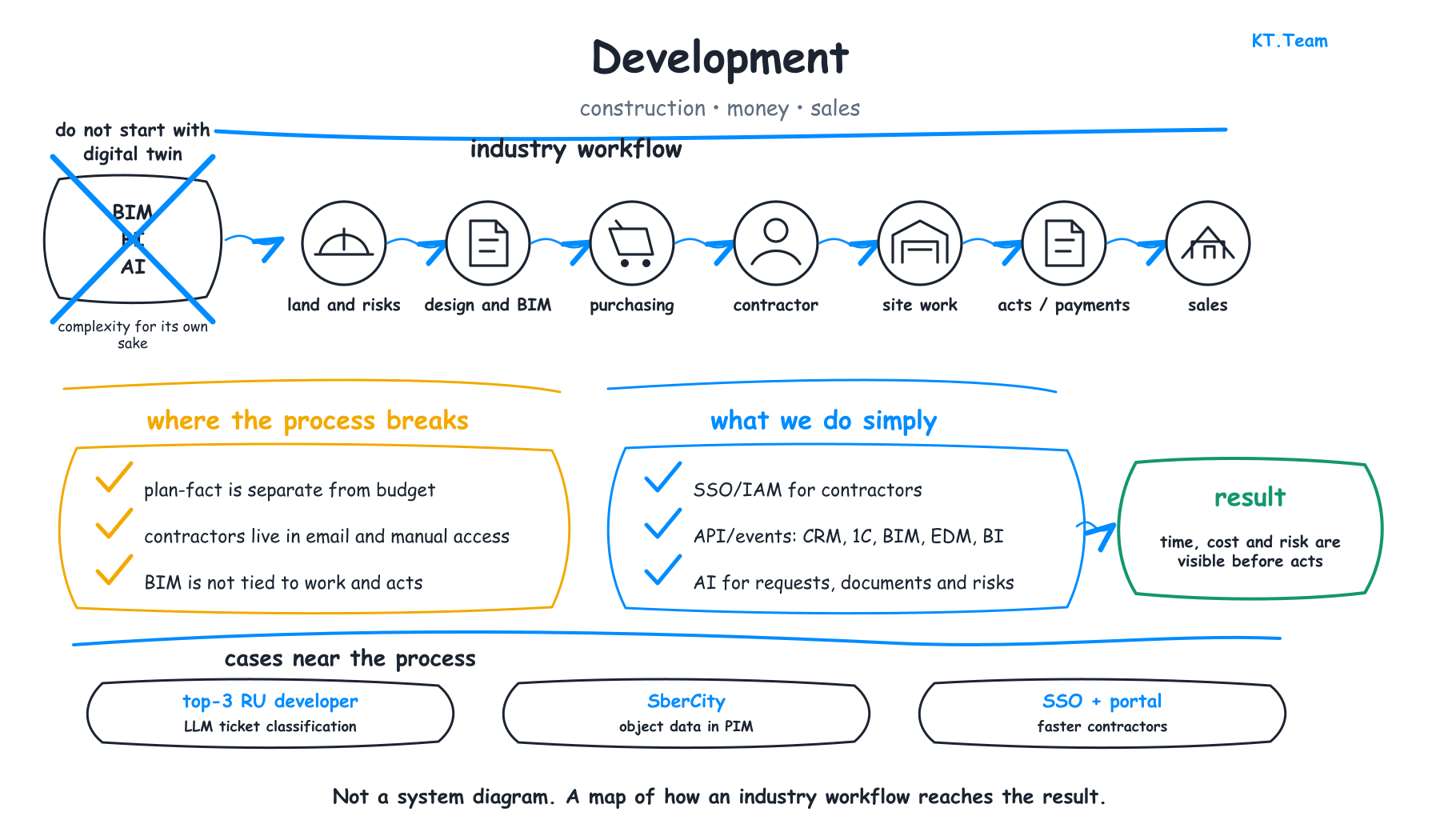
We assemble the flow property → contractor → work → money → risk so CPO, CIO and CDTO manage construction on end-to-end data.
Processes
- Construction plan-vs-fact
- Contractors and access
- BIM and documents
- Sales and reservations
- BI/AI risk loop
Platform
- SSO/IAM for contractors, services and internal roles
- API/events/ESB between CRM, 1C, BIM, EDM, BI
- Process platform: statuses, routes, templates, permissions
- LLM/AI agents for requests, documents, market and knowledge base
Impact
- Unified plan-vs-fact for deadlines, money and readiness
- Contractors run standard scenarios without manual support
- Risks and deviations visible before closing documents
- CIO/CDTO gets a managed loop instead of an IT zoo
Industries
One engineering base, different industry KPIs
Industry pages speak the language of specific KPIs: construction is about deadlines and margin, retail about availability and revenue, logistics about SLA, manufacturing about time-to-market, distribution about order speed.
Construction
Plan-vs-actual, contractors, procurement, estimates, CDE/BIM and AI summaries for the project manager.
Retail
PIM, omnichannel, reservations, marketplaces and honest channel analytics.
Logistics/manufacturing/distribution
WMS/TMS/MES/ERP/PIM/EDI connect through a shared data and integration layer.
Real estate and construction
How we approach development
We don't build a digital twin for its own sake. We improve the process that affects deadlines, money, sales or contractor control.
Process by process
We take a procurement, a schedule, contractor access, as-built documentation, a sale or a warranty request. We remove manual gaps and lock the result into the system.
Simplicity for construction
The system must work for the site, the office and the contractor. If a process needs a complex manual and manual reconciliation, it isn't simplified yet.
Weak connectivity
We link CRM, 1C, BIM, portals, EDM, BI and service systems through APIs, events and an integration layer, without turning the landscape into a monolith.
Process platform
We move roles, approval routes, statuses, document templates, access rights and contractor rules into a manageable layer for internal teams.
Data for management
A single loop across properties, contracts, works, payments, sales and deviations gives the CPO, CIO and CDTO a manageable plan-vs-actual.
Where development loses money
- Plan-vs-actual on deadlines, budget and property readiness diverges between construction, finance, procurement and contractors.
- BIM is becoming mandatory, but the model often lives apart from procurement, schedules, as-built documentation and operations.
- Accreditation, access, requests, contracts and contractor documents run through email and Excel — deadlines get lost in approvals.
- Sales, bookings, mortgage, CRM and 1C give no single picture of properties, clients, payments and constraints.
- Project changes, extra works, claims and closing documents are poorly traced, so risks and margin are hard to manage.
- External contractor access lives outside the corporate perimeter: contractor employees have no client account credentials, access doesn't revoke on contractor-side termination, and permissions are needed at the building and section level.
TIM to Cash: Where the Chain Breaks
The model alone doesn't save money: the benefit appears where data from it reaches the estimate, procurement, site actuals, accounting and the project financial model. Below are six links in the chain and typical break points.
1. Model in common data environment
The break begins where the model sits in the common data environment as a drawing archive: versions and comments exist, but nobody pulls anything from it further down the process.
2. Volumes and scope of work
The scope of work statement must be rebuilt with every design change — from the model if it's populated, or from the designer's specification when construction documents are released in 2D. What's not in the source — consumption rates, cutting waste, reinforcement, complicating factors, height variations — is added through master data with client-side coefficients. If volumes are calculated manually in spreadsheets, design changes never reach the estimate.
3. Estimate
An estimate built from current scope of work shows the price of change immediately, not at closeout. Manual volume transfer turns the estimate into a historical report.
4. Procurement and subcontract
Lots, subcontracts and delivery schedules emerge from the estimate. When procurement starts from a separate file instead of the estimate, the project receives materials on different timelines and at different prices.
5. Site actuals and 1C
Work journals, as-built documentation and acceptance bring actual data back into the chain. Without this, the accounting system sees only paid invoices, and plan-vs-actual is assembled manually.
6. Cost items and financial model
The estimate must map to the financial codebook — the master reference for project financial model items. Without mapping estimate line items to items, one estimate with diverse work hangs entirely on one line, and construction cost is broken down manually after the fact.
Where to go with your request: sales, buyer services, property checks
Technology and integrations
CIS market solution map
Developers will choose products with or without us: reviews exist, vendors sell licenses. Our work begins where you need a master data system, classifier and data flow between chosen systems — through estimate, tender, procurement, accounting and financial model. KT.Team is an integrator, not a reseller. Below are system categories and products most common among developers.
Model authoring
Renga, nanoCAD BIM, Model Studio CS. There's no direct Revit replacement, so selection depends on object type and project discipline, not a universal checklist.
Common data environment (CDE)
Vitro-CAD, Pilot-BIM, Exon, SIGNAL DOCS, Sarex. This is where model versions, remarks and approvals live; value emerges when the Common Data Environment feeds into schedules, procurement and as-built documentation.
Volumes and scope of work
Larix.EST, Tangl Value. They calculate volumes from the model and rebuild schedules with changes. We don't implement these products—we deliver their data into the estimate and accounting system, and our AI estimator prepares the draft budget.
Estimates
GRAND-Estimate, 1C:Estimate TIM CORP. The estimate system connects to scope of work and subcontracts: this is the most common point of manual data transfer.
Tenders and Procurement
Tender platforms, bidder cost estimates and contractor work lots. Value emerges when lots are composed from estimate items and bidding results feed back into contracts, delivery schedules and plan-vs-actual tracking.
Accounting system
1C:ERP Construction organization management. Contracts, closing documents, payments and project cost; actual data from the site should flow here, not just paid invoices.
Project Financial Model
Financial codifier, cost elements and project financial model. Estimates should arrive already broken down by cost item, not as a summary that the finance manager manually assembles at period end.
Complete market breakdown
Seven software categories, comparison tables and each product's limits — in our review 'Construction and BIM software in CIS 2026'.
Real Estate Development: Completed Work
KT.Team has 7 years of project experience with construction companies and developers. Most of these projects are under NDA, so case studies show only a portion of our work.
Contractor reporting — twice or three times a week
Client: a developer and PropTech corporation in CIS's top-5 by construction volume; manages work on 50+ large-scale projects. Each day of delay on one construction project costs approximately 200,000 rubles. Contractor reports came once a month; after launching the work planning and control system — twice or three times a week.
Material procurement: prepayment 4.9x faster
Redesigned the construction material procurement process: prepayment procurement sped up 4.9x, postpayment 3x.
SSO and Contractor Service Portal: 2 Months
Implemented SSO and launched a services marketplace to simplify contractor access and accelerate digitalization in development — in 2 months.
Projects
Cases in development
SSO and service catalog in 2 months
- SSO and a contractor service portal launched in 2 months
- Support workload decreased
- Contractor onboarding sped up
Pimcore PIM for SberCity
- Consolidated property data in one PIM
- Prices and statuses are updated across all systems
- Actual floor areas are automatically entered into billing
S.Pass Stabilization for Samolet
- Gate access, access control, and SMS were linked into one system
- The optimization plan reduced operational risks
- Access services became manageable during support
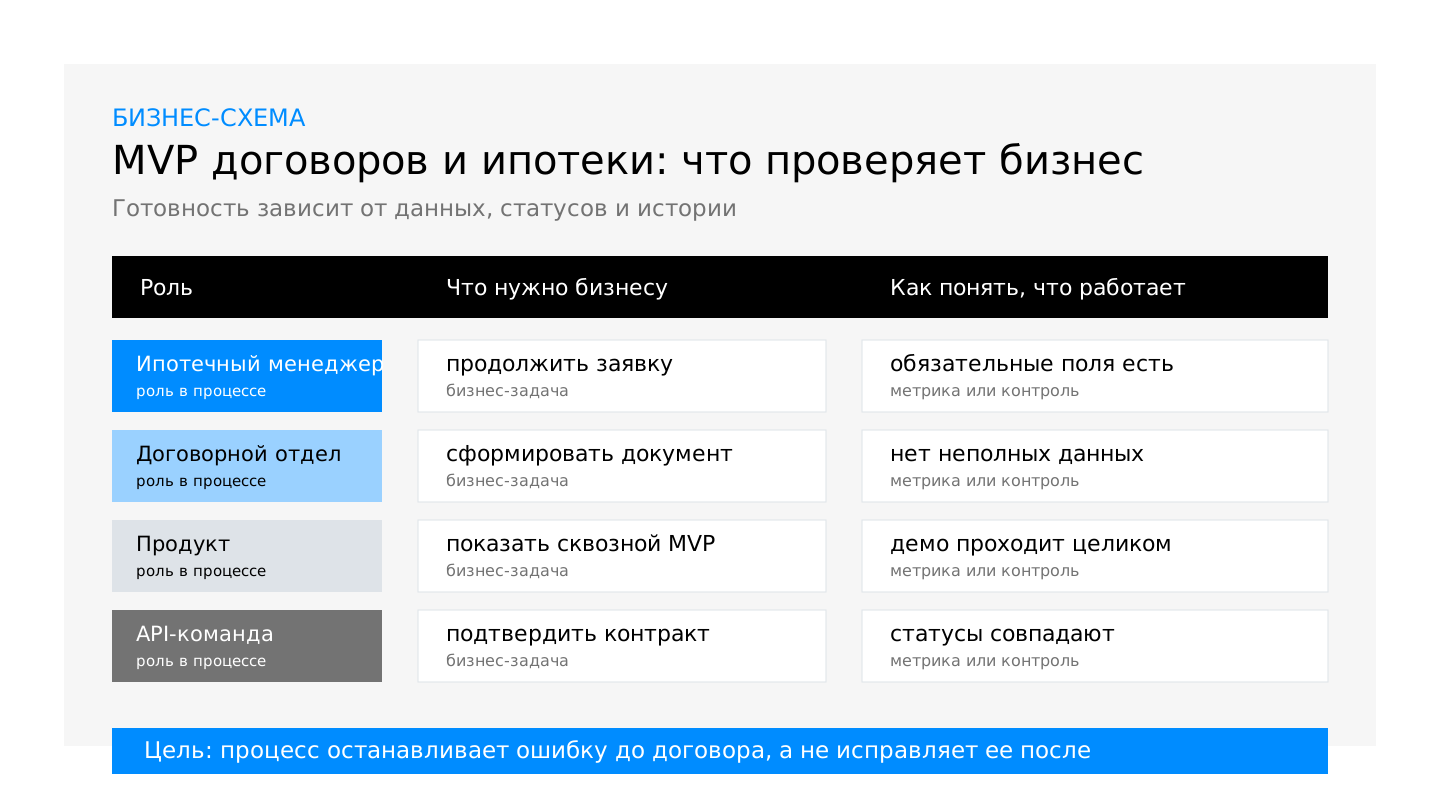
Contracts and mortgage processing for a major developer
- 1C EDMS and CRM linked statuses across teams
- Linked mortgages and contracts into an end-to-end process
- Automated document preparation for the deal
Accreditation and marketplace processes: one of CIS's top 3 developers
- Accreditation was moved into a digital service
- The admin panel simplified marketplace process development
- Datareon connected the platform with internal systems
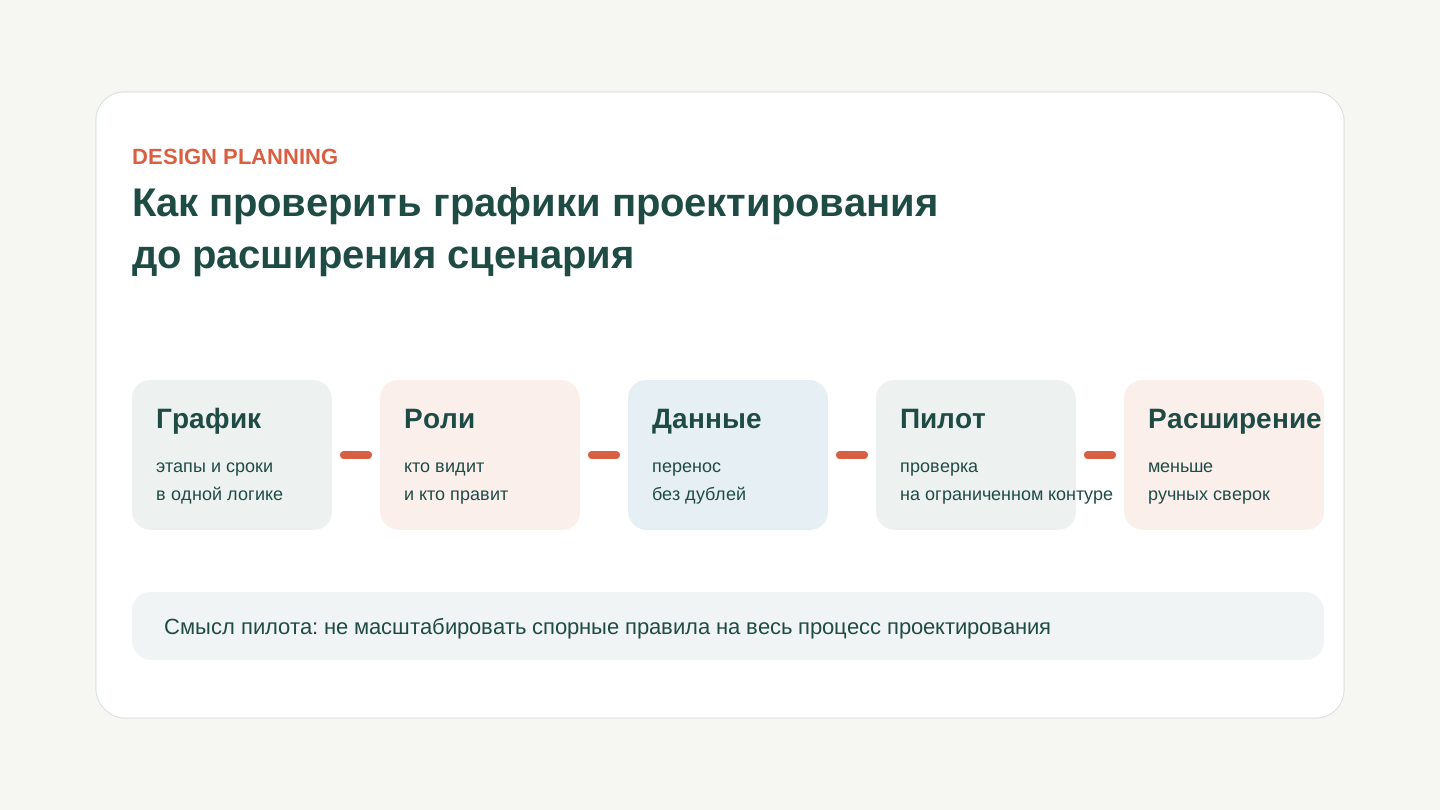
Design schedules: one of CIS's top 3 developers
- Schedules became a single digital environment
- Migrated without losing context
- Naumen connected design with services
LLM ticket classification: one of CIS's top 3 developers
Learn moreConstruction material procurement 3x faster
- Prepayment became 4.9 times faster
- Postpaid purchasing became 3 times faster
- Automated material procurement for sites
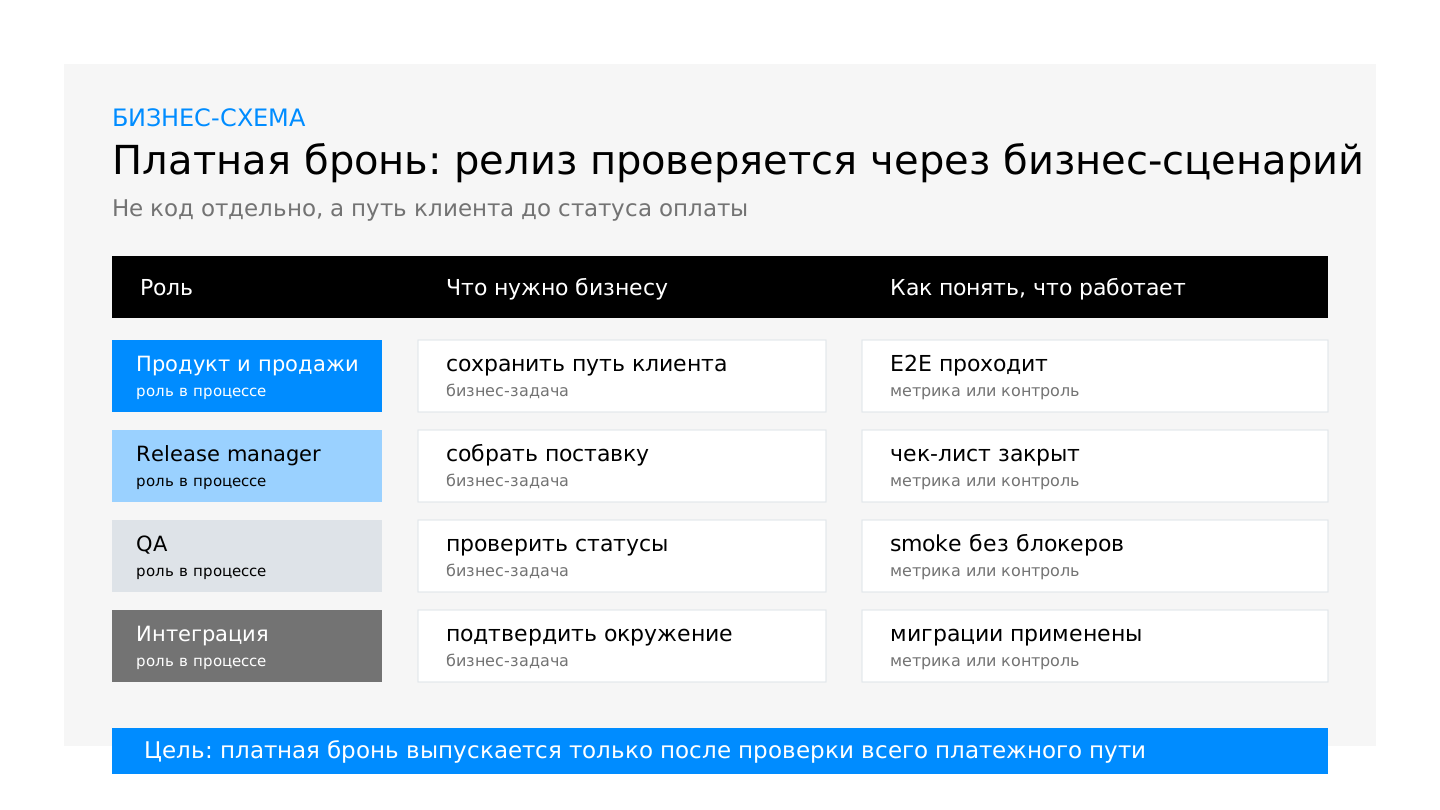
Paid booking for a major developer
- Smoke checks started catching failures earlier
- Payment statuses were connected without manual reconciliation
Construction control system for a top-5 developer
- Schedule shifts became visible in real time
- Construction forecasting became the basis of the IT stack
- Deadline tracking reduces the risk of delays on site
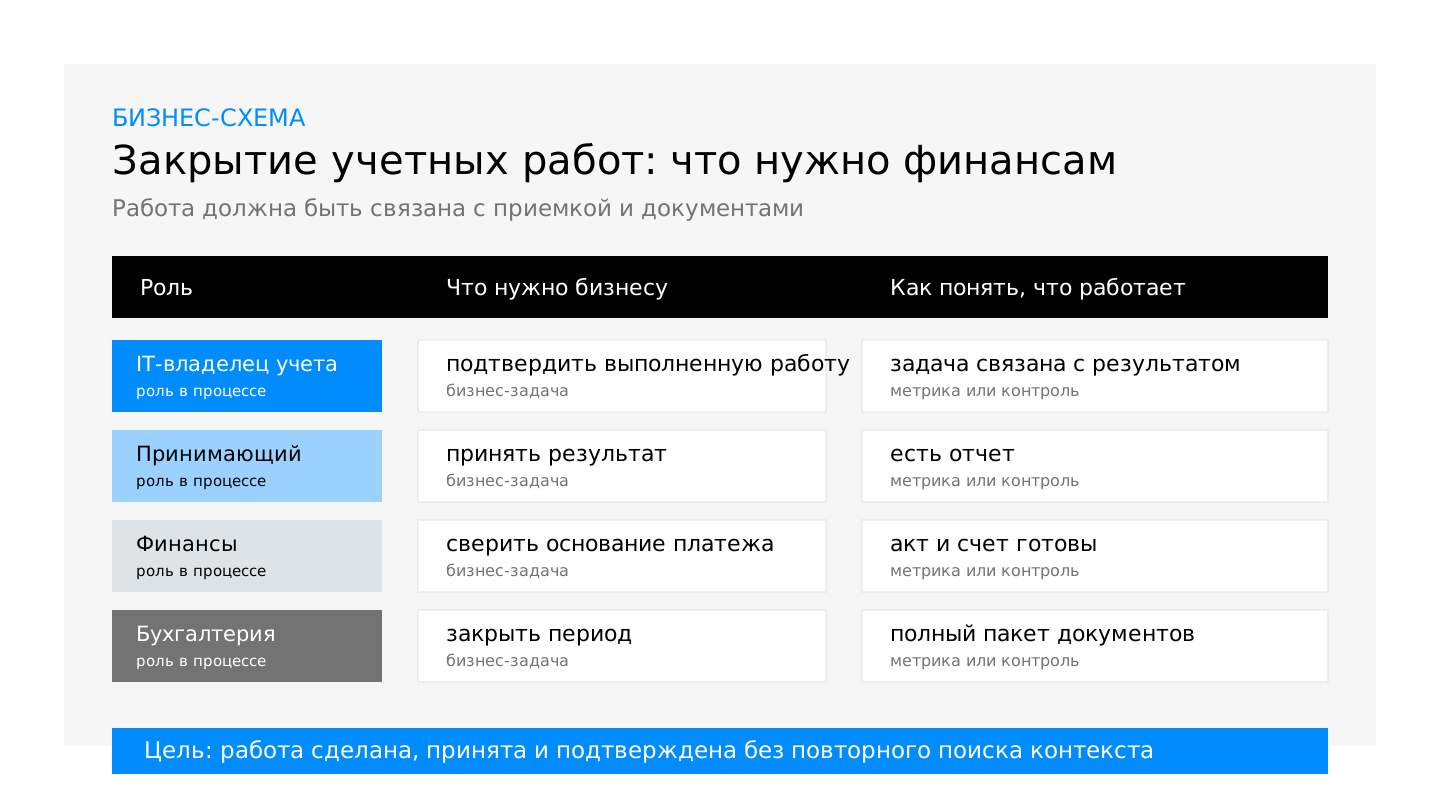
Developer case study - closing accounting tasks
Learn moreDeveloper case - contracts and mortgage
Learn moreDeveloper case - design schedule control
Learn moreDeveloper case - paid booking and release control
Learn moreTestimonials
What those already with us say
The KT.Team team is a mature development partner. The delivery process is very clearly organized, and the smooth collaboration within the engineering team deserves special mention. When the team sees that the development process needs fine-tuning, it does it. During discussions, the team digs into the essence of the tasks and seeks to understand the business context. The work is aimed not at formally fulfilling the specification but at solving the real problem. Thanks to strong engineering expertise and product thinking, the team can be trusted not only with implementation but also with the architecture of the entire system.
Blog
Expertise in development
Construction and BIM Software in CIS 2026: Expert Review
Learn moreBill of Quantities: From Specification to Estimate
Learn moreTIM Is Mandatory: The Model for Review and the Model for Money
Learn more
Development digitalization: how to adopt BIM, AI and data platforms to speed up construction and grow profit
Learn more