








What this tool is
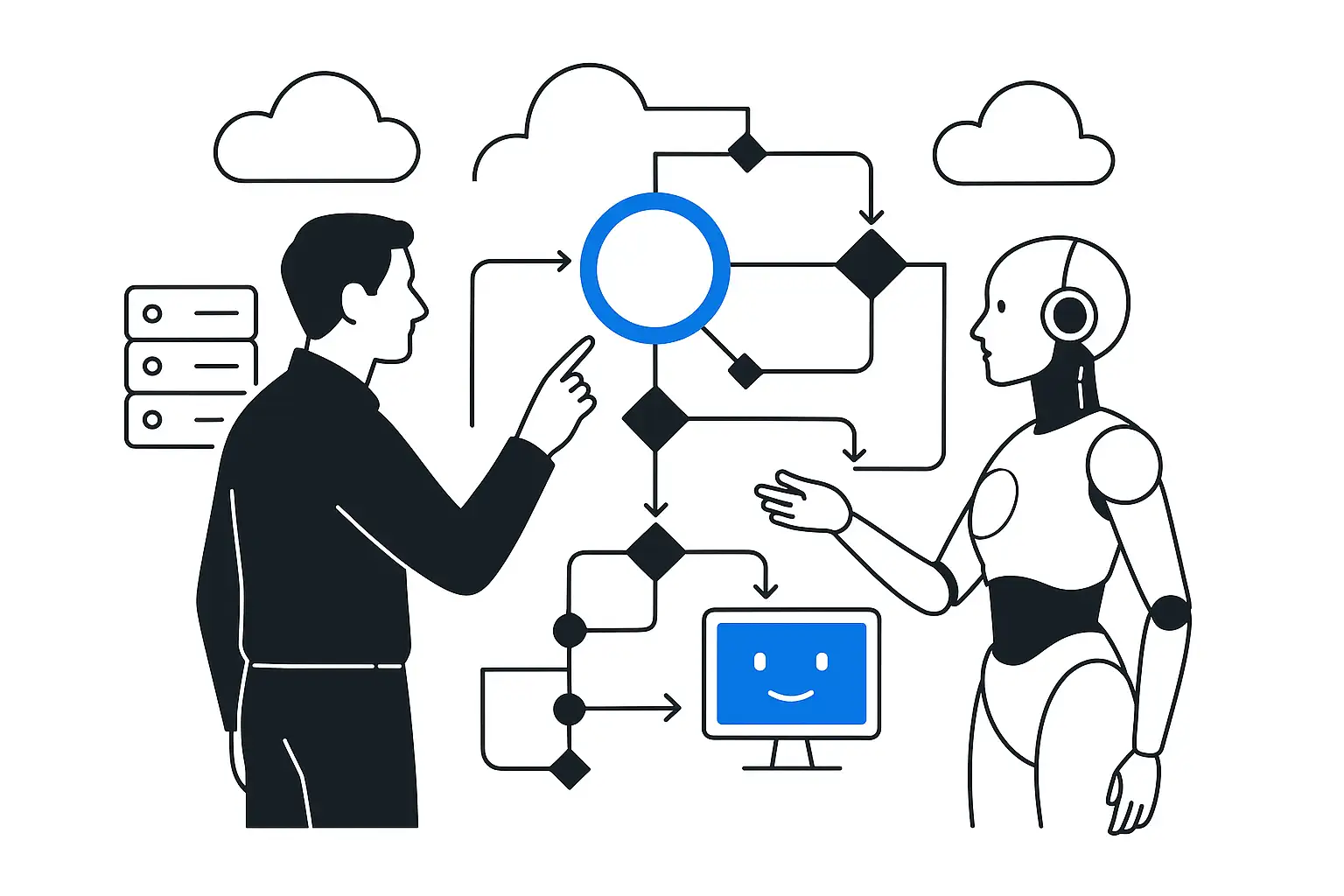
RAG (Retrieval-Augmented Generation) is the pairing of search over a document corpus with a language model. A user query is first turned into a semantic search over the knowledge base, the found fragments are inserted into the prompt, and the LLM formulates an answer strictly based on them. For manufacturing this means one thing: tech regulations, GOSTs, equipment data sheets and operating manuals, maintenance-and-repair charts, and occupational safety documents become not an archive of PDFs and paper folders, but a search system that answers in natural language and attaches a link to a specific clause of a specific document.
The key difference from "a chatbot that knows something": the model does not invent an answer from its memory but relies on your documents. If a fragment is not found, a correct system honestly answers "not found" rather than hallucinating. It is precisely this transparency that makes the approach applicable in manufacturing, where an error in a procedure is a safety risk.
What problem it solves in manufacturing
The basic scenario is an engineer, process specialist, or operator searching for the right procedure. According to IDC data cited by the baobab soluciones industry analysis, engineers spend up to 30% of their workday searching for scattered data. An LLM wiki cuts this search from minutes (and sometimes tens of minutes of wandering through folders) to seconds: the operator asks "what is the tightening torque for assembly X per the regulation" and gets an answer with a link to the current document revision.
The second effect is eliminating the risk of working from an outdated version. The HELLO PEOPLE manufacturing review describes the feature directly: every answer contains a citation specifying the source document, revision number, and section. The system answers from a single current source, not from a three-year-old printout lying by the machine.
What open sources show
This is not a KT.Team case study but a summary of public examples and research.
A peer-reviewed study on knowledge sharing in manufacturing (PMC, studying a detergent plant) built a database from plant instructions — equipment operation, safety protocols, quality control — and unstructured reports on line problems. On a benchmark of 20 production questions, GPT-4 achieved 97.5% factual accuracy, 95% completeness, and 0% hallucinations; weaker models lagged noticeably. It was separately noted that RAG showed operators relevant document fragments so they could verify the answer against the primary source. At the same time, the study candidly records a user concern: "if the answers are inadequate, you risk safety" — meaning document quality and verifiability are critical.
The baobab soluciones industry analysis describes industrial RAG built on top of technical documentation, drawings, electrical schematics, work orders, and sensor logs. Citing Deloitte, it says scaling predictive maintenance and AI assistants can reduce equipment failures by up to 70% and cut maintenance costs by about 25%; Schaeffler is cited as a public example, with sharply lower unplanned downtime thanks to instant access to repair documentation.
The HELLO PEOPLE manufacturing guide provides a practical framework: the system connects to SOPs, work instructions, maintenance and repair manuals, quality checklists, OEM documentation, safety data sheets (SDS), and engineering specifications; it accepts PDF, Word, spreadsheets, and scans via OCR; on well-maintained documents, accuracy on factual questions is typically 90–95%.
Where the boundary of applicability lies
The main limitation is stated the same way across all sources: RAG is only as good as the documents. If regulations are outdated, contradictory, or poorly written, the model will confidently return incorrect information. So such a project is first and foremost a discipline of document and version management, and only then a choice of model. On safety-critical questions, the answer must be accompanied by a link to the primary source, and a human must be able to verify it.
From implementation practice (the same HELLO PEOPLE): a proof of concept takes 4–6 weeks, production 8–14 weeks with a pilot and iterations, and a mandatory step is validation of answers by the plant's engineers (human-in-the-loop).
How this fits the KT.Team approach
KT.Team builds such solutions as loosely coupled rather than monolithic. The LLM wiki is not "baked into" the documentation sources (DMS, PLM, file storage, 1C) but connects to them as a separate search-and-generation layer. The business value is twofold: transferability — the solution can be handed between teams and contractors without rewriting, because the "document source / index / LLM / interface" boundary is explicit; and locality of change — you can replace the model or reindex without touching neighboring systems. This is a pure AI-native scenario: the agent searches, cites, and answers on its own, and instead of searching, the engineer gets on with the work. Deployment and observability practices rely on DORA and Google SRE, so such a setup is stood up and maintained by a small team (3–7 people).
Business impact
The target process is engineers and operators finding the right procedure: from minutes to seconds and without the risk of working from an outdated version. Indirect effects confirmed by open sources: recovering part of the ~30% of work time that goes into searching, and reducing unplanned downtime thanks to instant access to repair documentation.