Results stick
After launch, your staff adjust the process within safe boundaries — it keeps improving without us.

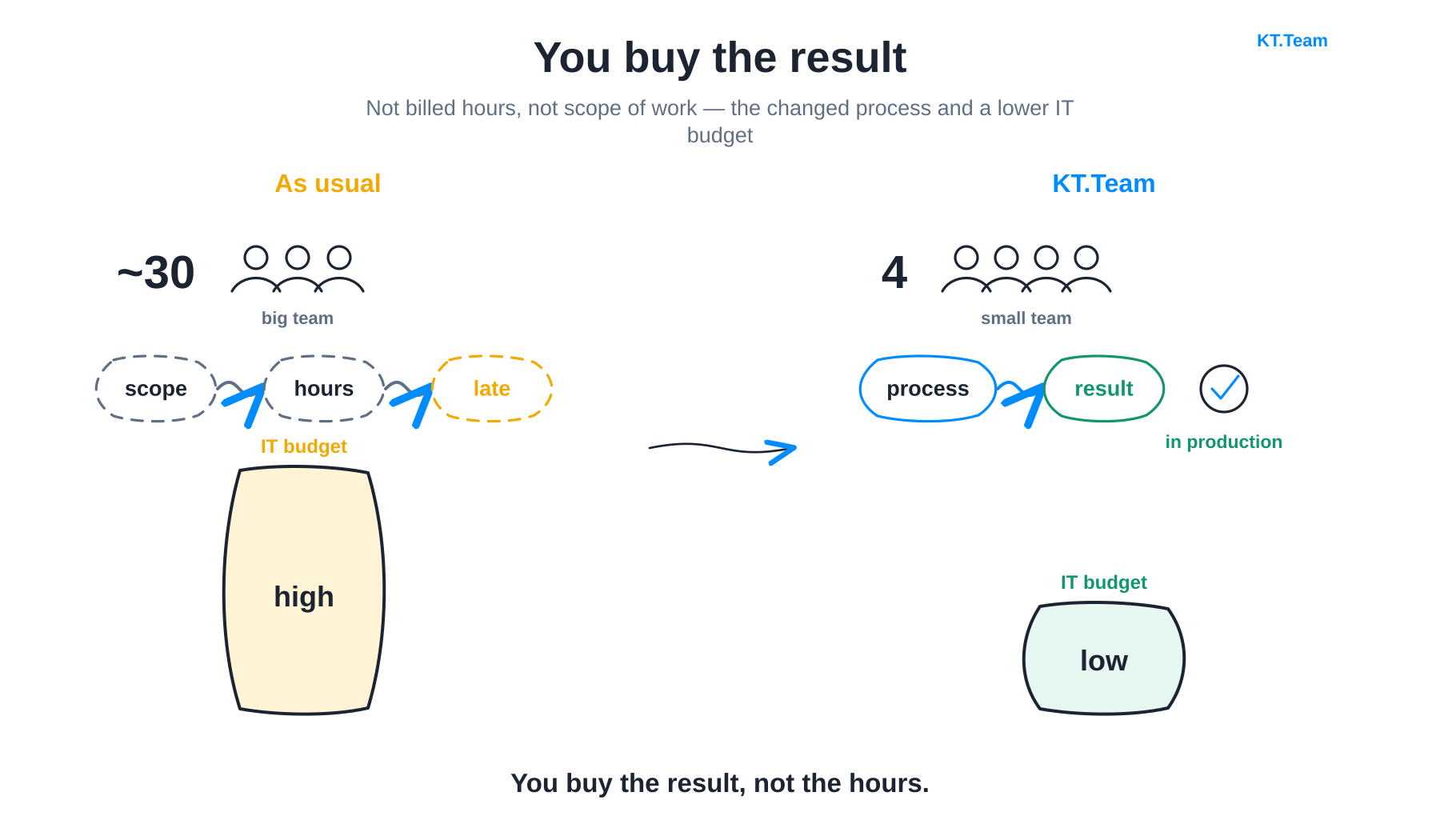
KT.Team delivers large enterprise projects with small, strong teams. Lower IT budget, shorter timeline, and you can always take the system back. We do not sell hours and we do not rewrite your entire IT landscape — we take the one process that is slowing your business and bring it to real production use.
Our clients











What you get
A large integrator earns on roles and hours — it profits from taking longer. We charge for your result — we profit from delivering fast with a small team. The budget is lower for three reasons: a small team with no coordination overhead, a short path to adoption with no shelf-ware, and simple integrations with no costly rewrites across the whole landscape.
After launch, your staff adjust the process within safe boundaries — it keeps improving without us.
A KT.Team curator removes resistance: role-based training, clear answers about data and rules, early wins instead of a big-bang rollout.
Where we start
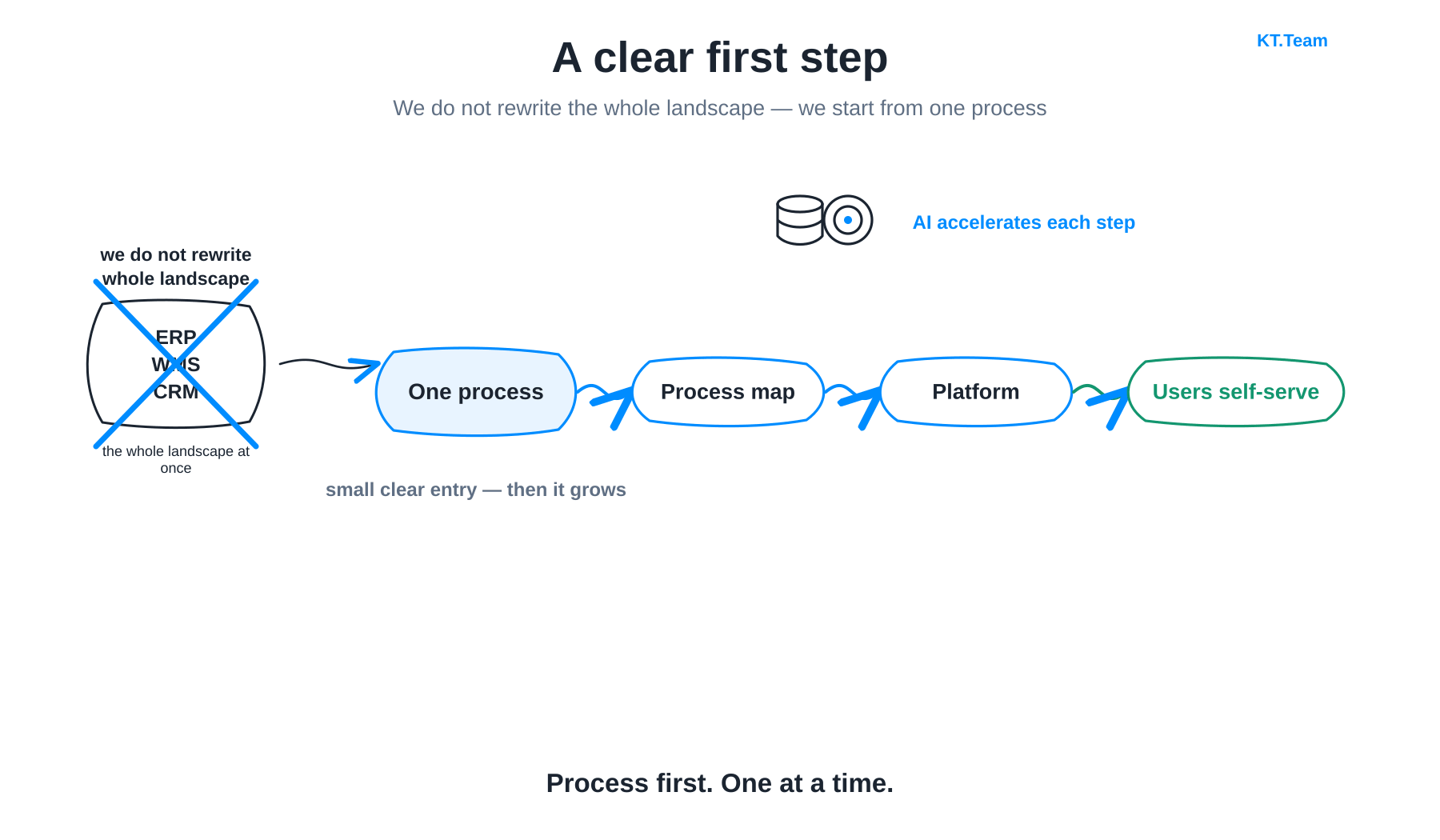
We do not touch your entire landscape. We take the process that is limiting your results and bring it to real user adoption within weeks. The legacy system stays the source of truth until the new scope proves itself at the boundary through well-defined contracts. Then we scale what already works. AI accelerates routine work — it is the source of speed, not magic.
Why this is not a risk
Knowledge lives in contracts, code and documentation, not in someone's head. The solution is transferable: another team can take it over.
L1/L2 support is a dedicated team with its own quality focus. Release is the start of operations, not the end of the project.
We split large scope into loosely coupled domains and run them with several small teams. We don't inflate one team — we reduce the coupling of the problem.
Ten years of industry research confirm: fast teams are also more stable. Speed is the outcome of engineering maturity, not a trade-off against quality.
Fewer technologies mean a smaller failure surface and less vendor dependency. The system can be handed to your in-house team or another contractor without stopping your business.
Time to Use (TTU)
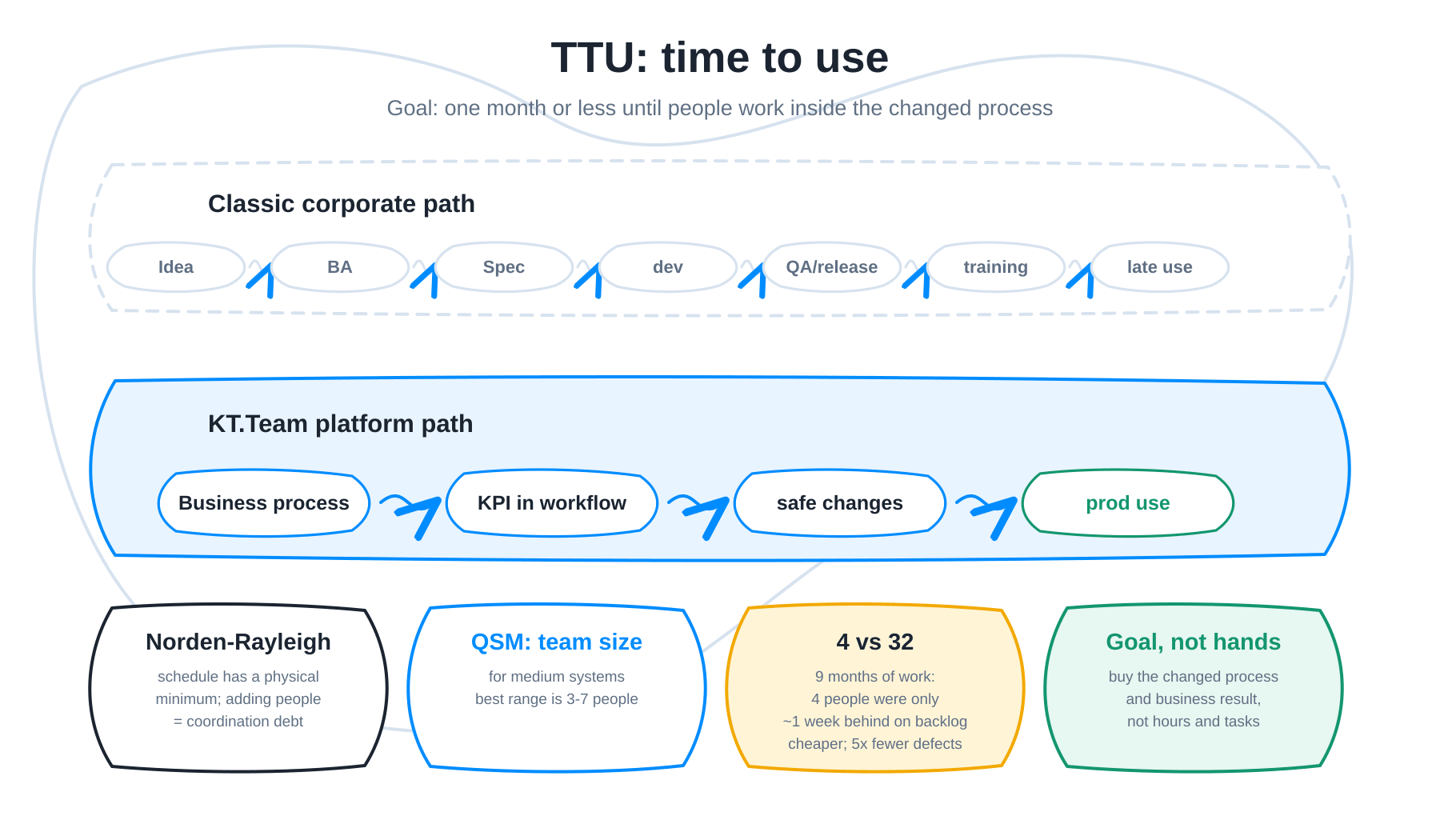
TTU is the time to real-world use, not to handover; our honest counterpart to time-to-market. Value counts from the moment people are working in the system. The higher the TTU, the harder and more stressful it is to roll out innovation, the greater the resistance to change, and the more complex the launch cycle and the business process become — unnecessary roles appear.
Effort on a project follows the Rayleigh curve, and the timeline has a physical minimum. A stretched timeline bloats the team, multiplies unnecessary roles and approvals; ramping up headcount sharply statistically leads to missed deadlines.
Scope = productivity × effort^⅓ × time^(4/3). Time and effort are linked nonlinearly: a dragged-out launch ends up disproportionately more expensive, while a short timeline with a mature team is cheaper and more stable.
10 years of research: speed and stability correlate, they don't conflict. Elite teams ship a change in less than a day and break production less often. Speed is not the enemy of quality.
Small, frequent changes are absorbed more easily than rare, large ones. High TTU means accumulated resistance, rollout stress, and the risk of work that never gets used.
That's why we minimize TTU: loose coupling, small teams, and short cycles — so innovation reaches people quickly and without stress.
Time to Use
In one project, a team of 4 kept pace with a team of 32: by month nine the gap was about one week of backlog, at a fraction of the cost and with 5× fewer defects. That is not luck — it is the result of engineering maturity. AI-native capability is a built-in accelerator of this cycle, under our control.
Approach
We improve the process that limits the business result. We choose technology after that — exactly as much as the process needs.
We take a specific business process and carry the change through to real user work.
Systems exchange data by clear rules, so one change doesn't drag the whole landscape with it.
The team owns the scenario in operation, not a narrow technical piece.
We keep the stack as small as the task allows. Simple systems last longer.
What sets us apart
The less of your budget and time we spend, the better for us. The outcome-based pricing model aligns the contractor's incentives with yours.
Most vendors build to keep you locked in forever. We build so you can leave — any module can be handed off without stopping your business.
Enterprise results — logistics, real estate, retail, FMCG — without an enterprise army of contractors.
By comparison: a large integrator earns on hours and roles — it profits from bloating scope, we profit from shrinking it. In-house means hiring and retaining an expensive senior team for peak demand; with us you engage that team for a result and stay independent of the hiring market.