Languages and development
PHP — a backend language for websites and e-commerce
PHP is a mature server-side language that powers most of the web and the key e-commerce platforms: Magento, Pimcore, 1C-Bitrix, and projects on Laravel and Symfony. In KT.Team practice.
Backend language
Our clients
Clients and partners












The #1 languageThe most common server-side web language: about 71.8% of sites with a known backend language - a broad hiring market (W3Techs, 2026)
Short TTMReady-made frameworks and components (Laravel, Symfony) deliver a fast cycle from idea to a working website, MVP or catalog
E-commerceThe native language of Magento, Pimcore and 1C-Bitrix: customization and integrations without a foreign stack
AI-readyOfficial MCP SDK for PHP (PHP Foundation + Symfony) - the backend becomes an MCP server without a separate Python service
Industry solutions
What you can build with PHP
Capabilities
PHP capabilities
Browser / SPA frontend (React, Vue)Web server (Nginx) + PHP-FPM/OPcache/JITBackend framework (Symfony, Laravel)E-commerce platform (Magento, Pimcore, 1C-Bitrix)Database and cache (MySQL/PostgreSQL, Redis)Queues and integrations (RabbitMQ, REST/GraphQL)AI layer (MCP SDK, Neuron AI / LLPhant LLM)
Mature ecosystem
Composer, thousands of packages, the Symfony and Laravel frameworks, ready-made components for catalog, payments, queues and integrations — less code from scratch.
Hiring availability
The most widespread server-side web language: a broad engineer market, fast team scaling and a low bus factor.
Time to market
A fast development and deployment cycle, rich tooling and starters deliver short TTM for websites, MVPs and catalogs.
Compatibility with e-commerce platforms
The native language of Magento, Pimcore, 1C-Bitrix — customization and integrations are done in the same environment, without a foreign stack.
Modern typing
PHP 8.x: strict types, union/intersection types, enums, readonly, property hooks and asymmetric visibility (8.4) — fewer bugs, cleaner contracts.
Predictable performance
OPcache caches bytecode, JIT speeds up compute-heavy sections; the process-per-request model is simple to operate and scale.
Low hosting cost
Runs on almost any hosting and in containers, light on infrastructure — cheaper to operate than many alternatives.
Approach
How we implement PHP
Without modifying the core
We do not fork or patch the PHP core. PHP remains on a standard, updateable version, while customizations are implemented as separate modules or services. Before updating, we verify the compatibility of modules and integrations in a test environment.
International Standards, Not Homegrown Hacks
Where a mature international solution exists, we use it instead of inventing our own protocol or platform. Before writing code, we study how the problem is already solved in the industry.
Transferability
The solution is loosely coupled and documented: it can be handed over between teams and contractors without rewriting. You are not tied to us.
AI compatibility
PHP in the AI Stack
Official MCP SDK for PHP
The mcp/sdk from the PHP Foundation together with Symfony turns a PHP application into an MCP server: it provides tools, resources, and prompts to AI agents (Claude, ChatGPT, and others).
LLM frameworks in PHP
Neuron AI and LLPhant provide a unified interface to Anthropic, OpenAI, Gemini, Mistral, and Ollama, with provider switching in one line, plus agents, RAG, and vector search.
Code generation by agents
The huge body of public PHP code and predictable syntax make the language convenient for AI assistants: generating controllers, tests, and migrations.
AI directly in the e-commerce stack
LLM features (search, recommendations, product-card enrichment, chatbots) embed into Magento/Pimcore/Laravel without a separate Python service.
Strict typing as a contract for agents
Explicit types and interfaces in PHP 8.x give AI tools clear signatures, reducing hallucinations and making safe code easier to generate automatically.
Context 2026
What changed in the market
Dominance on the web
PHP remains the #1 server-side language: ~71.8% of sites with a known backend language (W3Techs, 2026); the closest — Ruby, JavaScript, Java — trail far behind.
A modern language
The current branch is PHP 8.5 (8.5.2, January 2026); 8.4 brought property hooks and asymmetric visibility; ~57.5% of PHP sites already run PHP 8.x.
Frameworks 2026
Symfony 8.1 is the current stable release (May 2026), Symfony 7.4 is LTS; Laravel 13 shipped in March 2026 with a focus on modern PHP and a built-in AI SDK.
E-commerce across PHP versions
Platforms keep raising the bar: Pimcore 2026.1 requires PHP 8.4+; Magento and 1C-Bitrix keep evolving on current PHP 8.x branches.
AI readiness
An official MCP SDK for PHP (PHP Foundation + Symfony) and mature LLM frameworks (Neuron AI, LLPhant) have emerged, bringing PHP into the agent ecosystem.
Honestly
Pros and cons
Pros
- Mature ecosystem: Composer, Symfony, Laravel, thousands of packages and ready-made components.
- The most accessible hiring market among server-side web languages — fast team scaling.
- Short time-to-market for websites, catalogs and MVPs.
- Native compatibility with Magento, Pimcore, 1C-Bitrix — no foreign stack for e-commerce.
- A modern language: strict typing, enums, property hooks (8.4), OPcache and JIT.
- Cheap hosting and a simple operations model.
Cons
- A reputational legacy-code trail: many old projects on PHP 5/7 and weakly typed codebases.
- Not the best choice for CPU-bound and real-time workloads (heavy computation, persistent WebSocket connections, streaming) — JIT does not help everywhere.
- The classic "process per request" model trails async runtimes without extra tools (Swoole, RoadRunner, FrankenPHP).
- Quality depends heavily on team discipline: the language allows both very good and very bad code.
News
What’s New in PHP
-
Coordinated security release for PHP 8.5.6 / 8.4.21 / 8.3.31 / 8.2.31
The PHP team released patches simultaneously for all four supported branches, including fixes for PHP-FPM XSS and SQL injection.
-
PHP 8.5.0 release
New major release: the pipe operator (|>) for chaining calls without intermediate variables, URI extension (RFC 3986 + WHATWG URL, replacing parse_url), clone with for immutable objects, array_first()/array_last(), the #[NoDiscard] attribute, static closures and first-class callables in constant expressions, and backtraces for fatal errors.
Projects
Cases

Akeneo PIM for the Norgau B2B store
- A catalog of 600K SKUs assembled in a single PIM database
- Integrated Akeneo PIM for Norgau
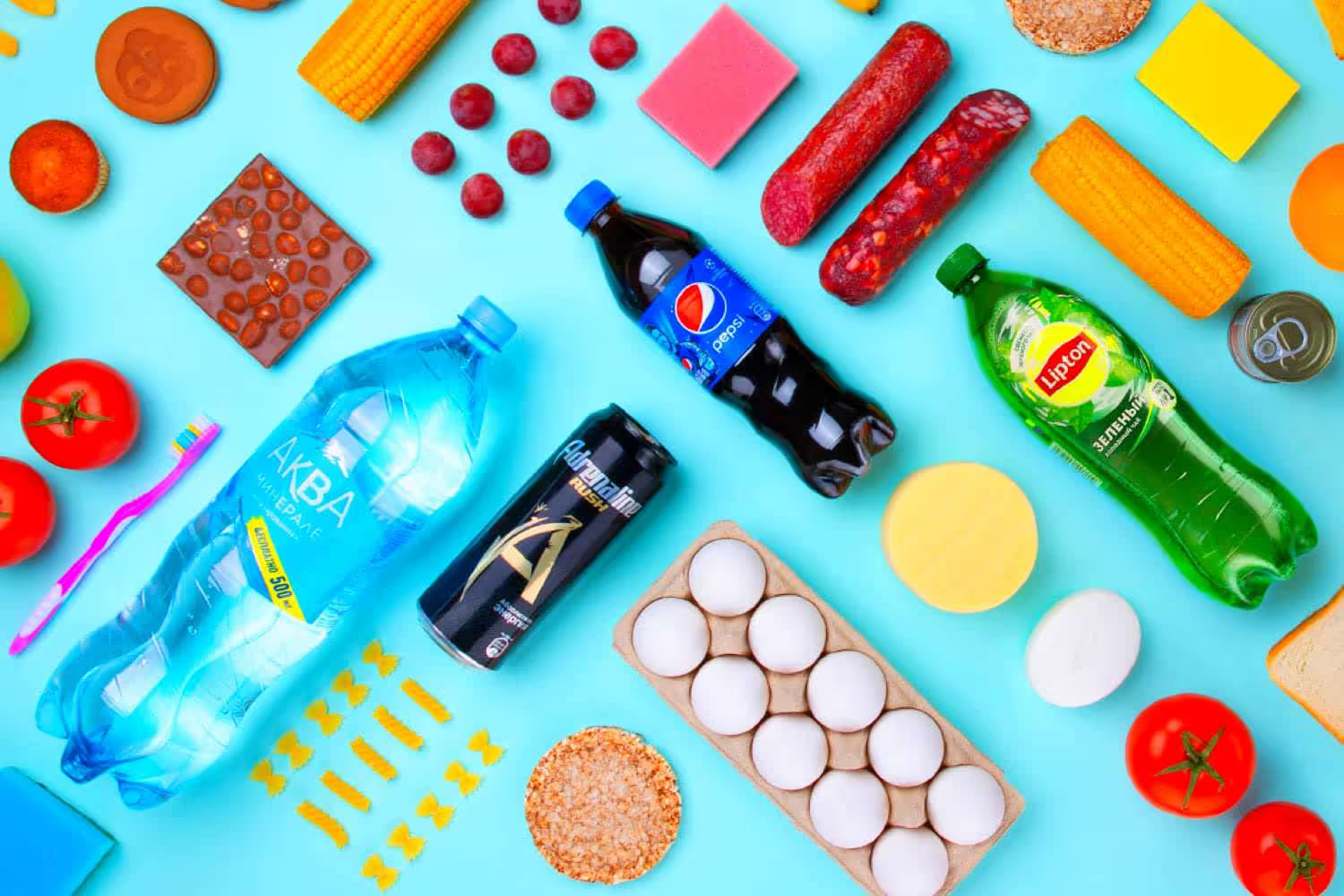
Custom Akeneo modules for delivery
Learn more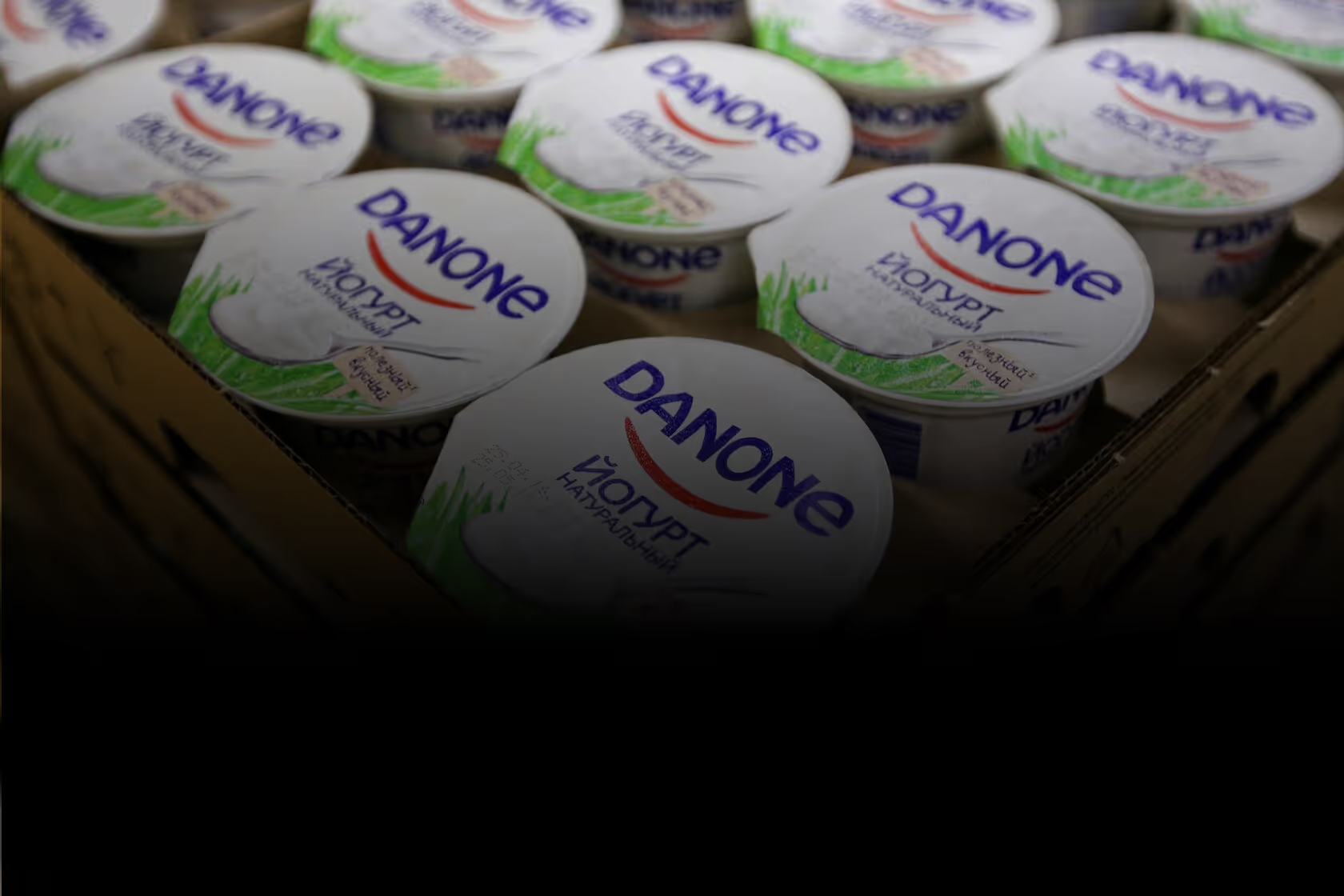
Subscription grocery delivery service for Danone
- Average order value grew from $16 to $38
- Monthly revenue grew from $1,100 to $13,000
- Site conversion rose from 0.14% to 1.25%