Mis-picks and losses
Goods are not where they are recorded, and shortages only surface during inventory counts.

KT.Team is not a boxed WMS vendor. We implement, customize, and integrate your warehouse system with your processes, 1C, and IT landscape. We select the system for the task, own the business outcome, and reduce IT spend.
Our clients













When needed
Goods are not where they are recorded, and shortages only surface during inventory counts.
Without location-based storage, the picker relies on memory, and orders are assembled slowly and with errors.
A mismatch between actual and recorded stock leads to returns, incorrect balances on the website and marketplaces, and penalties.
WMS needs to be replaced without losing customizations and integrations.
The system is unstable, expensive to maintain, does not scale, and enhancements take months.
The warehouse is running, but there are no dashboards or KPIs, so bottlenecks are unclear.
Architecture
From receiving to shipping
Warehouse
WMS
Integrations
Approach
We select a suitable WMS from the CIS software registry, including 1C-based solutions, or adapt your current one. We do not sell our own.
Project metrics are picking speed, stock accuracy, and costs, not the fact that licenses were installed.
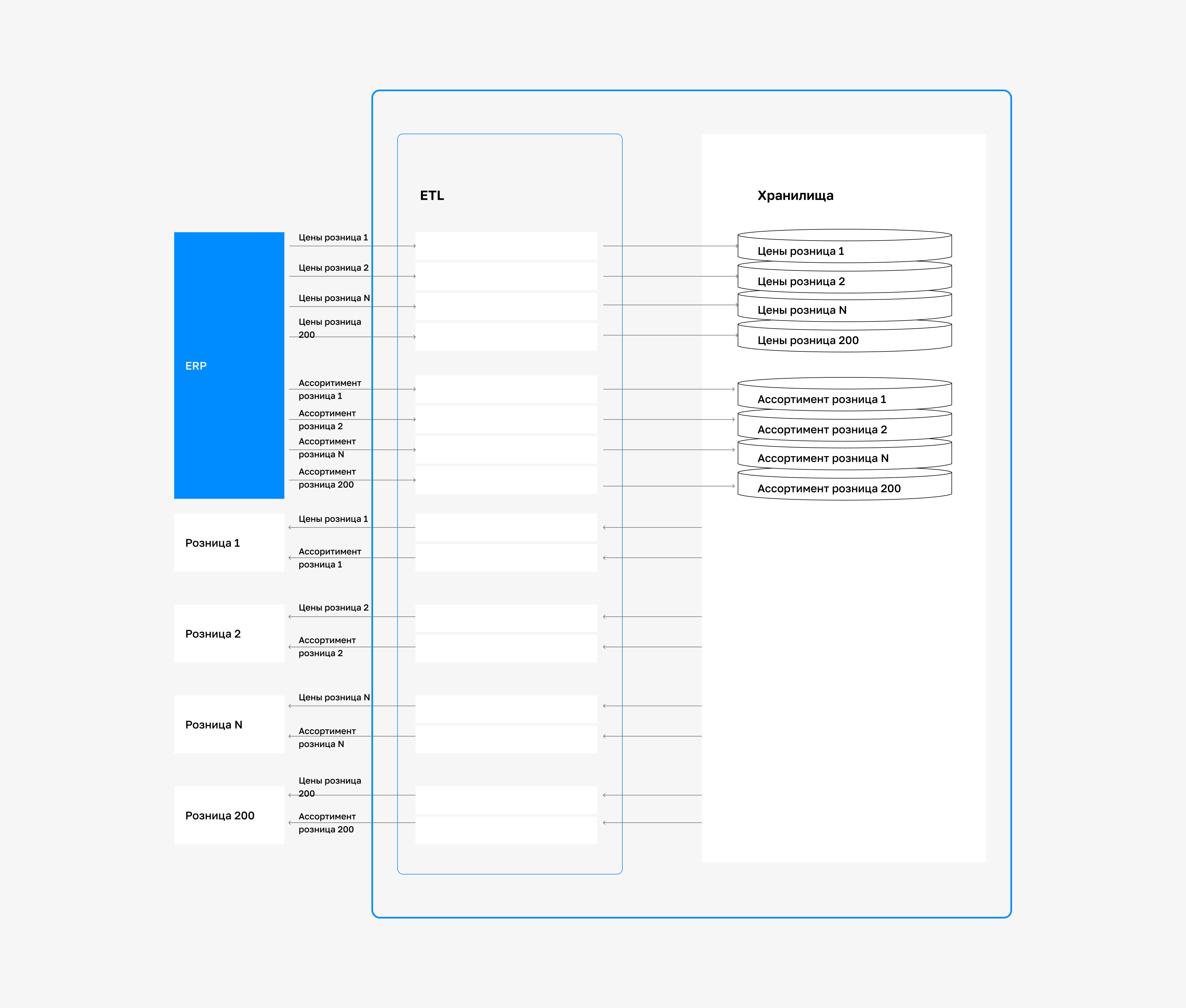
WMS works together with 1C, ERP, DWH, and marketplaces through an ESB, so components can change without rewriting the landscape.
A small, strong team and a short TTU instead of a bloated rollout.
Scope of work
System selection for your processes and volumes, warehouse topology design, zone and rule setup, launch, training, and support.
We extend your current system for real-world processes: putaway and picking logic, reports, integrations, and non-standard scenarios.
We migrate project customizations and integrations to a domestic WMS. Emergency MVP or a planned phased migration with minimal downtime.
Location-based topology, putaway and picking rules, handheld terminal workflows, faster picking, and fewer packing errors.
Setup for FBS/FBO, inventory synchronization with marketplaces (WB, Ozon), returns handling, and traceability for Chestny Znak.
DWH-based dashboards and KPI: zone utilization, shift productivity, bottlenecks, and stock accuracy.
Platforms
We don't sell our own WMS — we select a system tailored to your warehouse, processes, budget and existing IT landscape, not for vendor lock-in. Three implementations KT.Team works with in practice.
| Environment | Platforms | When we choose it | KT.Team's role |
|---|---|---|---|
| 1C suite | 1C:WMS Logistics. Warehouse Management (on 1C:Enterprise 8) Bin location in 1C:ERP, 1C:UT, 1C:UNF | You already have 1C, and the warehouse should operate in a unified configuration and ledger, not as a separate silo | We implement, configure storage zones and picking rules, embed into the 1C landscape |
| Commercial solutions (CIS and global) | Solvo.WMS, LEAD WMS (LogistiX), Logistics Vision Suite (Ant Technologies) — from CIS software registry From global solutions — Manhattan Active WM | Large or high-throughput warehouse requiring a mature platform; global solution — for international operations or existing licenses | We implement, customize for your processes, integrate with 1C and the rest of the landscape via ESB/messaging bus |
| Open-source | Odoo Inventory, OpenBoxes, myWMS (Fraunhofer IML, GPL) | Pilot, small warehouse, or limited budget — with readiness to customize; lower maturity and feature depth than packaged WMS | We deploy, customize for your processes, integrate with 1C; as volume grows, we prepare migration to industrial-grade WMS |
Impact
These are market benchmarks, not a KT promise. The exact result depends on the warehouse and starting point, and we define measurable goals at project kickoff for your case.
Lower warehouse operating costs.
Location-based storage and handheld terminals eliminate manual searching.
Faster receiving, putaway, and picking.
End-to-end data between WMS and 1C.
Integration
End-to-end stock balances, documents, and orders between WMS and 1C.
We connect WMS to your landscape through an ESB, not with point-to-point workarounds.
Export warehouse data to a data warehouse for dashboards and KPI.
Inventory and order synchronization for FBS/FBO.
Mobile data capture, transport, mandatory traceability, and labeling.
Warehouse Automation
Warehouse automation is not buying a system, but a sequence of four steps. Skipping any of them turns the project into an expensive replacement of paper with a screen.
The warehouse is divided into zones and bins, and each gets an address. Without this, the system has nowhere to place goods and nothing to tell the picker, so any WMS is reduced to stock accounting.
Dimensions, weight, storage conditions, expiration dates, batches, and barcodes. Put-away and picking rules are calculated from these attributes; empty fields disable the algorithms.
Receiving, put-away, picking, and inventory are turned into terminal tasks. Manual searching disappears here, and every operation leaves a trace.
Stock, orders, and shipments are synchronized with 1C. While exchange is manual, automation inside the warehouse has no external effect, and the business sees outdated numbers.
According to industry reviews, more than 80% of new WMS implementations in CIS are domestic solutions, so the question is usually not which foreign system to choose, but what to do with the one already in place. We work equally well in three scenarios: implement from scratch, enhance the current system, or replace the one that left the market while migrating customizations. See the full industry overview on the page IT solutions for logistics. If the warehouse handles third-party goods, see Contract warehousing and 3PL.
Warehouse analytics
WMS records every operation, but logs alone do not solve anything. Warehouse analytics begins where operations are turned into metrics that reveal the bottleneck.
Picking lines per person per hour, by zone and by shift. It shows not who is working poorly, but where the warehouse layout forces extra walking.
Difference between recorded and actual stock from cycle counts. A drop in accuracy is an early sign that the put-away process has broken down.
Where the warehouse is congested and where it stands idle. The basis for moving fast-moving items closer to the picking zone.
From receipt to shipment, broken down by stage. Average values are not enough - we look at p95, otherwise the tail of problematic orders stays hidden.
Share of mispicks and returns caused by the warehouse. This converts directly into money: a return is more expensive than correct picking.
How long goods stay in the receiving area before put-away. A long receiving process blocks picking and creates an invisible shortage.
Technically, this means exporting WMS operations into a data warehouse and building dashboards on top of it, so metrics are calculated from history rather than the current database state. Warehouse data then enters the shared analytics environment together with sales and procurement: see DWH and data analytics.
Warehouse on 1C
Warehouse accounting is built into 1C configurations themselves - UT, ERP, and Integrated. A separate warehouse system is not always needed, and the honest answer depends on what the warehouse manages.
The assortment is small, storage is not location-based, picking follows a paper delivery note, and shipment volume is predictable. Putting WMS here adds complexity without benefit.
Location-based storage, picker tasks on handheld terminals, batches and expiration dates, wave picking, multiple zones and shifts. This is operational control that the accounting system does not provide.
Domestic by default, familiar to administrators, and closer to accounting. Exchange with 1C is simpler, but compare operational capabilities with specialized systems against your own scenarios.
When the warehouse is an operations engine and strong picking algorithms are needed. Then exchange is critical: stock, tasks, and shipment statuses between WMS and 1C.
In both cases, the choice of system is not the deciding factor, but the exchange. Direct writes to the database produce discrepancies at the first load spike, so we build the warehouse ↔ 1C connection through an integration layer with an exchange log, making discrepancies visible when they occur, not during inventory. See also 1C:ERP and WMS on 1C.
Import substitution
WMS from the Unified Register of CIS Software; solutions on the 1C platform are domestic by default.
We reproduce the departed system's customizations and integrations, so migration is effectively a new implementation.
We handle registry compliance as a requirements checklist, not as a product called a “registry.”
Still choosing a WMS?
If WMS is not yet selected, start with WMS-readiness: warehouse process, data and integration audit, vendor comparison scenarios, pilot plan and TCO assessment — before RFQ
FAQ
No. KT.Team is an integrator, not a boxed WMS vendor. We select a system for the task from the CIS software registry or adapt the one already installed. Our priority is business results, not selling licenses for a single platform.
Starting with WMS readiness assessment: we document processes, data and integrations, prepare working scenarios for vendor comparison, pilot plan and TCO estimate. So your system choice is based on your workflows, not feature checklists.
Yes, this is one of the main use cases. We extend the system to fit your processes: putaway and picking algorithms, reports, integrations with 1C and marketplaces.
Based on urgency, we choose the right scenario: an emergency MVP on a domestic WMS or a planned phased migration with transfer of customizations and integrations.
Through bus-level integration: end-to-end stock, orders, and documents between WMS and 1C (ERP, trade management, accounting). WMS ↔ 1C integration is our core expertise.
Yes. We configure fulfillment for FBS/FBO, synchronize stock with WB and Ozon, handle returns, and support traceability for Chestny Znak.
Yes. We select a system from the CIS software registry; 1C-platform solutions are CIS by default. We document compliance as a verifiable checklist.
Cases