
eCommerce
1C-Bitrix: enterprise websites and eCommerce under load
1C-Bitrix is the #1 CMS in CIS's paid market with native 1C integration; we scale it for enterprise load: highload catalog, traffic peaks, and accounting system sync without monolithic design.
platform
Our clients
Clients and partners














CIS's market leader.#1 in the paid CMS segment: large market of specialists, modules, and pre-built 1C integrations.
Out of the boxCatalog, cart, orders, and 1C sync via CommerceML — without building an e-commerce engine from scratch.
Under load.Web cluster, composite cache, and faceted index keep a highload catalog with millions of SKUs performing under peak load.
AI-readyThe REST API is wrapped in an MCP server — the agent reads the catalog, stock and orders as tools
Industry solutions
What you can build on 1C-Bitrix
Capabilities
1C-Bitrix capabilities
1C (accounting): the source of truth for products, prices, stock, and ordersESB, bus, and queues: idempotent exchange and routing between 1C, Bitrix, WMS, and systems.Bitrix: catalog, cart, checkout, storefront contentREST API / webhooks: exposing the catalog and orders externallyHeadless frontend and mobile app: consume APIs and are independent of the CMSAI layer: content generation, semantic search, recommendations, MCP to the catalogExternal systems: CRM, marketplaces, analytics, payment, and logistics servicesCorporate memory: architecture documentation and API contracts
Two-way exchange with 1C via CommerceML 2.x
Products, prices, inventory, orders, and partners sync with the accounting system without custom connector development.
Catalog, cart, orders, and discounts out of the box
Launch an online store without building a core e-commerce engine from scratch
Highload Infoblock and faceted index.
Product attributes and smart filters work on catalogs up to millions of SKUs without search degradation — faceted index and Infoblock 2.0 maintain query speed.
Composite cache, web cluster, and performance panel.
Composite mode and multi-level caching reduce PHP and database load, web cluster balances it across servers, and performance panel identifies bottlenecks under peak conditions.
REST/SOAP API and webhooks
The catalog and orders are available to external systems, mobile apps, and headless frontends
Editions for scale (Standard to Enterprise)
Higher editions (Business, Enterprise) add web cluster and scaling — licensing grows with your project without platform migration.
CIS Software Registry
compliance with import-substitution requirements for state companies and regulated industries
Integrator and solution base in the Marketplace
standard tasks are covered by ready-made modules, and hiring contractors is predictable
Migrating and optimizing legacy Bitrix.
We eliminate vendor lock-in: move logic to services alongside the core, optimize bottlenecks, and restore updateability without forking.
Approach
How we implement 1C-Bitrix
Without modifying the core
We do not fork or patch the 1C-Bitrix core. 1C-Bitrix remains on the standard updatable version, while customizations are moved into separate modules or services. Before each update, we verify the compatibility of modules and integrations in a test environment.
International Standards, Not Homegrown Hacks
Where a mature international solution exists, we use it instead of inventing our own protocol or platform. Before writing code, we study how the problem is already solved in the industry.
Transferability
The solution is loosely coupled and documented: it can be handed over between teams and contractors without rewriting. You are not tied to us.
AI compatibility
1C-Bitrix in an AI stack
Content generation
AI writes and optimizes product card copy, descriptions, and SEO meta tags; the Marketplace offers integration modules for GPT, GigaChat, and YandexGPT
Semantic search and recommendations
The catalog from info blocks is fed into a vector index, which powers recommendations and semantic search
MCP access to the catalog
The REST API is wrapped in an MCP server, and the agent reads products, stock and orders as tools without touching the core
Agentic development on top of the repository
a deployed agent edits templates and components from a skill library instead of manual edits for every task
AI outside the monolith
Models and agents live in separate services and talk to Bitrix via API, so CMS updates do not break the AI stack
Context 2026
What changed in the market
Composable / headless
the frontend is decoupled from the engine, Bitrix stays the backend for the catalog and orders via the REST API
AI content and meta tags
The model creates product cards and SEO copy, and a person reviews them, which is now the norm rather than an experiment
Semantic search
semantic search and personalized recommendations on top of the catalog are becoming a baseline expectation
MCP access to data
The catalog and orders are exposed to agents as tools through MCP on top of API, without touching the core
Stack import substitution
demand for a CMS from the CIS Software Registry in the public sector and regulated industries
Honestly
Pros and cons
Pros
- Out-of-the-box 1C exchange via CommerceML, saving on connector development and giving 1C-based businesses predictable operations
- Leader of the paid CMS segment for online stores in the RuNet: a large pool of integrators, ready-made solutions and hiring
- Mature e-commerce engine (catalog, cart, orders, discounts) and load-handling tools — Highload Infoblock, faceted index, composite cache.
- Web cluster enables horizontal scaling: highload catalog and traffic peaks are handled by adding servers without rewriting the project.
- Listed in the domestic software registry, meeting import substitution requirements
- REST/SOAP APIs and webhooks make it possible to move the frontend and AI into a separate layer and avoid keeping everything in a monolith
Cons
- License: one-time purchase plus paid renewal. From November 1, 2025, a 30% preferential rate applies in the renewal window (90 days before, 15 after); otherwise the full price applies, and it will be more expensive in 2026
- Demanding of server resources and hosting: load handling requires web cluster, tuning, and certified specialists — operational costs beyond licensing.
- A heavy monolith with a specific core API — without architectural discipline it's easy to end up with vendor lock-in and fragile point integrations
- Tied to the vendor's ecosystem and versions: PHP 8.2+ required from 02/01/2026, updates depend on an active license
- Customization requires knowledge of Bitrix specifics (info blocks, components, core API), which raises the entry barrier and creates dependence on specialized talent
- Weak position in the international market: outside the RuNet the ecosystem and support are limited
- It is overkill for lightweight storefronts and projects without a 1C accounting stack: the platform pays off where there is 1C exchange and real load, otherwise you pay for capabilities you do not use
News
What is new in 1C-Bitrix
-
Bitrix24 has increased cloud storage limits on all plans
Automatic quota increases at no extra cost: the Free plan grows from 5 to 25 GB, Professional from 1 GB to 10 TB, and Enterprise up to 120 TB; covering files, call recordings, and task and deal attachments.
-
Bitrix24 Cowork/Code — an AI agent powered by BitrixGPT 5.6 Agent 1M
An application with two modes: Cowork performs work tasks (reports, planning, and data analysis) itself rather than just advising; Code uses the Vibe coding platform to build applications without programming. The BitrixGPT model is closed, runs only on the vendor's servers in CIS, and its weights are not available for self-hosting.
n8n is an open agent orchestrator with self-hosting; Cowork/Code is closed and runs only in the cloud or on the vendor's servers n8n → -
AI audit of marketplace modules in the Safe Integrations program
Alongside static analysis, expert review, and a public vulnerability registry, AI code audits now cover modules (>2,000 solutions in the marketplace) against CWE/OWASP Top 10/CVSS; vulnerable versions are blocked from publication until fixed.
Pimcore/Akeneo have no comparable centralized AI review of third-party marketplace modules Pimcore → -
Bitrix24 Vibe coding release: BitrixGPT 5.5 and the open OpenClaw agent
BitrixGPT 5.5 now supports long context, files/images, and search (the model itself is closed, with closed weights). OpenClaw can be connected separately as a ready-made external open-source AI agent for tasks/CRM within the user's access permissions (open weights/open source).
OpenClaw connects to Bitrix24 as an external agent—the same class of integration addressed by the open MCP protocol MCP →
Blog
Articles about 1C-Bitrix

Projects
Cases

Marketplace launch in 1 day
- Delivery time reduced after launch
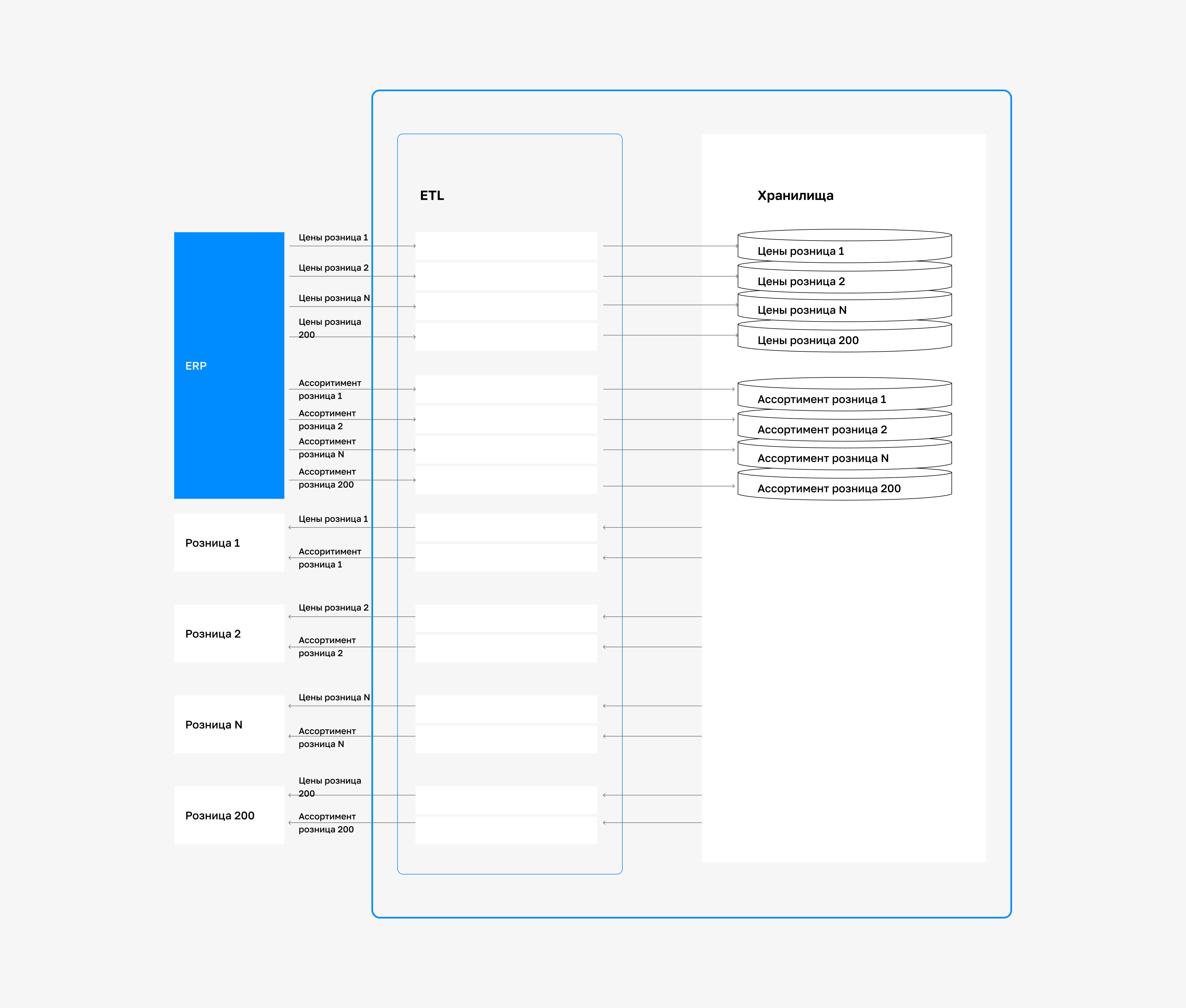
A single API for 200+ 1C:Retail instances
- Integrations became fault-tolerant and transparent
- Built a unified API to connect 200+ 1C:Retail locations

Multi-reserve and omnichannel for Snezhnaya Koroleva
- The customer reserves and changes the order in store
- OMS and 1C in a single order process
- Connected online and offline sales
Discuss 1C-Bitrix: Enterprise sites and e-commerce under load…
Related solutions
Articles on the topic
- Magento for B2B: How the Platform Automates Corporate Sales
- Choosing an ERP system: an expert comparison of Shopify, Magento, Odoo, and other solutions
- Overview of the Saleor e-Commerce platform
- Replatforming and omnichannel: the Accent Group online store upgrade case study
- Global experience in migrating projects to Magento 2


