Source documents
Documents, VAT, reconciliation statements, and purchase and sales ledgers.

For each scenario, we document inputs, rules, exceptions, and the accountant review point. A typical process takes 1-2 weeks and costs 300,000 RUB; the exact price is set after analysis, and payment is due after acceptance.
Starting map
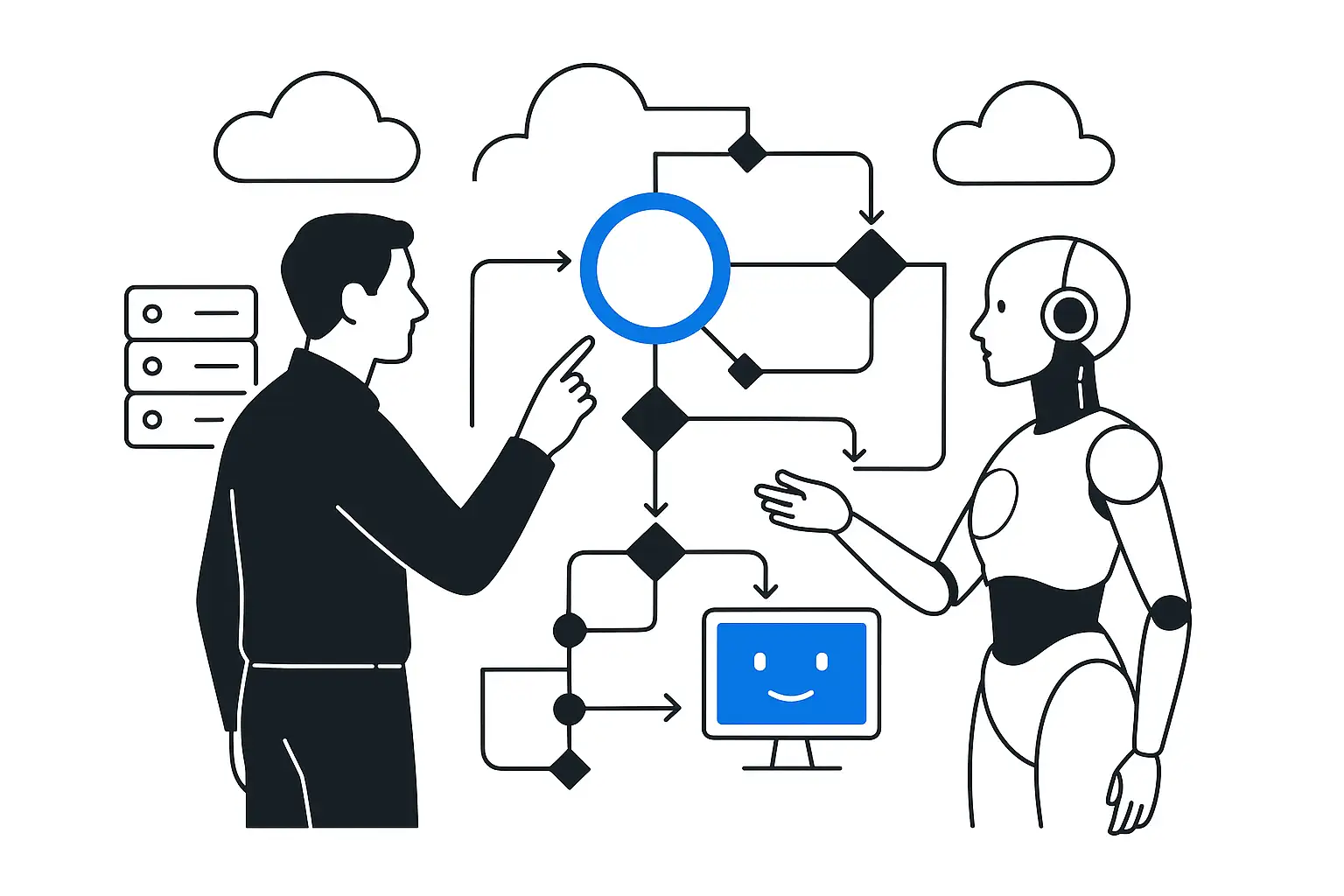
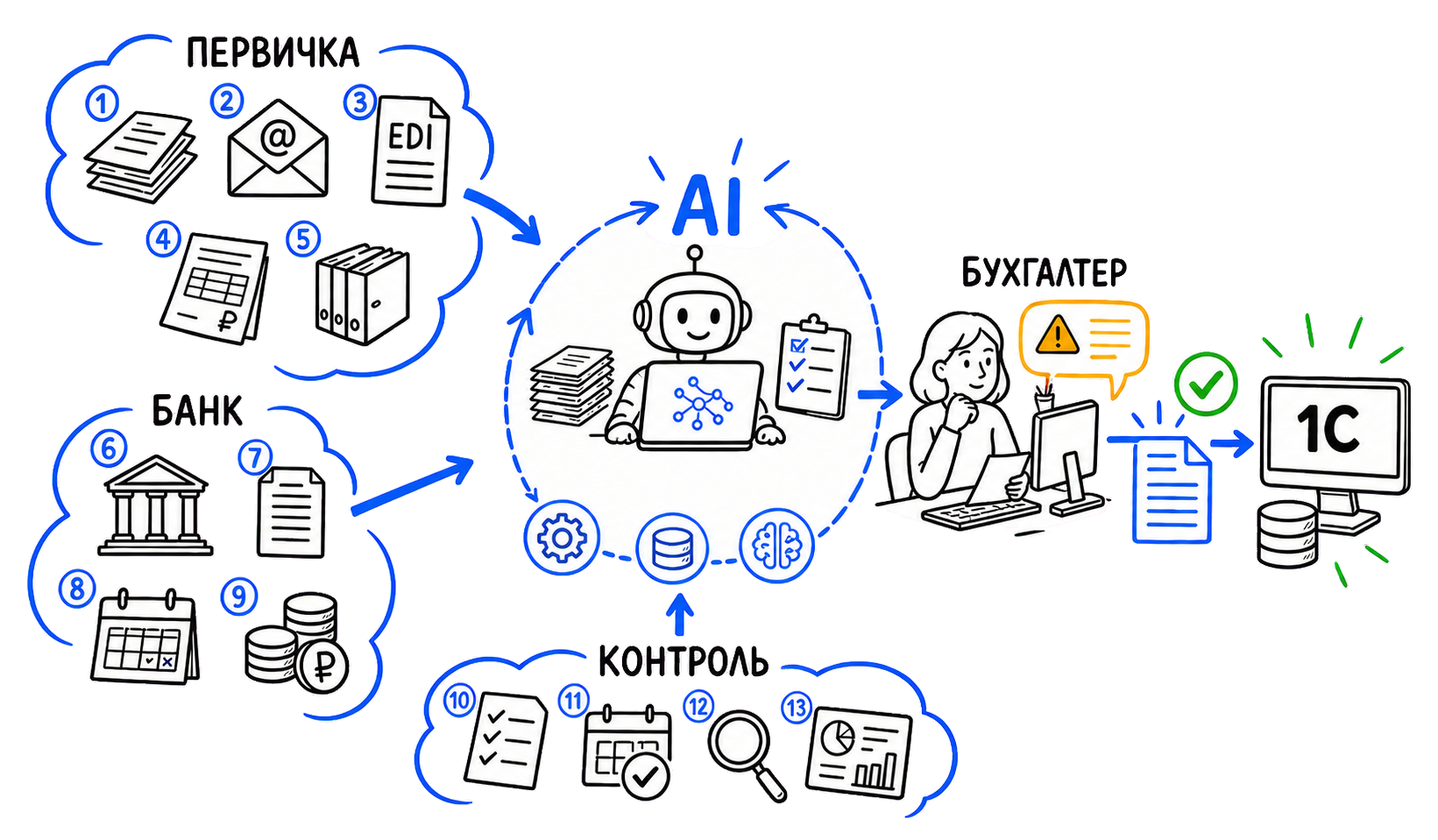
The agent gathers data, checks rules, and prepares an action. The accountant handles the exception and confirms the entry in 1C.
Documents, VAT, reconciliation statements, and purchase and sales ledgers.
Statements, obligations, payment register, and payment schedule.
Month-end closing, intercompany transactions, accounts receivable, and financial reporting.
One process, clear boundaries, real data, and acceptance agreed in advance.
Our clients














This is a catalog of candidates for a limited pilot.
The exact scope depends on systems, data quality, the number of variations, and control rules.
For a first rollout, source documents, bank statements, and reconciliation statements are usually the best fit: they have repeatable input, a verifiable outcome, and a clear exception queue.
The full product scope is described on the page AI assistant for accountants.
Suitable for a repeatable flow from EDI, email, or scans. In the pilot, we check recognition, matching to the counterparty, and preparation of a draft or an exception.
Suitable if statements are regularly requested and compared manually. In the pilot, we define the workflow for generating, receiving, and explaining discrepancies.
Suitable when the list of checks is agreed. In the pilot, we collect transactions with risk indicators into a register with the reason and owner.
Suitable if the deduction criteria can be formalized. In the pilot, we check documents against agreed fields and conditions, and send disputed cases to the accountant.
Suitable when exports are available and matching rules are clear. In the pilot, we identify discrepancies and create a review queue before the return is prepared.
Suitable for stable statement formats and posting rules. In the pilot, we load an agreed set of banks, prepare matches, and move unidentified and partial payments into a register.
Suitable if deadlines, limits, and document completeness are available in the accounting system. In the pilot, we produce a verifiable list of deviations.
Suitable when an approval workflow is in place. In the pilot, we collect requests, check the supporting basis, and prepare a register for approval by the responsible parties.
Suitable when scheduled payments and balances are available. In the pilot, we schedule payments by date and priority and highlight possible cash gaps.
Suitable for one limited close-related area with dependencies that can be formalized. In the pilot, we track statuses and surface errors to the responsible person.
Suitable when companies have unified identifiers and matching rules. In the pilot, we find pairs and send discrepancies for review before consolidation.
Suitable when due dates, amounts, and owners are available. In the pilot, we segment overdue items and prepare approvable reminders; complex cases are handed off to staff.
Suitable when the sources and breakdowns are agreed. In the pilot, we build one recurring summary for the selected metrics and show deviations together with the sources.
Document travels from source to verified action
Sources
AI agent
Control
Action
Next
Offer
Guideline - 300,000 RUB excluding VAT
In 1-2 weeks, we build and validate one typical bounded workflow on the client's data: for example, source documents outside EDI, reconciliation statements, bank statements, a payment schedule, or a recurring report. The exact price is fixed after reviewing inputs, outputs, and integrations; payment is due after acceptance.
We document the sources, document types, examples of standard cases and exceptions, and access to the agreed test environment.
We define one verifiable action: a draft in 1C, a discrepancy register, a prepared statement, a payment calendar, or a recurring summary.
You need a process owner, an accountant to validate the rules, access to examples, and agreed timelines for feedback on exceptions.
Before building, we measure current manual steps and time, then agree on the target metric. The pilot is accepted when the defined scenarios work on the client's data and exceptions are sent to the responsible person with a clear reason.
In many companies, accounting already uses 1C, EDI, online banking, and Excel.
Manual work remains between these systems: some counterparties send documents by email, reconciliation statements must be requested and tracked, period-close statuses are kept in email threads, and reports require regular rework.
When there are dozens or hundreds of such operations, they turn into separate hidden processes.
People download files, open emails, transfer data, remind counterparties, reconcile amounts, and manually track responses.
Agent checked
Document is reconciled with counterparty record and contract. No critical discrepancies found.
Suggested action
Create receipt draft in 1C
After confirmation: 1C · operation draft
Trace: UPD + counterparty record + check rule
Source documents
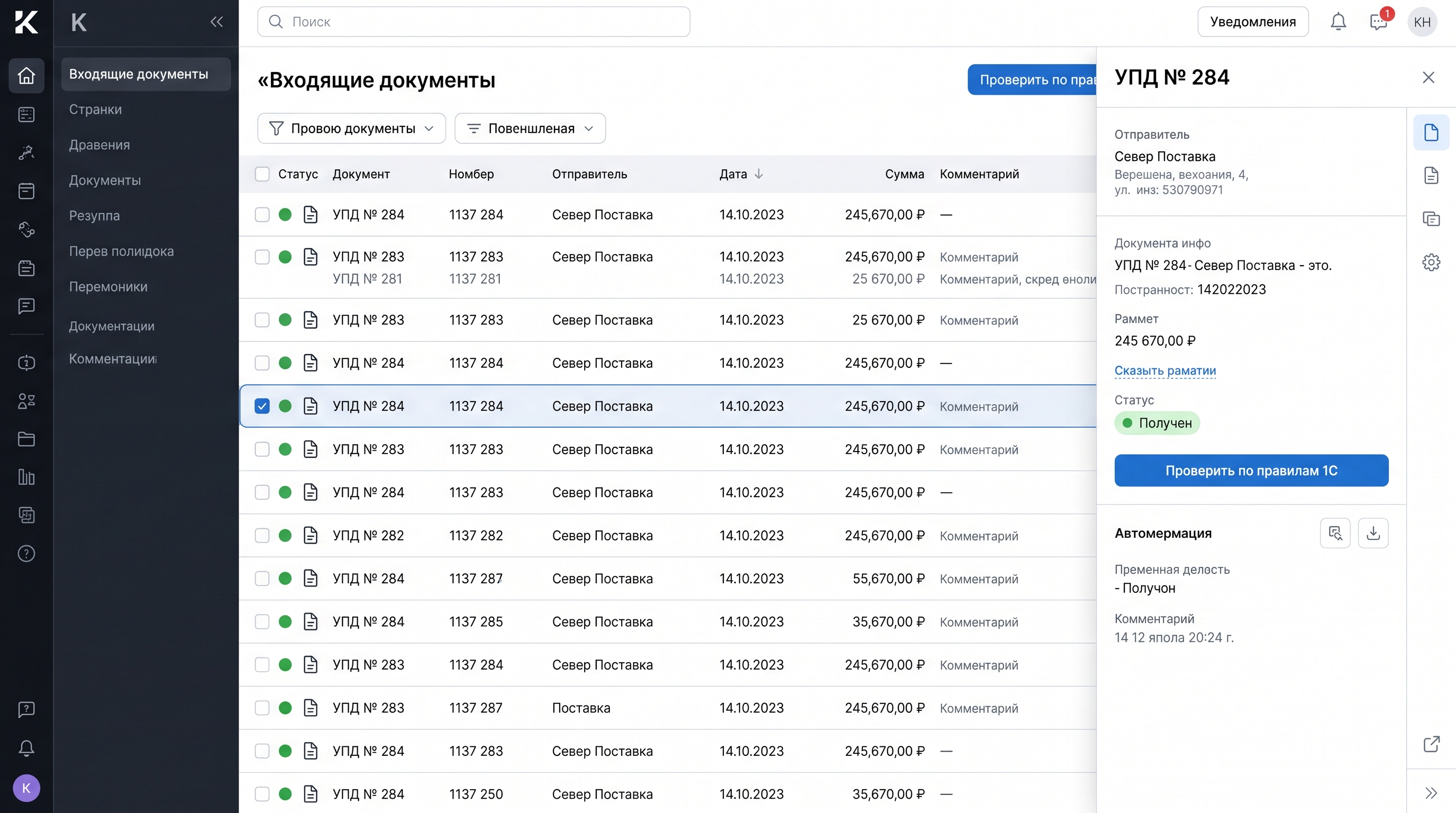
Incoming document is verified against 1C rules; exceptions go to Foundation and remain under accountant control.
 01
01
An incoming UTD triggers a 1C rule check without manual re-entry.
 02
02
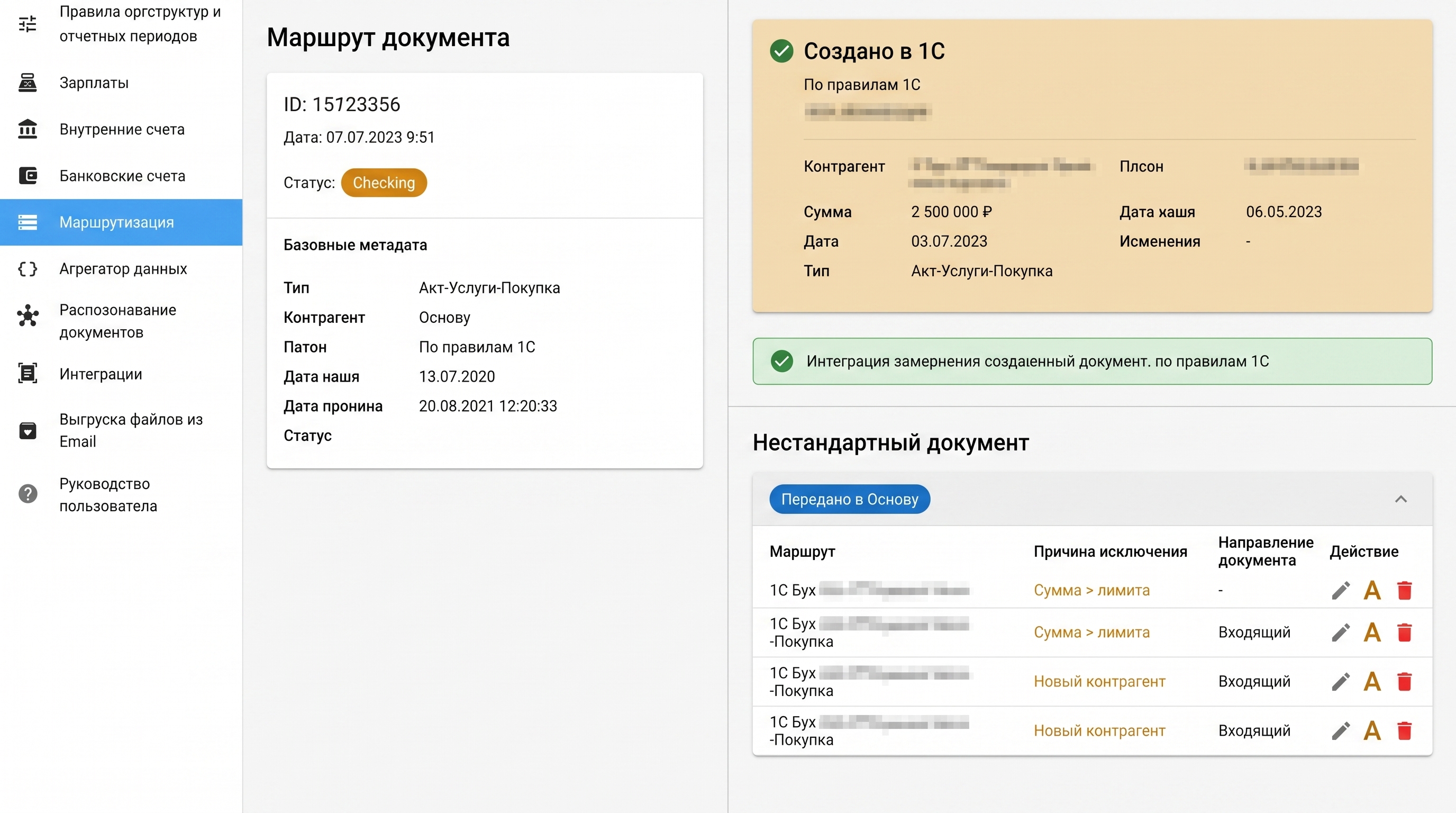
A standard document is created in 1C, and a nonstandard one is passed to Osnova.
 03
03
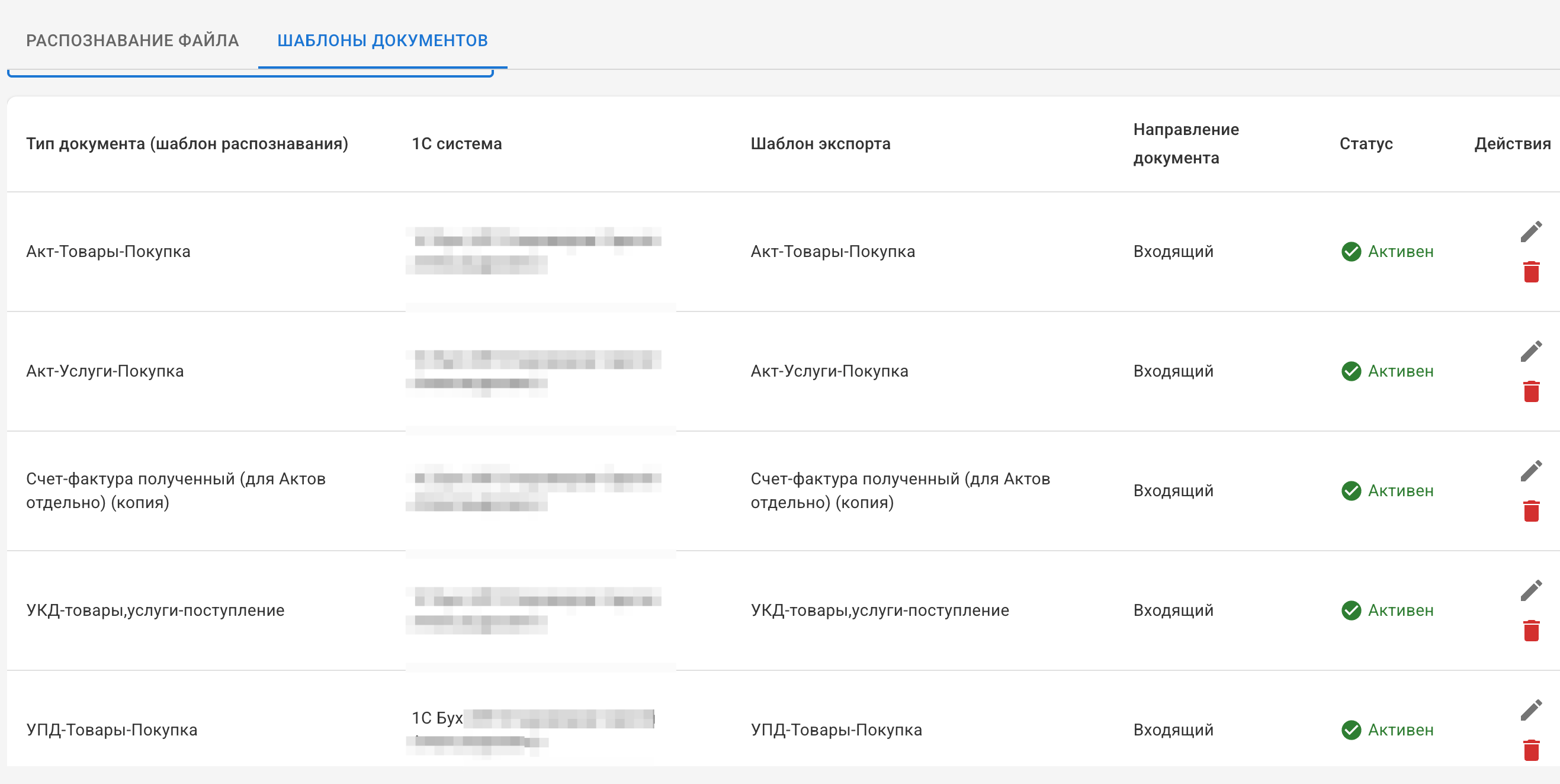
Real anonymized screen: the document type is linked to 1C and an export template.
 04
04
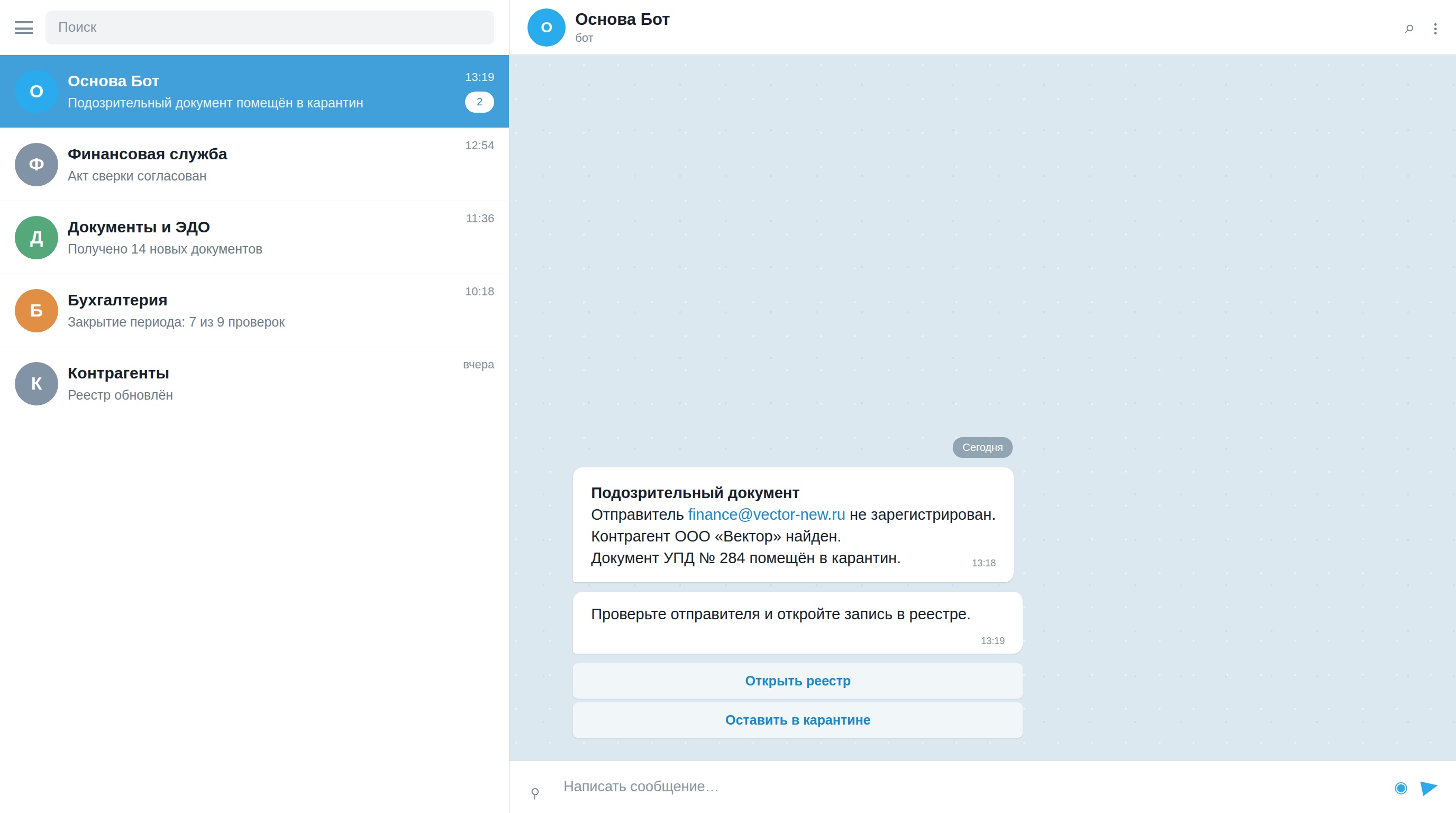
The bot warns about an unregistered sender and lets the user open the register or leave the document in quarantine.
A pilot is a good fit if the process has a repeatable flow, a client-side owner, access to source data, and a verifiable output. The accountant must be ready to confirm the rules and handle exceptions. Company size is secondary: what matters is enough volume of similar operations to measure the current workload and compare results after launch.
Agent checked
Service amount on line 4 differs from 1C order. Automatic posting stopped
Suggested action
Request amount confirmation or correct line 4
After confirmation: exception queue · awaits accountant
Trace: act + 1C order + amount reconciliation rule
Reconciliation statements
Agent collects sources, explains the discrepancy, obtains confirmation, and records transmission via EDI and entry in 1C.
 01
01
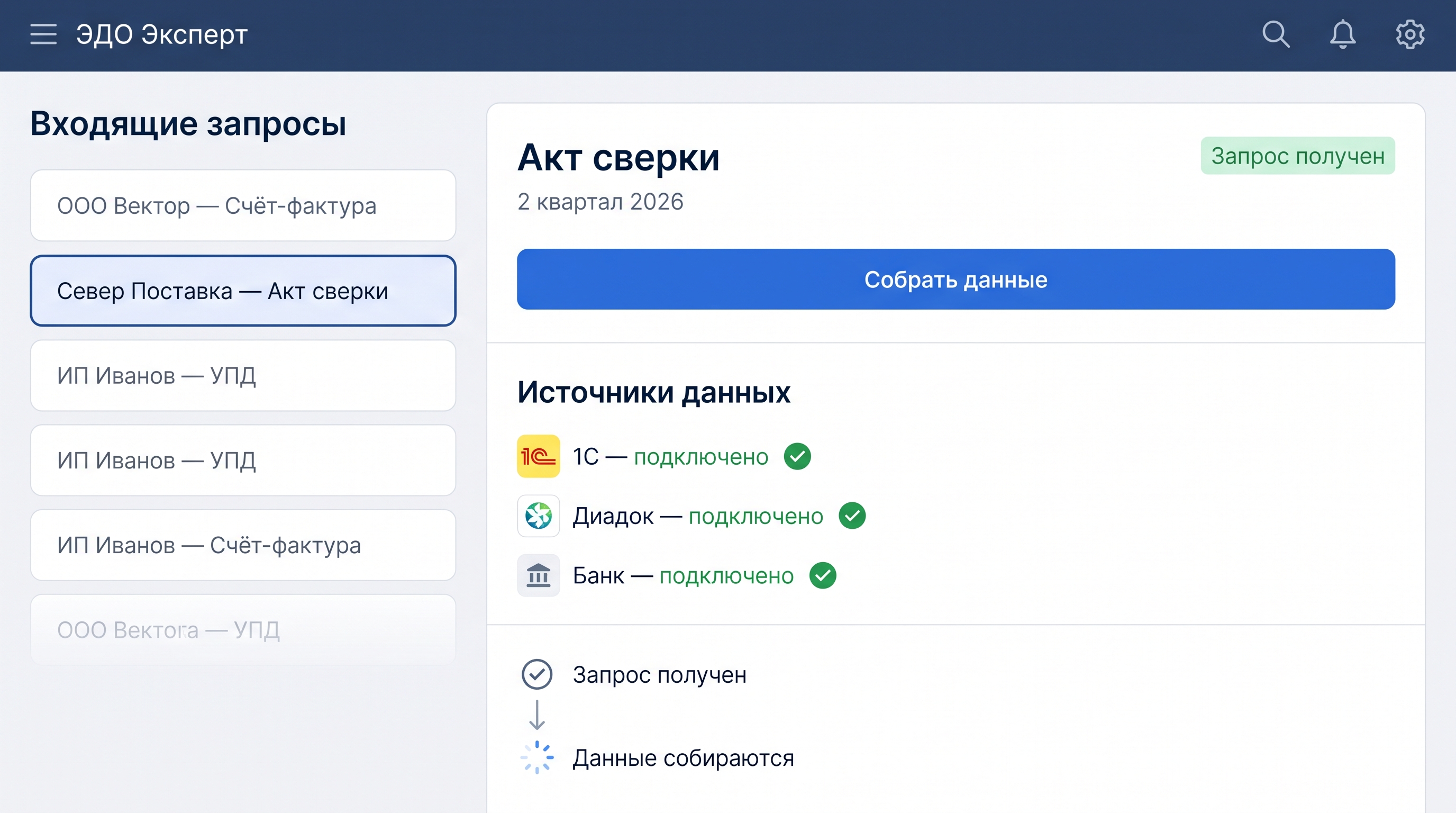
A request for a reporting period becomes a data collection task.
 02
02
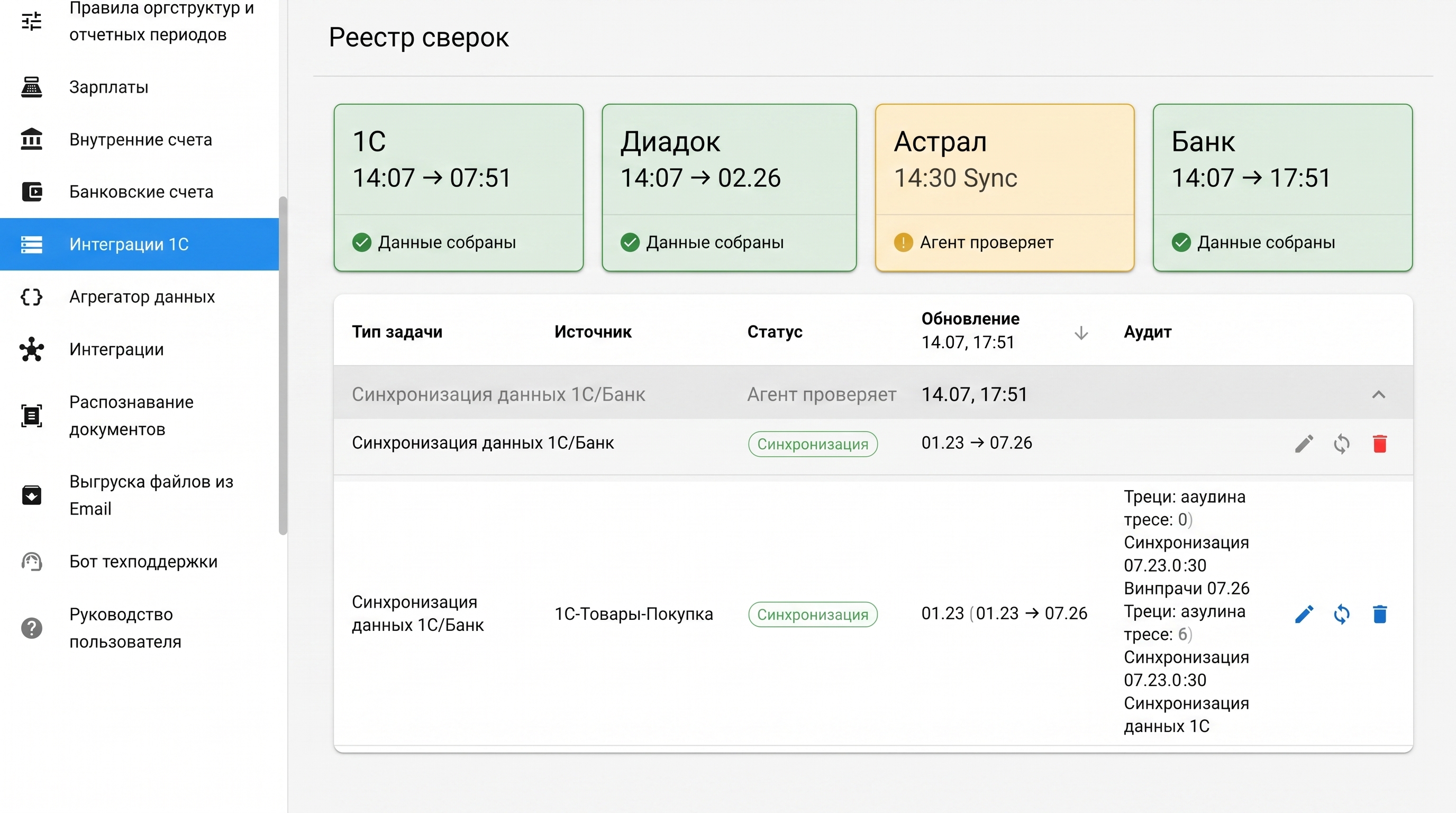
1C, Diadoc, Astral, and the bank are combined in one register with the status of each source.
 03
03
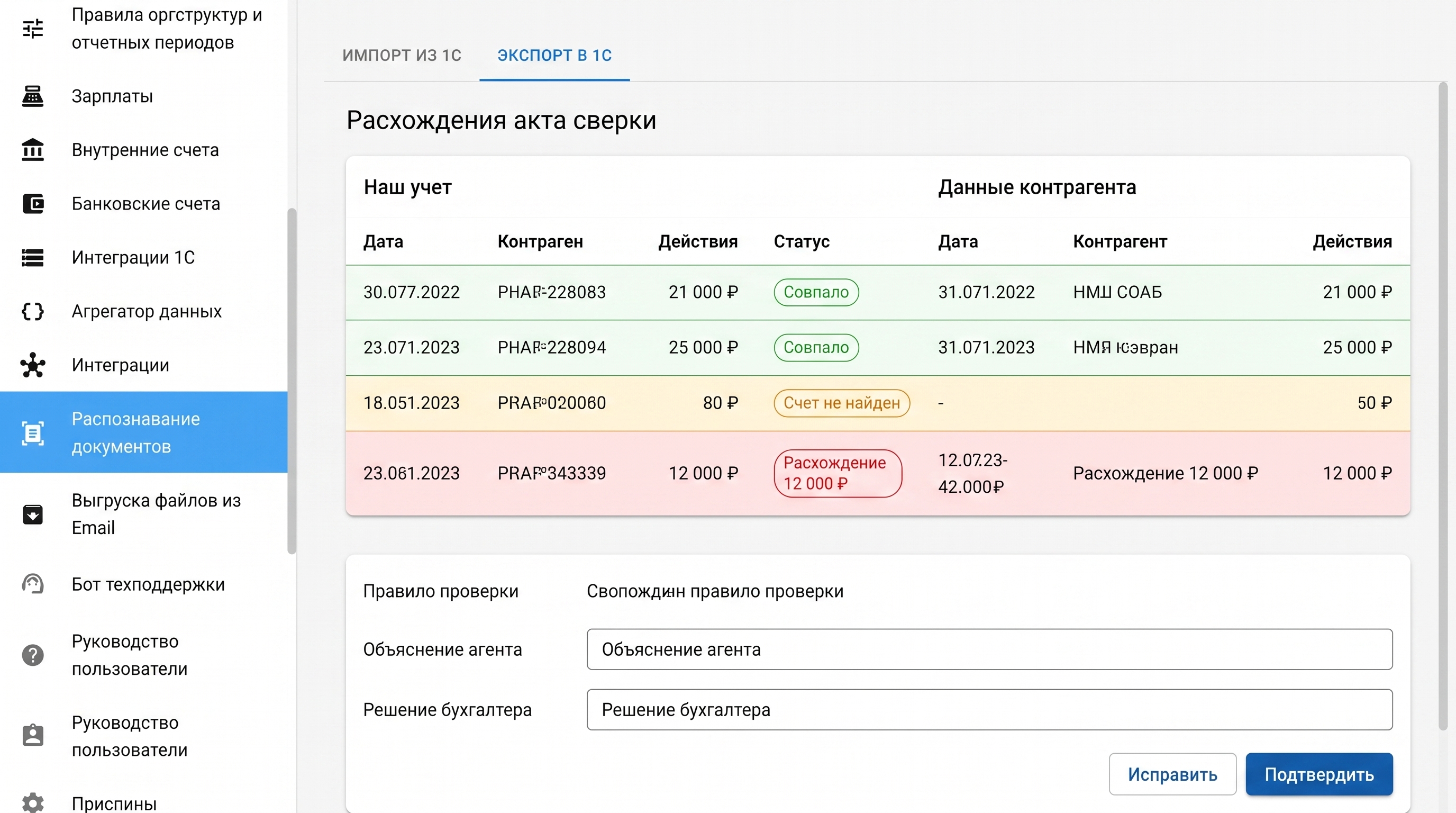
The system matches two ledgers, shows the source of the difference, and leaves confirmation for the chief accountant.
 04
04
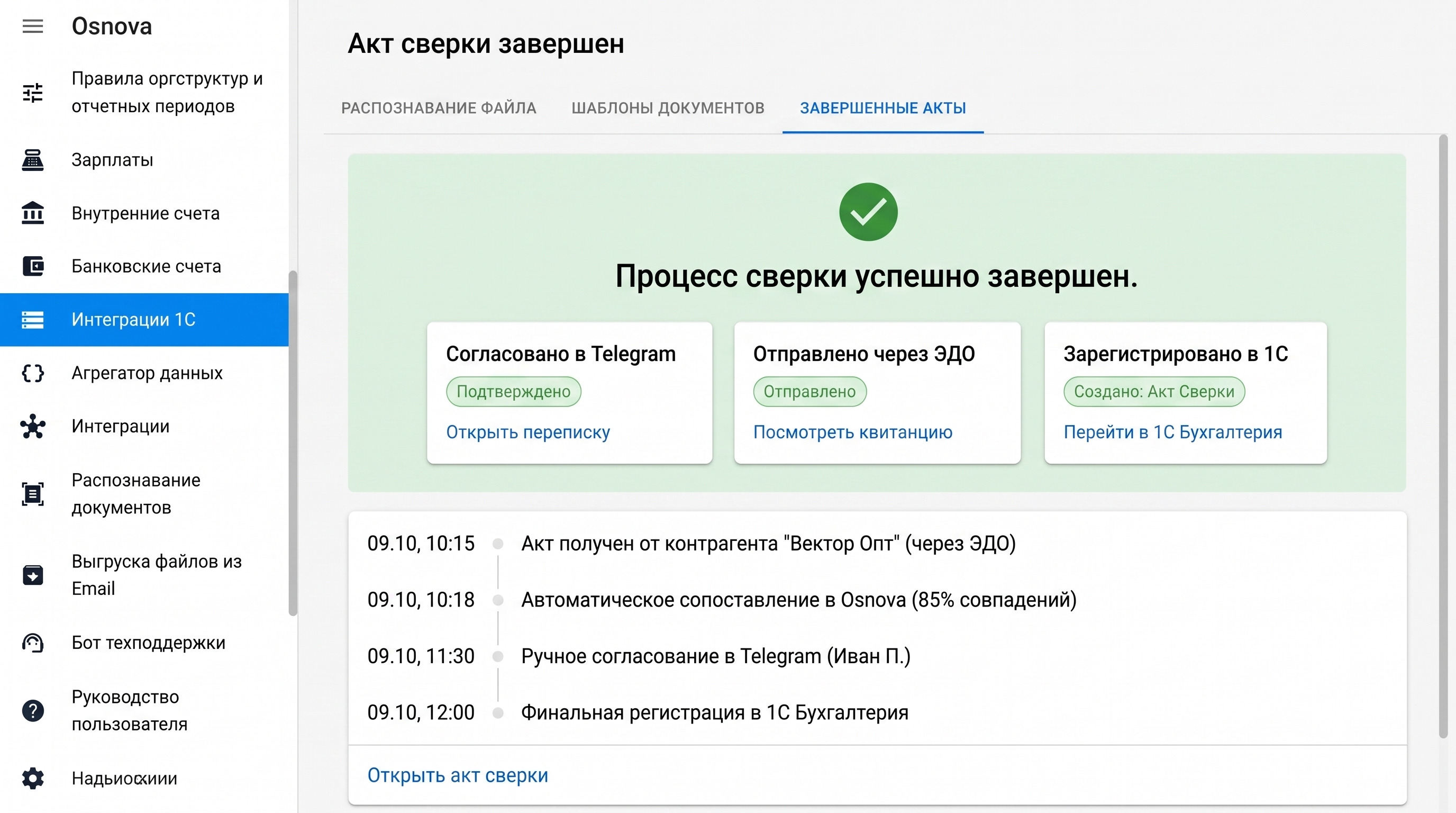
A single screen records approval in Telegram, sending through EDI, and registration in 1C.
If a quick review shows that it actually contains three different processes, we reduce the scope honestly and define the first part.
We document the files, systems, roles, manual operations, expectations, common errors, and the checks that must stay with the person.
This can be an integration with 1C, incoming email processing, document recognition, a status traffic light, act comparison, preparation of an upload file, or an exception review interface.
We look at how much manual work was eliminated, which exceptions remain, and which rules need clarification before the next process.
An accounting work area with reduced manual entry, status tracking, and a clear exception queue.
The metric for the first project is how much time and how many manual operations are removed from the process. Headcount savings appear cumulatively once there are several such automated processes.
AI does not make critical accounting decisions on its own. It prepares the data, compares it, highlights discrepancies, and passes clear exceptions to the person.
After the first successful area, it is easier to take on the next one: the data structure, access, rules, and confidence in the approach are already in place.
The starting format is one process, a short review before kickoff, and fixed outcome boundaries. At the start, we agree on access, examples, rules, and feedback timelines. We measure the result by reducing manual work in the selected process: the number of manual operations, processing time, the share of exceptions, and the time needed to prepare a recurring report. Fixed-price terms are described in pricing basics.
A broad request to automate the entire accounting function requires a separate change program and goes beyond the scope of the initial pilot. We postpone the pilot if there is no client-side owner, no access to source data, no repeatable flow, or no accountant ready to review the result. These organizational constraints must be removed first.
First step
30 minutes
Choose one pain point: source documents outside EDI, reconciliation statements, a report, statements, a payment calendar, or another repeatable process. In the first call, we assess manual work, data, the process owner, and the measurable result of the first project.
Cases