Languages and development
C# and .NET for enterprise services and integrations
C# is the language of the .NET platform, which enterprises use to build backends, integrations, and warehouse logistics services. In KT.Team practice, this is .
Backend language
Our clients
Clients and partners











Top 5C# consistently ranks in the top five language lists (TIOBE, Stack Overflow Survey), with a broad hiring market
2 environmentsLive .NET environments for enterprise clients: a top-5 developer in CIS and an international logistics operator
LTS.NET 8/10 with long-term support: Linux, containers, and a predictable release cycle
AI-readyOfficial C# SDK for MCP (Microsoft + Anthropic) - a .NET service exposes data to AI agents via the standard
Industry solutions
What you can build with C#
Capabilities
C# capabilities
Clients: web, mobile, internal workstationsAPI and services (ASP.NET Core)Background workers and ETL in C#Databases (MS SQL, PostgreSQL) and legacy schemasIntegrations: 1C, WMS, message busesAI layer (MCP SDK, Semantic Kernel LLM)
Mature .NET platform
ASP.NET Core, Entity Framework, a rich standard library, and the NuGet ecosystem mean less code from scratch for enterprise services.
Strict static typing
Compile-time contracts, generics, and nullable reference types catch errors before production, and the code reads like a specification.
Cross-platform support and containers
Modern .NET runs on Linux and Kubernetes: the service is deployed like the rest of the landscape, without being tied to Windows.
I/O and CPU performance
A compiled runtime, async/await, and low-level optimizations deliver predictable performance for integrations, ETL, and high-load APIs.
ETL and data processing
LINQ, EF Core, and connectors to MS SQL/PostgreSQL make C# a strong tool for ETL pipelines and refactoring legacy databases.
Warehouse and logistics integrations
Background workers, services, and message buses are the standard stack for Yard/WMS services and data exchange with 1C.
Hiring availability
A large .NET developer community in CIS and the CIS: the team can scale without exotic skills.
Approach
How we implement C#
Without modifying the core
We do not fork or patch the C# core. C# remains on the standard updatable version, while customizations are moved into separate modules or services. Before an update, we verify module and integration compatibility in a test environment.
International Standards, Not Homegrown Hacks
Where a mature international solution exists, we use it instead of inventing our own protocol or platform. Before writing code, we study how the problem is already solved in the industry.
Transferability
The solution is loosely coupled and documented: it can be handed over between teams and contractors without rewriting. You are not tied to us.
AI compatibility
C# in the AI stack
Official MCP SDK for C#
The Model Context Protocol SDK is being developed by Microsoft together with Anthropic - a .NET service exposes tools and data to AI agents through an open standard.
Semantic Kernel and Microsoft.Extensions.AI
A single interface to OpenAI, Azure OpenAI, Anthropic, and local models: agents, RAG, and function calling in a native .NET stack.
Code generation by agents
Strong typing and a large body of public C# code make the language convenient for AI assistants: explicit signatures reduce hallucinations.
AI in the integration layer
LLM enrichment, document classification, and smart search can be built into existing .NET services without a separate Python stack.
Context 2026
What changed in the market
Current runtime
.NET 10 is the current LTS release (November 2025); .NET 8 LTS is supported through November 2026. Migration from .NET Framework is underway across the enterprise sector.
Ranking positions
C# consistently stays in the TIOBE top five and near the top of the Stack Overflow Developer Survey; TIOBE's 2023 language of the year.
MCP and agents
The official C# SDK for the Model Context Protocol is being developed by Microsoft together with Anthropic; an MCP server on .NET is a standard use case, not an exotic one.
AI stack
Semantic Kernel and Microsoft.Extensions.AI have become the standard way to connect LLMs to .NET applications.
Honestly
Pros and cons
Pros
- A mature platform with an LTS cycle and first-class tooling (Visual Studio, Rider).
- Strict typing and compile-time contracts deliver enterprise-grade reliability.
- Modern cross-platform .NET: Linux, containers, Kubernetes.
- A strong stack for ETL, integrations, and background services.
- The official MCP SDK is a direct path into the agent ecosystem.
Cons
- KT.Team does not yet have public C# case studies - there are two active enterprise contracts; the case study selection features the same clients in adjacent stacks.
- Part of the ecosystem leans toward the Microsoft stack (MS SQL, Azure), so open-source alternatives should be chosen deliberately.
- Fewer off-the-shelf platforms for e-commerce/PIM than in the PHP ecosystem.
- The hiring market in web and e-commerce is narrower than for PHP/Python.
- Legacy .NET Framework projects need migration to modern .NET.
News
What's new in C#
-
.NET 11 Preview 7: labeled break/continue, exhaustiveness checking, NativeAOT CLI enabled by default
C# adds labeled break/continue, improved union pattern matching, and exhaustiveness checking for constrained type parameters. NativeAOT CLI and the MSBuild server are enabled by default in the SDK. EF Core brings improvements to query translation and Cosmos DB.
-
Agent Framework at Build 2026: Agent Harness, CodeAct, hosted agents
Agent Harness automatically compacts chat history when the token limit is exceeded and includes built-in file, todo, and web-search providers. CodeAct (agent-framework-hyperlight) combines multiple tool calls into one program in an isolated micro-VM: 52.4% lower latency and 63.9% fewer tokens in test scenarios. Foundry Hosted Agents provide scale-to-zero deployment with file system persistence between sessions.
CodeAct replaces step-by-step tool calls with one program in a micro-VM — a different approach to saving tokens than n8n node-based workflows n8n → -
Microsoft Agent Framework 1.0 GA
AutoGen and Semantic Kernel merged into a unified SDK with stable APIs and long-term support. An MIT license, open source, and open weights are not required — the framework orchestrates any models: Foundry, Azure OpenAI, OpenAI, Anthropic Claude, Bedrock, Gemini, and Ollama. MCP and A2A support enables cross-platform agent interaction.
-
.NET 11 Preview 1 released
The .NET 11 cycle begins: CoreCLR has been ported to WebAssembly, RISC-V and s390x support added, and the interpreter expanded. C# introduces Collection Expression Arguments. GA is planned for November 2026 (STS, not LTS).
Projects
Cases
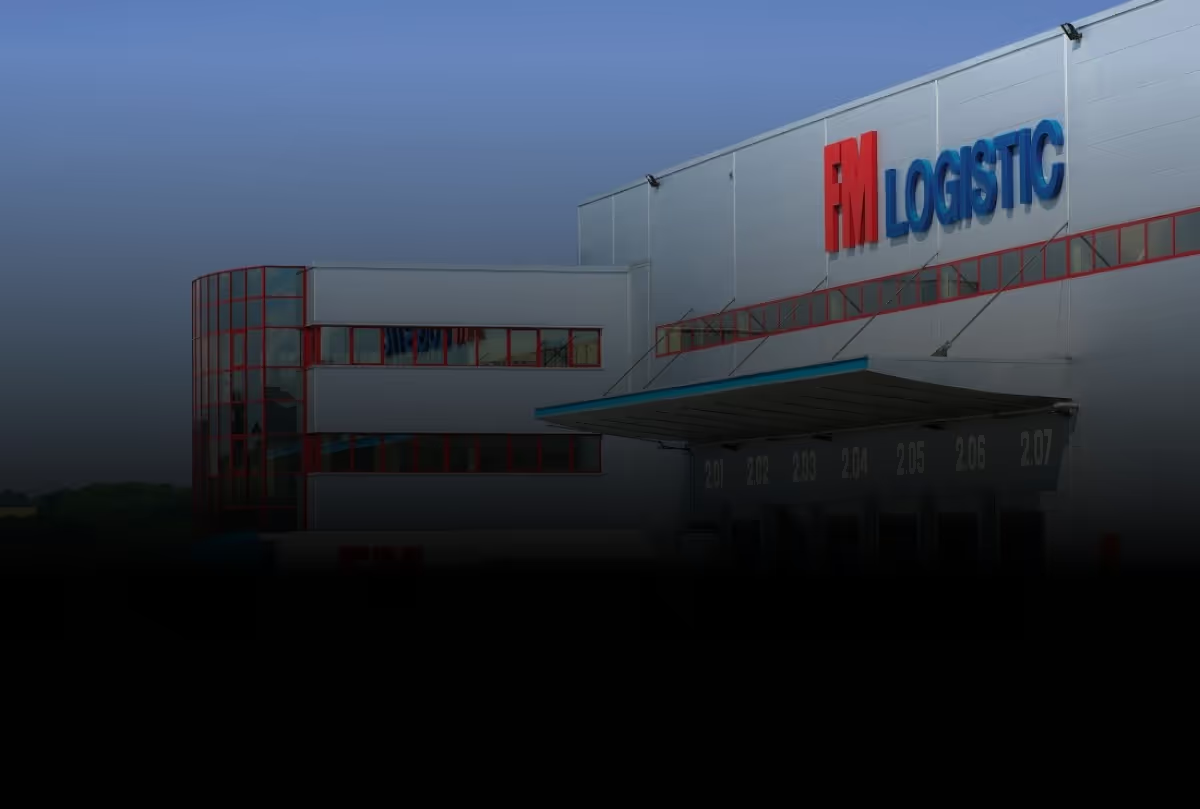
Pimcore for FM Logistic temporary staff management
Learn morePimcore for FM Logistic transport requests
- Delivered a Pimcore-based system for FM Logistic
Talend ESB for FM Logistic integrations
Learn moreDiscuss C# and .NET - the language for enterprise services and...
Articles on the topic
- AgentScope 2.0.10: the enterprise agent breaks when reading tables
- n8n templates from the community: what separates a demo from an integration
- AI Agents Need Clean Documents: Why Extraction Matters
- Why Microsoft Has AI Impact but Meta Does Not
- Cross-platform development: RN, Flutter, or Kotlin Multiplatform