What is included in a B2B system
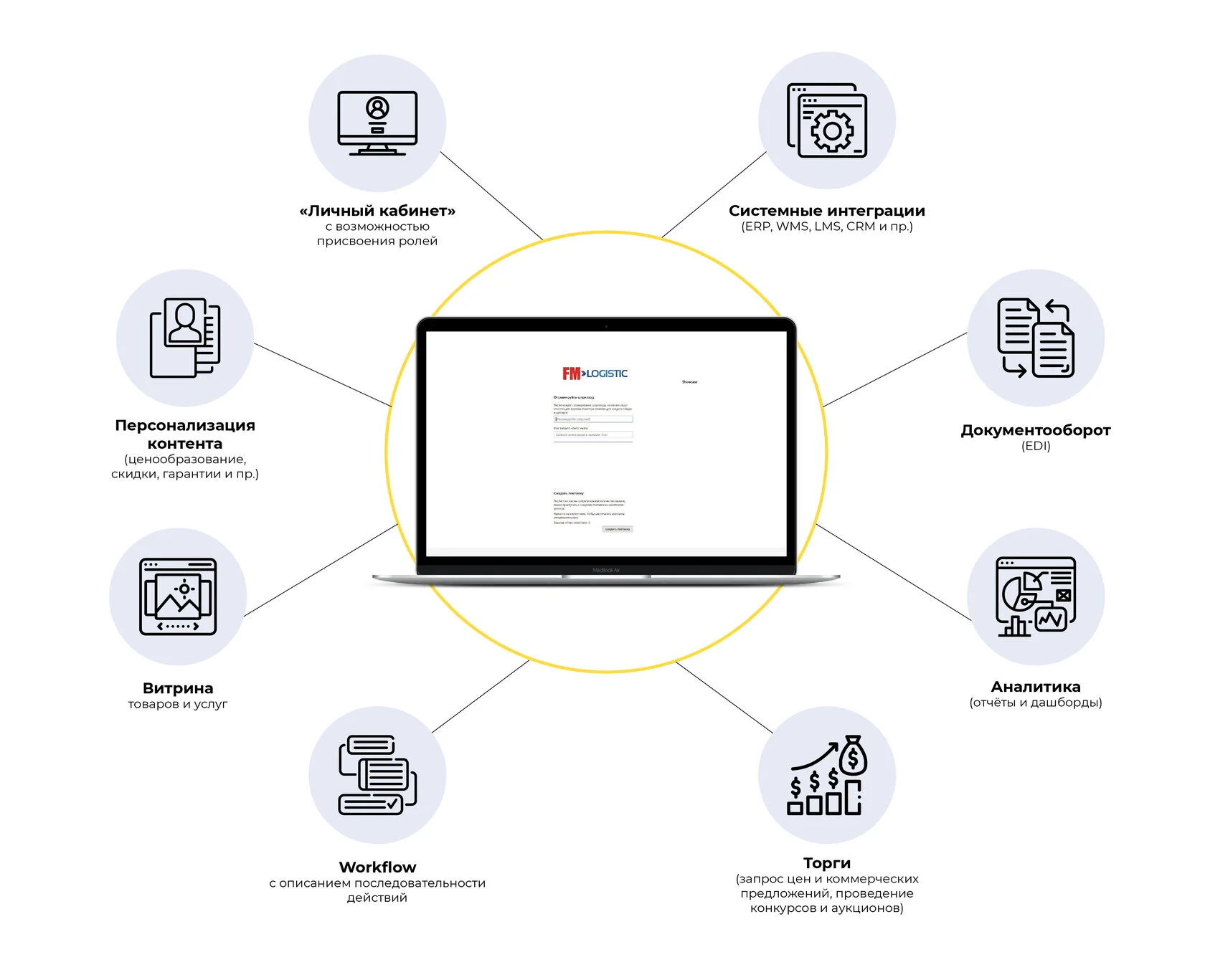
A B2B system is a tool for automating wholesale sales and order processing that enables quick responses to customer feedback and a personalized approach to each customer.

Solutions
We build B2B platforms and customer portals to automate wholesale sales, orders, and customer service.
Our clients














Development
For e-commerce, B2B, microservices and Python, what matters is not the stack itself but the locality of change: a new channel, order, catalog or service launches without breaking the whole system.
Omnichannel, accurate channel analytics, reservations, PIM and marketplaces.
Self-service portal, personal prices, stock, limits, documents and reorders.
Services around the core that can be tested, shipped and scaled independently.
Without a B2B system
With a B2B system
A B2B system is a tool for automating wholesale sales and order processing that enables quick responses to customer feedback and a personalized approach to each customer.
Personal terms and workflows for each client are fixed as a business process rather than kept in a manager's head.
Routine order and service operations are automated, so a smaller support team handles the same volume.
Orders from different channels converge into one system with a single status and history.
The client places and tracks orders in a personal account at any time, with no manager involved.
Order and request data in a single loop reveals bottlenecks and lets you improve processes in iterations.
Cases
Layers around the B2B portal
ESB
PIM
BPM
PWA
| System / layer | Scope of responsibility |
|---|---|
| ESB | A universal tool for fast integration of services and applications: it organizes data flows between the B2B system and integrations, routing them through a single point. |
| PIM | Working with suppliers, storing and managing product and manufacturer information through PIM system integration with the B2B portal. |
| BPM | Digitization and automation of business processes: deadline and quality control, process monitoring by KPI. |
| PWA | A front end that does not depend on devices or operating systems: it loads fast and works reliably even on a slow internet connection. |
FAQ
From reusable layers: ESB handles integrations and routes data flows through a single entry point, PIM handles product and manufacturer data, BPM digitizes processes and tracks deadlines against KPIs, and PWA powers a front end that loads quickly and does not depend on the device or OS. Loose coupling lets you replace layers piece by piece and take control of the system at any time.
Custom terms and workflows for each client are defined as a business process, not kept in a manager's memory. Customers can place and track orders in their account 24/7 without a manager, and orders from different channels are consolidated into one system with a single status and history.
Through ESB as a single integration point. In logistics, this includes integrations with WMS and LMS systems (Shiptor, CIS Post, DPD/SPSR, CDEK, Pony Express, and similar providers), order status updates, EDI order generation and billing, and for large volumes of asynchronous exchanges, API Gateway and queues with transaction handling for each segment.
Logistics, manufacturing companies, retail, finance, and healthcare. Industry specifics fit into the same layers: integrations and business rules change, not the portal architecture.
Individually. Our clients do not have standard tasks. The rate is transparent, 4,200 RUB per hour, but we calculate total cost of ownership over years, not the hourly development price. The evaluation logic is described in the section pricing fundamentals.
Pricing
$51 per hour
Projects are estimated individually because our clients never have off-the-shelf tasks. We calculate the cost of ownership over years, not the price of a development hour.