Selection Quality
Alignment of go/no-go recommendations with tender team decision and reasons for any deviation.

AI
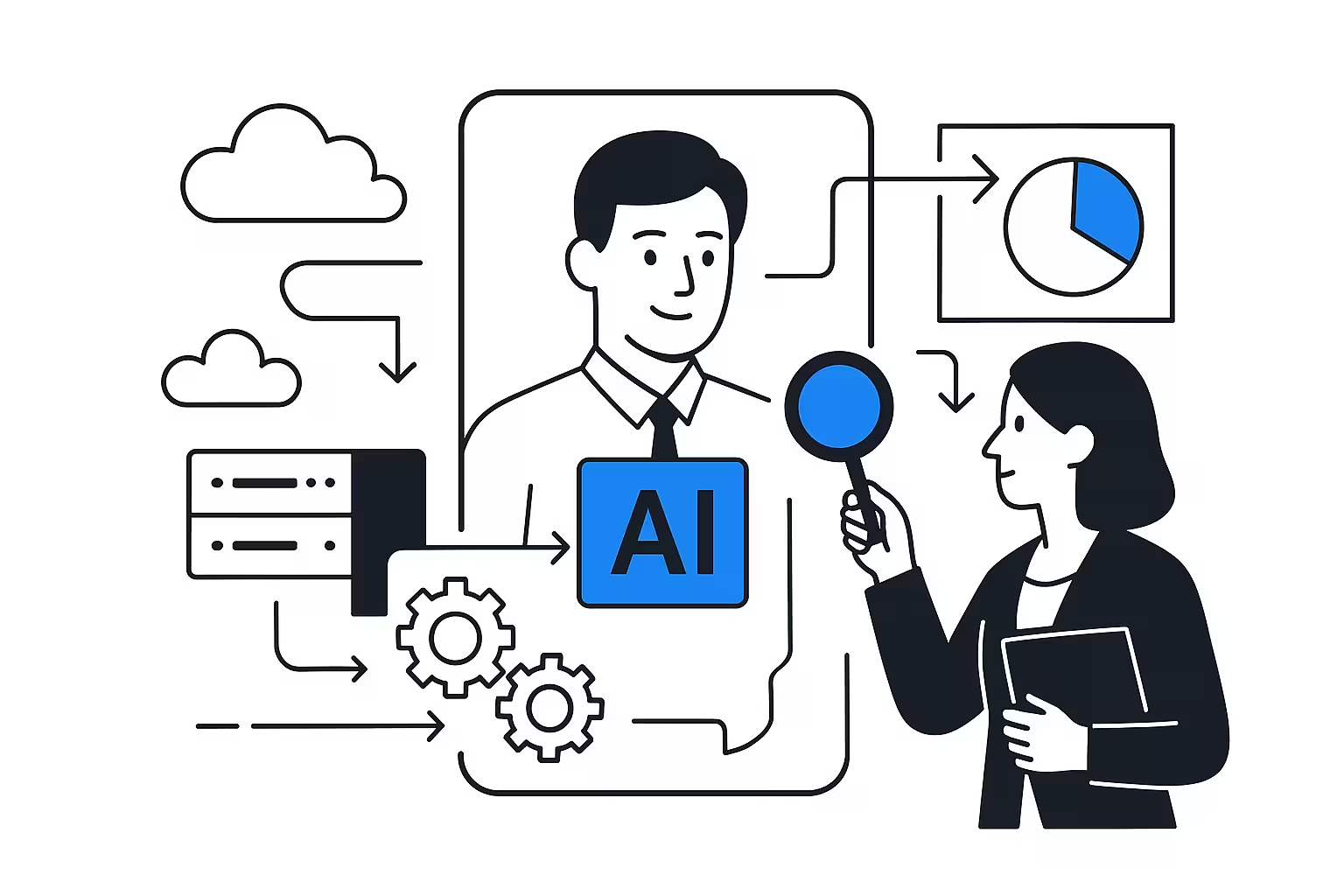
Implement an AI assistant to select procurements, analyze requirements, and prepare verifiable drafts with sources, permissions, and expert review.
Our clients











From Procedure Collection to Submission Package
Selection
Analysis and Assessment
Preparation
Agent checked
The procurement subject matches the profile. The documentation includes an experience requirement, but no supporting company document was found.
Suggested action
Send the card to a specialist with a request to confirm experience.
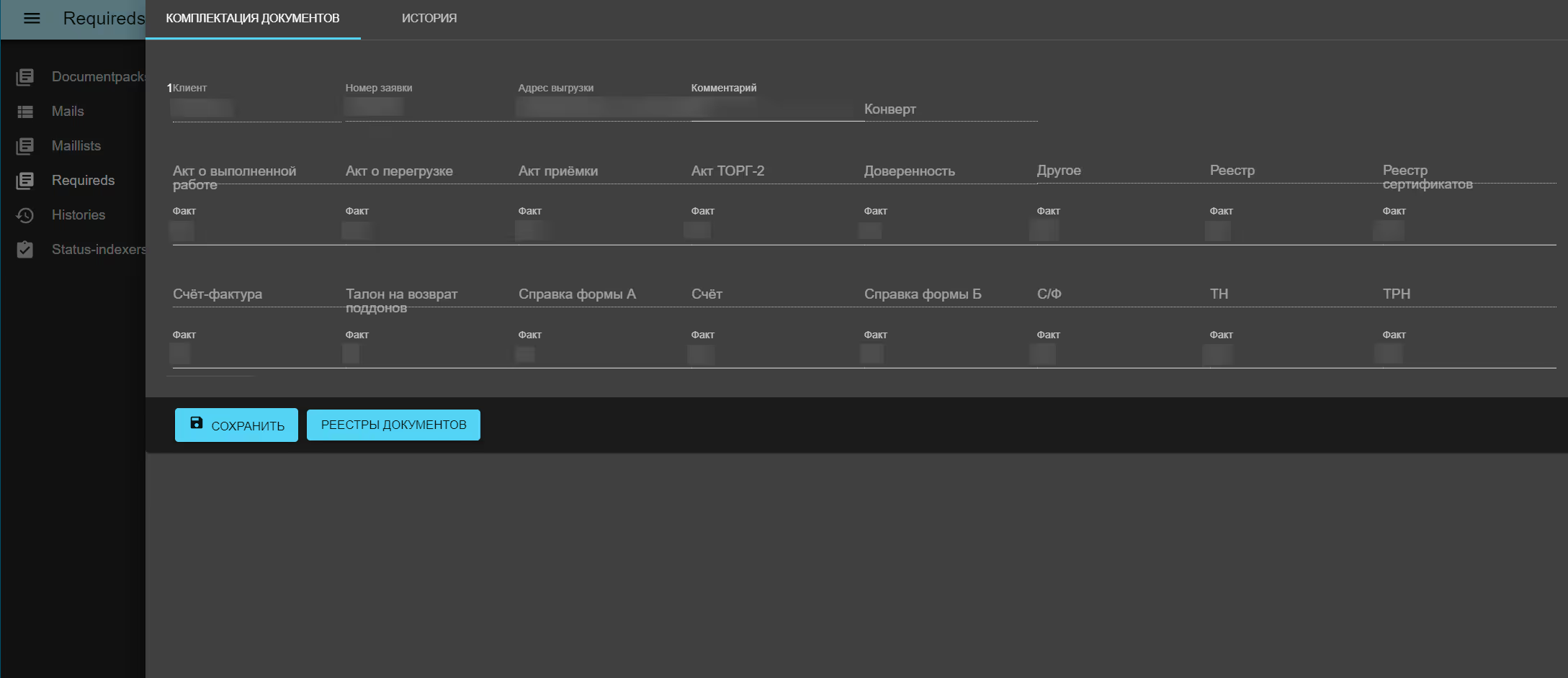
After confirmation: CRM or tender register · The decision, responsible person and links to documentation sections are saved. The bid is not submitted automatically.
Trace: Illustrative workflow example. A link to the source document is saved for each requirement.
The tender team spends most of its time not on preparing bids, but on sifting through platforms: out of hundreds of published procurements, only a few are relevant, and to know that, each one has to be opened.
The agent handles exactly this step. It screens procurements by your criteria - OKPD, region, volume, customer, experience requirements - filters out clearly non-qualifying ones, and leaves a short list. For each item, it analyzes the technical requirements and pulls out the decision points: scope, deadlines, security, penalty terms, and participant requirements. It then prepares an evaluation draft that a specialist reviews instead of creating from scratch.
This is not a subscription service or another platform. The agent works on your criteria and within your environment: participation history, cost structure, and production load stay inside the company. For public procurement, the logic is the same; only the set of checks and data sources differs.
The impact is measured in hours spent on screening and in the share of bids that make it to submission:
The assistant does not "search for tenders on the internet" - it works from the source list you approve at the start. Public procurement under 44-FZ and state-owned company procurement under 223-FZ is published in the unified procurement information system (zakupki.gov.ru), electronic procedures run on federal e-trading platforms, and commercial procurement lives on customer platforms and portals, in invitations and mailings.
Each source is connected separately and only where the company has a legal basis to receive the data: public publication, platform accreditation, or access granted by the customer. From the connected sources, the assistant compiles not a link but a procedure card: the procurement subject, customer, deadlines, starting price, participant requirements, and the documentation package with attached files.
Next, a filter applies the company profile: industry, budget range, preparation time, qualifications and licenses, acceptable risk. Rejected procedures do not disappear - you can see which rule filtered them out, and the rule can be adjusted without rewriting the process.
Connecting each new platform is separate work: platforms have different export formats, different access requirements, and different documentation completeness. That is why the pilot starts with one or two sources that provide the main flow, and the rest are added after selection is already working for them.
Connects agreed platforms, notifications, or exports available to the company by lawful right.
Assistant applies industry, budget, timeline, qualification, and acceptable risk criteria.
Document is decomposed into mandatory requirements, tasks, documents, deadlines, and client questions.
Calculation uses agreed templates, standards, and history of verified assessments from similar projects.
Expert reviews sources, assumptions, risks, and corrects the estimate.
Approved data flows into CRM, document management system, or application templates; submission remains a controlled action.
| System / layer | Scope of responsibility |
|---|---|
| Platforms and Notifications | Available information on procedures and tender documentation package. |
| Criteria Database | Go/no-go rules, constraints, qualifications, and company risk profile. |
| Assessment History | Verified labor costs, rates, assumptions, and actual results from past projects. |
| AI assistant | Search, specification decomposition, assessment draft, and links to source documents. |
| Expert and manager | Verification, participation decision, final estimate, and application submission. |
Pilot runs on historical procedures with known decisions and expert assessments.
Alignment of go/no-go recommendations with tender team decision and reasons for any deviation.
Share of mandatory conditions and documents found in the control sample.
Share of tasks and risks accepted by expert without adding new items.
What portion of the assessment draft and document package was changed before approval.
The tender assistant is one of the processes where the assistant prepares a verifiable draft and the decision remains with a person. The same model works wherever there are many documents and the rules are formalizable.
Analysis of incoming terms, comparison of offers, and preparation of justification, built on the same principles of a verifiable draft. AI in procurement
The assistant answers an employee's question with a link to the relevant document clause, not a paraphrase, so the answer can be verified. AI Assistant for Policies and Procedures
The transcript becomes a record with decisions and owners, not a verbatim transcript. AI Meeting Minutes
Cases
FAQ
Monitoring connected sources, selecting procedures by your criteria, breaking down tender documentation into requirements, tasks, documents, and deadlines, drafting an estimate from verified history, and assembling the submission package. The participation decision, final price, and submission itself remain with the person.
From the sources you approve at the start. Procurement under 44-FZ and 223-FZ is published in the unified procurement information system (zakupki.gov.ru), electronic procedures run on federal e-trading platforms, and commercial procurement appears on customer platforms and portals, in invitations and mailings. Each source is connected separately and only where the company has a legal basis to receive the data.
No. Submission is a legally binding action performed by an employee with a power of attorney and electronic signature. The assistant prepares the package and transfers approved data into CRM, EDM, or application templates.
No. The specialist checks sources, assumptions, and risks, interprets ambiguous requirements, and requests clarifications. The assistant handles the mechanical work: platform monitoring, initial screening, document review, and the draft calculation.
Company profile and selection criteria, access to approved sources, participation history with known go/no-go decisions, verified estimates for similar work, and a specialist to label the control sample.
One process is AI-enabled in 1-2 weeks, with a benchmark of 300,000 RUB for a standard process, and payment is made after the process is accepted and used by the team. What the price consists of - in analyzing cost and TCO of the AI agent, you can estimate the effect on your volumes in AI implementation calculator.
On historical procedures where decisions and expert assessments are already known: the match between go/no-go recommendations and the team's decision, the share of mandatory requirements and documents found, the share of tasks and risks accepted without edits, and the share of the draft changed before approval. Percentages are recorded from actual measurement, not promised in advance.
The model's access to documentation goes through a controlled LLM gateway: documents do not leave controlled services, actions are logged, and access is limited by role and operation.
Pilot
Select completed tenders, reconstruct team decisions, and verify selection, specification analysis, and draft assessments on one control sample.