
ESB · iPaaS · Integrations
n8n: AI Business Process Automation on Your Servers
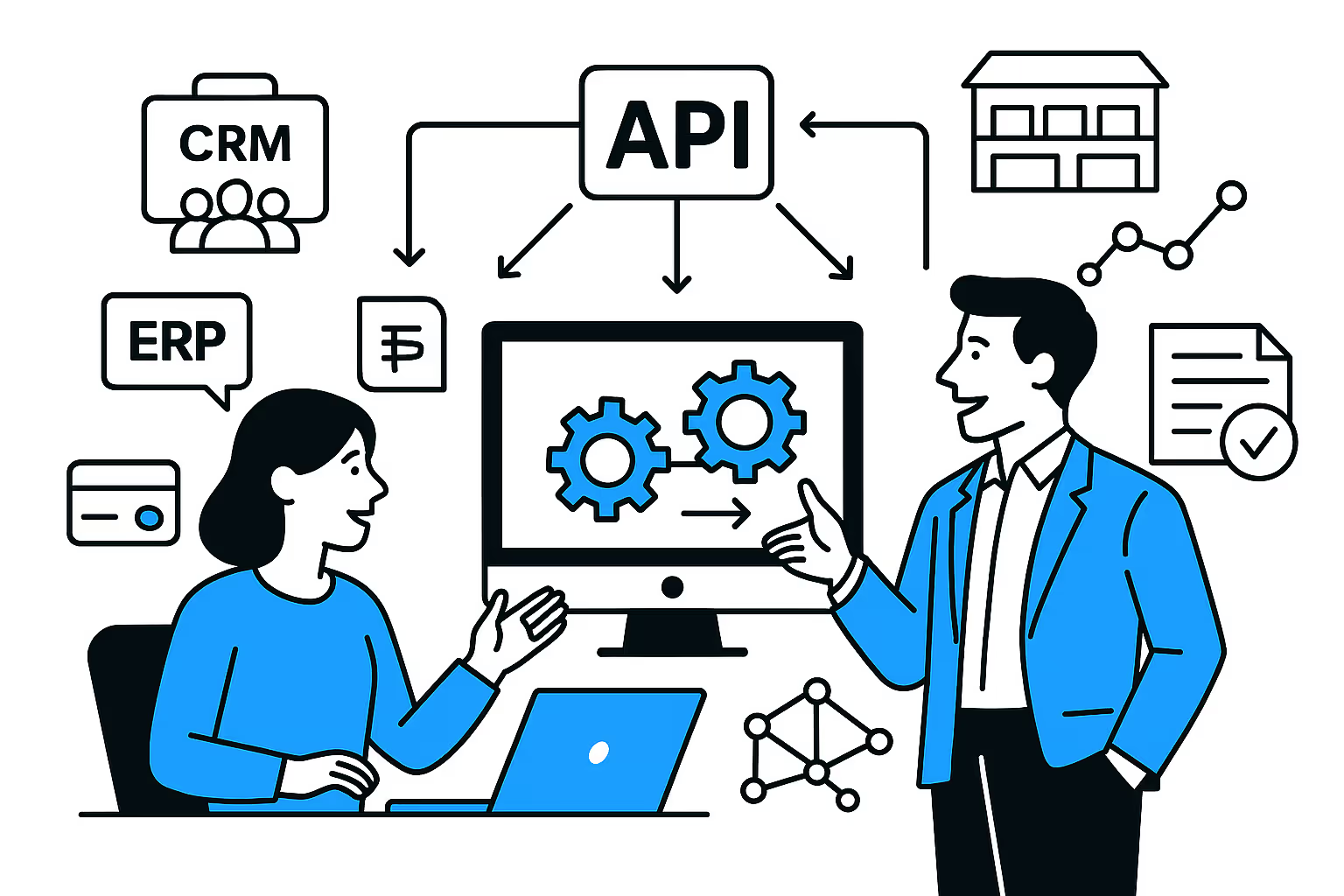
n8n is an open-source visual automation platform (iPaaS/low-code) that connects enterprise systems and adds an AI step directly into the workflow.
iPaaS instead of a heavy ESB: each workflow is an event, a set of nodes, and an AI step that can be changed and handed off without rewriting the entire integration.
Our clients
Clients and partners












500+ready-made integrations to launch workflows without custom code
17LLM providers and 12 vector stores for RAG and AI agents out of the box
~200kactive users and 3000+ enterprise customers
~197kGitHub stars — a mature ecosystem and community
Integrations
Change one system without rewriting the rest
The integration layer cures four ailments of rigid data exchange: data loss, cascading rework, source overload and inconsistency. ESB, Kafka and n8n solve different problems.
ESB
Routing, transformation, guaranteed delivery and low-code support of legacy exchanges.
Kafka
Durable log: an event is stored, re-read, multiple consumers read at their own pace.
n8n
Fast orchestration of a process and AI steps where heavy event streaming isn't needed.
sourcedata contractESB/Kafka/n8nmonitoringconsumers
Industry solutions
What you can build with n8n
E-commerce and retail
Synchronizing orders, stock, and product records across marketplaces, warehouses, and ERP with AI-enriched descriptions
Order and catalog management: less manual data transfer and fewer stock discrepanciesLearn more →Manufacturing
Collecting events from systems (MES, 1C, sensors) and automatic alerts on failures and deviations
Rapid response to production incidents without manual monitoringLearn more →Logistics
Orchestrating delivery statuses across TMS, carriers and customer channels via webhooks
Delivery transparency and automatic customer notifications at every stageLearn more →Finance and accounting
Extracting data from invoices and documents through an AI step and posting it into the accounting system
Processing incoming documents: less manual entry and fewer reconciliation errorsLearn more →Customer support
AI classification and routing of requests from email, chats, and forms with auto-drafted replies
First-pass ticket handling: faster replies and a lighter first lineLearn more →HR and recruiting
Automating applicant screening, parsing resumes with an AI step, and updating the ATS
Recruiting: faster initial candidate screeningLearn more →Marketing
Collecting leads from forms and ad channels, enriching them and passing them to CRM on an event
Lead management: no request lost between channel and CRMLearn more →B2B services and SaaS
Connecting internal tools (Slack, Jira, databases) into end-to-end processes with AI summaries
Internal operations: automating teams' routine cross-system tasksLearn more →
Capabilities
n8n capabilities
Trigger: webhook / schedule / system eventConnector node: reading data from CRM/ERP/emailAI step: classification, extraction, generation (LLM + RAG)Logic: branching, filters, custom code (JS/Python)Action: write to a system, send a notification, reply to a customerExecution log and monitoring; workflow export to Git
Visual workflows built from nodes
An integration can be built and read not only by a developer but by an analyst or product manager — reducing reliance on a single knowledge holder.
500+ Ready-to-Use Connectors
Connecting CRM, ERP, warehouses, messengers and databases takes days, not months: standard integrations aren't written from scratch.
Event-driven: triggers, webhooks, schedules
Processes run at the moment of an event (an order, an email, a system change) rather than on manual trigger — less delay and less manual work.
AI step inside the workflow
Request classification, document data extraction, and response generation are built into an existing process without a separate AI project.
Deterministic Execution Loop
Retries, queues, idempotency, logs, and graph versioning in Git make execution repeatable and observable, wrapping a probabilistic AI step in predictable runtime behavior.
Self-hosted deployment
Data, accounts, and LLM calls stay within your perimeter: the issue of sending corporate data to an external SaaS is removed, along with a compliance blocker for regulated industries. The tradeoff is that updates, backups, and recovery become your responsibility, so the operating model must be planned before launch.
Loose coupling of services
Business logic lives in workflows alongside the systems, not inside them: the core (e.g. ERP/CRM) is neither forked nor patched.
Custom code in a node (JS/Python)
A non-standard step is added precisely into the workflow itself — no need to spin up a separate microservice for a single transformation.
Workflow portability
A workflow exports as JSON and is versioned in Git — the process moves between teams and contractors without a rewrite.
Open-source and fair-code license
No limits on executions or integrations and no vendor lock-in: total cost of ownership stays predictable as load grows.
Approach
How we implement n8n
Without modifying the core
We do not fork or patch the n8n core. n8n remains on the standard updatable version, while customizations are moved to separate modules or services. Before each update, we verify module and integration compatibility in a test environment.
International Standards, Not Homegrown Hacks
Where a mature international solution exists, we use it instead of inventing our own protocol or platform. Before writing code, we study how the problem is already solved in the industry.
Transferability
The solution is loosely coupled and documented: it can be handed over between teams and contractors without rewriting. You are not tied to us.
AI compatibility
n8n in the AI stack
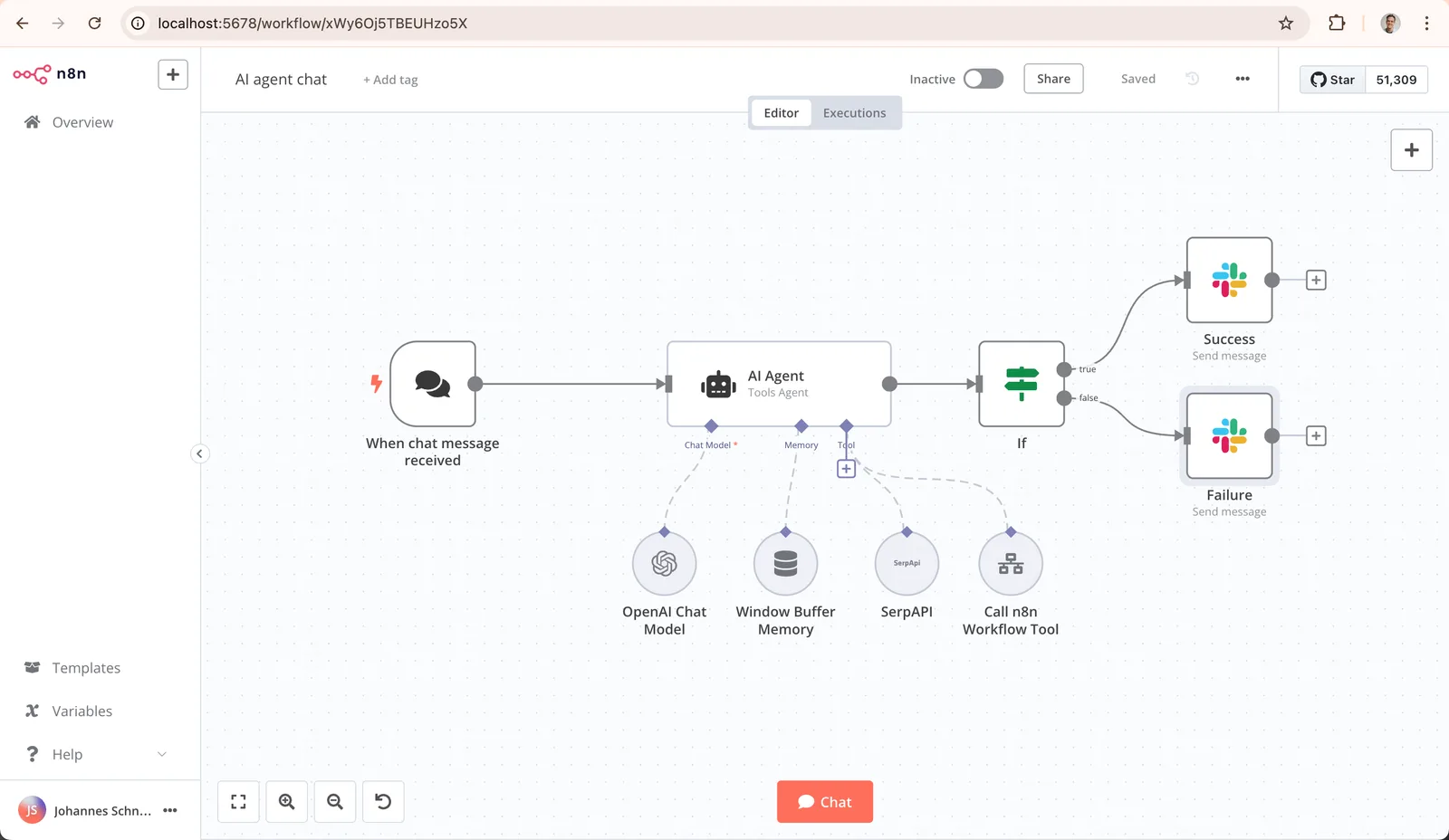
The agent decides WHAT, n8n executes HOW
LLM agents select actions (non-deterministic reasoning); n8n transforms them into reproducible steps: permitted actions, retries, idempotency, secrets, least-privilege—agents never blindly call production APIs.
AI Agent based on LangChain
The AI Agent node (Tools, ReAct, SQL, Conversational, and others) builds agent workflows with tools and memory directly on the canvas, without a separate framework.
17 LLM providers, including Anthropic Claude
OpenAI, Anthropic, Google Gemini/Vertex, Mistral, Bedrock, plus local models via Ollama — swap the model without rewriting the workflow.
RAG on 12 vector stores
Pinecone, Qdrant, PGVector, Weaviate, Redis, and more connect as nodes — search over enterprise data is built into the workflow.
AI as a process step, not a separate product
The LLM call sits between the trigger and the action in the system, so AI immediately affects a real operation instead of staying a demo.
Local models and privacy
With a self-hosted deployment, AI calls can be kept inside your perimeter (Ollama, local inference), so data does not go to an external provider.
News
What's new in n8n
-
AI Assistant on self-hosted simplified to a single command in 2.35
Previously, running AI Assistant self-hosted required manually enabling the instance-ai module and configuring the sandbox, model, and web search through environment variables. In 2.35, the module is enabled by default, installation takes one command, and the model provider (Anthropic, OpenAI, OpenRouter, or any OpenAI-compatible endpoint, including local ones), sandbox, and web search are configured directly in the UI.
n8n lets each instance choose its model, including a local OpenAI-compatible endpoint, without requiring the vendor's cloud; it does not provide centralized routing or quotas across multiple instances like a dedicated gateway. LLM Gateway → -
A security update fixed 9 vulnerabilities, including RCE via $fromAI and sandbox escape
Nine security advisories in one release: 6 High (including an Expression Sandbox Escape via a prototype leak in $fromAI leading to Host RCE — GHSA-9x83-43r8-5hwc; RCE in the Git node; credential leaks from Strapi, SeaTable, and Mailcheck nodes; SSRF and local file reads through Gmail/Brevo) and 3 Medium (including query injection in Elasticsearch/Firestore nodes). Fixed in v1.123.73, v2.35.4 (stable), and v2.36.2 (beta); Cloud was patched automatically, while self-hosted instances require manual updates.
The vulnerability is not in Elasticsearch itself, but in the n8n connector node for it (query injection): the risk lies in the integration layer, not the search engine. Elasticsearch → -
OpenTelemetry tracing for workflow and node execution
Each workflow run creates a root span with status, duration, and error, plus an optional child span for each node. Enabled with two env variables, exported to any OTLP collector (Jaeger, Tempo, Datadog, Honeycomb, Grafana Cloud) with no vendor lock-in.
Kafka currently has no native OTLP tracing on the broker side; it is usually instrumented through client libraries or Kafka Connect. n8n provides tracing out of the box with two environment variables. Apache Kafka → -
Managed connection to MCP servers without manual client setup
n8n 2.22.0: the agent connects to some external MCP servers (Apify, Linear, Notion, and others from the official MCP registry) by selecting them from the node panel and logging in, without manually creating an MCP Client node and credential.
Lowers the entry barrier to the MCP protocol to selecting a connector from a list, removing the manual client+credential setup that was previously required even for standard MCP servers MCP →
Blog
Articles about n8n
Projects
Cases



Discuss n8n: AI business process automation on your...
Related solutions
Articles on the topic
- Copilot Can Now Click: When Computer Use Beats an API
- Thirty Minutes of Silence: The Cost of a Cold AI Start
- ESB Systems for Integration Comparison: 2026 Overview
- How Kafka helps CIS companies earn more: fraud reduction, higher LTV, and more efficient logistics
- Apache Kafka and ESB in a Loosely Coupled Architecture: How to Reduce Costs, Guarantee Delivery, and Ensure Data Integrity in the IT Systems of Large Enterprises


