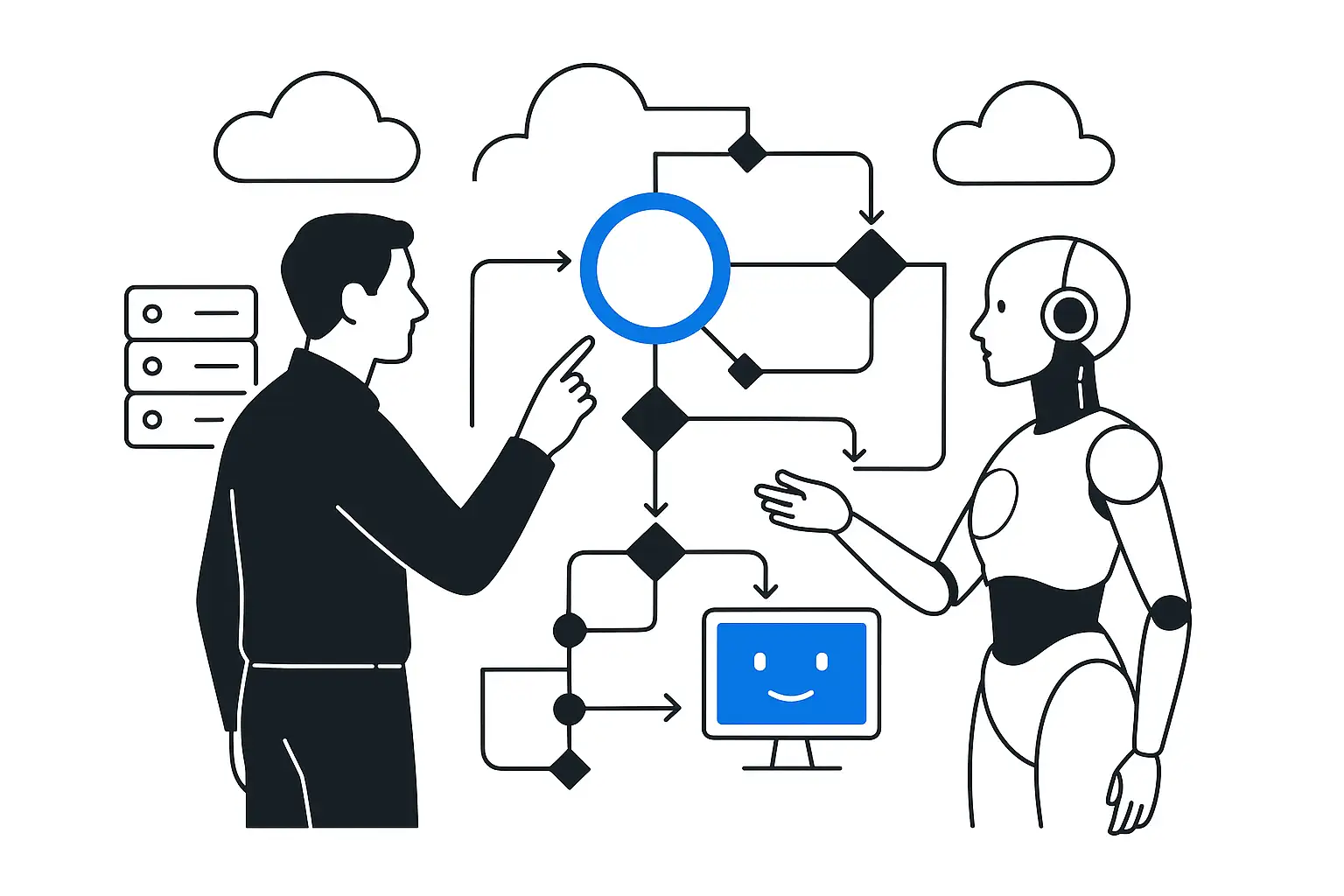
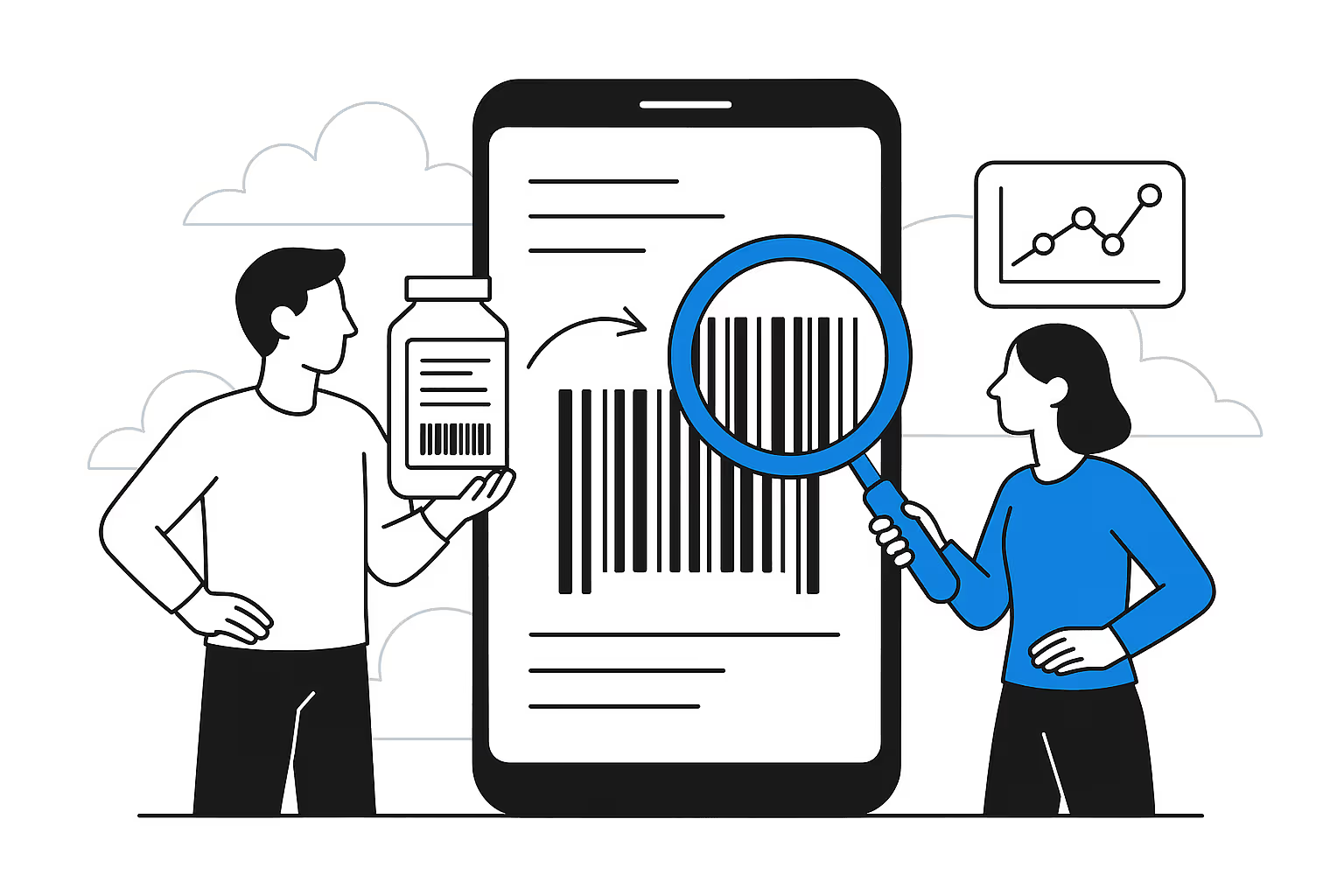
Real task
We take a report, Excel file, export, presentation, document, or recurring summary.

AI
We take one report, export, presentation, or recurring leadership task, build a working AI solution for it, and show how to use it without waiting for a large IT project.
Visual scribing
Page map: the leader brings a recurring report, export, or presentation; the KT.Team team builds the first AI lever, shows how it works in practice, and defines the boundary between self-service refinement and production rollout.
We take a report, Excel file, export, presentation, document, or recurring summary.
We build an AI scenario on real material, not on a training example.
We break down how the solution works and show how to use it and refine it further.
We define where a personal tool is enough and where integrations and enterprise implementation are needed.
Our clients










Many companies are already discussing AI, but for a leader the question is usually simpler: where in my work or my team’s work can we quickly remove manual routine and get a measurable effect? The agent sprint does not begin with a lecture on artificial intelligence. We take a specific process, artifact, or management task, review the source data, and build a solution that can be used in practice and further refined independently.
The format is suitable for CEOs, owners, e-commerce directors, commercial directors, operations directors, HR directors, and functional heads who spend a lot of time on recurring manual work in reporting, analysis, content, documents, or management summaries. The IT director and IT team are important here as partners in enterprise implementation. The first result can be achieved without a large IT project, but if the solution needs to be embedded into corporate systems, scaled, and supported, that becomes a separate workstream.
You can bring one specific artifact or recurring task into the sprint: a report, Excel file, export from 1C, CRM/BI report, document, presentation, template, correspondence, or recurring management summary. Suitable tasks are those with repetition, clear input materials, and manual work: gathering data, comparing metrics, highlighting deviations, preparing commentary, converting information into the required format, or assembling the basis of a management document.
Less manual routine in one recurring task — faster preparation of reports, summaries, presentations, and analytics.
Not a training exercise: the solution is built for a specific executive or team task.
What you can adjust independently, what input data is required, where the limitations are, and what the next step is to automate a role, process, or department.
Suited for an executive who wants a personal AI lever on a recurring task. Format: first meeting to select the task and source data, solution prep between sessions, second meeting to review, train, and define the next step.
Suited for teams of up to 8. Before the workshop we select the process, gather source data, and prepare a prototype. During the 4-hour workshop the team walks through the solution, understands how it works, and identifies what can be refined independently versus what requires a production rollout.
Before the sprint
After the sprint
Many useful AI scenarios can be tested with the company’s familiar tools: Excel, exports from 1C, CRM/BI reports, documents, presentations, email, and enterprise AI tools. If you start immediately with integrations, security, procedures, and production operations, the company may spend a lot of time before understanding the real value of the scenario. The sprint helps validate the idea on one task first, then design the next project more precisely.
The basic sprint includes analyzing one task or process, selecting the source data, preparing a solution or prototype, training on how to use it with a client example, and defining the next step. It is not the same as full-scale rollout into company processes. Integrations with enterprise systems, rules for the entire team, broader team training, solution support, and changes to an operational process at the department or company level are a separate follow-up project.
If the first AI lever proves valuable, the next step is comprehensive AI automation of a role, process, or department. Such a project may include integrations with 1C, CRM, BI, DWH, and corporate portals, operating procedures, quality control, team training, access rights, and support. The sprint is not devalued by this. It already delivers a useful result and reduces uncertainty: the company understands what exactly to automate, why the business needs it, and what conditions are required for production rollout.
Where to start
30 minutes
Bring one report, export, or recurring task, and in 30 minutes we will assess whether it can be turned into an agent sprint and discuss the format and scope of the result.
FAQ
Not exactly. The sprint includes training on how to use the solution, but the main focus is not theory or a tool overview. We take a real task from a leader or team and build a working AI scenario for it.
Not always for the first result. You can often start with familiar work artifacts: Excel, exports, reports, documents, and presentations. But if the solution needs to be deployed into company systems, with integrations, access setup, and support, the IT team becomes an essential partner.
Two basic formats: a personal sprint with two meetings and preparation in between, and a 4-hour process workshop for a team of up to 8 people. The exact timeline depends on the chosen task and the readiness of the source data.
The public page does not list prices. It is better to discuss cost after the task, format, and result boundaries have been chosen.
Cases