
Languages and development
Python: Custom Development, Data and AI
When no boxed solution exists and the tool's core cannot be modified, business logic is written as a separate service.
We don't touch the tool's core: business logic moves into adjacent Python microservices linked via API and queues.
Our clients
Clients and partners












57,9%of developers actively code in Python — 4th place worldwide and +7 pp year over year
#1in the TIOBE index with a ~23.9% share — more than C++ and Java combined
600k+ready-made PyPI packages instead of custom-built solutions — "read before you write"
15–20k RPSthroughput of an async FastAPI microservice on a single machine
Development
Development speeds up business process change
For e-commerce, B2B, microservices and Python, what matters is not the stack itself but the locality of change: a new channel, order, catalog or service launches without breaking the whole system.
e-commerce
Omnichannel, accurate channel analytics, reservations, PIM and marketplaces.
B2B
Self-service portal, personal prices, stock, limits, documents and reorders.
Microservices/Python
Services around the core that can be tested, shipped and scaled independently.
ordercatalogserviceintegrationsales channel
Industry solutions
What you can build with Python
E-commerce and retail
Pricing and recommendation microservice alongside Pimcore/PIM
Assortment management and storefront personalization without modifying the PIM coreLearn more →Manufacturing and distribution
Data pipelines and demand forecasting on historical data
Procurement and inventory planning based on predictive analyticsLearn more →Finance and Insurance
ML scoring and transaction anomaly detection service
Risk scoring and anti-fraud without touching the core systemLearn more →Logistics and transportation
Route optimization services and telemetry integration
Delivery planning and real-time fleet controlLearn more →B2B services and SaaS
LLM assistants and RAG search over the internal knowledge base
Customer support and employee onboarding through an AI assistantLearn more →Media and content
Pipelines for processing and automatic content labeling
Moderation, tagging and preparing content for publicationLearn more →Healthcare and pharma
Medical data ETL and ML analytics for research
Collecting and analyzing anonymized data for decision-makingLearn more →
Capabilities
Python capabilities
Tool core (Pimcore / ERP / CRM) — left untouchedPython business-logic microservice (FastAPI, async)Message bus / queue (REST, gRPC, Kafka/RabbitMQ)ETL/ELT data pipeline (Airflow, pandas/Polars)Analytics layer and data warehouseAI/ML inference service (PyTorch, LLM, RAG)Clients and external systemsCI/CD, tests, observability (DORA/SRE practices)
Custom microservices alongside the core
Logic missing from the box lives in a separate service — Pimcore, ERP and CRM stay on an upgradable base, without forking or patching the core.
API and integration layer
FastAPI/async serves 15,000–20,000 requests/s on a single machine — external systems and the frontend get data with no bottlenecks.
Data engineering and ETL/ELT
Pipelines on Airflow, pandas and Polars gather data from disparate sources into a single layer for analytics and reporting.
ML and AI services
Recommendation, forecasting and classification models are deployed as services and embedded into existing business processes.
LLM and RAG wrapper layer
Python is the native environment for LangChain, vector databases and agents: internal assistants and document search reach production faster.
Automation and processing scripts
Routine exports, syncs and data checks move into code — less manual work and fewer operator errors.
Transferability and handover to teams
The widest developer market and mature standards: the project moves between teams and contractors without rewrites.
DORA/SRE engineering practices
Tests, CI/CD, typing and observability deliver predictable releases and fast recovery during incidents.
Approach
How we implement Python
Without modifying the core
We do not fork or patch the Python core. Python remains on a standard, updateable version, while customizations are moved into separate modules or services. Before each update, we verify module and integration compatibility in a test environment.
International Standards, Not Homegrown Hacks
Where a mature international solution exists, we use it instead of inventing our own protocol or platform. Before writing code, we study how the problem is already solved in the industry.
Transferability
The solution is loosely coupled and documented: it can be handed over between teams and contractors without rewriting. You are not tied to us.
AI compatibility
Python in the AI stack
Native stack for AI and ML
Python is the de facto standard for ML and data science: 41% of Python developers use it for ML, and the PyTorch/scikit-learn/Transformers ecosystem covers the cycle from prototype to production.
LLM agents and RAG out of the box
LangChain, LlamaIndex, Claude/OpenAI clients and vector databases are first-class Python libraries. Assistants and search over corporate data are built on mature components
AI-friendly codebase
Python leads in model training data and in AI-assisted development coverage, making code generation, review, and refactoring more accurate and speeding up delivery.
Serving models alongside business logic
FastAPI inference endpoints are deployed as separate microservices and embedded into existing processes without touching the ERP/CRM core.
News
What's New in Python
-
Python 3.14.7 and 3.13.15: scheduled releases
Routine maintenance releases: 3.14.7 includes about 499 bug fixes from 86 contributors, and 3.13.15 includes about 400 bug fixes. A regular support cycle with no announced critical security fixes.
-
Python 3.15.0rc1: release candidate, feature freeze
The first release candidate of 3.15 is out, with the final release planned for 2026-10-01. Confirmed features include lazy imports (PEP 810), built-in frozendict (PEP 814), a Sentinel type (PEP 661), unpacking in comprehensions (PEP 798), and a new sampling profiler (PEP 799); JIT has added about 8-9% performance on x86-64 Linux.
-
Python 3.14.0: release
Free-threading (a build without the GIL) is officially supported, per PEP 779, and the penalty for single-threaded code has been reduced to about 5-10%. The JIT compiler remains experimental (PYTHON_JIT=1). The new t-strings syntax (PEP 750) provides template strings with deferred interpolation for safe SQL/HTML construction.
.NET has always had full multithreading without a GIL, while Python only removed the limitation in 3.14, and even then optionally C# / .NET →Node.js remains single-threaded by design (event loop), so comparing architectures matters when choosing a runtime for CPU-bound workloads JavaScript / Node.js →
Projects
Cases
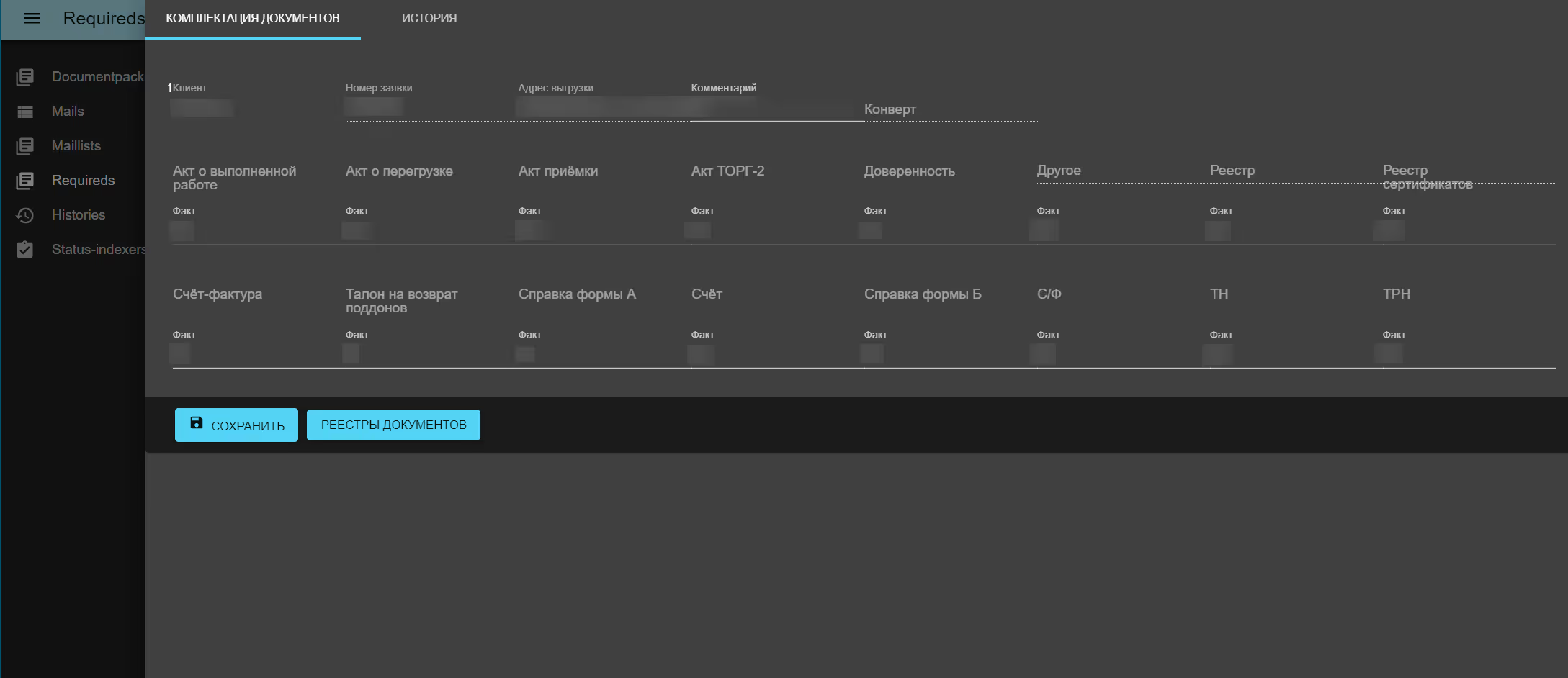
Automated document package validation
- Built a system in Python
Python platform for a hackathon with 10,000+ participants
- Built an international hackathon platform on Python and Django