











Simple is not easy

Solutions

Integrations for data exchange between IT systems

We design data exchange between systems using ESB, ETL, and DWH so integrations are manageable and scalable.

Integrations: enterprise solution

Clients and partners

Integrations

Change one system without rewriting the rest

The integrations block must explain four ailments of rigid exchange: data loss, a cascade of rework, source overload and inconsistency. ESB, Kafka and n8n serve different tasks, not one hammer.

50flows in 6 months — a speed benchmark for an ESB project
48flows in production with a target loosely coupled architecture
16xfaster launch of standard integrations compared to code

ESB

Routing, transformation, guaranteed delivery and low-code support of legacy exchanges.

Kafka

Durable log: an event is stored, re-read, multiple consumers read at their own pace.

n8n

Fast orchestration of a process and AI steps where heavy event streaming isn't needed.

sourcedata contractESB/Kafka/n8nmonitoringconsumers

Integrations for data exchange between IT systems Using the ESB approach and a Data Lake, we reduce system load, prevent data loss during exchange, simplify changes to IT systems, and speed up analysis of all data. Discuss the task Download the presentation You will also receive a comparison table of integration types

Prevent data loss during exchange between systems

The Problem

In point-to-point exchange, when one system fails, data may be lost: one system considers the message delivered when the other has not received it.

Solution

We configure integrations so that if the connection drops, the message is treated as unprocessed and will be sent on the next pass.

Change one IT system without changing the others

The Problem

In the old approach, the source delivers data as is. The consumer must transform it into its own format. With this setup, any change in the source will trigger a cascade of changes in all related data flows.

Solution

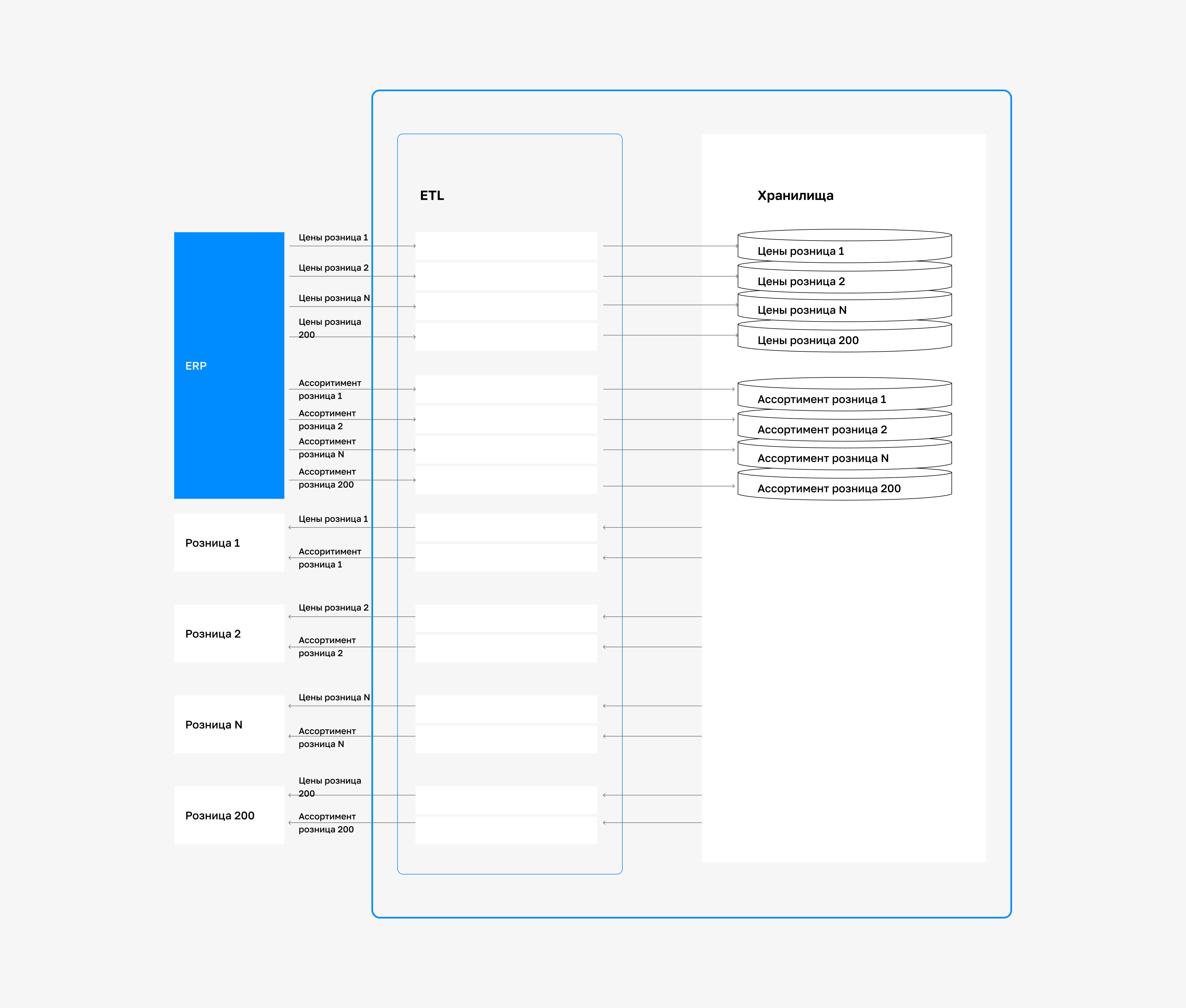
Changing the ERP or any other system will not require modifications to all connected systems. If a system changes, only the source-to-storage connectors will be affected. For all consumers, everything will remain unchanged.

Reduce load on systems without changes or added resources

The Problem

The same data is needed by different systems. Consumers duplicate requests to the source system, which increases the load. If a company has one system for storing master data, it will receive a huge number of requests. Often this is an old monolithic system that the business wants to replace in the future.

Solution

Consumers query the storage. The load on the main source decreases without changes to the source system itself or additional resources. When it is time to replace the old system with several new services, the source-to-storage flows will need to be changed. The changes will not affect the many consumers.

API as a separate service. Connect similar consumers without added load

The Problem

To connect many similar consumers, such as retail outlets, an API is often created inside the system. In this case, the load created by the consumers falls on that system. If the source system becomes unavailable, it becomes a problem for all consumers. They will not be able to retrieve data.

Solution

We build API connectors as a separate service, not inside the application. They operate independently of the source system and handle high loads. You will be able to support systems reliably for many consumers.

We demonstrate with 1C systems: any transformation logic is possible

Transferring data of type "reference" To transfer an object of type "reference", you need to make sure that all reference data has been created in the consuming system. Otherwise, the object will be created incorrectly or the stream will return an error. Our connectors check whether the system contract is met (completeness, correctness). Only when all conditions are satisfied will the message be sent to the consumer. Building an object from multiple tables Information about an object may be stored in multiple sources.

It is necessary to request information from each source and combine it for transmission. Our solution makes it possible to aggregate object data. For example, collect "orders" and "payments" separately (from different sources) and send them as "orders with payments". Deleting a record from an object's tabular section Such a record is not registered for 1C exchange. The receiving system must know this 1C behavior and calculate changes on its own. Our connectors can check for deletion from the tabular section. If a deletion occurred, they mark it in the storage.

Consumers do not need to perform calculations.

Current price snapshot

1C does not provide a snapshot of current prices. The consumer must determine for itself which price from the full register, past, current, or future, is the current one. Using the storage, we calculate current prices so that any consuming system can retrieve them without extra logic.

With a ready-made data warehouse, BI implementation is easy

By implementing ESB, we create a shared structured enterprise data repository: a Data Warehouse (DWH). Any analytics or reporting system can be easily connected to this repository. All the data is already prepared. We design the repository architecture so that generating reports from large volumes of information does not reduce the speed of daily data exchange.

The monitoring system tracks every flow

  1. We log the key stages of each flow.

  2. If an error occurs that requires action, you will receive a message in Telegram. It will include the error description and a link to the details.

  3. You will be able to respond to incidents proactively, rather than waiting for user reports.

  4. The support operator will know exactly where and what went off script.

  5. This will help resolve the incident faster.

  6. We will deploy a monitoring system from scratch.

  7. Or we can set up monitoring in your infrastructure.

The data bus (ESB) is a set of microservices, not a monolith

  1. With our approach, the architecture has no single point of failure.

  2. The data bus (ESB) is a set of microservices that are not connected to one another.

  3. ESB components do not depend on one another and can run on different servers in different locations.

  4. A failure in the exchange of any system affects only that system.

  5. Change one IT system without changing the others

  6. Build APIs as a separate service

  7. Transform data (using 1C as an example)

  8. Control flows with monitoring

  9. Be confident in fault tolerance

Get a 100% result without risk

We are confident in our approach. Tell us about the problem that needs to be solved. In the documents, we will specify the result you will get, the cost, and the timeline (usually 1-2 months). If, after implementation, you are not satisfied with the result, you do not have to sign the acceptance document or pay for the work. Discuss the problem Building loosely coupled IT system architecture

Trusted by

1 / 22

Integrating Talend ESB into the IT infrastructure of a logistics company

Learn more

Redesigned the IT architecture and created a transformation roadmap

Learn more

KT.Team FSK Group

Vadim Mizhensky, Head of Digital Product Development

KT.Team Maxxium

We have been working with kt.team for more than a year, and during that time we have come a long way, from a quick launch of a small website to a showcase catalog and several integrations. The team responded promptly to our requests and changes to the requirements, and together we tested several hypotheses and chose the most effective ones. Our project cannot be called highly loaded; unlike other projects kt.team works on, our catalog is not large.

But we needed to focus on a specific audience with high expectations, and we are constrained by legislation and the specifics of our industry. All of this did not prevent us from working together to create a project with a modern design and functionality that is convenient for both users and Maxxium employees. Andrey Ivanov, Head of Digital Transformation

KT.Team La Nature

Our online store urgently needed renovation and a fresh start. We chose kt.team in a competition on one of the tender platforms. You won us over with your forward-thinking approach and, above all, your bold use of the most advanced web development stacks. I would also like to note the professionalism of the design team: without unnecessary questions or discussion, they immediately captured our mood and vision for the result. The outcome is a very refined, concise, and beautiful design. Great job, keep it up! Denis Fedyunin, CIO

KT.Team St Gobain

You are professionals. At our first meeting, I told you about the project idea, and you helped refine and transform it into something special. Vladimir Belyaev, Head of Sales Development

KT.Team Tvoe

To launch the project on time, the team literally lived in our office. The project was launched on time. Keep up the good work! Maxim Sakib, Chief Operating Officer

KT.Team SQ 2

Before KT, there was another contractor, a large well-known integrator, and every change was expensive and painful. We were even thinking about abandoning Magento altogether! kt.team took on a huge amount of work. Great team! Sergey Gorbunov, Chain Sales Director

KT.Team SQ 1

After several years of joint, productive work, I would like to thank my colleagues at KT.Team. Together, we have come a long way, solved thousands of tasks, survived three Black Fridays, and developed and successfully launched several major projects estimated at more than 2,000 person-hours. Both I and the company management are satisfied with our collaboration. I believe in further fruitful cooperation. I wish KT.Team prosperity and professional growth to everyone at KT.Team. Roman Radovich, Head of Internet Projects

KT.Team Norgau

Norgau Russland LLC, development of the first B2B site in the country on Magento 2. A large volume of technical and design work was completed. The quality is very high. Dubovsky Alexey, IT Director

KT.Team Muztorg

The Muztorg Group of Companies has been successfully working with the KT.Team for more than two years. In our projects, we greatly value our partners' high professionalism and their ability to combine clear project organization with minimal formal constraints. I would also like to highlight the friendliness and openness of the KT.Team team. I would like to express my gratitude for the productive cooperation. Dmitry Savelyev, Board Advisor for Digital Development

Sablukov workbook

Ilya Sablukov, Project Manager

Servetnikov workbook

Sergey Servetnikov IT Architect

KT.Team Brandly

On behalf of Inventive Retail Group, I would like to express our deep gratitude to the KT.Team for fruitful cooperation in delivering a new ambitious project. We would like to note the high level of involvement at every stage of implementation, as well as the professionalism and personal qualities of all employees involved in the project. Andrey Borisovich Mistulov, Director of Web Development and Project Management

KT.Team Transatlantic

KT.Team delivered a PIM implementation project for TRANSATLANTIC INTERNATIONAL. Although the project was short, the project manager regularly organized status review meetings, showed progress, and shared plans for the next sprint. Progress on the project was transparent and clear for our team, and we had the opportunity to adjust the plan. The project manager's requests made it possible to adapt the PIM system to our needs. Maksim Sergeev E-Commerce Product Value Manager

KT.Team FML

We came to KT.Team with a request to set up a platform to easily connect clients, carriers and WMS in FM Logistic France. The result was successively achieved. The work on project went well, and by now we have onboarded on a new platform a big client — it’s great result! I’d like to especially note very good reactivity and professionalism of the project managers, devs and ops who always help us. We look forward to working with your team on our new projects!

Eric Duboille Directeur Expertise E-Commerce, FM France SAS

Shilov workbook

It looks great and draws attention. People who know the field ask questions, and conversations follow that ultimately lead to discussing the tasks at hand and solving them. It is convenient to take notes and track thoughts. Interesting, useful quotes make it possible to step back and sometimes lower the level of seriousness. Maxim Shilov, IT Team Lead

Helped reduce load and scale system throughput

"For some systems, we physically would not have been able to handle the load that grew over the current year if we had stayed on the old technologies. We achieved results in a key and critical metric for us: we managed to scale throughput without scaling the sources and receivers." Andrey Kurilyuk, Deputy IT Director

Implemented a scalable service bus for Atimo

Learn more

Enabled Polaris to easily launch new products on marketplaces

Learn more

Automated product data handling for the Fix Price chain

Learn more

Developed the target system integration scheme. Implemented ESB technology and launched 48 flows

Learn more We will select proven international open-source products. We use open-source solutions, so our clients reduce license costs without the risk of restrictions from the laws of different countries. Graphic studio for creating connectors A simple and flexible low-code platform that is part of Salesforce, with annual revenue of more than $30 million. We use the Community Edition version.

Version control and access rights configuration (roles) An open-source DevOps lifecycle web tool. More than 30 million registered users. Database (storage) A powerful open-source object-relational database system that has been under active development for more than 35 years. Log storage, analysis, and search Enterprise security, observability, and search solutions built on the Elasticsearch platform used by thousands of companies.

Dashboards with flow status information A visualization and analytics system that lets you work out of the box with a wide range of data sources. 1 2 2 /

If you have preferences, we can use other products as well, including those with a paid license.

Database MongoDB Hadoop Arenadata PostgreSQL Message broker ActiveMQ RabbitMQ Kafka ETL (extract, transform, load) Ballerina Nifi Datareon WSO2 MuleSoft Talend BI (analytics system) Yandex Datalens Redash Google Data Studio Microsoft Power BI

A typical workflow

We have structured the implementation process so that you get the maximum benefit. You can go through the entire journey with us. Or you can order any of the steps separately and hand the rest over to your team.

1. Designing a loosely coupled architecture

We will analyze the current IT architecture, AS-IS; work through exchanges for key entities; design the TO-BE architecture; prepare a roadmap for transitioning to the new architecture; prepare recommendations on tools; and prepare documentation. You will receive

A transition plan tailored to your business specifics

2. Migrate your most critical flows

BPMN flow diagrams; deployment and configuration of the required components (ETL, storage, logging, monitoring); connector setup; log collection and integration monitoring setup; documentation and training. You will get

Solving 80% of data exchange problems between systems

3. Migrating the remaining flows to populate the data warehouse

BPMN flow diagrams; connector setup; log collection and integration monitoring setup; documentation and training. You will get

A single enterprise-wide exchange mechanism and complete data for analytics

Get the integration type comparison table

We assessed how three popular integration types affect IT environment quality. The result is presented in a compact comparison table. Submit a request and get the file for free. Submit request

idea
idea
Integrations: enterprise solution
Integrations for data exchange between IT systems Using the ESB approach and a Data Lake, we reduce system load, prevent data loss during exchange, simplify changes to IT systems, and speed up analysis of all data.
Integrations: enterprise solution
Problem In point-to-point exchange, when one system fails, data may be lost: one system considers the message delivered when the other has not received it.
Integrations: enterprise solution
Solution We configure integrations so that if the connection drops, the message is treated as unprocessed and will be sent on the next pass.
Integrations: enterprise solution
Problem In the old approach, the source delivers data as is. The consumer must transform it into its own format. With this setup, any change in the source will trigger a cascade of changes in all related data flows.
Integrations: enterprise solution
Solution Changing the ERP or any other system will not require changes to all related systems. If the system changes, only the source-to-storage connectors will be affected. For all consumers, everything will remain unchanged.
Integrations: enterprise solution
Problem The same data is needed by different systems. Consumers duplicate requests to the source system, which increases the load. If a company has one system for storing master data, it will receive a huge number of requests. Often this is an old monolithic system that the business wants to replace in the future.
Integrations: enterprise solution
Solution Consumers access the storage layer. The load on the main source is reduced without changes to the system itself or additional resources. When it is time to replace the legacy system with several new services, you only need to change the source-to-storage flows. The changes will not affect many consumers.
Integrations: enterprise solution
Problem To connect many similar consumers (for example, retail outlets), an API is often created inside the system. In this case, the load created by consumers falls on that system. If the source system becomes unavailable, it becomes a problem for all consumers. They will not be able to get the data.
Integrations: enterprise solution
Solution We build API connectors as a separate service, not inside the application. They operate independently of the source system and handle high load. You can support systems without issues for many consumers.
Integrations: enterprise solution
By implementing ESB, we create a shared structured enterprise data repository: a Data Warehouse (DWH). Any analytics or reporting system can be easily connected to this repository. All the data is already prepared. We design the repository architecture so that generating reports from large volumes of information does not reduce the speed of daily data exchange.
Integrations: enterprise solution
We log the key stages of each flow. If an error occurs that requires action, you will receive a message in Telegram. It will include the error description and a link to the details. You will be able to respond to incidents proactively, rather than waiting for user reports. The support operator will know exactly where and what went off script. This will help resolve the incident faster. We will deploy the monitoring system from scratch. Or we can set up monitoring in your infrastructure.
Integrations: enterprise solution
With our approach, the architecture has no single point of failure. A data bus (ESB) is a set of microservices that are not connected to each other. ESB components do not depend on one another and can run on different servers in different locations. A failure in the exchange of any system affects only that system. Everything else continues to work.

Contacts

Let's Discuss Your Project

Leave your current contact details and describe your task. We will come back with clarifying questions and a proposal for the next step.