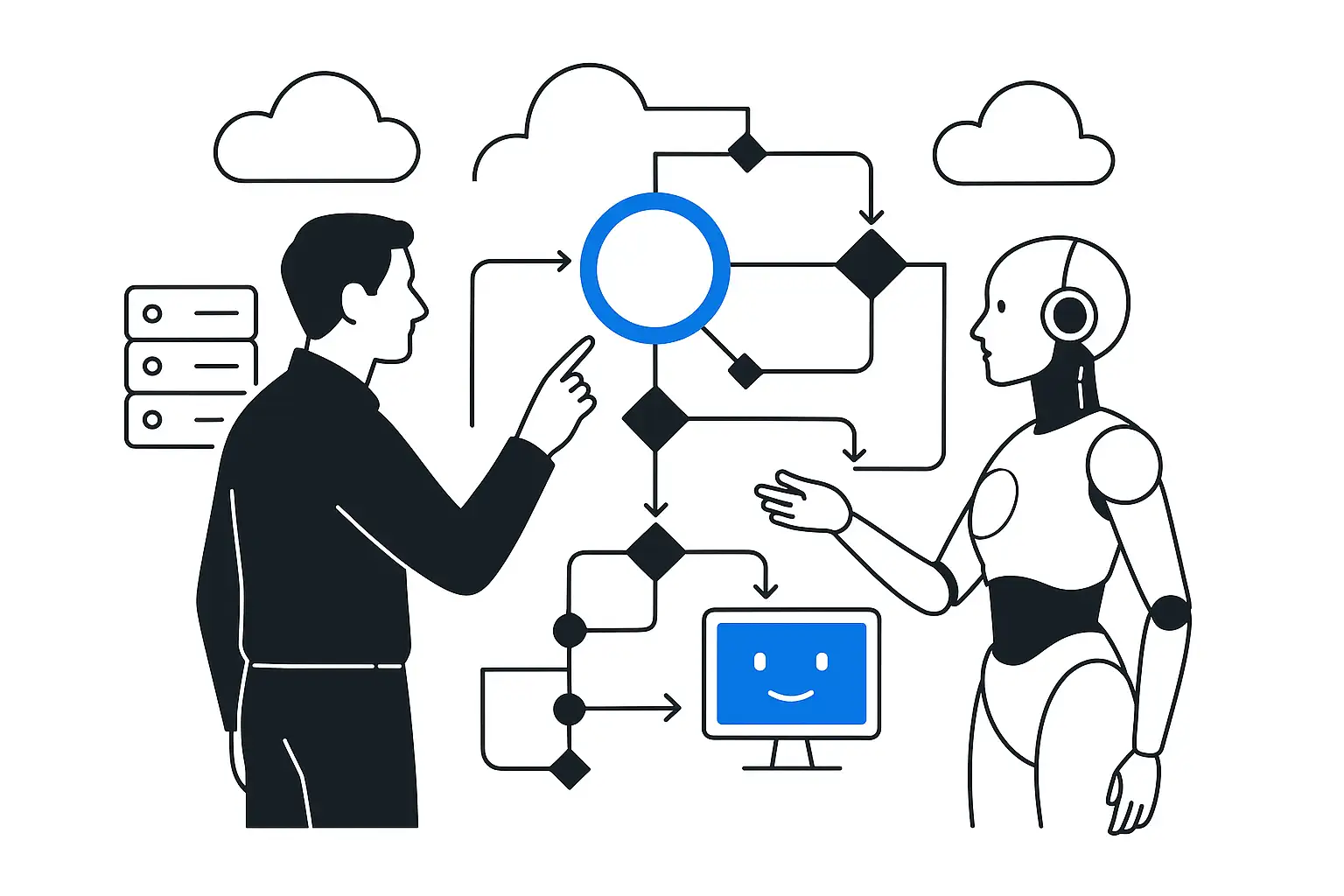
Creates estimates
Analyzes requirements, bill of quantities and specifications, forms the estimate structure, suggests rates, resources and volumes. Passes disputed line items to the estimator with sources.

AI cost estimator creates estimates, selects materials and alternatives, prepares orders, tracks usage, and syncs approved data to 1C/ERP via API.
Our clients














An estimator's work breaks down into four steps: gather volumes into a schedule, match each line item with a rate from the standard database, compile the draft estimate, and check it before release. The first three steps involve reviewing and verifying large datasets, which is exactly what the AI Estimator automates: it reads specifications and technical requirements, suggests rates with justifications, and assembles the document structure.
The fourth step is not delegated. One work item can have multiple correct rates depending on technology, production conditions and customer requirements. Choosing between them, applying coefficients and expert accountability remain with the engineer: the agent provides a draft with source references, not a finished document.
Working scenarios
The estimator posts a task in Telegram, receives a verifiable result, and opens it in their familiar system. Here are illustrated scenarios for creating and verifying estimates in GRAND-Smeta, Smeta.RU and 1C:Smeta.
 01
01
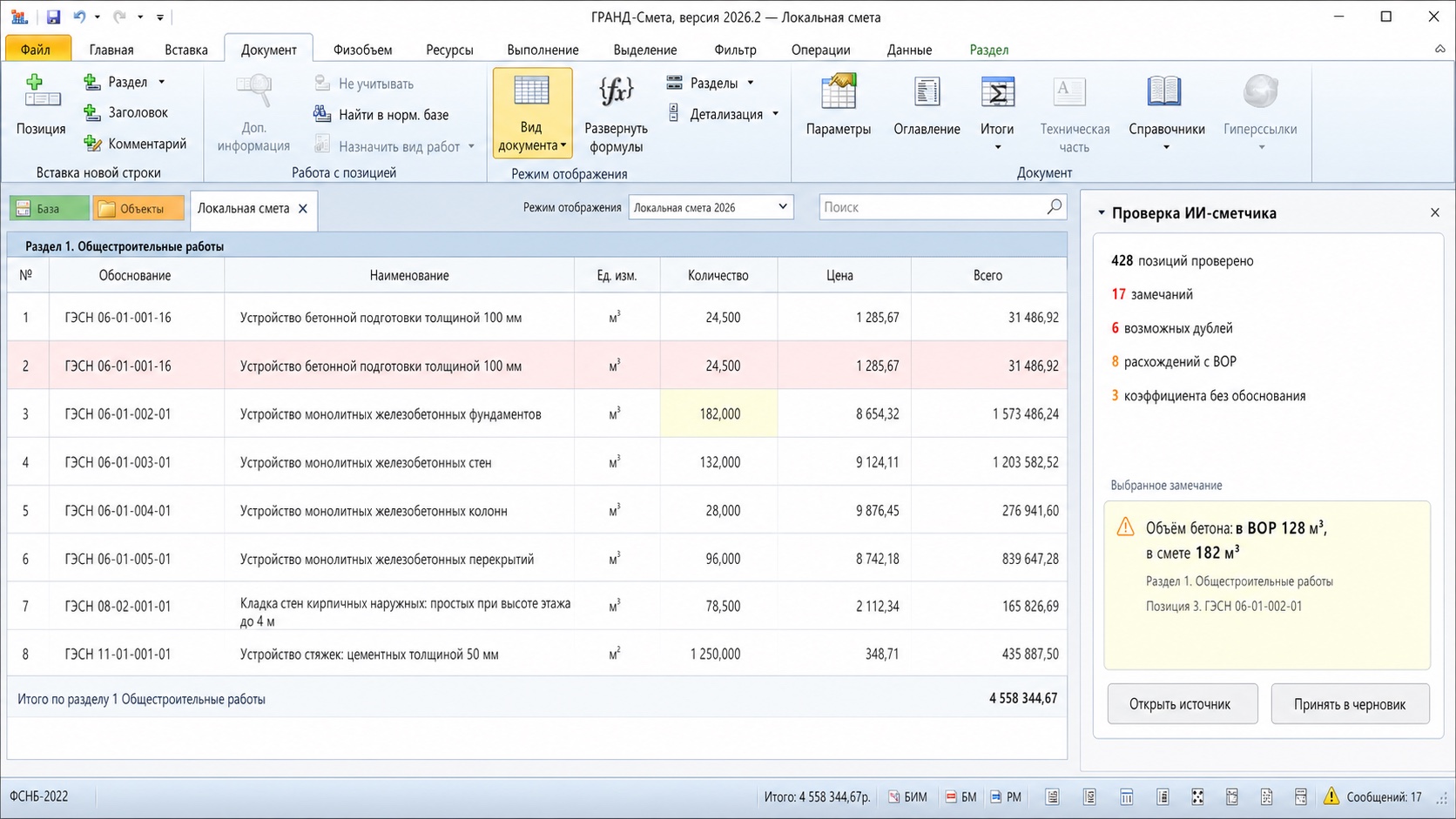
AI Estimator checks 428 line items and identifies duplicates, BOQ discrepancies, and unsupported coefficients.
 02
02
Illustrative integration scenario: agent highlights duplicates and volume discrepancies alongside the local estimate
 03
03
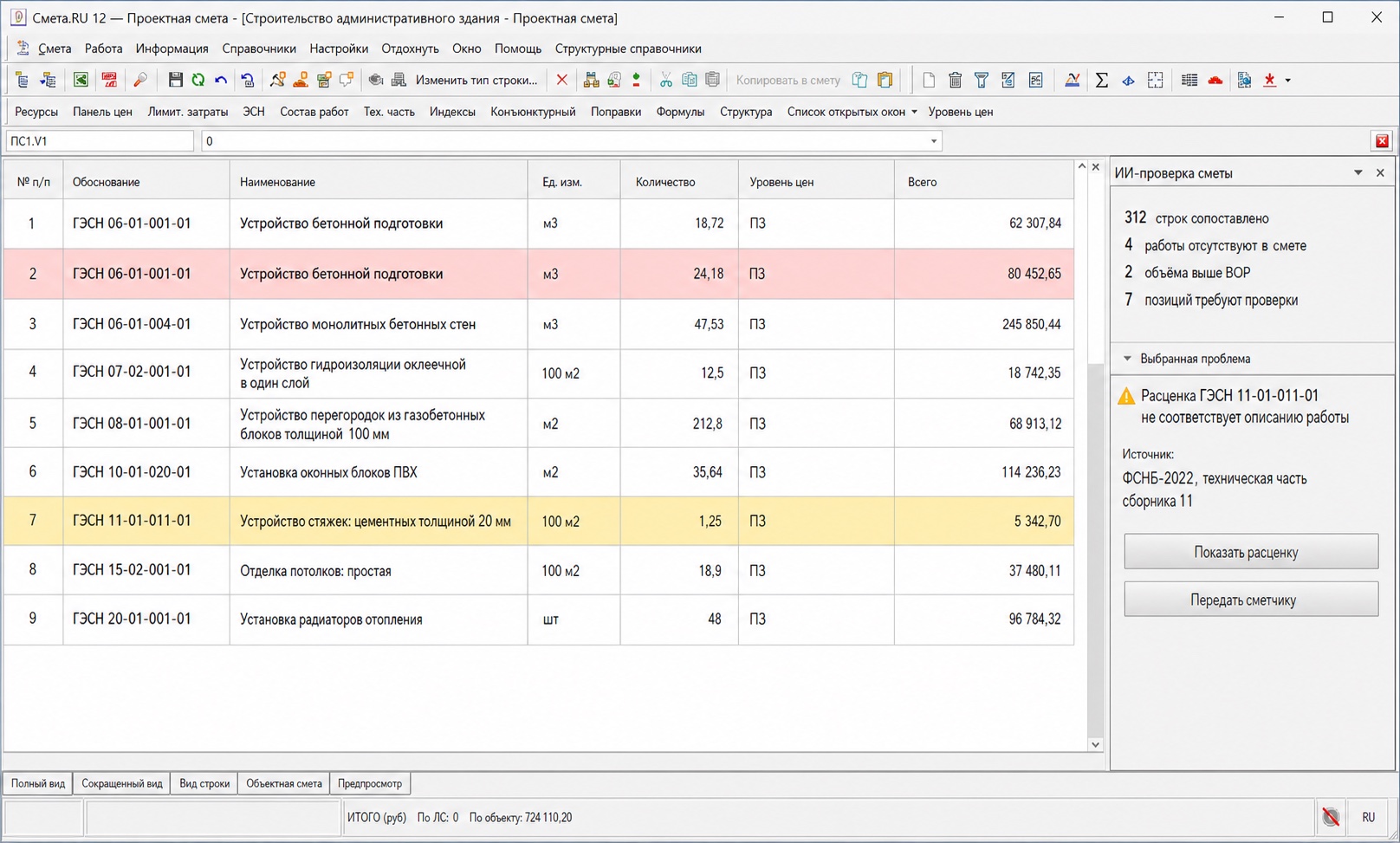
The agent matches bill of works and estimate lines, highlights missing work items, volume overages, and ambiguous positions.
 04
04
Illustrative integration scenario: agent shows problematic rate, FSN-2022 source, and passes line item to estimator
 05
05
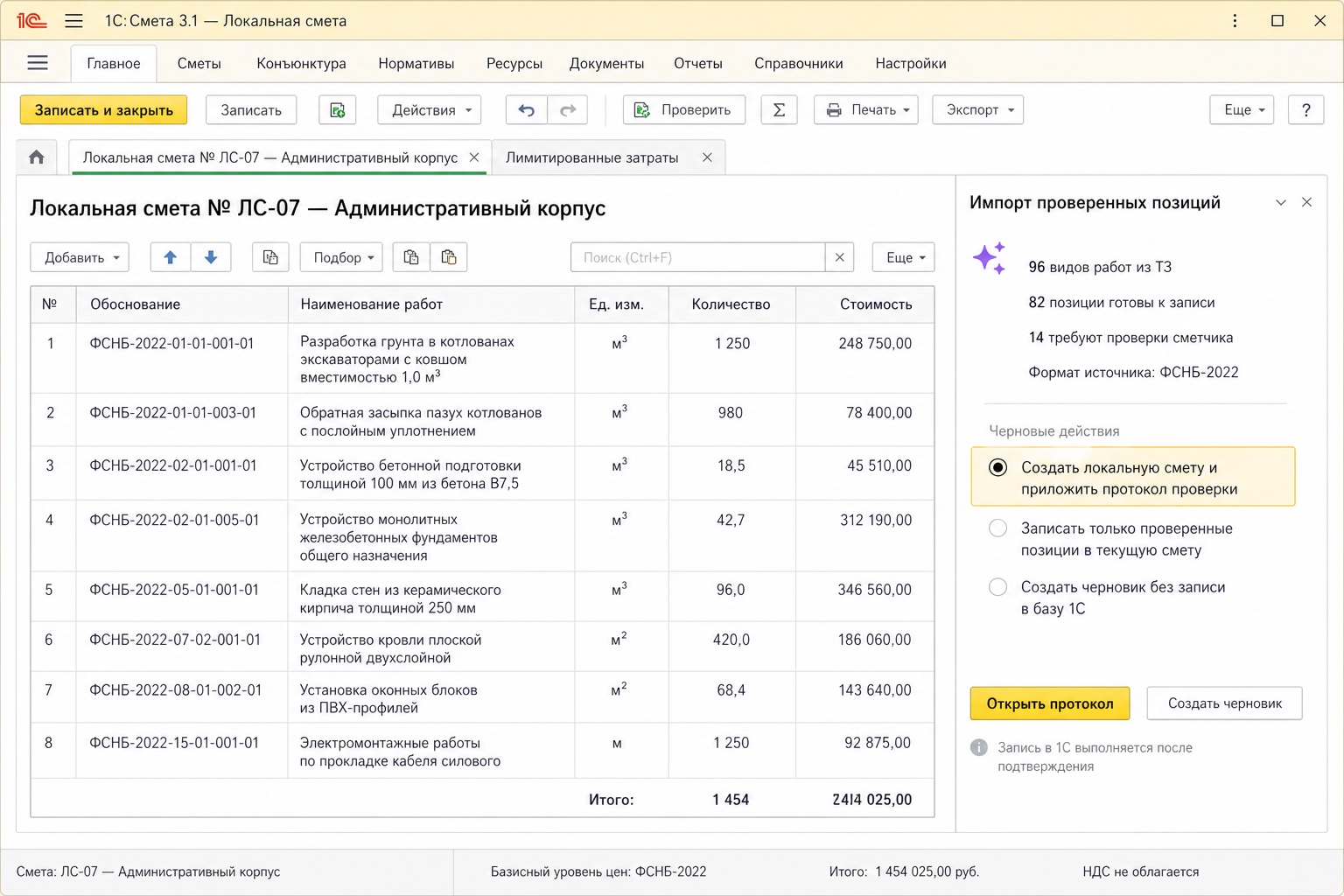
The agent parses work types, selects FSNB-2022 line items, and prepares an export for the estimator's review.
 06
06
Illustrative integration scenario: verified line items ready for recording, disputed items remain with estimator, action requires confirmation
The agent uses documents and system data as tools within one process. Each operation records the source, status, and confirmation owner.
Analyzes requirements, bill of quantities and specifications, forms the estimate structure, suggests rates, resources and volumes. Passes disputed line items to the estimator with sources.
Compares project requirements, certifications, price, availability and delivery timeline. For substitutions, shows impact on estimate and need for designer approval.
Verifies budget balance and supplier quotes, can split urgent needs among suppliers, prepare requisitions, and track delivery status.
Links estimate volumes, orders, digital documents, site receipts, reports and work logs. Routes discrepancies to the foreman or procurement for confirmation.
Transmits confirmed data to 1C, ERP, WMS, and BI without re-entry. Records preserve source, user, timestamp, and operation result.
Connects via REST, SOAP, OData, GraphQL APIs, webhooks, SDKs, file exchange, or managed connectors. Available actions depend on permissions and contract.
Materials and accounting
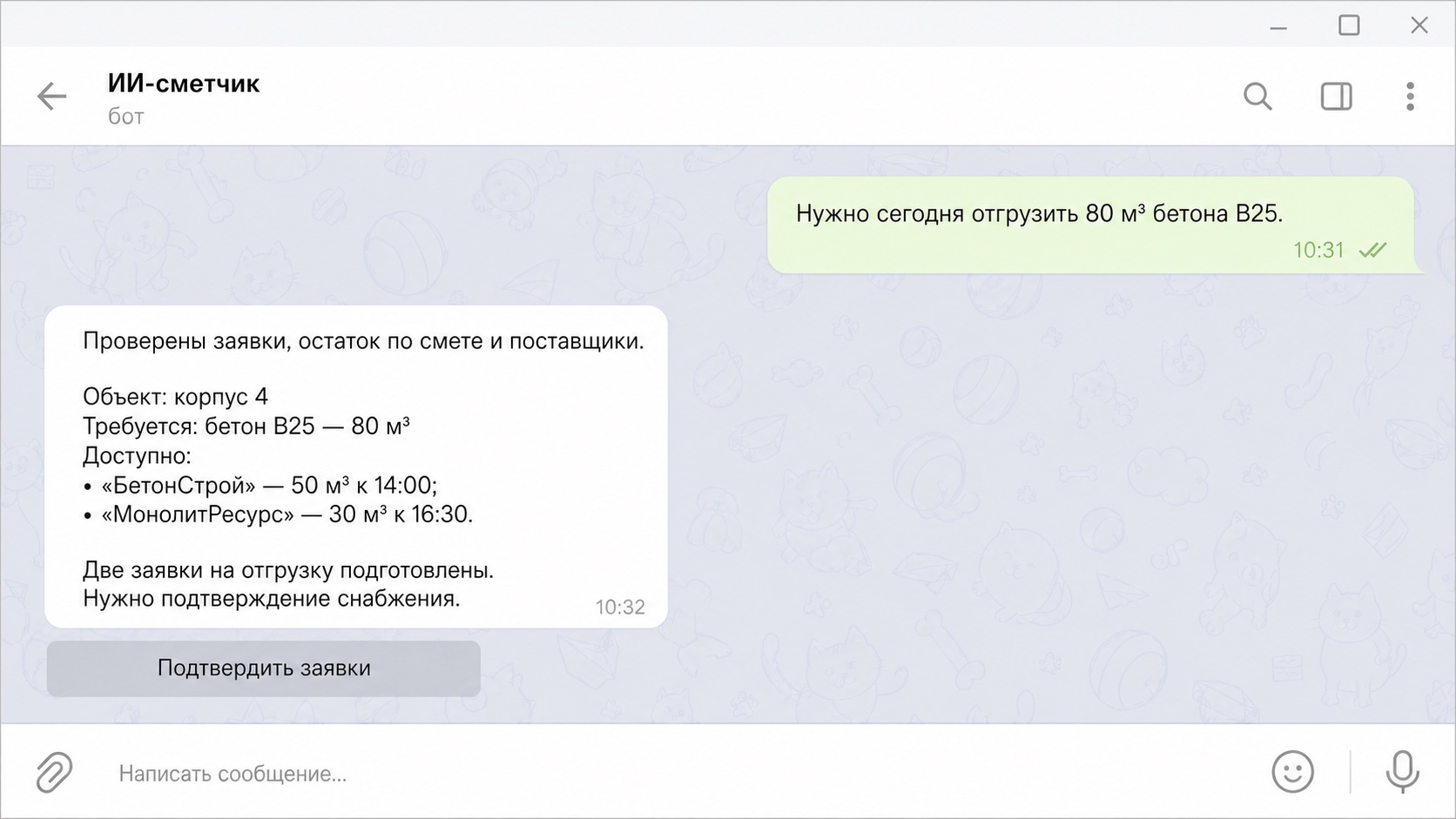
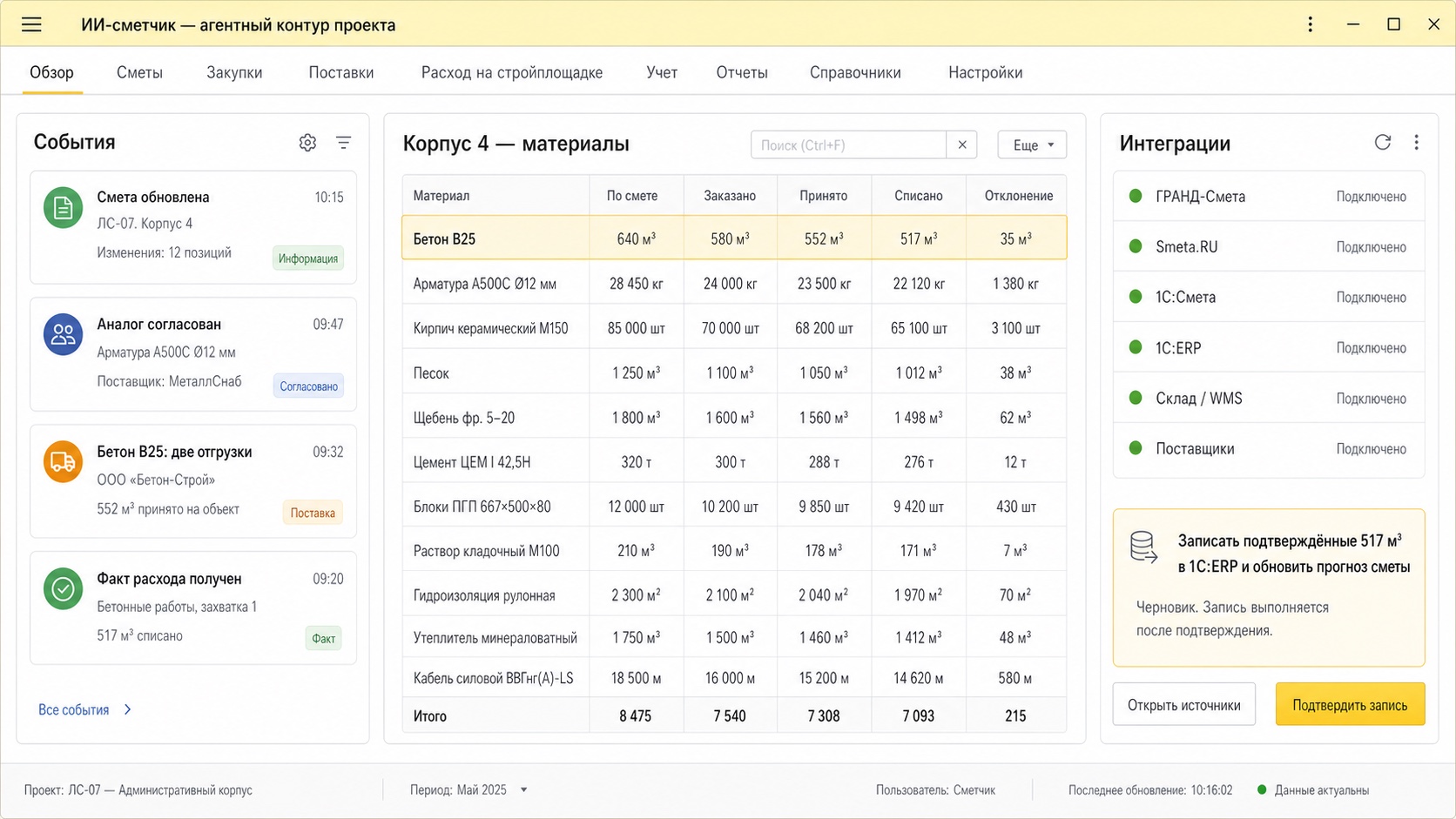
Illustrative sequence shows agent workflow: select alternatives, prepare urgent shipment of 80 m³ B25 concrete, identify consumption discrepancy, and record verified fact in 1C:ERP.
 01
01
The agent compares design specifications, price, lead times, certificates, and the impact of substitution on the estimate.
 02
02
The agent checks estimate stock levels and suppliers, splits the requirement into two requisitions, and passes them to procurement for approval.
 03
03
The agent reconciles the estimate, order, receipt, and write-off, then sends discrepancies to the foreman for confirmation.
 04
04
A single interface links the estimate, alternatives, shipments, spending, and verified record in 1C:ERP via connected systems.
AI Estimator can start with source documents and create a verifiable estimate draft: break down work types, match line items with GESNR, FER, TSN, FSN-2022, or corporate databases, select resources, and preserve references to justifications. When verifying the completed estimate, it identifies duplicates, volume discrepancies, unsupported coefficients, and items requiring technical decisions.
The agent continues the workflow in procurement and on site. For example, for the request "need to ship 80 m³ of B25 concrete today"
It verifies budget balance, checks supplier availability, prepares multiple requisitions if needed, and awaits approval from the responsible party.
After delivery, reconciles order, UPD, receipt, and documentation.
Confirmed consumption is recorded immediately after the event, reducing manual assumptions and delayed corrections in reports.
The specific integration method depends on available machine interfaces and permissions: API, webhook, SDK, file exchange, or managed connector.
The agent can read data and perform authorized operations across systems while maintaining an action log and source for each result.
Model/specification → BOQ → rates → draft → verification
Source data
Quantities
Rates
Draft
Check
Draft quality depends not on the AI model but on data connectivity: BOQ should rebuild when the project changes, estimate line items should reference volumes, and contracts and actuals should reference estimate items.
If volumes live in separate spreadsheets and are manually transferred, the agent will receive an outdated schedule and honestly compile a draft from stale data.
That's why the pilot starts with data flow verification.
How the bill is assembled from the model or specification and reaches the estimate — breakdown work quantity statement; how to link the estimate, purchases, and KS-2 with the accounting workflow - in integrating TIM/BIM with 1C.
Volumes calculated from model Larix and Tangl - we don't implement these products, we integrate their data into the estimate.
TIM requirement mandates this approach for government contracts — see article for details "TIM is mandatory: what does it mean".
Site actuals returned to the system Receipt and execution documentation, and what software covers each construction layer - in CIS construction software overview.
| System / layer | Scope of responsibility |
|---|---|
| Project and estimating systems | Requirements, bill of quantities, specifications, BIM data, GESN, FER, TSN, FSNB-2022 and corporate reference databases for estimate creation and verification. |
| Procurement and suppliers | Remaining needs, prices, alternatives, availability, requisitions, orders, and shipment statuses via available system interfaces. |
| Construction site and warehouse | Receipt, UPD, movement, write-off, documents, and work log for operational control of actual consumption. |
| AI Estimator and tools | Estimate creation and verification, material selection, operation preparation, plan-to-actual reconciliation, and API calls within granted permissions. |
| 1C, ERP, WMS, and BI | Storage of confirmed data, accounting documents, plan-actual reports, demand forecasts and change history. |
| Responsible employees | Estimator approves the estimate, designer approves material substitution, supply manager approves order and shipment, foreman approves actual consumption. |
Define one estimate section or work type: volume sources, regulatory bases, reference data, roles, accounting systems, available APIs and acceptance criteria.
1-2 weeks: the assistant collects and verifies the estimate for a selected section on a completed project with known verified results.
We compare calculations, selections, prepared operations and recorded actuals against employee decisions; the process is accepted only when employees actually use it.
We add materials, objects, suppliers, and systems using the same model: one verified process per iteration.
Cases
FAQ
No. The agent prepares a verifiable estimate draft and performs permitted operations, leaving methodology, disputed items, and document approval to the engineer. Responsibility to expert review is not transferred.
We don't promise accuracy percentages until the pilot: the working framework is 'draft + verification.' In the pilot, the agent works on a completed estimate with a known result, and you compare its draft with the verified estimate — this is the only honest measurement.
Bill of works or designer specification, access to regulatory databases (GESN, FER, TSN, FSNB-2022) and company directories, and—for performance tracking—orders, UPD, and work logs. The agent marks unsupported line items instead of inventing them.
Yes. If working drawings are in 2D, the agent follows the designer's specification route: volumes come from schedules, missing data from reference data and client-side coefficients.
With estimating software, 1C and ERP, WMS, work logs and supplier services — via REST, SOAP, OData, GraphQL, webhooks, SDK, file exchange, or managed connector.
Model access to documents goes through a managed LLM gateway within the GDPR perimeter: data doesn't go to unmanaged services, actions are logged, access is limited by role and operation.
Estimated price: $3,600 for standard process, 1-2 weeks implementation, payment upon acceptance. Price breakdown at analyzing cost and TCO of the AI agent, you can estimate the effect on your volumes in AI implementation calculator; exact pricing is confirmed after process analysis.
Review date: 17.07.2026
Pilot
We choose a completed process with known results: estimate creation or update, material selection, ordering and shipment, performance tracking or accounting record. We compare the agent's actions against your team's decisions.