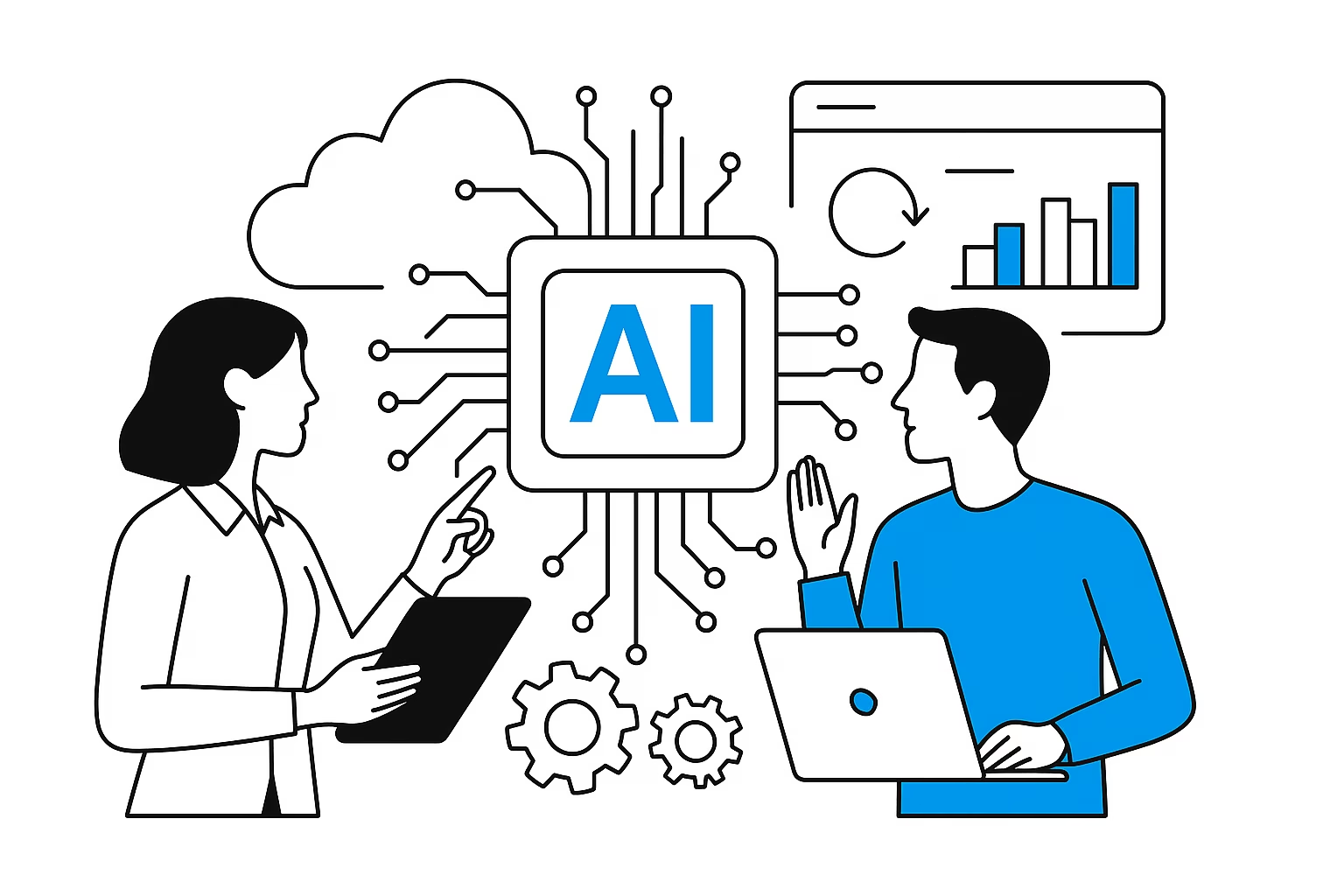
DevOps at KT.Team is not renting an engineer who fixes environments at night. We make production a managed business capability: the team can ship value, deploy services, provision access, see incidents, and manage AI infrastructure without constantly waiting in line for an external engineer. Simple does not mean easy here: we simplify the platform, remove manual rituals, introduce standards, loose coupling, and measurable operating rules.
Solutions
DevOps as a Managed Platform for Business
We build DevOps platforms on Kubernetes/OpenShift: CI/CD, SSO, security gateways, self-service deployment, and local AI infrastructure.
DevOps
DevOps is the speed of recovery and releases, not a toolset
DevOps pages need to be grounded in DORA/SRE: release frequency, lead time, change failure rate, MTTR, observability, and operational ownership.
Observability
Metrics, logs, traces, and alerts before incidents, not after business complaints.
Delivery
CI/CD and infrastructure as code make releases repeatable and verifiable.
Operations
SLA/SLO, runbooks, and postmortems turn support into a system.
Where business loses money without mature DevOps
-
Releases wait for one person with server access; environments differ from one another; an incident starts with the question of where the logs are; contractors and employees log in to different services with different passwords; Kubernetes exists, but network policies, RBAC, and resource limits have not been standardized; AI agents start working with data without proper SSO, isolation, or an audit trail.
-
At the CPO level, this increases TTU: business value takes longer to move from idea to use.
-
At the CTO and CIO level, this increases WIP, incident risk, and cost of ownership.
-
At the CDTO level, this slows AI transformation: the model or agent may be ready, but it cannot be safely connected to data, tools, and production processes.
What We Build
Kubernetes and OpenShift as a product platform
We design clusters, namespaces, quotas, storage, ingress, registries, test/stage/prod environments, and operating rules. In Kubernetes, we configure RBAC separately for API access and NetworkPolicy to control traffic between pods, namespaces, and external networks, taking CNI plugin support into account. In OpenShift, we account for the host, container/orchestration, build, and application security layers so the platform is a managed environment, not just a set of YAML files.
CI/CD and Self-Service Deployment
We build a pipeline from commit to production: build, tests, security checks, container registry, migrations, preview/test environments, blue-green or canary deployment, rollback, and release notes. The goal is for the product team to be able to deploy a service on its own using the standard process, and for DevOps not to become a bottleneck between business outcomes and production.
Observability, SRE, and DORA
We build metrics, logs, traces, alerts, runbooks, and postmortems. We manage not the number of DevOps tasks, but throughput and stability indicators: deployment frequency, lead time for changes, MTTR, and change failure rate. These DORA metrics show where the platform accelerates the business and where it only adds rituals.
Security gateways and Zero Trust access
We deploy a gateway layer for API, integrations, and AI tools: authentication, authorization, rate limits, allowlists, mTLS, WAF/API protection, policy gates, and auditing. We segment the network into zones, isolate critical services, keep secrets out of pipelines and repositories, and make access temporary and measurable.
SSO for people, services, and AI agents
We implement Keycloak and compatible IAM setups based on OIDC/OAuth2/SAML: a separate auth server, realm/client models, roles, groups, MFA, federation with AD/LDAP, and service accounts. For AI agents, we design SSO separately: the agent gets an identity, scope, short-lived token, and audit trail instead of a shared technical user with unlimited rights.
Local LLM Infrastructure
We deploy self-hosted and on-prem environments for LLMs: vLLM production stack, NVIDIA NIM, Open WebUI, private model registry, GPU scheduling, inference endpoints, quotas, latency/cost monitoring, and data isolation. For Red Hat environments, we look at OpenShift AI as a hybrid platform for open-weight models and autonomous agents.
Core Competency Matrix
Kubernetes
Clusters, Helm/Kustomize, operators, ingress, a service mesh when needed, storage classes, backup, autoscaling, pod security, RBAC, NetworkPolicy, policy-as-code, resource quotas, and multi-tenant rules.
OpenShift
Enterprise environments on Red Hat: security context constraints, image streams, routes, builds, compliance, OpenShift GitOps, OpenShift Pipelines, and OpenShift AI for LLM/inference workloads.
CI/CD and GitOps
GitLab CI/CD, Argo CD, Tekton/OpenShift Pipelines, environment promotion, immutable artifacts, migrations, automated tests, quality gates, rollback, and release governance without manual SSH access to servers.
Networks and Security
Security gateways, API gateway, ingress/egress policies, DNS/TLS, certificate lifecycle, secrets management, VPN/private links, mTLS, segmentation, action logging, and incident investigation readiness.
SSO and IAM
Keycloak, OIDC/OAuth2/SAML, AD/LDAP federation, MFA, service accounts, client credentials, role mapping, delegated administration, access lifecycle management, and single sign-on for internal systems, contractors, and agents.
AI agents platform
Self-deployment AI agents without chaos: an agent can create an MR, request a test environment, or trigger deployment only through pipeline, policy gates, approvals, sandbox, signed artifacts, and logged tool calls.
Local LLM platform
Local models, inference serving, model/runtime registry, vLLM, NVIDIA NIM, Open WebUI, GPU quotas, offline/self-host mode, data control, compliance, and unit economics for LLM workloads.
Operations and Support
Observability stack, SLI/SLO, incident response, capacity planning, backup, disaster recovery, patch management, FinOps, and training for the client team so the platform does not depend on a single external engineer.
AI-native DevOps: Agents Must Live in a Managed Environment
-
An AI agent differs from a chatbot because it acts: it reads corporate memory, calls API/MCP tools, changes data, runs pipelines, creates documents, or calculates metrics. That means the DevOps environment for AI must solve three tasks at the same time.
-
First is identity: who is acting, on whose behalf, with what scope, and for how long.
-
Second is runtime: where the agent runs, which models and tools are available, and how CPU/GPU, memory, network, and secrets are constrained.
-
Third is control: which actions require human-in-the-loop, where the audit trail is stored, how to roll back an error, and how to prove the agent stayed within policy.
-
That is why we combine SSO, MCP/API gateways, Kubernetes/OpenShift, local LLM infrastructure, and DORA/SRE practices into a single production environment.
How We Work
1. Diagnostics
In 1-2 weeks, we map services, environments, pipelines, access, incidents, costs, security gaps, and AI scenarios. We also identify where business value gets stuck before production use.
2. Target Architecture
We design a minimally sufficient platform: Kubernetes or OpenShift, CI/CD, GitOps, SSO, security gateways, observability, backup, DR, local LLM infrastructure, and operating rules. We do not add complexity for fashion's sake: we keep only what reduces TTU, WIP, cost, or risk.
3. Fast Value-Delivering Scope
We launch the first flow that actually gets used: for example, self-service deployment for one service, SSO for contractors, monitoring of a critical process, or an on-prem inference endpoint for an AI agent. We do not consider a demo or test environment finished until users have started working.
4. Service Migration
We migrate services in batches so the business keeps running. We containerize, separate configuration, move secrets out, define IaC, and add health checks, readiness/liveness probes, rollback, and alerts.
5. Handover
We document runbooks, train the team, introduce DORA/SRE metrics, and remove dependence on external DevOps for routine operations. KT.Team stays on architectural support, but the platform becomes transferable.
Cases We Rely On
SSO and service catalog in 2 months
In a public case for GC TOCHNO, the KT.Team team deployed a product development infrastructure, configured Keycloak, connected SSO to Active Directory, and integrated the first service. This demonstrates expertise in SSO, a service catalog, and access for employees and contractors.
On-prem DAM on Kubernetes for Lenta
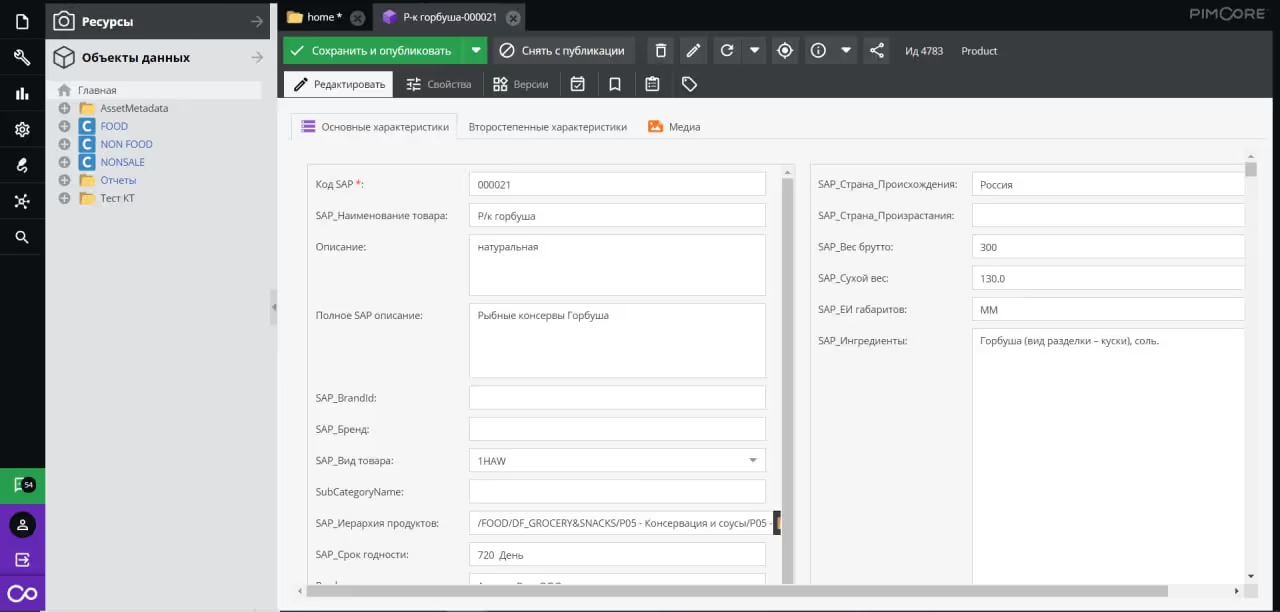
For Lenta, we deployed Pimcore DAM on the client's servers, set up a Kubernetes cluster with test/prod environments, connected the solution to the data bus and website via API, and used S3 storage for images. The result was an on-prem system with no dependency on a cloud vendor.
Kubernetes orchestrator for DAM, RabbitMQ, Redis, Filebeat
In a DAM project for a major manufacturer and retailer, the architecture included a Kubernetes orchestrator, Pimcore, RabbitMQ, Redis, Filebeat, storage infrastructure, and Elasticsearch. Media search dropped from 16 hours to a few minutes, and media usage restrictions save about 3.5 million rubles per year.
AI Agents, MCP, and Corporate Memory
In KT.Team's public AI cases, the architectures show an agent working with 1C and systems via API/MCP, Sloy turning chats, meetings, Drive, Git, tasks, and finance into memory for AI agents, and a financial agent receiving data through MCP and SQL. These projects require the same DevOps foundation: identity, gateways, runtime, observability, and auditing.
Measurable Results
Delivery Speed
Releases go through a standard pipeline, lead time for changes decreases, the team ships small changes more often, and the business gets usable value faster, not just a demo.
Stability
Incidents are detected through monitoring, not by users. MTTR is reduced through logs, traces, runbooks, rollback, and clear ownership.
Access Security
People, services, and AI agents receive only the minimum necessary rights through SSO/IAM, network policies, security gateways, and auditing.
Independence from External Engineers
The client's team gets self-service deployment, documentation, runbooks, and clear operating rules. An external expert is needed to evolve the platform, not for every release.
AI Readiness
Local models, an MCP/API gateway, agent SSO, a sandbox, and an audit trail make it possible to connect AI to real processes without moving sensitive data outside.
Total cost of ownership
Quotas, autoscaling, FinOps, observability, and environment standards show where the platform spends money and where it saves development time, downtime, and incident risk.
Contacts
Let's Discuss Your Project
Leave your current contact details and describe your task. We will come back with clarifying questions and a proposal for the next step.