Resistance first
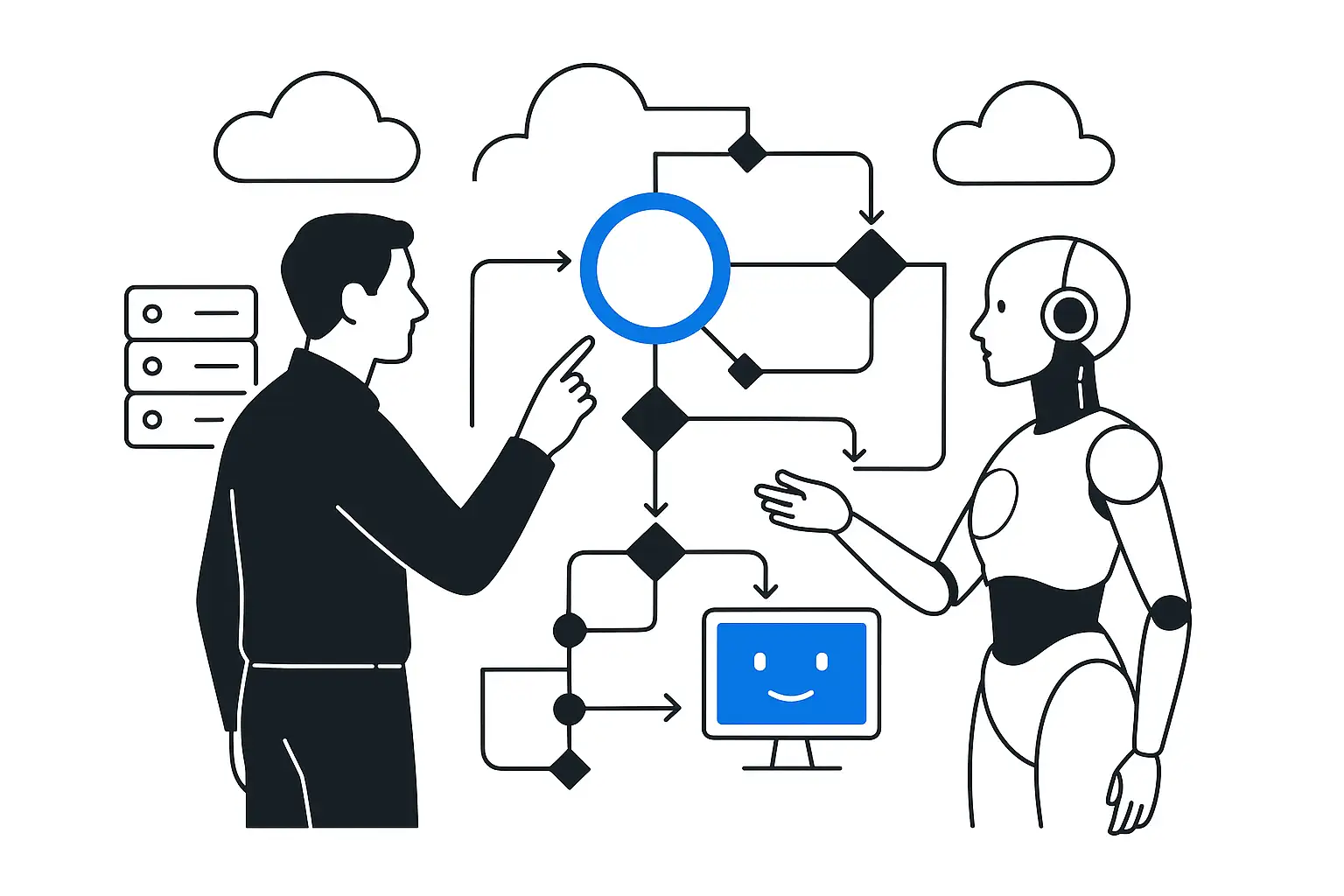
Resistance is usually rational: people do not understand what will change in their role, and they protect themselves from the risk of "they will replace us."

In mid-size and large businesses, AI stalls not because of models. People fear that "we'll be fired," legal and accounting demand the impossible, and IT becomes the only change bottleneck. We first solve a real task, then show how it was solved, and teach management to handle such changes independently.
Adoption roadmap
The journey starts with simple questions about payment, access, and rules, passes through resistance and control requirements, and ends with personal AI assistants in the daily work of managers and specialists.
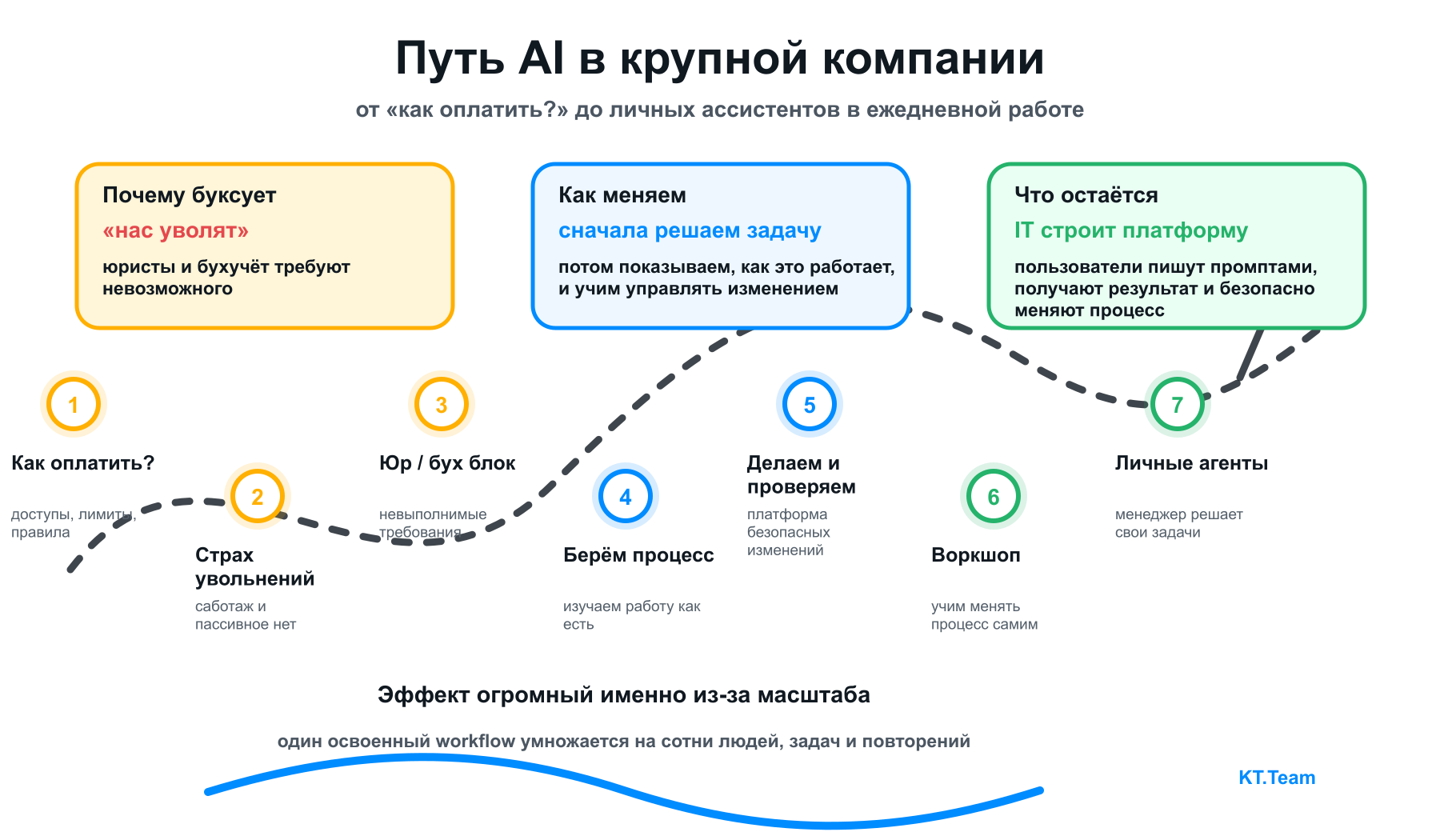
Resistance is usually rational: people do not understand what will change in their role, and they protect themselves from the risk of "they will replace us."
Legal and accounting teams require guarantees that cannot be met with old procedures without a new control platform.
IT stops handling every small change manually and builds a safe environment for business process changes.
One mastered workflow multiplies across hundreds of people, tasks, and repetitions, so the impact is especially large in a big company.
Our clients












Catalog
Each card is a practical path: we take a real process, build an AI setup, and teach the team to repeat it independently.
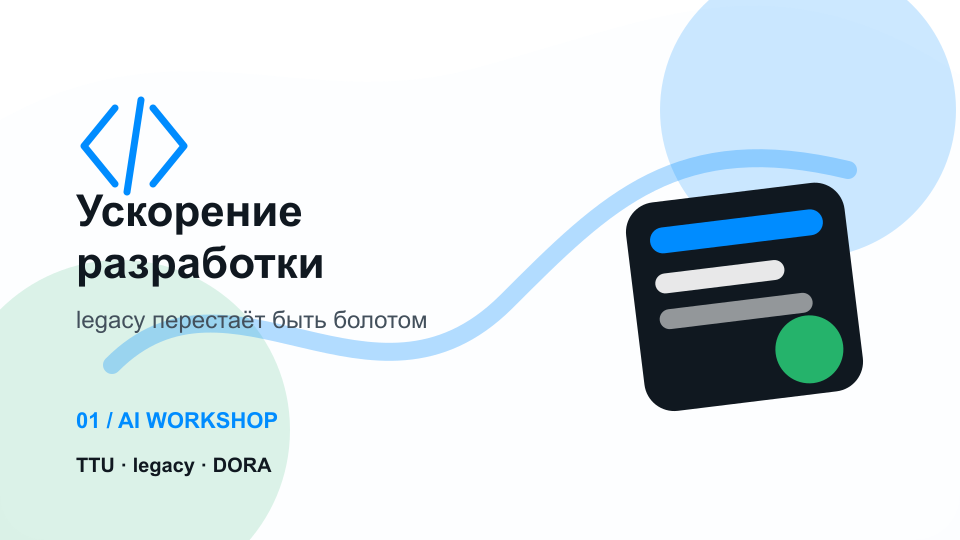 Mission 01
How to stop drowning in legacy and start delivering value faster.
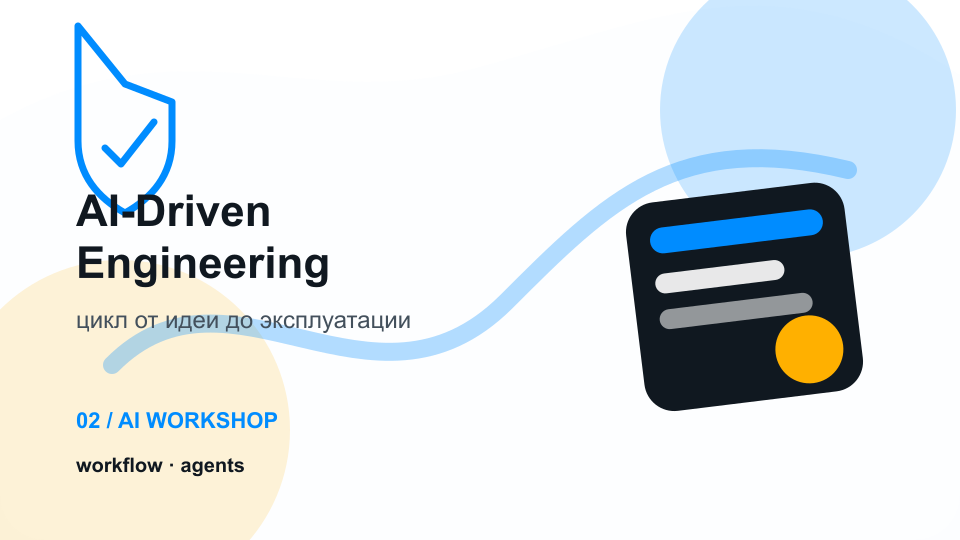 Mission 02
From "AI as a chatbot" to "AI as an engineering accelerator" — integrating AI into the TTU methodology.
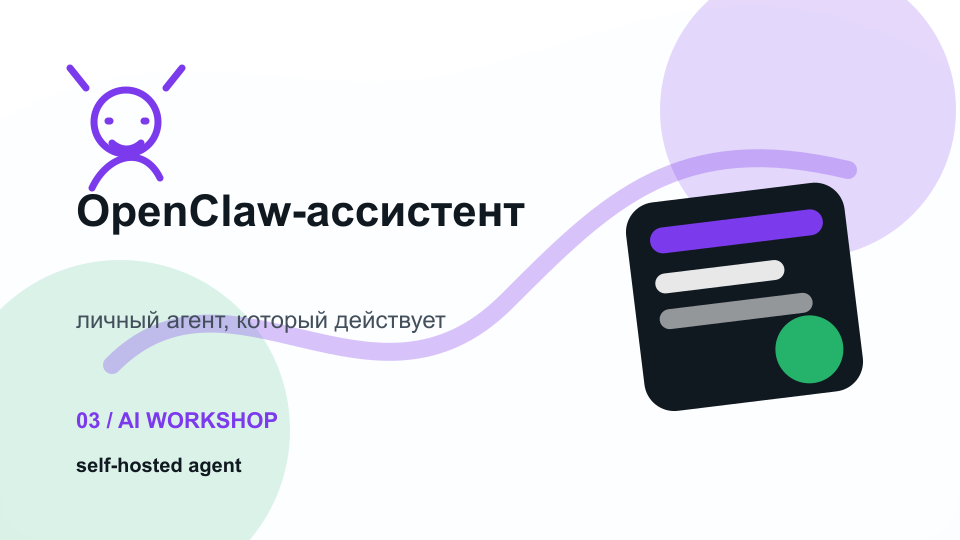 Mission 03
From zero to a digital worker in 2 hours — self-hosted, multichannel, zero routine.
 Mission 04
An assistant that lives in familiar channels, remembers context, runs routine tasks, and works with company tools under IT control.
 Mission 05
How to speed up security checks 10x without losing quality — from manual audits to 24/7 agents.
 Mission 06
A mix of OpenClaw and an AI IDE (Claude Code) that handles basic support tasks: from answering users to automatically configuring the product.
 Mission 07
Advanced Claude Code tools and approaches — highly effective AI-agentic development.
 Mission 08
LLM Wiki + SurfSense: a corporate knowledge base that assembles and updates itself automatically.
 Mission 09
We'll build a personal agent on Claude Code or Codex that helps analyze communications, chats and voice notes.
 Mission 10
An online program for management teams: 50% foundational literacy and 50% work on your processes. In the standard format, participants learn Claude and other models over two days, then design 3–4 practical use cases.
The workshop does not start with theory. We analyze a new business process, assemble and test a working solution, and then run a workshop where the company’s specialists learn to repeat that path on their own.
We look at how the work is set up today: roles, data, decisions, legal, accounting, and information security constraints, and real points of resistance.
We build a working AI-agent setup and validate quality, security, cost, and suitability for daily use.
We show how the solution was built and teach specialists to manage process changes without constantly going through IT.
The company is dealing with practical questions: how to pay, who may use it, what data cannot be shared, and where accountability is recorded.
The team stops just "trying chat" and starts handling repeatable tasks: reports, reconciliations, tickets, documents, analytics, and procedures.
Managers and specialists get personal agents that understand context, help with decisions, and prepare outputs within the workflow.
When dozens or hundreds of employees adopt one scenario, the effect repeats every day and quickly outweighs the pilot cost.
AI is especially useful where there are recurring decisions, documents, reconciliations, communication, and exception handling.
IT builds a safe platform for change, while users describe the needed result in plain language and get it faster.
Overcoming team resistance, a fast move to full-stack, and independent quality assessment of large projects based on Amazon and Google practices.
Using AI (Codex and Opus), he onboarded onto a project that had grown for 5+ years without documentation and brought up the dev environment in hours instead of weeks.
Embedding AI into the engineering and product processes of enterprise teams, the Time-to-Use methodology.
Automation of engineering processes and agentic development on real enterprise tasks.
AI-driven architecture, static analysis of legacy and objective quality control.
Schedule
The browser highlights the nearest date automatically. Past sessions fade out: recent ones stay visible, the oldest almost disappear.
For more than 13 years, we have delivered large enterprise projects and seen where adoption breaks down: not in the model, but in trust, control, processes, and accountability. That is why our workshops are built around results that can already be validated in real work.
A change in team behavior, not a set of lectures about prompts.
Real process -> working solution -> workshop -> independent changes.
DORA/SRE/QSM, weak coupling, a secure platform, and measurable Time-to-Use.
AI is not adopted by order. It is adopted through safe experience, when people see value in their own work.
Let's learn
First we solve the practical task, then we show how it was assembled so the team can repeat the approach safely and independently.