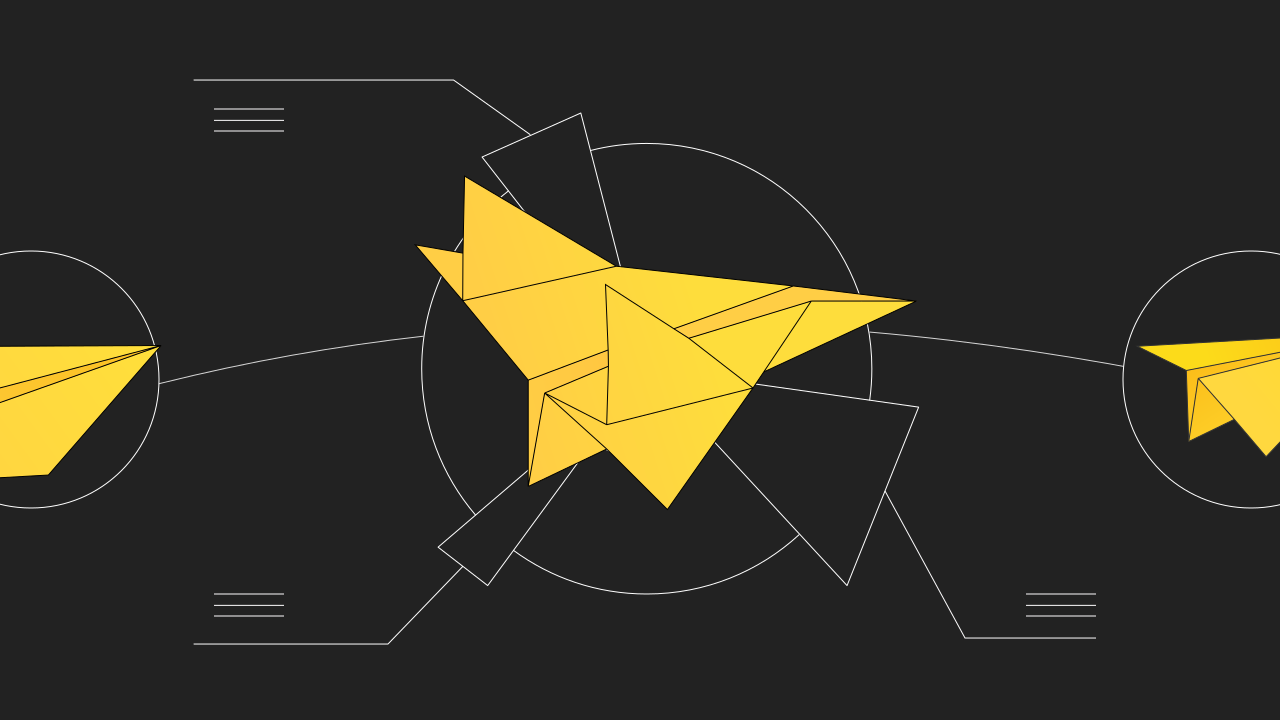
A bus instead of point-to-point links
Connecting a new system means one adapter to the bus, not an integration with every existing one. The number of connections grows linearly, not quadratically, so the architecture stays manageable as it scales.

ESB · iPaaS · Integrations
When you run a dozen-plus systems, point-to-point "every-to-every" integrations turn into spaghetti: one swap breaks neighbors, there is no monitoring, and you cannot change the vendor.
The bus provides decoupling: the integration contract lives on the ESB side, so replacing or handing off any connected system does not require touching the others.
Our clients












Industry solutions
Capabilities
Connecting a new system means one adapter to the bus, not an integration with every existing one. The number of connections grows linearly, not quadratically, so the architecture stays manageable as it scales.
Systems know nothing about each other's address, technology and format — only about the bus contract. Replacing or upgrading one system does not break neighbors or require changes to them.
Content-based routing, filters, aggregation, splitter — from 92 proven Camel patterns, not custom code. Fewer integration defects and faster rollout of new routes.
XML, JSON, CSV and the HTTP, JMS, SOAP, REST protocols are reduced to a single contract on the bus. Systems with different data structures exchange data without rework on their side.
Service Locator maintains an endpoint registry and supports failover and load distribution across several Talend Runtimes. The failure of one node does not stop the data flow.
Data Integration and mediation routes are designed in a single Studio and published to a shared Artifact Repository. Batch loading and events use the same connectors and logic.
Service Activity Monitoring logs and aggregates service calls into a separate database. A single point of visibility instead of scattered logs means incidents are visible and traceable.
Routes and services are stored in Git and an Artifact Repository as versioned artifacts. The integration layer can be handed to another team or vendor without reverse engineering.
Built on Apache Karaf, CXF, and Camel, with open source and open standards. No proprietary route format: skills are available on the market, and migration is not tied to a vendor.
Approach
We do not fork or patch the Talend ESB core. Talend ESB remains on the standard updatable version, while customizations are moved into separate modules or services. Before each update, we verify the compatibility of modules and integrations in a test environment.
Where a mature international solution exists, we use it instead of inventing our own protocol or platform. Before writing code, we study how the problem is already solved in the industry.
The solution is loosely coupled and documented: it can be handed over between teams and contractors without rewriting. You are not tied to us.
AI compatibility
LLM and ML endpoints connect to the ESB through the same Camel REST/JMS connectors as every other system. A model call becomes a route step rather than a separate point-to-point integration.
ETL flows and bus-based transformations normalize and enrich data from disparate sources before it reaches the AI service, providing a single contract instead of mixed exports.
The content-based router, enricher and aggregator patterns route requests across multiple models and services and assemble responses — a manageable pipeline instead of hardcoding.
Service Activity Monitoring records AI endpoint calls alongside other services, making latency, errors, and volumes visible in one place to control cost and quality.
Loose coupling lets you add or swap the AI provider behind the bus contract without touching consuming systems, enabling A/B testing and model replacement without reworking integrations.
News
Declarative pipelines as contracts, pipeline generation through coding agents (Claude Code, GitHub Copilot), and Qlik MCP Server, which exposes Qlik Talend Cloud governance objects (data products, lineage, catalog) as MCP tools, are now generally available in Qlik Cloud / Qlik Talend Cloud.
Studio and Runtime now support Java 21 (a direct upgrade is possible only from 8.0.1-R2024-05 or later). Apache Syncope is no longer included in the ESB installer and must be installed separately from the Apache Syncope project. The current combination is Syncope 4.1 + Java 21 + Tomcat 10; Syncope 2 is incompatible with TAC/STS starting with this release.
Routes in Talend Studio can call tools from any MCP-compatible server, including Qlik MCP Server; the context window has been expanded for complex agentic scenarios. Agentic Routes have existed since early 2025, so this is an enhancement, not a new feature.
Unauthorised remote code execution through the JobServer monitoring JMX port, CVSS 9.8. Patches: JobServer 8.0 TPS-6017 and 7.3 TPS-6018 (16 January 2026), Runtime 8.0.1.R2026-01-RT and 7.3.1-R2026-01 (24 January 2026). As a temporary measure, disable the monitoring JMX port or protect it with TLS authentication.
Blog
Projects