
AI-Native
AI-native integration: standard agent access to enterprise systems
For the client's existing services, KT.Team builds MCP servers and agent connectors: LLM agents and tools access enterprise systems through one open standard instead of a set of point integrations for each model.
AI-native integration: MCP servers and agent connectors on top of existing systems
Our clients
Clients and partners











Standardone interface for agents to access systems instead of N×M point integrations for each model
~40%Enterprise applications will have task-specific AI agents by the end of 2026, according to Gartner (it was less than 5% in 2025)
Unitscompanies have taken agents to production - the gap from experiments is closed by the engineering layer (Gartner)
Freedomswitching models (Claude, ChatGPT, Gemini, Copilot) and vendors without rewriting integrations
Industry solutions
What can be done with AI-native integration
Capabilities
AI-native integration capabilities
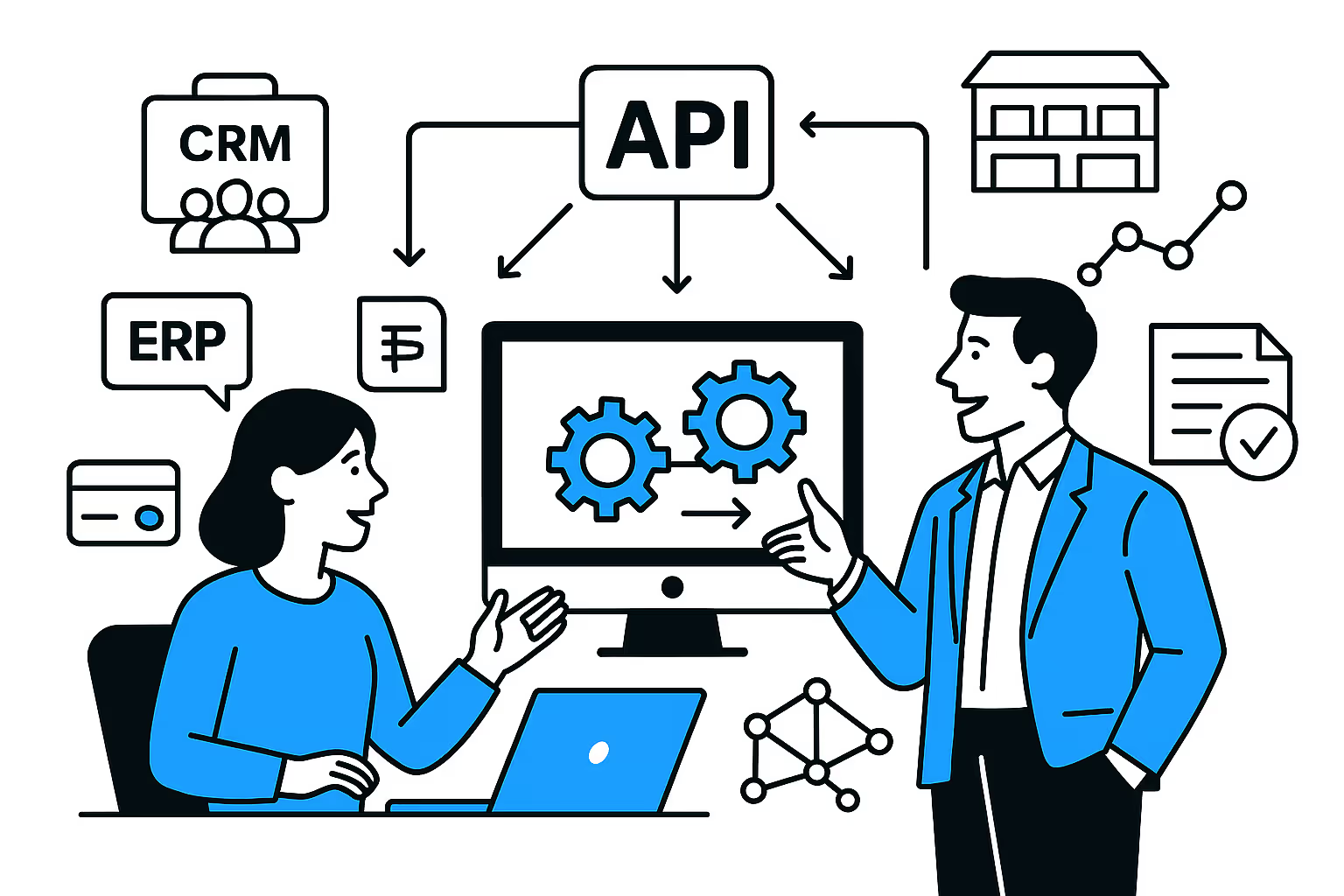
Enterprise services: ERP, CRM, PIM, warehouse, billing, DBESB/bus (DATAREON): guaranteed delivery and loose coupling between systemsMCP servers: each source is wrapped in resources and tools to the standardMCP gateway: OAuth authorization, scopes, PII obfuscation, call auditingLLM gateway: model routing, budgets, observabilityAgents and LLMs: Claude, ChatGPT, Gemini, and Copilot call toolsBusiness scenarios: data answers, actions in systems, automation
Agent access to up-to-date data
Agents access ERP/CRM/PIM/warehouse through one interface and see live data, not exports
End of integration spaghetti
Instead of N×M custom connectors for every system-model pair, one MCP server per source, reusable by all agents
Portability and no vendor lock-in
Open standard: hand off the integration to another team, switch models (Claude, ChatGPT, Gemini, Copilot) without rewriting it
Faster scenario delivery
A new agent scenario is assembled from ready-made MCP tools with prompts, not as a from-scratch integration project
Controlled access
Separate what the agent can do from what it can access through a gateway: authorization, scopes, and audit of every tool call
Data protection
Personal data obfuscation and policies at the gateway level before data goes to an external model
Corporate Memory
System knowledge and context are reused across agents instead of being embedded in one prompt for one model
Evolution without rework
Loose coupling: the source system can be replaced without changing the agents on top of it
Approach
How we implement AI-native integrations
Without modifying the core
We do not fork or patch the core of the AI-native integration. The AI-native integration remains on the standard updatable version, while customizations are moved into separate modules or services. Before each update, we verify the compatibility of modules and integrations in a test environment.
International Standards, Not Homegrown Hacks
Where a mature international solution exists, we use it instead of inventing our own protocol or platform. Before writing code, we study how the problem is already solved in the industry.
Transferability
The solution is loosely coupled and documented: it can be handed over between teams and contractors without rewriting. You are not tied to us.
AI compatibility
AI-native integrations in the AI stack
MCP servers
Each enterprise service is wrapped in an MCP server with defined resources and tools according to the 2025-11-25 specification
Tools
Actions and system queries as typed tools available to any MCP-compatible agent
Agents and models
Claude Opus 4.8 / Sonnet 4.6, ChatGPT, Gemini, Copilot - one interface; the agent connects to the server without knowing its internals
Security and gateway
MCP gateway as a control point: OAuth authorization, schema validation, PII obfuscation, auditing, and tool call limits
Context 2026
What changed in the market
MCP is the access standard
In the first year, SDK downloads and the number of public servers grew several times over; OpenAI, Google, Microsoft, and Salesforce announced support for the standard
Neutral foundation
MCP is governed by the Agentic AI Foundation under the Linux Foundation (co-founders Anthropic, Block, OpenAI), which reduces vendor lock-in risk
Production readiness
The 2025-11-25 release added async Tasks, modern OAuth authentication, and extensions, moving from synchronous calls to managed long-running processes
Security focus
Gartner predicts that more than 40% of agentic AI projects will be canceled by the end of 2027 due to cost, unclear value, and governance gaps; the control point is the MCP gateway
Gap from production
Most companies are experimenting with agents, but only a minority have taken them to production (Gartner); the gap is closed by the engineering layer, not a demo
Honestly
Pros and cons
Pros
- One standard interface instead of N×M custom connectors: integrations are reused and do not need to be rewritten when the model or vendor changes
- Portability and no vendor lock-in: the open standard is backed by OpenAI, Google, Microsoft, Salesforce, and governed by a foundation under Linux Foundation
- Loose coupling: the source system can be replaced without changing the agents on top of it
- Controlled access through a gateway: authorization, scopes, PII obfuscation, and audit of every tool call
- Speed: new agent scenarios are assembled from ready-made MCP tools, not built as an integration project from scratch
Cons
- MCP does not define security on its own - without a gateway with OAuth, scopes, and auditing, "open doors" appear: in early 2026, several vulnerabilities were found in MCP, including RCE
- Gartner’s main risk is confusing what an agent can do with what it can access; Gartner predicts over 40% of agentic AI projects will be canceled by the end of 2027
- The standard is changing quickly (current specification: 2025-11-25): server compatibility must be maintained
- Result quality is limited by the quality of data and contracts in the source systems - MCP does not fix dirty data, it makes it available to the agent
News
What's new in AI-native integration
-
MCP specification 2026-07-28: the protocol became stateless
The initialize/initialized handshake and session ID have been removed, allowing requests to reach any server instance behind a load balancer without shared storage. Multi Round-Trip Requests replace streaming server-to-client calls; header-based routing (Mcp-Method/Mcp-Name) enables gateways to route without parsing the JSON body; list results are cacheable (ttlMs/cacheScope); and authorization has been strengthened (RFC 9207 and Client ID Metadata Documents instead of Dynamic Client Registration). Roots, Sampling, Logging, and HTTP+SSE transport are deprecated with a 12-month window; all Tier 1 SDKs (TS, Python, Go, C#) have been updated, while Rust is in beta.
Header-based routing and authorization in MCP cover some functions that previously required a dedicated LLM gateway. LLM & Security Gateway → -
Skills for MuleSoft Vibes: portable instruction packages for agent assistants
MuleSoft publishes Mule skills from the mulesoft-dx repository as the @salesforce/mulesoft-vibes-skills package. The same instructions work in MuleSoft Vibes, Claude Code, Cursor, Windsurf, Cline, and Codex. Skills are activated on demand: a skill loads only when a request matches it, saving context.
The MuleSoft Skills format is compatible with Agent Skills from Claude Code: MuleSoft is reusing an existing format instead of inventing its own. Anthropic Claude → -
MuleSoft for Flow: Integration — low-code integration within Salesforce Flow, Winter '26 release
MuleSoft embeds ready-made integration components directly into the Salesforce Flow builder, without switching to Anypoint Studio or writing Mule configuration files. The target use case is no-code/low-code automation for admin roles, not integration developers.
n8n has offered a visual low-code builder for triggers and actions for years, independently of vendor lock-in; MuleSoft for Flow provides the same capability, but ties it to the Salesforce ecosystem. n8n → -
MuleSoft Vibes: the agentic development assistant is now generally available
An agent for building, managing, and scaling Mule applications through natural-language commands is built into Anypoint Code Builder and available free of charge to all Anypoint Platform users. It is a closed proprietary assistant that operates only within the MuleSoft ecosystem.
The same class of agentic coding assistants as Claude Code, Cursor, and others, but MuleSoft Vibes is locked inside Anypoint instead of working in any repository. AI-native development →
Blog
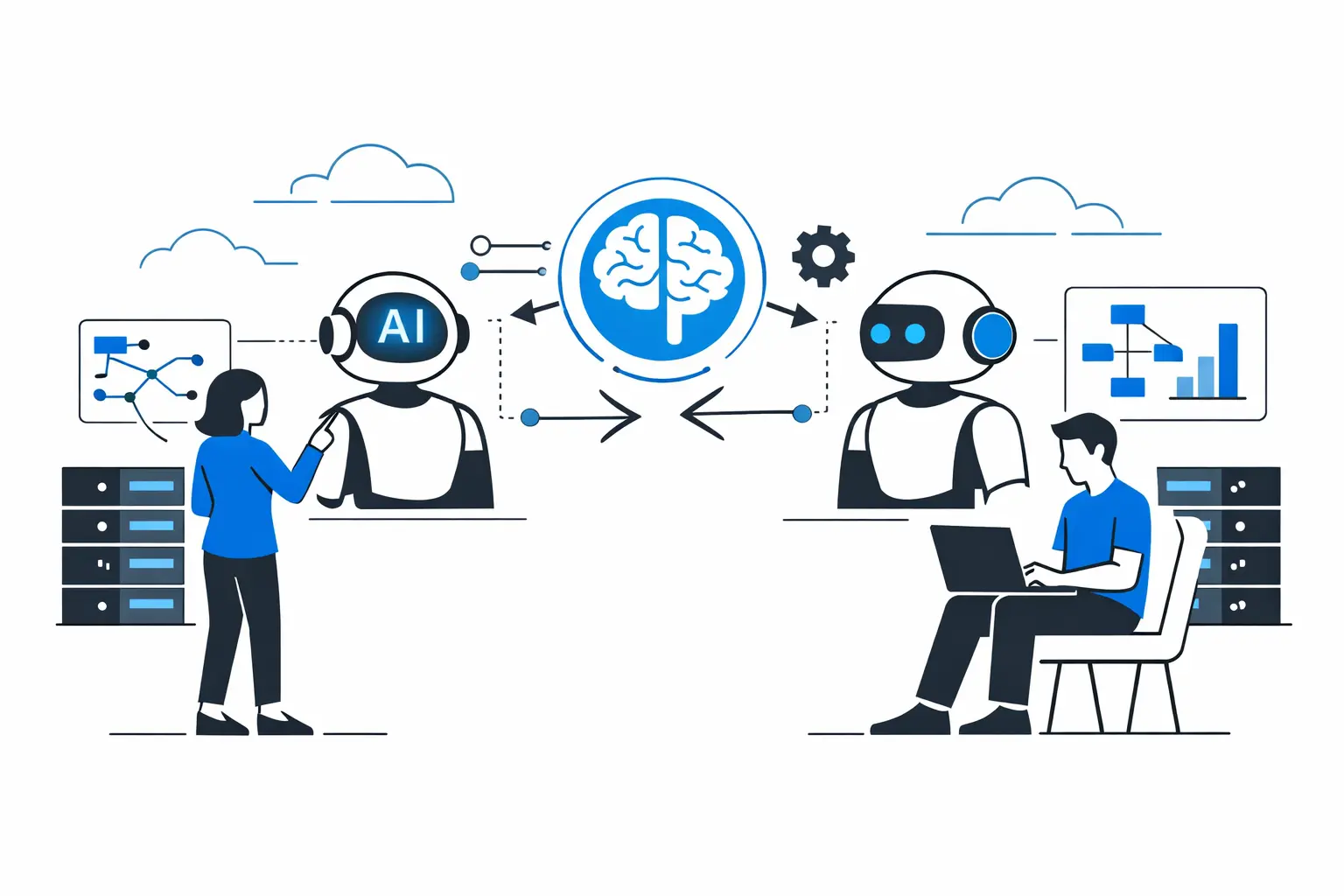
Articles about AI-native integrations
Projects
Cases

Custom Akeneo modules for delivery
Learn more
OSNO-VA: AI accountant
- Built an AI platform
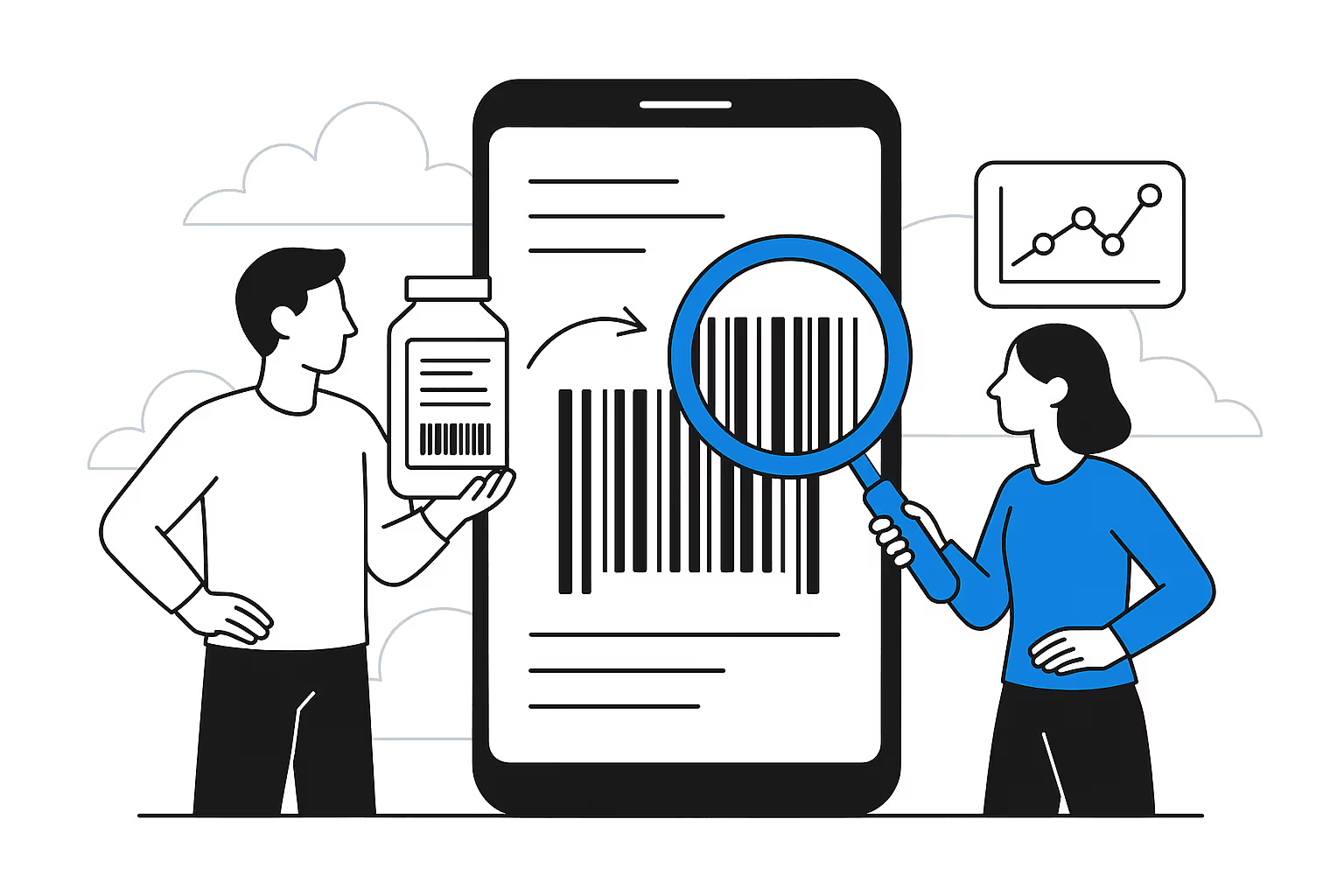
AI ingredient recognition by barcode
- The AI service processes up to 10 images in 2 minutes
- Recognition accuracy for composition is 80-95%


