Simple is not easy

How industrial digital transformation helps plants and factories cut costs, increase profits, and win the competition under pressure and sanctions

How digitalization helps factories cut costs, increase profits, and stay competitive.

  • Why does business need digitalization?
  • What does digitalization consist of?
  • We'll send you the materials you need or a commercial proposal
  • Why can’t you put it off?

Introduction: Digital Transformation in Industry

Published: 24.7.2025. Reading time: 7 min. Digitalization helps industry do more than survive - it helps it grow, even under pressure, sanctions, and labor shortages. In this article, we explain how digital technologies increase profits, reduce costs, and give CIS factories a competitive edge. Digital transformation in industry is about earning more, spending less, and making customers happier.

This is especially important for CIS factories and plants that are under immense pressure from loans and leasing, payroll obligations, constant price undercutting from China, sanctions, and labor shortages. For them, it is a chance to outpace competitors and move ahead. Let’s look at how digitalization is changing the rules, what it gives to business, and how it is already working in CIS. At the end, you will find a step-by-step plan so you can start tomorrow.
Why does business need digitalization?

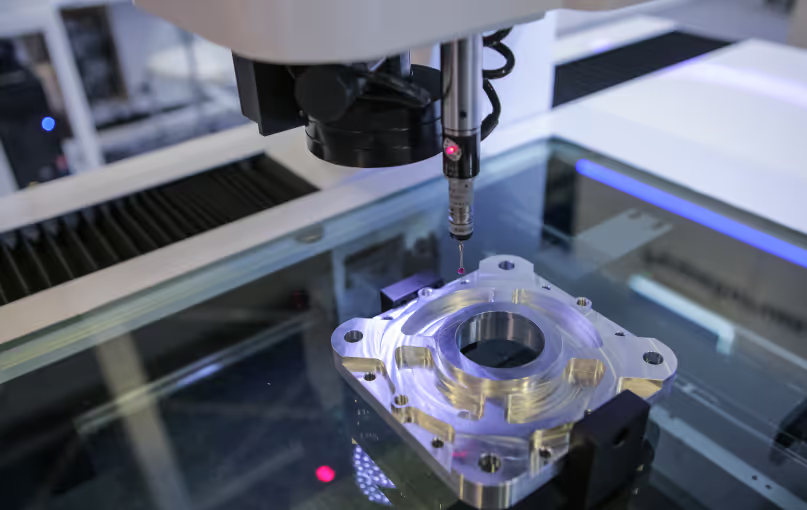
  1. Instead of stacks of paper and long meetings, you get clear data, fast decisions, and automated processes. On the shop floor, that can be a robot that assembles parts without errors.

  2. In the warehouse, a system knows how much stock needs to be ordered.

  3. For customers, a convenient portal where everything is visible in two clicks.

  4. A BCG study shows that companies that invested in digitalization increased revenue by 15% and cut costs by 20% in just a few years.

  5. For CIS, where industry is surviving under sanctions and expensive raw materials, this is like finding a new market without extra costs.

Automation: robots and smart software take over routine work

  1. Machines, robots, or software handle repetitive tasks that people used to do.

  2. This frees employees for more complex and creative tasks, such as developing new products or improving processes. In industry, automation includes robotic lines, planning software, and algorithms that control production.

  3. Robots on the assembly line put parts together with millimeter precision, never get tired, and do not make mistakes.

  4. Smart software automatically assigns orders, calculates equipment load, or builds shift schedules.

  5. Artificial intelligence (AI) analyzes processes and suggests how to make them more efficient.

  6. Example from abroad: Bosch has implemented robotic systems at its factories in Germany.

  7. Robots assemble automotive components, while AI optimizes their work to minimize downtime.

  8. This increased productivity by 25% and allowed employees to focus on developing new technologies.

  9. Time savings: tasks that used to take hours are done in minutes.

  10. Fewer errors: machines do not get tired or distracted.

  11. Freedom for the team: employees focus on strategy, not routine work.

Data: analytics knows what customers need and how to avoid excess inventory

  1. Analytics shows what customers are buying and how to avoid keeping excess stock. In industry, it helps determine what customers buy, how much raw material to order, and how to avoid overloaded warehouses.

  2. Systems collect data from equipment, sales, and the market, then turn it into clear recommendations based on algorithms or AI.

  3. Software analyzes order history to predict what will be popular in a month.

  4. Systems track inventory so you do not keep excess stock and lose money on storage.

  5. Analytics identifies bottlenecks, for example where production slows because of a shortage of parts.

  6. Severstal uses data analytics to manage its warehouse.

  7. Their system forecasts steel demand based on market trends and customer orders.

  8. This made it possible to reduce inventory by 20% - millions of rubles stopped sitting idle. In addition, customer deliveries sped up by 12% because the company planned logistics better.

  9. Example from abroad: Amazon, although not an industrial company, is a relevant example because it uses analytics to manage warehouses.

  10. Their algorithms predict which products will be popular in each region and distribute inventory in advance.

  11. It reduces delivery time and saves billions on storage.

  12. Business value: Accuracy: you order exactly what you need. Savings: lower warehousing and logistics costs.

  13. Satisfied customers: products arrive on time.

Sensors: Machines Under 24/7 Watch

  1. Sensors are devices that monitor equipment, collect data about its condition, and warn about possible failures. In industry, they are used to monitor machines, pipelines, or even entire plants.

  2. The Internet of Things (IoT), where machines "talk" to each other.

  3. Sensors measure temperature, vibration, or pressure in equipment.

  4. If something goes wrong, the system sends a signal: "Time to repair!"

  5. Data helps predict when a machine may break down so it can be repaired in advance.

  6. Lukoil, as part of the Digital strategy

  7. Lukoil 4.0 installed IoT sensors at oil refineries.

  8. They monitor pumps and turbines, spotting anomalies 2-3 weeks before failure.

  9. This reduced downtime by 25% and saved millions on repairs. For example, one plant avoided a breakdown that could have halted production for a week.

  10. Example from abroad: Siemens uses the MindSphere platform with IoT sensors to monitor turbines and production lines.

  11. Sensors warn about failures, which reduced downtime by 15% and lowered maintenance costs.

  12. Business value: Reliability: fewer breakdowns and stoppages. Savings: preventive repairs cost less. Planning: you know when to replace equipment.

We'll curate materials for your task

We'll reply within 30 minutes and send relevant cases, diagrams, or analyses tailored to your context.

Cloud platforms: manage your business from any device

  1. Cloud platforms are online services where business data and management software are stored.

  2. They let you monitor production, supply, and customers from any device, from an office laptop to a phone or tablet on the road.

  3. All data, from orders to machine status, is collected in one place.

  4. Employees and partners get access to the information they need in real time.

  5. Platforms integrate different processes: production, logistics, and sales.

  6. Example from CIS: PhosAgro launched a cloud portal for customers.

  7. Fertilizer buyers can see where their order is, how much stock remains, and how to use the product most effectively.

  8. This increased customer satisfaction by 30%, and repeat orders rose by 15%.

  9. Inside the company, the platform brings together production and supply data, which made planning easier.

  10. Global example: General Electric uses the Predix cloud platform to analyze turbine data.

  11. Energy customers receive recommendations on how to optimize equipment operation, saving 10% on fuel.

  12. Business value: Convenience: everything is managed in one place. Speed: decisions are made faster. Transparency: customers and employees can see what is happening.

Why can’t you put it off?

  1. Industry 4.0 is a new revolution in manufacturing, where the key role is played by introducing new developments, technologies, and AI into production processes to improve optimization and efficiency. Deloitte found that 80% of CIS plant executives understand that survival is impossible without digitalization.

  2. But only a third of them actually take action.

  3. If you sit back and do nothing, customers will switch to those who are faster, cheaper, and more convenient.

  4. Right now, CIS industry is drowning in problems: raw materials are getting more expensive, specialists are in short supply, and outside businesses are threatening price dumping.

  5. Digitalization is like a lifeline.

  6. It makes businesses flexible so you can adapt to any crisis. Deloitte found that 78% of executives believe their companies will not last five years without digital technologies.

The benefits of digitalization: what you gain

Savings: lower production and delivery costs. Customers: convenient services make them more loyal. Leadership: you move ahead of those stuck in the past. Quality: less defectives, more trust. Control: everything is visible at a glance.

The downsides of digitalization: what is the catch?

Money: you need to invest in equipment and training at the start. Challenges: old machines may not work well with new systems. Hackers: more data means more risks. People: not everyone is ready to change.

How to Start: A 7-Step Plan

  1. 1. Find where you are losing money Look at what is slowing things down: the workshop, the warehouse, or communication with customers.

  2. If machines break down often, start with sensors.

  3. Do not try to roll it out across the entire plant at once; start small. 2. Decide what you want

  4. Increase output by 20%?

  5. A clear goal helps avoid wasting time and money. 3.

  6. For the warehouse, analytics software.

  7. Choose the option that solves your problem. 4.

  8. Inspire your team PwC says that 65% of digitalization failures happen because people do not want to change. Explain how new tools will make their work and lives easier, and most importantly that they will not replace them, since that is people’s main fear. 5.

  9. Review the results after 3-6 months. Does it work?

  10. If the test works, roll it out more broadly. Check what works and improve it.

  11. Do not wait for competitors to pull ahead. Act now so you do not fall behind.

Contacts

Let's Discuss Your Project

Leave your current contact details and describe your task. We will come back with clarifying questions and a proposal for the next step.