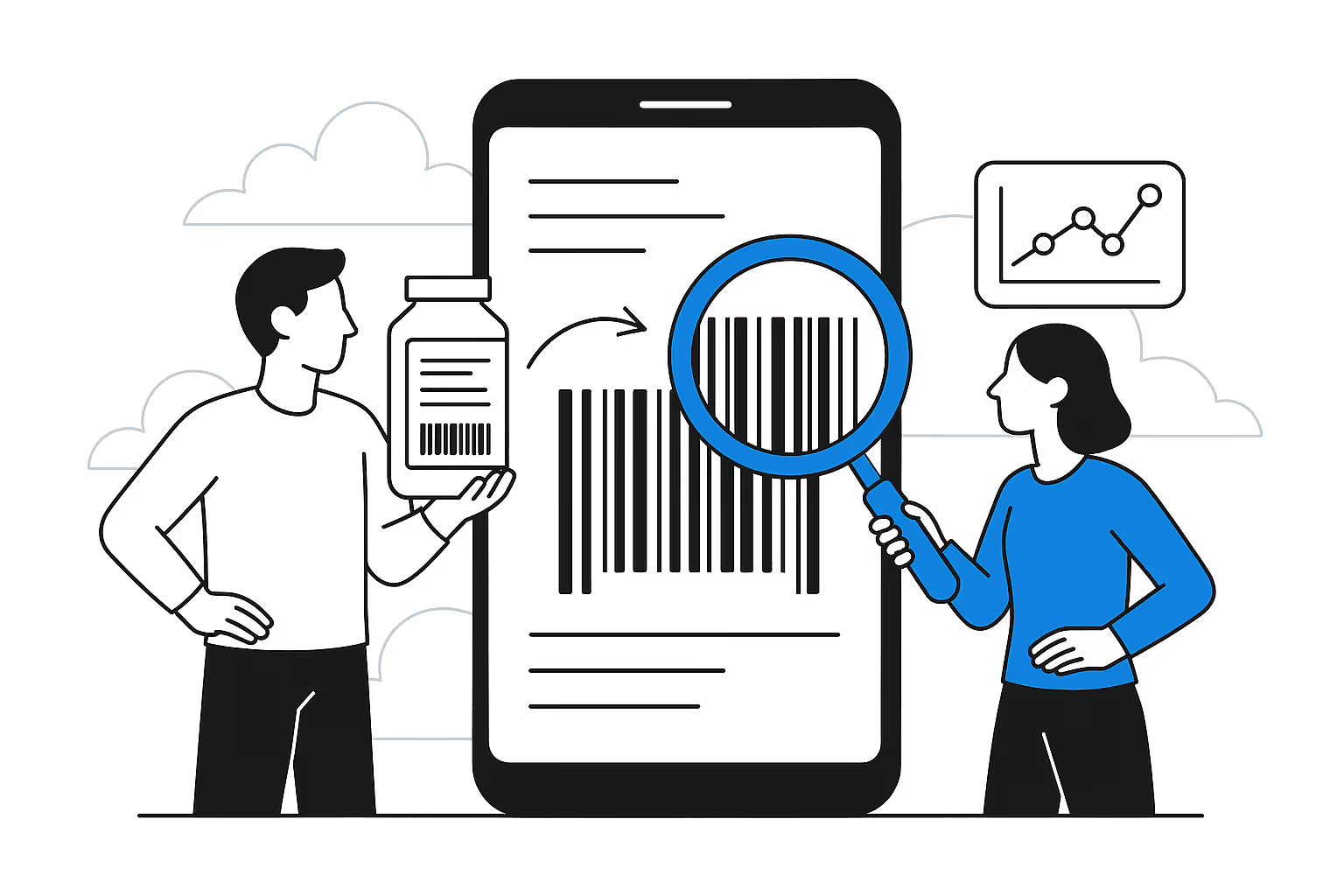
Data extraction
Packaging text, primary document fields, and scan details. Verification means comparing each required field with a reference and tracking correction time.

Explore AI use cases in retail, logistics, construction, and finance, with project stages, metrics, human oversight, and pilot criteria.
AI in business handles specific operations: recognizing text and images, classifying tickets, preparing documents, and calling tools according to procedures. A single process may combine computer vision, OCR, a language model, and standard software checks.
Below are KT.Team case studies by industry, with the outcome and project stage indicated.
A working service, a demonstration using historical data, and a future implementation program provide different types of evidence.
Assessing your project requires a comparable task, data, and the cost of checking the result.
A recurring flow of documents and requests helps build a validation sample. Recognition requires reference fields, classification requires agreed categories, and agent actions require procedures and permissions. First, identify the error that must not be missed and the cost of correcting it manually.
Packaging text, primary document fields, and scan details. Verification means comparing each required field with a reference and tracking correction time.
Support team, service, and document type. Validation covers category errors, ambiguous examples, and cases the model must pass to a specialist.
Document preparation, calculation launch, and tool invocation. Validation covers access rights, the activity log, and approval conditions before data is changed.
The order of AI implementation in a process
1. Business challenge
2. Data and rules
3. Pilot
4. Human in the loop
5. Scale-up
For a manufacturing company, accounting and document processing can be a separate area for AI application.
Their results should be measured separately from equipment performance, product quality, and production lead times. OSNO-VA - AI accountant - a KT.Team product for accounting operations in 1C and related systems. The published case describes API/MCP access, rule-based execution, action auditing, and escalation of exceptions to an accountant.
Round-the-clock processing of standard operations is a product mode, not a measured availability percentage.
The case does not specify the measurement period, the volume of processed operations, or a proven reduction in production costs.
For the pilot, document accuracy, the exception rate, and the accountant's time spent reviewing exceptions are checked here.

In retail and distribution, product cards and packaging data can be selected for a pilot. In case study on barcode-based composition recognition KT.Team built a computer vision and OCR service for an imported goods distributor. It extracts the contents from packaging artwork, links them to a barcode, and prepares a report for subsequent upload to PIM and the national catalog.
The original case compares 30 minutes of manual processing per package with 2 minutes of automated processing for up to 10 images.
The number of images is not equal to the number of products.
Therefore, these figures describe two operating modes but do not provide a valid acceleration factor.
The case reports recognition accuracy of 80-95%; the test sample composition and method used to calculate this range were not published.
More than 500 packages had been recognized when the project was described; the calendar period for this volume is not specified.
The user verifies the result, and unrecognized files are flagged in the report.
New types of packaging may require additional development.
The original source states a six-month project timeline from discussions, including three months from development start to launch; this is the project duration, not the quality measurement period.
For Fix Price's PIM team, KT.Team prepared an AI implementation program for software development. The case describes a team of about 20 people, stages from requirements to presales, human oversight, and a plan for baseline time and error metrics.
The published result is a program and risk map; this material contains no evidence of faster development or production launch of the complete system.
In iCdocs case study A logistics company handled thousands of shipments and multipage document packages every day. KT.Team developed a Python-based system that converts scans to text, identifies document types and pages, and groups documents by order number, trip, or counterparty.
Recognition here means OCR and computer vision; sorting, compilation, and storage also use software rules.
The use of an LLM is not stated in the published case.
An operator can verify recognized values and flag incorrect fields, while the change history is stored in the system.
The case reports an early recognition result of around 80%, but does not disclose the test sample or measurement period; this must not be presented as the final accuracy of a production system.
For a new pilot, it is more useful to measure in advance missing required documents, field errors, and the operator's time to correct a document package.
In LLM ticket classification case study For one of CIS's top three developers, KT.Team prepared a demonstration environment using a dataset of 12,000 resolved tickets in the first quarter.
The year of the quarter is not specified in the published text.
Before the demonstration, the data was cleaned of empty descriptions, email chains, and unusable labels.
The model first identifies the team, then the service within that team.
Instructions are refined based on errors, and test requests are checked for regression.
The case demonstrates an approach and methodology for further implementation; 12,000 requests indicate the size of the source dataset, not the number of successfully served customers or an accuracy rate.
An industrial pilot requires specialist review, metrics for each category, and rules for escalating ambiguous tickets.
Related design scheduling system It combines scheduling, data migration, and integrations. LLM/script-based classification is mentioned for a separate integration area with Naumen.
This does not justify attributing all scheduling and planning functions to AI or promising a percentage reduction in construction costs.
In the OSNO-VA financial agent case KT.Team separated the data, tool access, and calculation logic.
Data is stored in a database, the agent receives it through MCP, and calculation rules are executed in skills and scripts.
The language model uses verifiable tools; the numerical result must be reproducible according to the specified rules.
The published case confirms the structure of the financial system.
The calculation volume, observation period, and share of answers requiring no corrections are not provided.
When replicating the approach, validate the result against reference calculations, access to financial data, and handling of missing input values.
A designated specialist is responsible for resolving discrepancies.

| Case | What the publication confirms |
|---|---|
| Composition recognition | A working OCR and computer vision service |
| AI-Accountant OSNO-VA | A product platform for executing accounting regulations |
| AI program for Fix Price | Implementation program and metrics plan |
| LLM ticket classification | Demonstration using historical tickets |
| iCdocs | Document recognition, verification, and compilation |
| Design schedules | A planning and integration system with a separate classification task |
| OSNO-VA financial agent | MCP access to data and executable calculation logic |
| Industry | Potential task | What to verify in the pilot |
|---|---|---|
| Healthcare | Extracting details from administrative documents | Completeness of mandatory fields and employee review; clinical conclusions require separate evaluation |
| Education | Search across training materials and feedback drafts | Alignment with the curriculum, links to the material, and instructor review |
| Energy | Search for information in operational documents | Accuracy of links to instructions, document version currency, and handoff of the solution to an engineer |
| Agriculture | Classification of supplier requests and documents | Category errors, completeness of required details, and correction time |

Choose a repetitive operation, collect examples with correct answers, and record the cost of manual work.
Compare the solution options:
KT.Team helps connect the selected use case to 1C and other systems, define human oversight, and establish acceptance criteria.
The approach and implementation options are on the page AI for business.
The remaining projects are in the AI case study catalog.
FAQ
Choose a process with repetitive operations, available examples, and a verifiable result. Before launch, you need a reference sample and the pilot criteria from this article.
The cases examined involve OCR and ingredient recognition, LLM-based ticket classification, and rule-based tool calls. Software reconciliation and document compilation can be performed without a language model.
No. Compare the unit of measurement, sample, project stage, and cost of manual review. A demonstration and product description do not confirm savings in your process.
The timeline depends on data readiness, integrations, and verification complexity. Before starting, agree on the pilot scope, observation period, and acceptance criteria; expansion is based on the results obtained.
The processing location is selected during design: it may be the customer's environment or an approved external service. The entire data path, including the model, tools, and logs, must be checked; having an API or MCP alone does not determine where data is processed.
Verification date: 13.09.2026