Simple is not easy

DORA 2025, Part 1. Introduction, summary, and key insights on AI's impact on software delivery performance

A review of the key DORA 2025 findings on how AI amplifies the strengths and weaknesses of teams, platforms, and software delivery processes.

  • Research summary
  • AI is an amplifier
  • We'll send you the materials you need or a commercial proposal
  • Key Insights

About the publication

2.12.2025 This article is an adapted translation of the Google Cloud and DORA report "2025 State of AI-Assisted Software Development." The original is available at the link. Reading time: 10 min.

AI is an amplifier

  1. In 2025, the central question for technology leaders is no longer whether to adopt AI, but how to capture value from it.

  2. The DORA study includes more than 100 hours of qualitative data and responses from nearly 5,000 technical professionals worldwide.

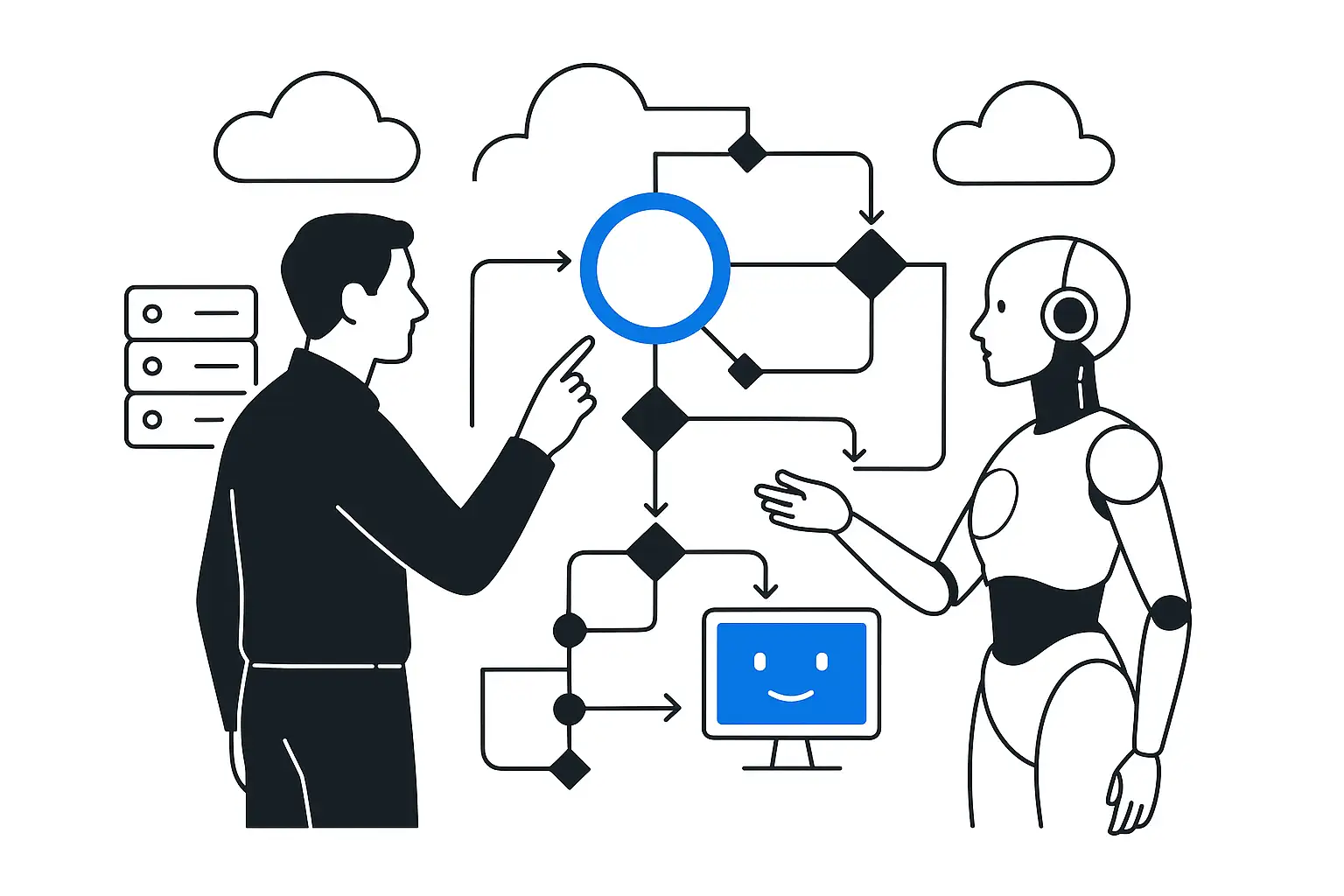
  3. This study reveals a critical truth: AI's primary role in software development is to act as an amplifier.

  4. It amplifies the strengths of high-performing organizations and the dysfunctions of struggling organizations.

  5. The greatest return on AI investment comes not from the tools themselves, but from a strategic focus on the underlying organizational system: the quality of the internal platform, clarity of workflows, and team alignment.

  6. Without this foundation, AI creates localized pockets of productivity that are often lost in the chaos that follows.

Key research insights

  1. Based on qualitative interviews and a global survey conducted from June 13 to July 21, 2025, the report highlights several key findings about how AI-powered software development is evolving:

  2. AI adoption has become nearly universal. 90% of respondents use AI at work, and more than 80% say it has increased their productivity.

  3. At the same time, 30% of respondents barely trust code generated by AI, which shows the importance of review and validation skills.

  4. The study identifies seven team types.

  5. They range from "harmonious high-performing teams" to teams stuck in a "legacy bottleneck".

  6. This typology helps improve processes in a targeted way.

  7. Value Stream Management (VSM) amplifies AI's impact. VSM is the practice of visualizing, analyzing, and improving the flow of work from idea to the end customer.

  8. When AI is adopted, VSM acts as an amplifier: local improvements turn into a measurable increase in team and product effectiveness.

  9. Successful AI adoption requires more than tools alone.

  10. The new DORA AI Capabilities model describes seven foundational practices, from a clear AI policy to a healthy data ecosystem and a user focus.

  11. These practices have been proven to strengthen AI's positive impact on organizational performance. AI speeds up development, but increases instability. Unlike last year, AI now improves software delivery throughput.

  12. However, it still increases instability, showing that speed is growing faster than process and architecture maturity. 90% of companies are adopting platform engineering.

  13. A high-quality internal platform becomes a key foundation for successful AI adoption.

Successful AI adoption is a systems question, not a tooling question

  1. Our new DORA AI Capabilities model shows that AI's value is unlocked not by the tools themselves, but by the technical and cultural environment around them.

  2. We identified seven foundational capabilities, including a clear AI usage policy, a healthy data ecosystem, a strong internal platform, and a user focus.

  3. These elements have been proven to strengthen AI's positive effect on productivity.

  4. Treat AI adoption as an organizational transformation.

  5. The greatest effect comes when a company invests in foundational systems that amplify AI's benefits: an internal platform, a data ecosystem, and core team engineering practices.

  6. These elements are the essential foundation for turning AI's potential into a measurable improvement in organizational performance.

Broad AI adoption, but with healthy skepticism

  1. Most developers already use AI to work faster, while remaining cautious about the quality of its output.

  2. This approach, "use it, but always verify it," signals a mature stage of technology adoption.

  3. The focus now needs to shift: not to simply "adopt AI," but to use it effectively.

  4. Employee training should focus on building critical thinking: how to write good prompts, how to evaluate model responses, and how to verify the quality of generated code or content, rather than simply increasing AI usage.

Seven team performance profiles

  1. Simple metrics are not enough to understand how a team works.

  2. We identified seven distinct profiles, each combining its own level of effectiveness, stability, and well-being.

  3. This model provides a more nuanced and precise view of current team issues and helps shape individual development paths.

  4. Use these profiles to assess team health more broadly than standard software delivery metrics allow.

  5. That way you can understand, for example, whether a team is delivering strong results but operating on the edge of burnout, or whether it is stable but stuck in legacy systems. You can then choose the right support and development measures based on that.

High-quality platforms unlock AI value

  1. Platform engineering has now become almost standard, with adoption at around 90% of companies.

  2. Our data show a direct link between internal platform quality and an organization's ability to realize real value from AI. Companies that treat their platform as a full-fledged internal product and deliberately improve the developer experience get significantly greater impact from AI adoption.

  3. That is why it is important to prioritize and fund the development of platform engineering.

  4. Poor developer experience, fragmented tools, and unstable processes can severely weaken the results of even the most well-designed AI strategy.

We'll curate materials for your task

We'll reply within 30 minutes and send relevant cases, diagrams, or analyses tailored to your context.

A systems view and VSM help channel AI's potential

This year's study confirms that value stream management (VSM) drives targeted improvements and increases the effectiveness of both teams and products. VSM acts as a force multiplier for AI investments. With a systemic view of processes, it helps apply AI where it truly matters, turning local productivity gains into major organizational advantages instead of amplifying chaos in later stages of work.

How to use this report

The report presents the data behind these findings in detail, including the new DORA AI Capabilities model, which identifies the key practices that increase AI's value. Although every organization is unique, the study results provide a useful reference for shaping strategy and managing teams. Use these materials to form hypotheses, run experiments, and measure results so you can determine what delivers the best performance in your context.

Preface: about the DORA program and AI

  1. Many believe that the purpose of science is to explain as many observed phenomena as possible with as few principles as possible, confirm our deepest intuitions, and reveal unexpected insights.

  2. For more than ten years, the DORA research program has been focused on exactly this.

  3. We are genuinely excited that this year's research helps us better understand how to use AI to improve software development.

  4. Kim - researcher, methodology developer (Vibe Coder), and coauthor of Vibe Coding, The Phoenix Project, The DevOps Handbook, and Accelerate. In 2013, I was fortunate to work with Dr.

  5. Humbled by the State of DevOps research.

  6. This work became the foundation of DevOps Research and Assessment, or DORA, which joined Google Cloud in 2018.

  7. Today it is hard for many people to believe that just ten years ago, software deployment was a dangerous and extremely complex process.

  8. It required careful planning and multiple approvals, and the releases themselves included hundreds of risky, error-prone manual steps.

  9. Even with all the preparation and care, deployments still often led to chaos and failures.

  10. That is why we dared to do them only once a year. In 2013, the State of DevOps study showed that multiple daily releases are not madness. On the contrary, reliability is directly linked to frequent, small deployments.

  11. Even more encouraging was the fact that you do not need to be a startup from

  12. Only three things are needed: mature technical practices (automated builds, automated tests, automated deployments, advanced production observability), an architecture that enables autonomy of action (the ability to build, test, and release value independently with minimal coordination costs), and a culture of continuous learning

The DORA 2024 anomaly and its explanation

Now, 12 years later, the technology community is once again facing a remarkable new technology - artificial intelligence. And, as ten years ago, we are asking the same question again: does this new technology actually help improve development and increase organizational effectiveness? In 2024, DORA published a landmark report that systematically measured, for the first time, the impact of AI on software delivery metrics.

For many, the results were unexpected.

The data showed that the more actively teams used AI, the worse development stability and throughput became, the very metrics the industry had spent the previous decade trying to improve. I have personally seen and experienced situations where using AI caused serious problems, from quietly deleted tests to obviously broken functionality and even data deletion in production.

But I have also seen how AI can dramatically improve outcomes.

That is why I started calling last year's report the "DORA 2024 anomaly" - a mysterious phenomenon that needed explaining.

This conviction was strengthened by the work I did over the course of a year with

Yeggi is an Amazon and Google legend with 20 years of experience.

He described in detail how a single letter from the founder of Amazon

Bezos launched the company’s transformation from a monolith into thousands of microservices.

This shift enabled Amazon to perform 136,000 deployments a day back in 2015, an achievement that inspired DORA research for years.

Vibe Coding: A New Way to Develop with AI

  1. Steve and I wrote the book Vibe Coding. In it, we define "vibe coding" as a development approach in which you do not write code manually, but generate it through an iterative dialogue with AI.

  2. We describe how vibe coding changed our lives: - we became faster at building what we want, - we took on more ambitious projects, - we worked more independently, - we enjoyed it more, - we explored far more ideas and options.

  3. At the same time, both of us have also seen the negative side of vibe coding - deleted tests, outages, and lost code repositories.

  4. But we concluded that the reason was different: the engineering instincts that had worked well for decades were no longer sufficient in the new reality. Imagine that the fastest you have ever moved is 6 km/h on foot. Now you are suddenly asked to drive a car at 80 km/h.

  5. The same goes for AI: when it sharply accelerates development, our management systems, meaning us, must speed up too.

  6. In other words, a decade of DORA research shows that the industry's engineering practices must evolve.

  7. Faster feedback loops, faster than ever, to keep up with the speed at which AI generates code. Autonomous architectures mean the ability to develop, test, and deploy independently of others.

  8. A learning culture, especially given the uniqueness of AI work and the pace of its development.

Adidas case study: fast feedback loops and software architecture

  1. Fernando Cornago, Adidas's Global Vice President of Digital Products and E-commerce Technology, leads nearly a thousand developers.

  2. During a generative AI pilot, they found that teams working in loosely coupled architectures with fast feedback cycles saw a 20-30% productivity gain.

  3. These improvements were measured by increases in the number of commits, pull requests, and overall feature delivery speed.

  4. In addition, such teams saw a 50% increase in "Happy Time," meaning they spent more time on actual programming and less on administrative tasks.

  5. For comparison, teams whose feedback was slow because of tight ERP dependencies gained almost no benefit from AI.

Booking.com case study: learning culture as the key factor

  1. Bruno Passos, Head of Product for Developer Experience at Booking.com, where more than 3,000 developers work. In experiments with generative AI, they found that developer engagement with vibe coding and assistant tools varied widely.

  2. Bruno quickly realized that one key element was missing: training.

  3. When developers were taught to give the assistant more precise instructions and better context, they achieved up to a 30% increase in merge requests, along with a noticeable rise in job satisfaction.

  4. Both of these cases show an important point: AI amplifies both the strengths and the weaknesses of engineering practices.

  5. Individual developers, teams, and entire team groups with a strong engineering culture gain exceptional benefits from AI.

  6. Those without such practices will likely face serious problems, which is exactly what the "DORA 2024 anomaly" pointed to.

Scale and significance of the 2025 study

  1. I am grateful and deeply honored to have the opportunity to work with the DORA team at Google, as well as the broader group of experts and researchers whose work I deeply respect, on this year's study.

  2. What inspires me most is the scale of the 2025 study.

  3. With nearly 5,000 participants, we can study practices deeply enough to expect our own "Eureka!" moments, just as we did ten years ago. I am confident that we will see new major breakthroughs in the coming months.

  4. Some findings are already included in this report, but many new and exciting insights are still emerging, and I look forward to sharing them in the coming months and years. I offer sincere thanks to the entire DORA team and everyone who helped make this large-scale study possible.

  5. Read the second part of the study, which focuses on software delivery performance.

  6. This section offers practical guidance on how to measure product delivery speed, stability, and quality, and why these metrics are critical for team growth.

Contacts

Let's Discuss Your Project

Leave your current contact details and describe your task. We will come back with clarifying questions and a proposal for the next step.