Managing Brand Image in Neural Networks: Pro et Contra

GEO gives no control over neural-network answers. What you can actually manage: brand facts, sources, reputation, measurement and the data perimeter.

  • Numbers That Put Things in Perspective
  • What Is Called Brand Image Here
  • Why 'GEO control' is the wrong promise
  • Managing Brand Image in AI: Pro et Contra

01.07.2026 Brand image in neural networks is formed in many places, not one. The model sees official pages, news, reviews, case studies, testimonials, forums, company profiles, videos, and old index fragments. When a user asks to compare vendors, the neural network compresses this footprint into a few sentences and can get facts, tone, or competitor selection wrong.

That is why the promise to 'set up GEO so AI talks about the brand in the right words'

dangerous. In the GEO study accepted at KDD 2024, the authors explicitly state that because generative systems are closed and rapidly changing, content creators have little or no control over when and how content appears in answers. This does not rule out work on visibility, but it changes the contract: you can manage facts, sources, and the probability of a correct mention, not a specific model phrase.

This article examines the pro et contra: where brand image management in neural networks is useful, where self-deception begins, and how to build a framework without marketing magic.


up to 40%visibility growth in the GEO experiments from KDD 2024; this is a result of the method, not a guarantee of position
<1 out of 100the chance of getting the same brand list in a repeat query to ChatGPT or Google AI in SparkToro's study
100K+answers from AI search engines about 100+ brands were analyzed in a 2026 arXiv study
6,7xtimes more often sentiment changed than the brand mention itself, in the GEO at Scale study
0 guaranteesGoogle states directly that indexing and display in AI features are not guaranteed

What Is Called Brand Image Here

For a neural network, a brand is not a brand book.

This is a set of facts and signals that a model or search AI can extract from available sources: - who the company is and what it does; - which products, industries, and customer roles are associated with it; - which case studies confirm its expertise; - which problems, reviews, comparisons, and news items appear alongside the brand; - which sources repeat the same fact, and which contradict it; - what tone most often appears when compared with competitors.

Managing it this way means reducing uncertainty in sources.

If the official website, directories, case studies, partner profiles, and publications use different wording, the model will assemble an averaged and sometimes incorrect picture.

If the facts are aligned and externally validated, the probability of a correct answer is higher, but control still remains probabilistic.

Why 'GEO control' is the wrong promise

Managing Brand Image in AI: Pro et Contra

Pro: When the Work Is Justified

  • customers are already asking neural networks about the category, vendors, integrators, products, or selection risks
  • the web contains outdated, conflicting, or incomplete facts about the company
  • sales depend on trust: case studies, industry experience, certifications, reviews, and comparisons must be easy to verify
  • the brand has multiple product lines, regions, or legal entities, and the model mixes them into one inaccurate answer
  • you need to see early reputation signals: negative narratives, incorrect comparisons, errors in service descriptions

Contra: Where Self-Deception Begins

  • you cannot guarantee that a specific model will name the brand first or repeat the desired wording
  • you cannot judge from a single screenshot of an answer: AI output is probabilistic and changes from run to run
  • you cannot replace real reputation with artificial mentions: search and AI systems are getting better at separating useful sources from noise
  • you cannot solve the problem with blog posts alone if product data, case studies, company profiles, and reviews exist in different versions
  • you cannot build reporting solely on 'brand visibility' without analyzing sources, errors, and business scenarios

Bad and workable contract

Bad contract: promising controlled output

  • fixed place in the answer
  • the desired wording for every user
  • a standalone GEO trick instead of SEO, reputation, and data
  • a series of AI-optimized texts instead of working on sources

Workable contract: manage the probability and quality of facts

  • we check what AI is already saying about the brand, competitors, and category
  • find error sources: official site, old publications, profiles, reviews, directories, partner pages
  • we align facts to one source of truth and keep it maintained by owners
  • add validation: case studies, numbers, customer stories, industry pages, expert materials
  • we measure dynamics by prompt groups, not by a single answer

Assess where AI can deliver impact in your process

Workable brand image control loop

Data → sources → validation → monitoring → adjustment

Measure

Promptsvendor selection, comparison, risks, reviews, alternatives
Platformsmultiple models, languages, and repeated runs

Analyze

Sourceswebsite, case studies, directories, reviews, media, video
Errorsfalse facts, company mix-ups, outdated data

Strengthen

Single source of truthbrand, product, industry, and limitation pages
External validationcase studies, partners, reviews, customer stories

Re-measure

Metricsmention rate, citation rate, source mix, fact accuracy
Dynamicssentiment distribution, volatility, competitive context
The loop does not control results, but the quality and repeatability of the brand's factual footprint. Fixes are made in the sources, then the answer sample is checked for changes.

What Can Be Managed, and What Cannot Be Promised

AreaWhat Can Be ManagedWhat Cannot Be Promised
Official factsname, positioning, services, case studies, industries, limitations, update datesthat the model will always use exactly this source
External validationcase studies, partner pages, reviews, customer stories, expert commentarythat independent sources will use only the desired tone
Visibility in AI responsesmention probability by query group and scenariofixed position, list, or order of brands
Toneless ambiguity, faster response to incorrect facts and negative narrativesguaranteed positive sentiment
Reputation risksmonitoring errors, recurring complaints, weak sourcesinstant removal of old or critical fragments
Technical foundationindexability, clean pages, clear headings, up-to-date structured dataspecial markup that will promote the brand in AI responses by itself

Cases

All cases

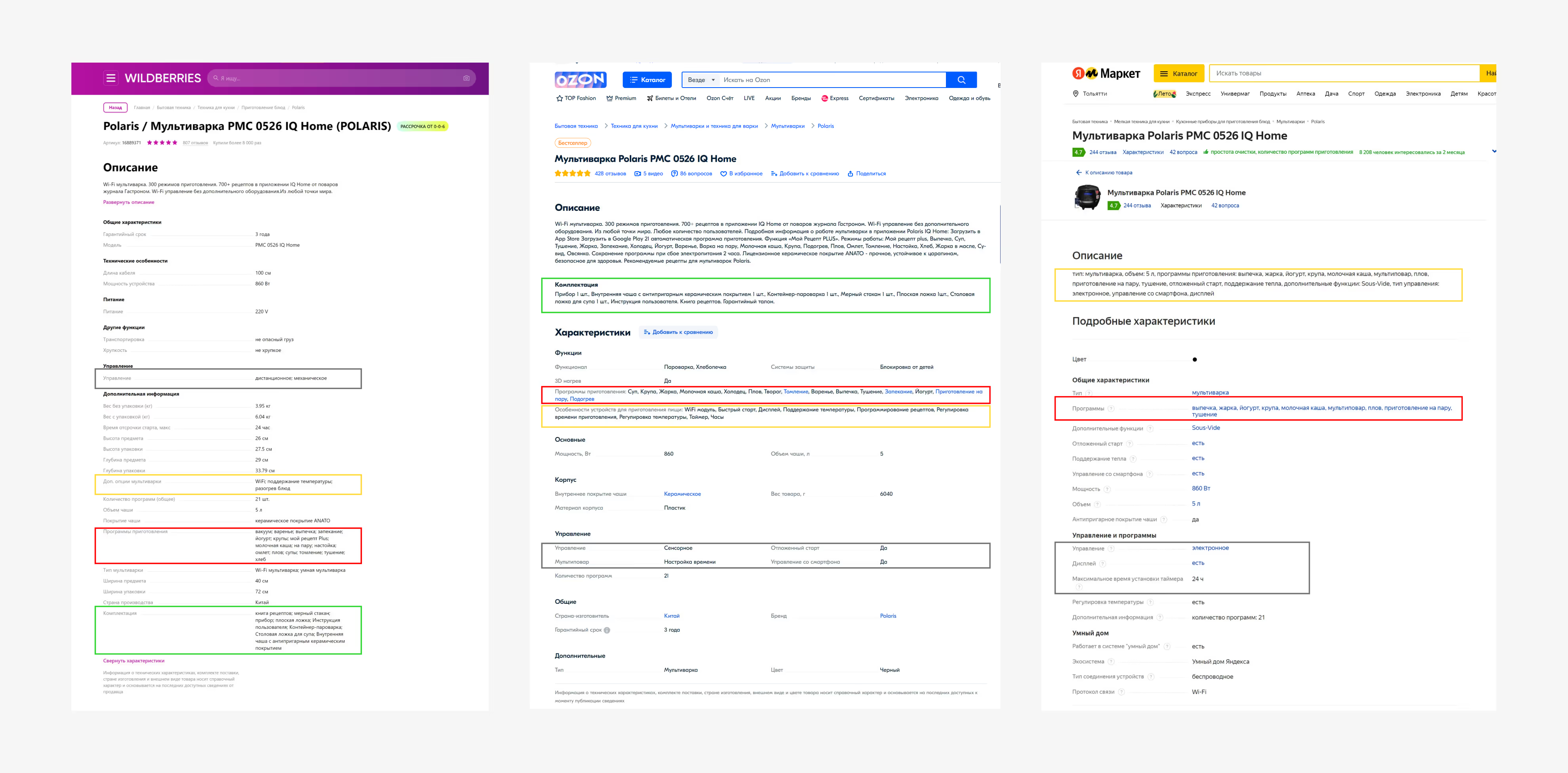
Sloy: Corporate Memory for AI Agents shows the internal side of the problem: chats, meetings, Drive, Git, tasks, and finance become machine-readable context that AI agents work with. For brand image, this is an important principle: the model should receive not a manager's summary, but a stable factual layer. Polaris: PIM for Marketplaces shows the external side: product data is centralized, and profiles and descriptions are updated in a controlled way. This is not a direct GEO case, but the mechanism is the same for AI visibility: if product facts differ across channels, external systems will reproduce the mismatch.

What to Do with an Incorrect or Negative Answer

  1. First split the problem into fact, interpretation, and opinion.

  2. An incorrect fact is fixed at the source: the official website, company profile, case study, documentation, product page, or partner profile.

  3. A negative interpretation requires more than text; it requires a cause: recurring complaints, weak case studies, conflicting descriptions, and a lack of fresh validation.

  4. An external source's opinion cannot be removed from the model with a GEO promise; it can be counterbalanced with evidence, a root-cause fix, and a proper public response.

  5. A good brand AI image report should show more than just “the model said something bad”

  6. , plus the correction path: which fact is wrong, which prompts repeat it, which sources support it, who owns the fix, and how repeatability changes after the update.

Brand AI Visibility

Let's check what AI says about the brand

We do not promise a place in the neural network's answer. We check the brand's factual footprint, error sources, competitors, tone, and repeatability; then we build a correction plan for official and external sources.

  • Prompt audit by category, competitors, selection risks, and reviews.
  • Source map: where AI gets facts and where they diverge.
  • Correction plan: website, case studies, product pages, profiles, reputation sources.
  • Re-measure after changes.
Build the brand's AI visibility loop →

FAQ

FAQ

Can we guarantee that ChatGPT will name us first?

No. You can increase the probability of a correct mention, but you cannot guarantee the position, brand list, order, or wording of the answer.

So does GEO make sense at all?

Yes, if GEO is understood as part of SEO, PR, data management, and reputation. No, if it is treated as a separate lever for controlling the model.

What Should Be Measured Instead of Position?

Share of mentions by prompt group, citation rate, source mix, share of incorrect facts, sentiment distribution, volatility, competitive context, and changes over time after updates. Sentiment cannot be read as a precise ranking: in the GEO at Scale study, it changed noticeably more often than the brand mention itself.

Do we need llms.txt or special AI markup?

For Google AI features, Google explicitly says no special files or new markup are required. The basic requirements are the same: the page must be accessible, indexable, useful, and understandable to people.

What Matters More: Articles or Data?

Data. Articles help when they confirm a specific fact and are tied to a product, case study, or industry. If systems, profiles, and case studies contain different versions of the facts, a new article only adds another version.

Where to start: content, PR, or data?

Start with data. First, understand which brand facts AI is already reproducing incorrectly and which sources support them. Then choose the tool: website edits, a case study, a product page, a company profile, a partner profile, a PR asset, or work with reviews.

When is PIM or corporate memory more important than new articles?

When the mismatch lives inside the company. If product descriptions, prices, industries, case studies, and limitations differ across CRM, the website, the catalog, marketplaces, and presentations, publications will not fix the root of the error. You need a managed data layer: PIM for product data or corporate memory for knowledge, decisions, and project context.

Conclusion

Managing brand image in neural networks is possible only as a discipline of probability: align facts to a single source of truth, back them with independent materials, measure repeatability, and fix the causes of errors. Anything that promises direct control over the model's answer does not hold up under source verification.

Sources

Checked on: 2026-07-01

Discuss the article: Brand Image Management in Neural Networks...

Send via: