DORA 2026: AI does not deliver ROI - your platform does

DORA 2026 on AI ROI in development: 88% see returns, but transformation is rare. Why AI is an amplifier of platform maturity, not a source of ROI. Analysis by Andrey Putin.

  • What DORA measured
  • The report's paradox: almost everyone sees the gains, almost no one sees the transformation
  • Main finding: AI amplifies system maturity
  • A market split in returns

Key point

Google and the DORA team published the 2026 study "The ROI of AI-assisted Software Development" (dora.dev/ai). The conclusion is uncomfortable for anyone who has handed the team AI assistants and expects speed to double: AI return on investment is determined by the system around the assistant - integrations, processes, and the maturity of the engineering platform. The assistant itself does not create that system. AI acts as an amplifier: it multiplies the return already built into the company.
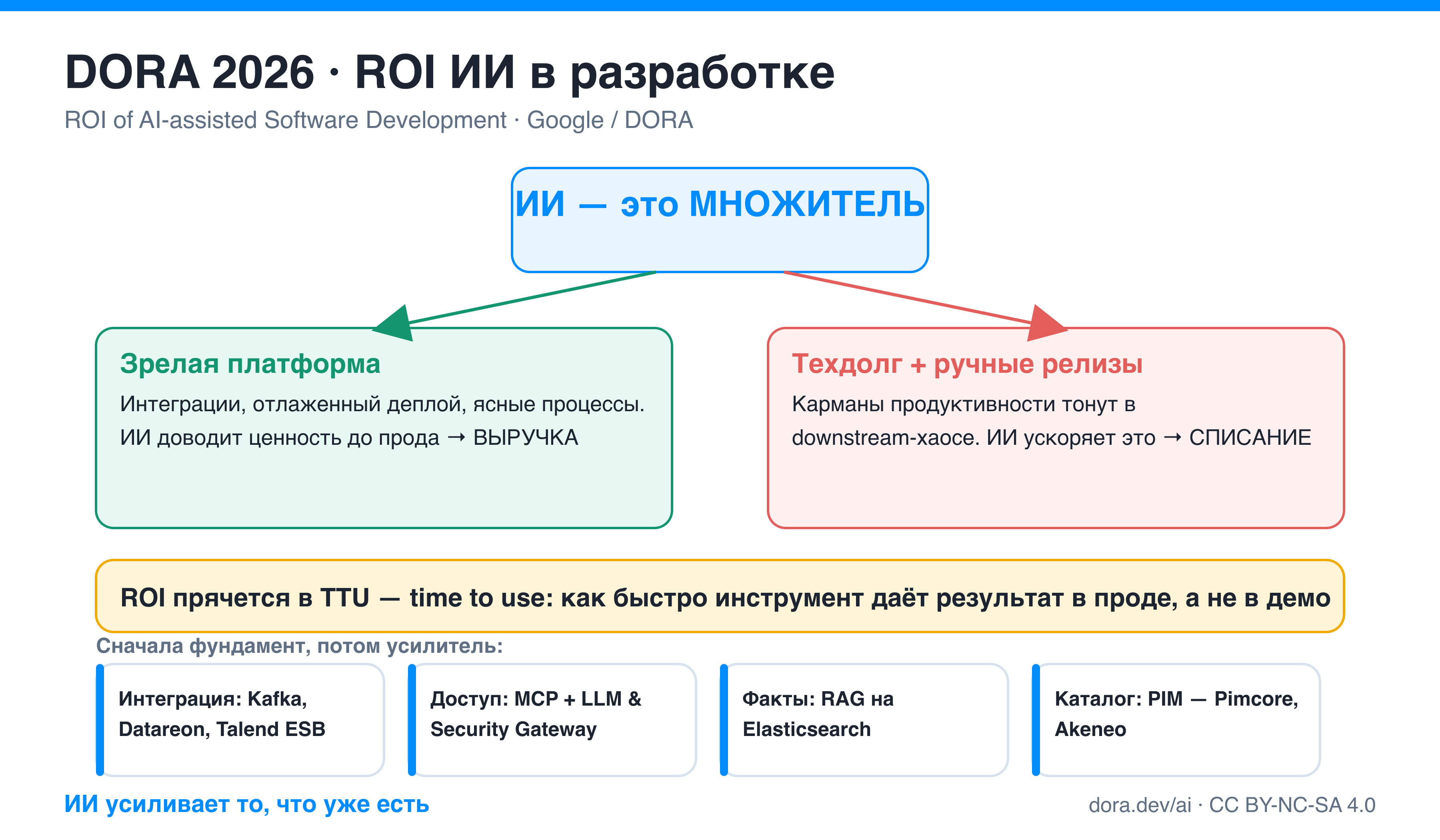
DORA 2026: AI Doesn't Deliver ROI — Your Platform Does

What DORA measured

For years, DORA has measured software delivery performance through two families of metrics: throughput (how often and how quickly a team ships changes) and instability (how often those changes break production and how long recovery takes). In the 2026 report, DORA links these metrics to ROI: delivery stability and speed are the basis for predicting AI returns.

The logic is straightforward

AI speeds up code production, and if the delivery pipeline already handles high throughput with low instability, that acceleration reaches business results.

If the setup is weak, the faster code runs into the same bottleneck, only the queue in front of it grows faster.

DORA also describes the adoption J-curve: at the start, teams go through a productivity dip and an adaptation period.

The authors ask leaders to read this failure as a learning phase, not a tool failure. Teams that go through the adaptation consciously see returns. Teams that are frightened by the setback and roll back the rollout lose what they invested.

The report's paradox: almost everyone sees the gains, almost no one sees the transformation

The numbers show the gap

According to Google Cloud, 78% of leaders report ROI from at least one generative AI use case, and 88% of organizations implementing AI are already seeing positive returns.

At the same time, structural transformation remains rare: many enterprises report only marginal or flat productivity gains.

The MIT NANDA study cited by DORA describes this gap more sharply. Where official corporate platforms do not give employees a daily productivity gain, "shadow AI" appears: people use unofficial apps to get their work done. Formally, the rollout is complete.

In practice, the value leaks outside the corporate perimeter and outside the reporting

DORA reduces the cause to one statement: it is about organizational design, not the model itself.

78%of executives see returns from at least one generative AI use case (Google Cloud)
88%of organizations adopting AI already see positive returns

Main finding: AI amplifies system maturity

  1. DORA calls AI an amplifier within the system.

  2. An amplifier does not create a signal - it boosts the one that already exists.

  3. A mature engineering platform with a well-tuned deployment process turns speed into revenue.

  4. A setup with technical debt and manual releases, under the same amplifier, produces isolated pockets of productivity: they sink into downstream chaos and never make it to the business metric.

  5. Let's break down the mechanics in one pass.

  6. A developer with an assistant writes code twice as fast.

  7. After that, the code sits waiting for review for a week, fails on a legacy integration, and breaks data in three systems that nobody synchronized. Input speed has increased.

  8. The delivery flow at the output stayed the same.

  9. The business pays for results in production, and that is where the queue now sits: code review, tests, integrations, and operations.

The J-curve of AI adoption: productivity dip before the rise

0–3 mo.

Implementationtraining, process redesign

The dip (J-dip)

Productivity dropmarginal or flat gains

Growth

Mature platformloosely coupled, CI/CD, SRE
Structural shiftreturns in P&L
Without platform maturity, a team gets stuck in the dip and writes off its budget before it reaches growth.

A market split in returns

Capital looks at the same data from different angles, and each position describes its own type of company.

PositionThesisWhat it describes
a16zAI agents become a new layer of the stack, English turns into a programming language, and the barrier to entry into code dropsStructural shift
Sequoia (David Cahn)"The $600B question": the gap between GPU capex and revenue is huge, building models ≠ monetizing them, the market underestimates the lagOvervaluation risk
JP Morgan, Goldman SachsMeasure pilots by actual metric changes, not by vendor promisesProof requirement

These positions do not contradict each other - they describe different companies. A strong engineering culture will see a shift along the a16z scenario. A weak one will lag along the Sequoia scenario and write off the budget before it realizes it bought a tool when the problem was in the foundation.

Assess where AI can deliver impact in your process

AI autonomy is overrated: today's assistant is a capable intern who needs supervision from a senior engineer.

Andrej Karpathycoined the term "vibe coding"

ROI is hidden in TTU

  1. A useful metric for deciding whether to invest is time to use.

  2. It shows how quickly the tool delivers results in real work, not in a demo.

  3. The model's intelligence and a polished presentation have nothing to do with TTU. A demo can be built in a day.

  4. The road from demo to production that can handle load and does not leak data runs through engineering and a mature process.

  5. A result that looks simple on the surface depends on expensive work under the hood, and AI does not do that work for the team.

What drives the return

  1. DORA breaks ROI down into value drivers: increased developer productivity, improved developer experience, and improved user experience.

  2. Every driver runs into the engineering system.

  3. Productivity turns into revenue only when an accelerated flow of changes passes through reliable deployment. Developer experience improves when engineers have data, access, and feedback at hand. User experience changes when a change actually reaches the user without regressions.

  4. The authors treat oversight of AI itself as a separate issue: the biggest return is lost where models have no control or boundaries.

Where AI ROI leaks: from developer speed to business outcome

AI speed

Developer + AIwrites code faster

Platform layer

Review and integrationloosely coupled?
CI/CD and proddeployment frequency

Business

Real use (TTU)≤ 1 month
ROIimpact on P&L
  • Weak platform Shadow AIFlat gains
  • No integration or review Return lagWritten-off budget
AI speeds up code entry, but returns are determined by platform maturity: review, integration, CI/CD, and time to real use.

What to strengthen before turning on AI

The foundation that DORA calls

Source

The ROI is made up of specific things

In KT.Team projects, we put those pieces in place before the assistant is layered on top. Data has to flow through.

An integration layer built on Apache Kafka, Datareon, or Talend ESB turns a zoo of systems into a predictable event stream.

Without it, faster code will hit desynchronization between ERP, the warehouse, and the storefront even sooner.

Assistant access must be controlled

MCP as a tool-connection protocol, together with an LLM and Security Gateway, gives the model hands inside systems - with auditing, limits, and no data leakage into third-party weights.

This is a direct answer to "shadow AI": when the approved environment is convenient and safe, employees have no reason to move to unofficial apps.

The answer should be based on your facts

RAG on top of Elasticsearch makes the model answer according to your catalog and policies instead of guessing.

The catalog must be clean

PIM on Pimcore or Akeneo provides the data clarity without which AI enrichment of product cards, facet generation, and taxonomy normalization run on garbage. In our projects, automatic facet generation and product card copywriting work because they sit on top of a managed product model.

How to calculate ROI

  1. DORA goes beyond claims and provides a financial model: a pre-implementation baseline, accounting for the initial productivity dip, a forecast for time to payback, and linkage to delivery metrics.

  2. The authors published a working calculator on dora.dev/ai/roi/calculator.

  3. The practical meaning of the model is simple: you should calculate return from your current maturity, not from the vendor's promises.

  4. A company with high throughput and low instability will get a short payback period.

  5. A company with the opposite profile first pays for the foundation.

Conclusion

DORA 2026 confirmed what every rollout shows: AI does not fix a broken process, it makes it louder. A company with a mature platform and well-tuned delivery will turn assistants into revenue within a quarter. A company with technical debt will get an expensive generator of technical debt. The choice of where to send the first budget is simple: foundation first, amplifier second. In reverse order, the company pays for a faster path to the incident room and layoffs over "AI that did not move anything."

Source

DORA, «The ROI of AI-assisted Software Development», Google LLC, 2026 - dora.dev/ai. ROI calculator: dora.dev/ai/roi/calculator. Original license: CC BY-NC-SA 4.0. Market estimates are based on public materials from a16z, Sequoia (David Cahn), JP Morgan, Goldman Sachs, and Andrej Karpathy.

Discuss the article: DORA 2026: AI Doesn't Deliver ROI — Your…

Send via: