Simple is not easy

How AI transformation is reshaping banking: from process automation to personalized financial services

How AI reshapes banking processes and supports scoring, anti-fraud, and personalized offers for clients.

  • Why banks need artificial intelligence
  • Areas of AI application in banks
  • Stages of AI transformation in a bank
  • We'll send you the materials you need or a commercial proposal

Introduction: AI transformation of the banking sector

  1. Reading time: 7 min. AI transformation is reshaping banking: from personalized offers and scoring to fraud prevention and process automation.

  2. These are not isolated projects but a rebuild of the entire operating model.

  3. The banking industry has entered an era where "technology" means not just automating operations, but rethinking the entire business model.

  4. Artificial intelligence (AI) and machine learning (ML) are no longer an experiment: they are becoming tools that change customer relationships, data processing, and risk assessment. Let's look at what AI transformation means for banks, which areas already deliver results today, and which challenges remain to be solved.

Why banks need artificial intelligence

Banks have historically been early IT adopters: they rolled out automated core banking systems for settlements, internet banking systems, and mobile apps.

But amid growing competition from fintech startups and tech giants, old methods are no longer enough. AI helps banks:

Analyzing large volumes of transactions and external data (social media, geolocation) makes it possible to craft individual offers for every client. For example, a bank can offer a credit card with a personal rate at the right moment, or send a notification about attractive deposit terms right after a client's income grows.

Improve risk management. AI algorithms can assess creditworthiness across hundreds of parameters: in-app behavior, data-entry speed and the presence of a credit history.

This improves the accuracy of scoring models and lowers default rates. AI also detects fraudulent transactions in fractions of a second by analyzing transaction patterns.

Optimize operational processes. In the back office, banks use chatbots to handle requests, robots for data entry and ML algorithms for document recognition.

This speeds up service and cuts costs.

Meet regulatory requirements. AI helps satisfy compliance requirements (KYC/AML) by analyzing customer data, tracking suspicious fund flows and generating reports. AI transformation is not just about deploying a chatbot.

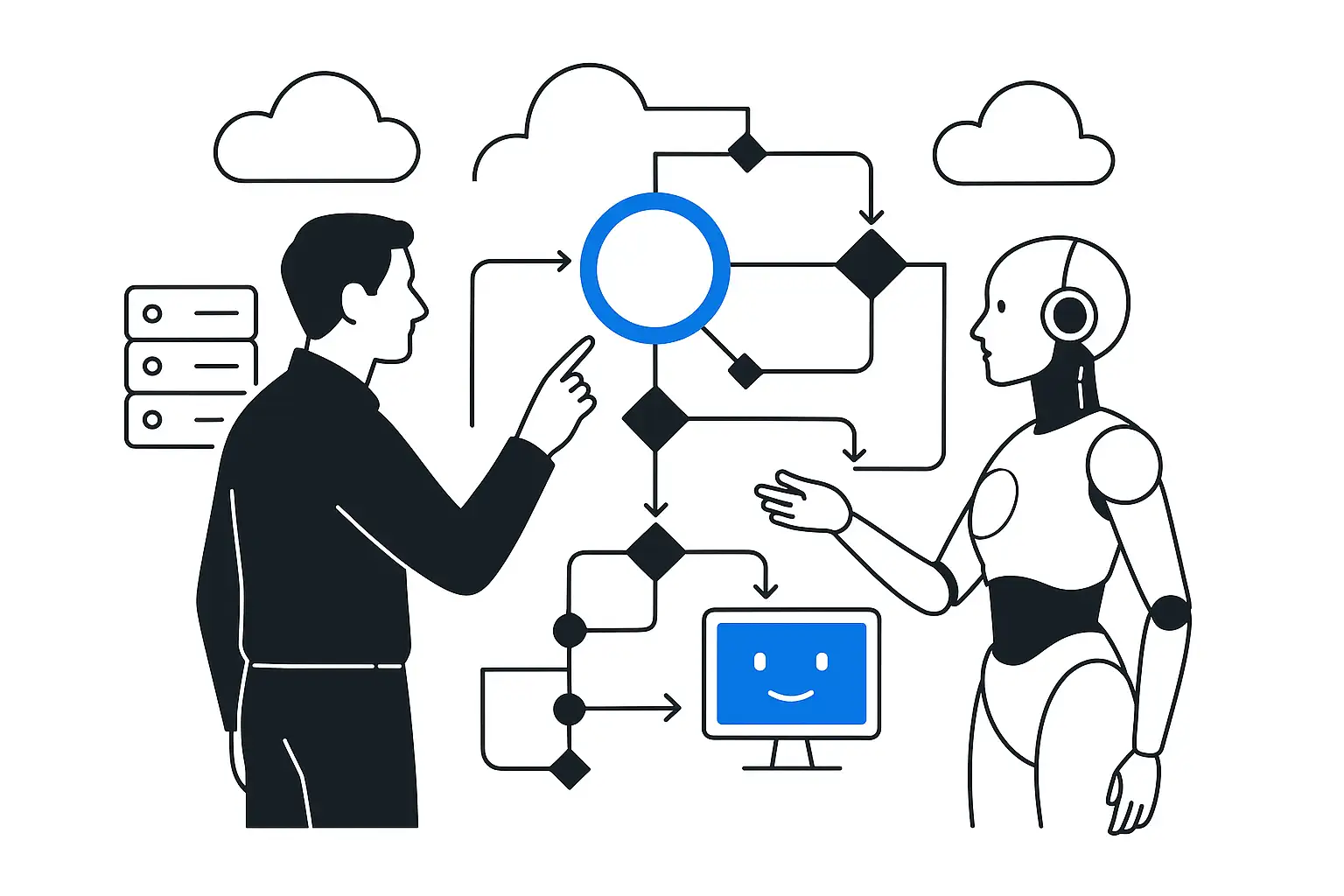
This is a complex process that requires rethinking business processes, building a new data architecture and coordination between departments. Business process management holds that processes must be seen "at a glance", modeled, analyzed and reworked as things change. In banks this matters even more: AI services must fit into existing processes without undermining the stability of the system.

Credit scoring and risk assessment

  1. Traditional scoring models used a small set of parameters: age, income and work experience. AI expands this list.

  2. Machine learning systems factor in thousands of variables: spending patterns, utility-payment discipline, mobile phone data and website behavior.

  3. Neural networks uncover hidden dependencies, allowing banks to approve loans where old models would reject them, or to deny clients with a high probability of default in time. In

  4. In CIS such models are used by the largest banks, including

  5. Sberbank and Tinkoff: they build their own ML platforms that compute a credit score within minutes.

Fraud prevention and compliance

  1. AI processes the transaction stream in real time.

  2. A sudden attempt to withdraw money in another country, an unusually large transfer, or purchases on different continents almost simultaneously — all of these events are instantly compared against the client's behavior.

  3. If a deviation from the typical pattern is detected, the transaction is blocked and the client receives a notification.

  4. Beyond operational security, AI helps detect money laundering (AML) by analyzing complex transfer schemes and chains of beneficiaries.

Robotic advisors, investment management and marketing

  1. Robotic advisors (chatbots/voice bots).

  2. Voice and text assistants are becoming the first level of communication.

  3. They answer routine questions ("How do I top up a card?", "Where is the nearest ATM?"), perform simple operations (paying for a phone, transferring money) and route complex requests to specialists.

  4. This reduces the load on the call center and resolves customer issues faster. AI bots learn from real conversations and continuously improve intent recognition accuracy.

  5. Investment management. In "smart" brokers, AI models build portfolios for a target risk level, taking into account macroeconomic data, market movement history and customer profiles. CIS banks are still developing such services cautiously, but global examples (Betterment, Wealthfront) show the potential of the robo-advisor.

  6. Optimizing operations and document flow. AI recognizes documents, extracts key fields, fills out forms and flags errors. For example, when opening an account the customer uploads a passport, and the system checks the document's validity and extracts the full name, number and expiry date on its own.

  7. Robotization reduces processing time and lowers the risk of human error.

  8. By analyzing spending, geodata, and payment timing, AI creates personal recommendations: partner discounts, alerts about favorable exchange rates, and personalized cashback.

  9. This boosts loyalty and increases the average transaction value.

We'll curate materials for your task

We'll reply within 30 minutes and send relevant cases, diagrams, or analyses tailored to your context.

Stages of AI transformation in a bank

  1. AI transformation is a long-term journey that can take several years.

  2. Management sets the goals: better customer experience, lower operating costs and stronger compliance.

  3. The strategy accounts for regulatory requirements (the central bank, the personal data law) and the specifics of the bank's portfolio.

  4. Building data infrastructure. AI needs high-quality data.

  5. Banks are building a "unified data platform," gathering information from core banking systems, CRM, social media, and credit bureaus.

  6. Quality standards matter: without "clean" data, models will not work correctly.

  7. Some banks build their own ML teams, while others work with fintech startups and vendors.

  8. The trade-off between in-house development and buying off-the-shelf solutions depends on budget and expertise.

  9. Pilot projects. AI is rolled out gradually: first a FAQ chatbot, then a scoring model for a single segment, then more complex areas.

  10. Pilots help measure effectiveness and prepare the team.

  11. Staff training and cultural transformation. AI requires a shift in mindset.

  12. Employees must understand that machine-driven decisions do not replace people but complement them. Training and new roles (for example, data scientist, data specialist) are essential elements.

  13. Integration into processes and scaling.

  14. Successful pilots are expanded to other units and integrated into the main workflow.

  15. It is important to automate not only the model itself, but also its updates, quality control, and regulatory compliance.

Challenges and risks of AI transformation

  1. AI transformation brings not only opportunities but also new risks:

  2. Models can become a "black box": why exactly was a client denied a loan?

  3. Banks are required to explain their decisions.

  4. That is why interpretable ML methods are used.

  5. Banks handle personal data that is protected by law.

  6. You must secure customer consent, encryption and access-rights separation. Anonymization may be required to use the data for training.

  7. Models can show unintentional discrimination: for example, denying loans to certain groups because of non-obvious correlations.

  8. Bias audits and regular model reviews are required. Skills. Data scientists and ML engineers are an expensive and scarce resource.

  9. A shortage of specialists slows projects down.

  10. Banks need to build internal expertise and collaborate with universities, organizing hackathons and incubators.

  11. Like any automation, AI can be perceived as a threat to jobs.

  12. It is important to communicate that algorithms take over routine tasks, leaving analytical and expert work to employees.

CIS experience and the global context

In CIS, the largest banks are actively adopting AI: Sberbank.

Sberbank stated that the company aims to become a "tech giant."

The "Sberbank ID" system unifies user data, while its units, including the AI center, develop the "Salute" assistant and scoring models. The "SberFinance" AI assistant helps choose financial products. Tinkoff.

The bank uses ML for scoring, anti-fraud, and recommendations, and is developing "Oleg" — a voice assistant that helps clients manage their products.

The Tinkoff Machine Learning team publishes research and shares its experience with the community. VTB.

Launched an "Analytics Platform" program and set up AI labs.

Uses computer vision technologies (for example, at pickup points) and develops solutions for analyzing client data.

Global examples: JP Morgan Chase is deploying the COIN system for automatic analysis of legal documents. Bank of America offers the virtual assistant Erica. BBVA and ING use ML to assess loan applications and forecast cash flow gaps. Notably, in some countries (Singapore, Canada) regulators actively support AI, creating dedicated "sandboxes" for testing. In the EU, there is a requirement for the explainability of automated decisions.

The future: synergy of AI, open banking, and quantum technologies

  1. AI transformation in banks does not happen in a vacuum.

  2. Related areas matter: open banking and the API economy.

  3. Open APIs let banks exchange data with fintech services. Combined with AI, this creates platform ecosystems where customers get services at the intersection of banking and non-banking offerings.

  4. Banks are reluctant to share data, yet they need to train models jointly (for example, for anti-fraud).

  5. Federated ML technology trains models across different sites without transferring the raw data, preserving privacy.

  6. Quantum computing. In the distant future, AI models will run complex calculations on quantum computers, optimizing portfolios and assessing risks at levels unavailable today. Hyperautomation.

  7. Combining AI, robotization (RPA), low-code platforms and BPM lets banks design and deploy processes within weeks.

Conclusion: AI as a bank's strategic advantage

  1. AI transformation in banks is not about trendy technology for its own sake.

  2. It is a deep overhaul of processes, the value proposition and the work culture. Banks that successfully integrate artificial intelligence gain a strategic advantage: they understand customers better, respond to change faster, reduce risks and cut costs.

  3. The path is hard, though: it requires data infrastructure work, engagement with regulators, skill development and constant monitoring of results.

  4. As with the BPM approach, AI transformation requires a clear vision and the ability to continuously adapt processes.

  5. This is not a one-off project but continuous development.

  6. The banks that grasp this philosophy and use AI wisely will become leaders of the new financial era.

Contacts

Let's Discuss Your Project

Leave your current contact details and describe your task. We will come back with clarifying questions and a proposal for the next step.