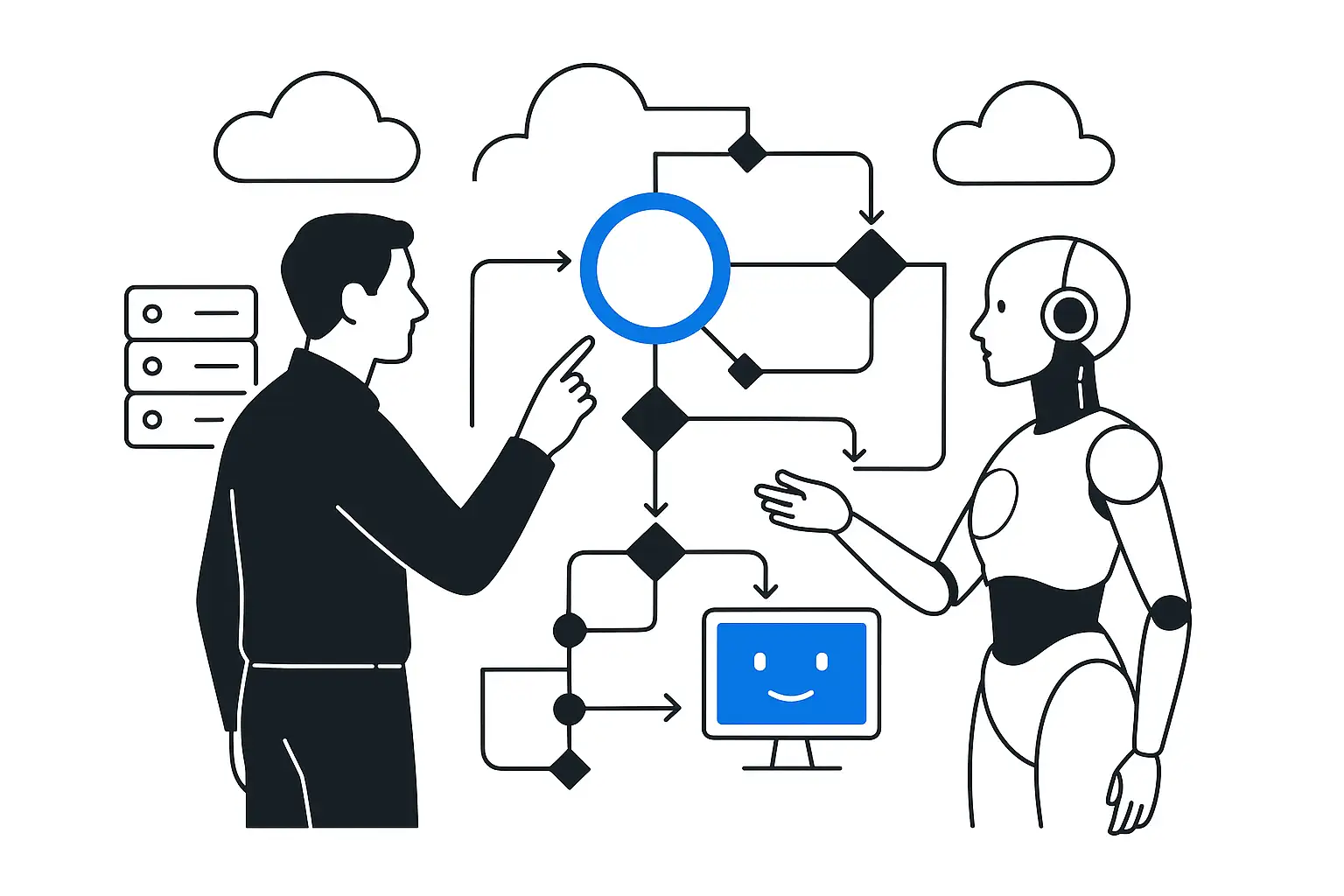
Rising costs
The cost of inference, integration and maintenance outpaces expectations, while the value per result isn't calculated in advance.

What reports from Morgan Stanley, Gartner, and Sequoia say about AI adoption in 2025-2026 and what it means for enterprise: ROI, agents, build vs buy.
28.06.2026 In 2025, AI stopped being an innovation-team experiment and became a line item in the annual plan.
But there is a gulf between "adopted" and "profitable," and major studies have already measured it. McKinsey: 88% of organizations use AI regularly, while 39% see a company-wide profit impact. Gartner: more than 40% of agentic AI projects will be shut down by the end of 2027. BCG: only 5% of companies capture durable AI value at scale.
This is not a reason to roll back AI - it is a map of where value is being lost.
Below are the most common business questions about AI adoption, each answered with the cited figure from the primary source (McKinsey, Gartner, BCG, Sequoia) and the mechanism that separates the 5% who got results from the 60% who did not.
All figures are current as of the verification date 28 June 2026, with a link to the report. The AI market changes within weeks, so check the primary source before deciding.
Almost everyone has adopted it: in McKinsey's survey (n≈2,000 respondents, fieldwork in summer 2025), 88% of organizations use AI regularly in at least one business function, up from 78% a year earlier. 62% are experimenting with agents.
So the lag is not in adoption itself. The lag is in the results.
Only 39% of respondents report company-wide profit impact (EBIT) from AI, and most of them put that impact below 5%.
Only 7% have fully scaled AI across the enterprise.
In other words: everyone deploys, a handful extract value.
The right question is not "Are we on time?" but "Is AI being applied to a process where it delivers a measurable effect?"
«We deployed AI»
«We got results»
Because most are early experiments and proof-of-concepts launched during the hype and often applied to the wrong task. Gartner explicitly forecasts that more than 40% of agentic AI projects will be canceled by the end of 2027.
Three reasons: rising costs, unclear business value, and insufficient risk control. Add to that "agent washing": out of thousands of vendors claiming agentic solutions, Gartner estimates that only about 130 offer truly agentic capabilities, with the rest being renamed assistants, chatbots, and RPA.
Takeaway for the buyer: filter not by the word «agent» in the pitch, but by which verifiable business result the project delivers.
How to choose a task and pilot so you do not end up in that 40% is covered in a separate analysis how to avoid failure and what slows AI adoption.
The cost of inference, integration and maintenance outpaces expectations, while the value per result isn't calculated in advance.
The project tackles an "interesting" task rather than one where the effect shows up in the P&L. Much of what's labeled agentic doesn't need to be agentic.
Without acceptance criteria, measurable quality, and a secure environment for sensitive data, security and legal will not allow the pilot into production.
In a study of more than 1,250 companies (September 2025), BCG identifies 5% as "future-built" - those capturing AI value at scale; 60% are laggards with virtually no material impact.
Leaders outpace laggards by roughly 2x in revenue growth and deliver ~40% more cost savings in the areas where they apply AI.
Key strategic insight:
Fewer fronts and deeper work on each one is the mechanism, not a slogan. McKinsey reaches the same conclusion from another angle: among roughly 25 tested factors, workflow redesign has the strongest impact on AI's effect on EBIT, meaning you redesign the process for AI instead of bolting AI onto the old one.
In its essay "AI in 2025," Sequoia describes the race among the largest models as narrowing to "five finalists": Microsoft/OpenAI, Amazon/Anthropic, Google, Meta, and xAI. The same essay calls 2025 a year of CapEx stabilization: after CapEx nearly doubled from pre-ChatGPT levels, normalization is expected, along with a shift from contract races to execution.
Sequoia's consumer-level forecast: every knowledge worker will use at least two AI search tools daily, one for work and one for everything else.
Meanwhile agents shift from demos to a share of value.
Per BCG, AI agents deliver about 17% of all AI value in 2025 and are projected to reach ~29% by 2028.
What agentic AI is and where it is truly justified - in the analysis AI agents 2025: autonomous LLM systems; keep Gartner's «agent washing» filter alongside.
Putting the four reports together yields a single picture.
Almost everyone has adopted it (88%), few see profit (39%), only a small share capture value at scale (5%), and the main lever is process redesign with focus on a few use cases.
This is the KT.Team stance: small strong teams take one process, rebuild it around AI and answer for the business result, not for the fact of deployment.
The practical decision behind these numbers is whether to build AI capability in-house or buy a ready-made solution.
The answer depends not on trends, but on how unique the process is and how often it will change.
FAQ
Every figure on the page comes from the primary source: McKinsey's "The State of AI in 2025" (survey of about 2,000 respondents), Gartner's press release from 25 June 2025, BCG's "The Widening AI Value Gap" study (September 2025, 1,250+ companies), and Sequoia's "AI in 2025" essay. All links are in the "Sources" section below, with the verification date. AI market figures become outdated within weeks, so verify before deciding.
No. It means adoption alone does not produce profit. Profit comes from placing AI into a process where the effect is measurable and redesigning that process. The gap is closed by the mechanism, not by another pilot. Details - AI in Corporations: Barriers and Impact.
Choose a task by measurable business outcome, not by the word "agent"; define acceptance criteria and risk controls before starting; do not spread across 6+ use cases. The task and pilot selection process is covered in the analysis how to avoid failure.
First determine which fields in the process are actually personal data and set up a boundary that keeps them from leaking out. This is a separate engineering task - see generative AI for business transformation and the solution AI for business.
Checked on: 28.06.2026