In 2025, businesses are increasingly moving away from chatbots and simple automations - AI agents are taking their place. These systems do not wait for commands; they act on their own: they build a plan, connect to APIs, generate reports, check errors, and enter data into software. We explain what AI agents are, how they work, how they differ from generative AI, and what business tasks they solve. We will show real cases, the architecture, and a step-by-step deployment plan with clear metrics.
AI Agents 2025: How Business Is Moving from Chatbots to Autonomous LLM-Based Systems - Case Studies and Deployment Plan
What AI agents are, how they work on LLMs, what tasks they solve and how to plan their implementation in business.
- What AI Agents Are and How They Work
- How AI agents work
- Types of AI Agents and Their Use in Business
- How AI agents solve business tasks: 2 real examples
What AI Agents Are and How They Work
AI Agents 2025 - these are software solutions based on large language models that analyze tasks, plan actions, and execute them without constant human involvement. Unlike chatbots that need step-by-step instructions, an AI agent only needs a goal - it breaks the goal into stages on its own, chooses tools, and interacts with external systems.
This is a shift from one-off answers to continuous, autonomous real-time operation. The key difference between AI agents and generative models - in the level of autonomy. Generative AI acts as an assistant: it suggests ideas, answers questions, and helps with content. An AI agent acts on its own, like a digital executor that does not just suggest, but delivers.
It connects to external services, runs processes, and makes decisions, all without requiring user input at every step.
Core components of an AI agent architecture: System core (LLM): large language models such as GigaChat Max or Gemma 2 are responsible for reasoning, planning, and decision-making. - Tools: "hands" of the agent that allow it to interact with the outside world - call APIs, work with databases, and automate tasks. - Memory: can be short-term (stores the context of the current session, for example in Redis) or long-term (semantic RAG memory for company knowledge and episodic memory for interaction history). - Orchestrator: a component that routes requests to the right agents or scenarios, ensuring the entire system works in sync.
Discuss your challenge with an architect
How AI agents work AI agents do not follow linear commands, but _through a "thinking" loop,_ independently planning and adjusting actions. This process consists of 4 repeating stages that ensure the goal is achieved. 1. Perception- the agent analyzes the task and context: dialog history, access rights, and available tools. For example, before creating a report, it checks what data is available to the user and in what format the result is needed.
2. Planning and reasoning- the system creates a step-by-step plan by evaluating possible scenarios. For example, it decides: "Connect to CRM → filter deals → group data → export the report". 3. Action- the agent executes the plan using tools: it calls APIs, works with databases, and sends emails. This is where it moves from reasoning to real operations.
4. Feedback and iteration - the system analyzes the result of each action. If it makes a mistake, it returns to the planning stage to find a new solution. This self-correcting ability sets it apart from simple scripts. A practical example of an AI agent in action: if an online store customer writes "Where is my order?", the agent does not give a canned response.
It identifies the user, finds the latest order, requests delivery status through the courier service API, and returns accurate information, including the tracking number and estimated arrival time. If there is a delay, it immediately offers compensation according to policy.
Types of AI Agents and Their Use in Business
Let's look at 5 main categories of agents, from the simplest to learning systems. 1. Simple reflex agents- work on an "if-then" principle: when a specific condition occurs, the predefined action is executed immediately. Example: a spam filter that automatically blocks unwanted emails based on key signals. 2. Model-based reflex agents - rely not only on current data but also on an internal model of the environment. This allows them to make decisions with incomplete information.
This is how voice assistants work when they take context, location, and user habits into account. 3. Goal-oriented agents - more advanced systems capable of independently building an action plan to achieve a goal. For example, recommendation algorithms in streaming services select content that is more likely to interest the user. 4. Utility agents - focus not just on achieving a goal, but on choosing the best path according to the specified performance metric.
A typical example is trading bots that analyze market signals to maximize profit while minimizing risk. 5. Learning-capable agents - the most advanced. They analyze the results of their actions and become more effective over time. This is how autonomous driving systems work: they accumulate experience and adapt to new road conditions. Use of AI agents across industries:
| Industry | Agent use case | Business Impact |
|---|---|---|
| Finance | Fraud detection systems that analyze transactions in real time. | Large banks reduce fraud losses by 60-70%, saving hundreds of millions of rubles annually. |
| Retail | Personalized product recommendations and dynamic pricing. | Increasing average order value by 10-15%, reducing cart abandonment by 20%. |
| Marketing and Sales | Automated CRM management, lead qualification, campaign planning. | Freeing up 30% of managers' time, increasing conversion by 15-25%, automating reporting. |
| Healthcare | Medical image analysis, patient monitoring, diagnostic support. | Increasing diagnostic accuracy by 25%, reducing result analysis time by 40%. |
| Transport and Logistics | Delivery route optimization, supply chain management, demand forecasting. | Reducing logistics costs by 15-20%, cutting delivery time by 25%. |
| Manufacturing | Predictive equipment monitoring and automatic spare parts stock replenishment. | Reducing downtime, lowering repair costs, and improving production stability. |
Reducing line downtime by 25%, lowering repair and spare parts logistics costs. According to expert estimates, in CIS the leaders in AI agent deployment fintech, retail, and the IT sector._ These industries were the first to see the practical value of autonomous systems - from automating routine tasks to working with large volumes of data.
In finance, AI agents accelerate key processes by 25-45% and reduce the number of errors by 15-30%. In retail, they are used for dynamic pricing and offer personalization, which increases conversion by 10-25%. Yet businesses need more than text generators — they need digital workers that take on tasks: from analyzing technical documentation and finding contractors to auditing code for vulnerabilities.
How AI agents solve business tasks: 2 real examples
To show how an AI agent works in practice, let us look at two cases: one in real estate and one in manufacturing accounting. 1.
Digital Realtor: Building an Autonomous Advisor for a Real Estate Platform Task: The Domclick team set out to turn a classic first-line support chatbot into a smart assistant capable of independently handling complex real estate customer requests, including multi-step scenarios. Solution: the company designed an architecture based on two _RAG chains_ - a technology in which AI first searches for relevant information in a knowledge base and then generates an answer.
The first chain is responsible for accurately identifying the user's intent, while the second uses a model GigaChat Max connects to the internal database if the request falls outside standard scenarios.
The agent acts as a real estate expert rather than just a phrase generator - this fundamentally changes the quality of customer interactions. Implementation specifics: - Autonomy: the agent independently determines the optimal way to process a request using a chain of reasoning. - Memory: the last 50 messages are used as memory, allowing the agent to account for dialog context. - Tools: the agent is integrated with the platform's internal APIs to perform practical actions. - Handling specifics: the filters were improved and a personal data anonymization mechanism was implemented for use with the cloud model. Result:The Domclick AI agent handles a wide range of requests autonomously, from property search to mortgage product consultations, easing the load on operators and improving customer service speed.
2. AI agent in manufacturing: automating document workflows in 1C Task: a large industrial company manufacturing metal structures faced routine tasks in 1C that took up to 3 hours a day from accountants and managers.
The company decided to automate document creation, data updates, and report generation so specialists could focus on higher-priority tasks. Solution:the partner team implemented AI agent integrated with 1C Via API. The architecture includes two processing layers: the first recognizes and classifies incoming tasks, and the second performs actions in 1C, strictly following the defined business logic. Implementation specifics: - Execution autonomy: the agent handles tasks on schedule or on demand, for example, it closes shift reports and creates service completion certificates every day. - Data handling: the system automatically updates customer and vendor records, checks for duplicates, and verifies field accuracy. - Quality control: the agent checks required fields, reconciles document totals, and identifies discrepancies. - Module integration: via API, it interacts with payroll, HR, and accounting modules to solve tasks comprehensively. Implementation results: - Reduce time spent on routine operations by 70%. - Automatically create 50+ documents every day. - Reduce data errors by 45%. - Generate 10+ reports daily without employee involvement. - Free up 2 hours of specialists' working time every day.
Discuss your challenge with an architect
Implementing an AI agent: a step-by-step plan for retail
Let's review a general step-by-step implementation plan AI agent for retail - using the example of a retail chain that wants to automate handling customer requests about order status and product availability. Step 1: Define the goal and metrics Clearly state which business problem the agent solves. For example: "Reduce the call center load by 40% within six months by automating responses to frequent requests".
Define the key metrics right away: response time, the share of issues resolved without an operator, and NPS. Step 2: Data analysis and architecture design Collect and standardize the data the agent needs: the product knowledge base, order statuses from CRM, and support history. At this stage, choose the agent type (for example, a model-based reflex agent) and its architecture - define the core (LLM), the tools for connecting to warehouse and delivery service APIs, and the type of memory.
Step 3: Choosing the technology stack and development Choose a framework based on the team’s technical maturity. For retail with standard scenarios, solutions like LangChain or low-code platforms such as Langflow are suitable - they let you quickly build an MVP without deep development. Step 4: Pilot rollout and training Launch the pilot in a limited way - for a narrow audience or through a single channel (for example, a website chat). At this stage, it is important to collect feedback, analyze conversations, and identify problematic scenarios.
This is critical for fine-tuning the model and adapting it to real-world situations. Step 5: Scaling and process integration After successful testing, roll out the solution across all channels: the website, messengers, and apps. At the same time, redesign support processes - employees should switch to complex cases, while the agent handles standard requests. Step 6: Continuous monitoring and optimization Special attention should be paid to monitoring.
Track not only business outcomes but also technical metrics: API load, token usage, response speed, and failure rate. An agent is not a one-time deployment but a continuously learning system that must be adapted to changing conditions. Implementation risks and specific mitigation measures:
| Risk | Specific actions to prevent |
|---|---|
| Unclear project goals | Set measurable KPIs before work begins: "reduce call center workload by 40% in 6 months" |
| Poor data quality | Conduct a full data audit and clean the databases of duplicates and errors before integration |
| Employee resistance | Involve the team in development from the first stage and provide training before the system goes live |
| Budget overrun | Break the project into fixed-cost stages and track spending weekly |
| Insufficient scalability | Build in 50% performance headroom for the architecture and test peak loads |
| Poor answer quality | Set up daily testing on 100+ real scenarios and update the model once a week |
Do you need an integrator to implement an AI agent?
In 85% cases require involvement a specialized integrator. An integrator is a company that professionally implements complex AI projects and uses proven methods. Choosing the right contractor reduces risks, speeds up launch, and improves return on investment. How to choose an integrator: - Industry experience - ask for case studies with concrete results in your field.
It is important that the team has already handled similar tasks - for example, support automation in retail or assortment management. - Tech stack - ask which frameworks and platforms they work with. Request examples of integrations with the systems you use: CRM, ERP, warehouse solutions, and more. - _Team_- make sure the project involves not only developers but also business analysts who understand the specifics of your processes.
Request information about the key specialists, including their expertise and experience. - Methodology - prefer an iterative approach with a mandatory pilot stage. Discuss how interim results will be demonstrated and how adjustments will be made during the project. - Support - agree in advance on post-project support terms: incident response time, update schedule, and options for scaling and feature development.
The future of AI agents: what awaits business over the next 5 years
According to Gartner’s forecast, by 2028 up to 80% corporate processes will be automated with AI agents. This will require businesses not just to adopt new technologies, but to rethink operational models and workforce management approaches.
Five key directions are already taking shape today, and they will define the development of agentic AI in the coming years. 1. Hyper-specialization. Companies are moving away from universal solutions in favor of niche agents. Each such agent will solve a strictly defined task - from risk calculations in finance to analyzing feedback in a brand's digital channels. 2. Multi-agent systems. The future belongs to teams of agents that interact with one another.
For example, a procurement AI agent automatically passes data to the logistics agent, which then coordinates actions with the warehouse. This reduces manual operations and speeds up decision-making. 3. Predictive decision-making model. Agents will learn not only to react, but also to anticipate events. In logistics, they will reroute before bad weather arrives; in manufacturing, they will order parts in advance based on the probability of failure. 4. Cloud-free operation.
As edge computing evolves, agents will be able to operate on local devices without sending data to the cloud. This reduces latency, improves stability, and strengthens control over sensitive information. 5. Rules and standards. A regulatory framework and common technical protocols are expected to emerge.
This will be an important step toward large-scale adoption of AI agents in heavily regulated sectors - from healthcare to public administration. Interesting fact: agents show early signs of social behavior - in experiments, they negotiate on their own, divide tasks, and form teamwork without external control. In business, this means self-organization capability - as demand grows, one agent can hand tasks off to another, while a third joins the chat to support customers.
All of this happens automatically, without human intervention.
Discuss your challenge with an architect
Discuss article: AI Agents 2025: how business is moving away from…
Related Cases

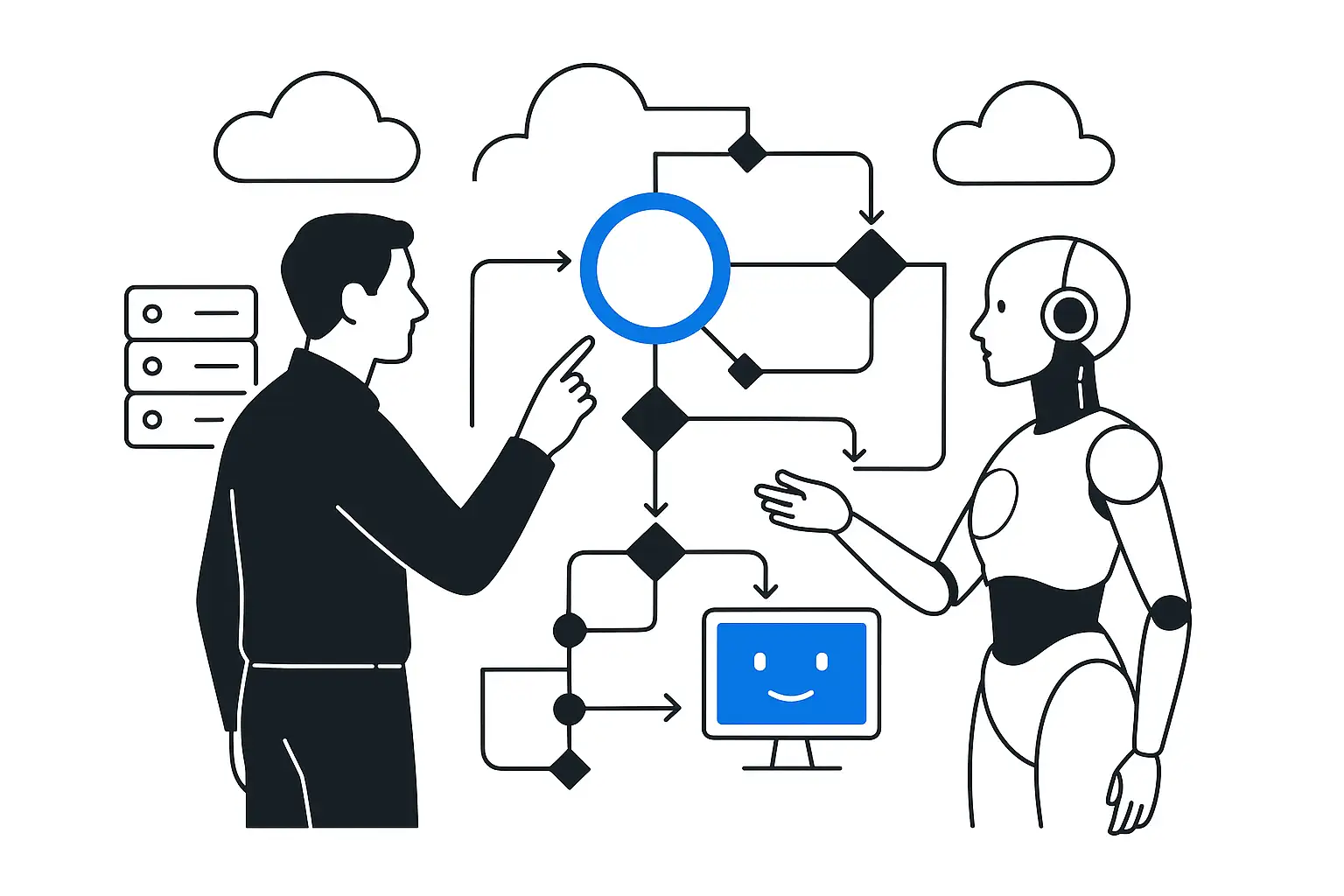
OSNO-VA: AI accountant
- Built an AI platform
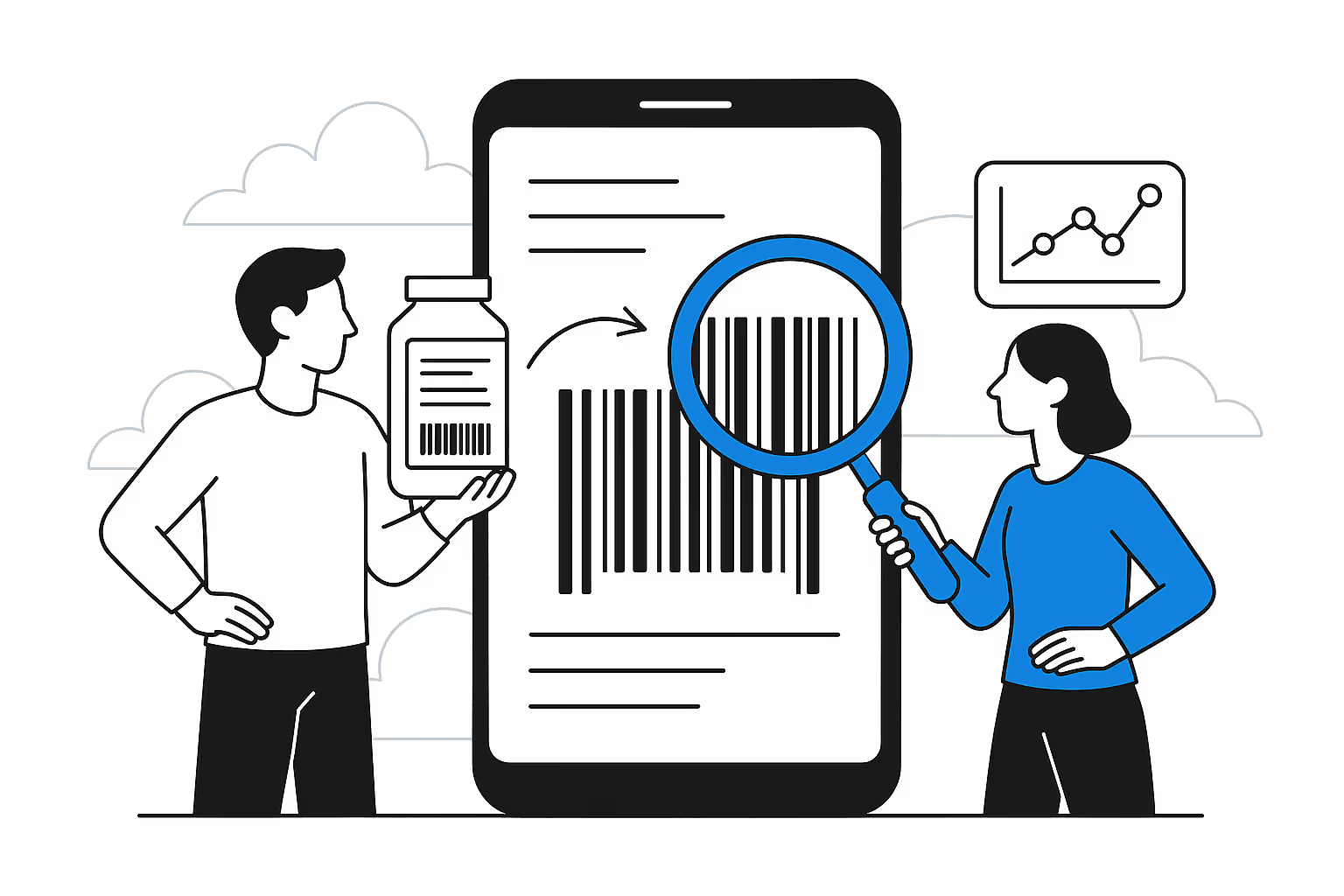
AI ingredient recognition by barcode
- The AI service processes up to 10 images in 2 minutes
- Recognition accuracy for composition is 80-95%
Related solutions
Articles on the topic
- 30,000 merges a day: AI hits the software delivery bottleneck
- A Claude key in Git: GitHub blocks the push by default
- Four frontier labs: the edge lies in the system around the model
- AI accelerated releases. Now the system must withstand failures
- AI agents in production depend on the system around the model