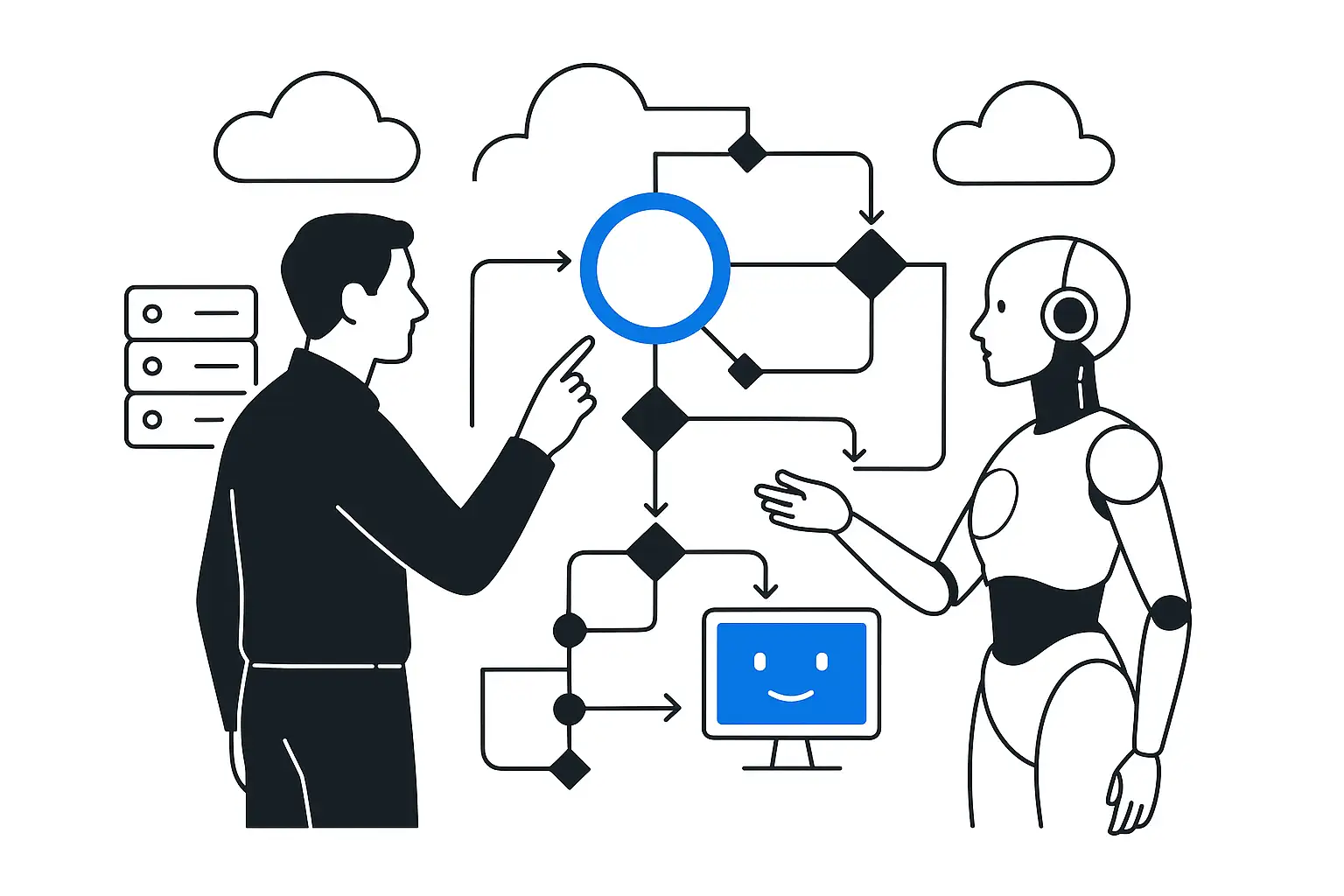
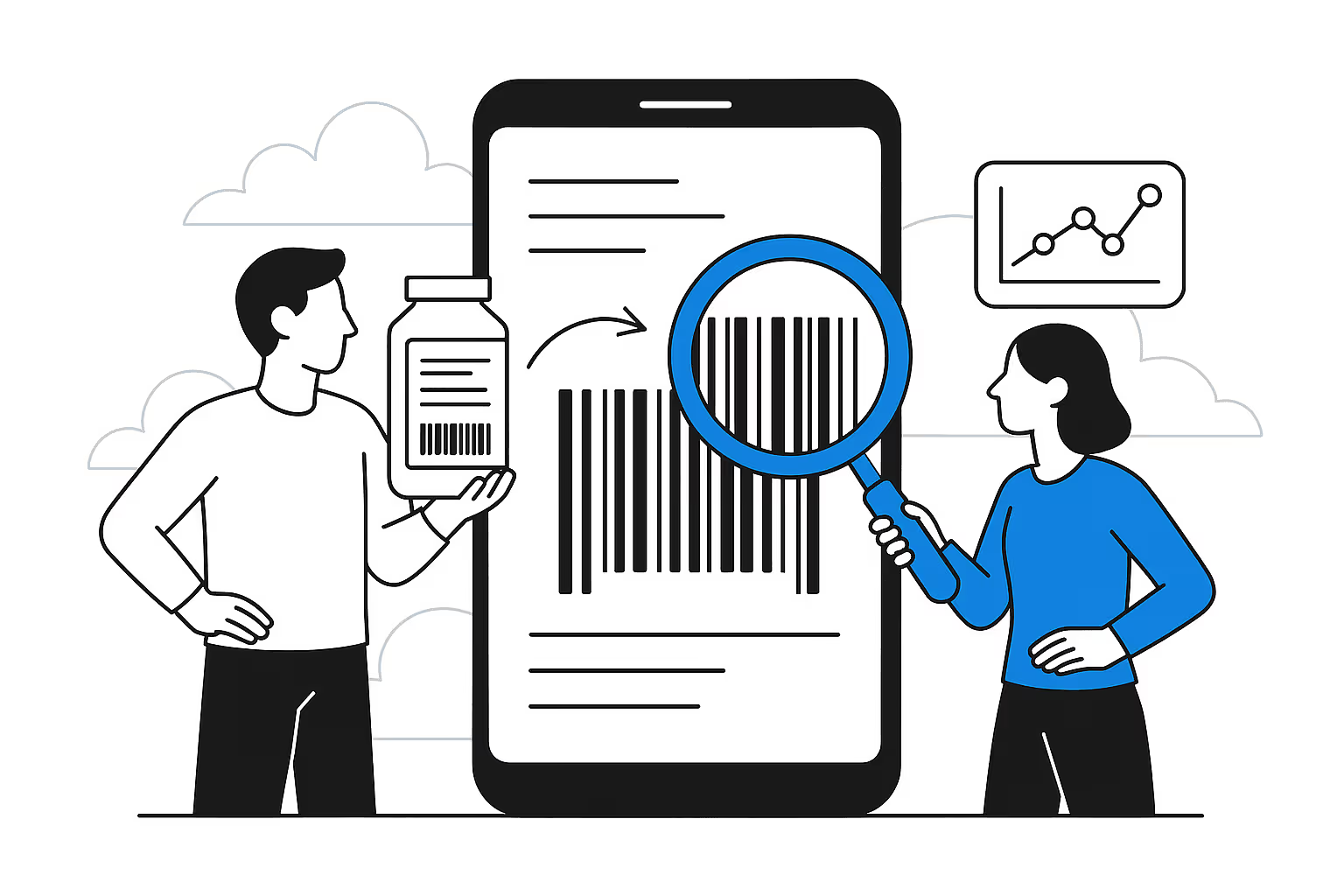
Implementing generative AI is not just installing new software, and process transformation, approaches, and culture inside the company. To make the process effective, you need to move step by step, with clear metrics and a well-thought-out strategy. Stages of implementing generative AI 1.
Assessment: what should be automated? At this stage, identify: - Which processes are routine and scalable? - Where are creative or human resources lacking? - Where are the biggest delays and bottlenecks? Examples: - In banking: handling incoming customer requests. - In e-commerce: generating product cards. - In HR: automating job posts and emails. Marketing teams spend up to 30% of work time on preparing texts, visuals, and standard content.
In customer support, up to 85% of inquiries can automatically process LLM models, which saves to 3 minutes for each request. 2.
Choosing a platform and approach The choice depends on your tasks, budget, and confidentiality requirements. Possible options: - Ready-made tools: YandexGPT, GigaChat, Kandinsky - are suitable for getting started without development. - Proprietary AI model (LLM) based on open source, for example LLaMA or RWKV - requires resources but increases control. - API solutions: Cloud MTS, VK Cloud, Yandex Cloud - well suited for CRM integrations. Criteria for choosing generative AI
| Criterion | What matters | Solution examples |
|---|
| Implementation goal | What AI is for: text generation, visual content, support automation | GigaChat - chatbots and documents
YandexGPT - texts, instructions, and search tasks |
| CIS language support | Morphology, slang, legal, and business style | YandexGPT based on Search and Alice
Sber GigaChat on a CIS-language corpus |
| Security and Compliance with Federal Law No. GDPR | Data storage in CIS, encryption, personal data protection | SberCloud, Yandex Cloud, VK Cloud - all with data centers in CIS |
| Infrastructure integration | API, SDK, REST/gRPC, low-code and no-code tools | All major platforms: GigaChat, YandexGPT, MTS AI, VK Cloud |
| Business customization | Prompt instructions, style tuning, RAG, embeddings, fine-tuning | YandexGPT Pro, GigaChat SDK |
| Human-in-the-loop (manual control) | Manual moderation, generation controls, log auditing | All platforms - via API integration or an admin panel |
| Support and SLA | 99.9% SLA, technical support, documentation, and service stability | Sber, Yandex Cloud, and VK Cloud provide B2B support |
| Cost and scaling | Price per token, tariff transparency, predictable costs | GigaChat - from about 200,000 RUB per million tokens
YandexGPT - from about 120,000-180,000 RUB |
| Speed and stability | Response latency, failover, API scale | Major providers offer fault tolerance and limits tailored to business tasks |
| Documentation and training | Level of API documentation, availability of SDKs, training materials | GigaChat SDK, YandexGPT Playground, detailed guides in Yandex Cloud |
3. Pilot project The goal is to test AI in real conditions with a limited scope of tasks and staff.
To do this: - Choose 1-2 key processes: email campaigns, customer replies, description generation. - Set metrics: execution time, number of errors, conversion rate. - Compare with manual methods. In pilot projects with generative AI, the average ROIreaches200-400% in 3-6 months. 4.
Integration and scaling Once the pilot delivers results, the AI model must be embedded into the existing infrastructure: - CRM (Bitrix, AmoCRM); - CMS (1C-Bitrix, Tilda); - ERP systems; - chatbots / call centers. In Tinkoff, AI suggestions built in in the operator interface.
This reduced the average response time to 25 % and increased customer satisfaction by 14%.
Discuss your challenge with an architect
5. Team training For a successful rollout, explain the value of generative AI to employees and train them to work with it: how to write prompts and recognize "hallucinations." Develop internal usage guidelines to make adaptation easier for staff. 6. Quality control and moderation If AI creates customer-facing content, data is published without additional verification, or you work in a regulated industry, human review is required in the workflow.
An employee should perform: - Moderation for toxicity, inaccuracies, and legal risks. - Checking compliance with brand guidelines and tone of voice. - Checking originality. 7. Performance evaluation Analyze metrics before and after adoption.
Key metrics: - Cost reduction: fewer freelancers, fewer revisions. - Time savings for a task: a content plan in 1 day instead of 1 week. - Higher conversion: AI content is personalized -> higher response rates. - Increased revenue: marketing campaigns launch faster. - Reduced response time in support: from 60-120 s to 5-10 s. - Greater automation support: from less than 40% to 85%. What mistakes do companies make when implementing AI
| Error | How to avoid |
|---|
| Using AI without training the team | Provide internal training and onboarding |
| Expecting "magic" from the model | Build a pilot project with clear metrics |
| No manual moderation | Implement mandatory human-in-the-loop |
| Moving all tasks and operations to AI | Automate only routine tasks and functions |
| Ignoring the legal side of AI use | Define instructions and usage policy |
Implementing generative AI is not a one-time action, but a strategy. Key to success: - Identify processes with the highest operational load. - Start with a pilot project and measure the benefits. - Choose a platform with localization and SLA. - Roll out with training, moderation, and team support.
Checklist: is your business ready for AI adoption - You have repetitive routine tasks. - You understand which tasks can be automated. - You have people willing to experiment and learn. - You know how you will review and moderate AI content. - You have a dedicated budget and 2-3 months for a pilot project. - You have chosen a technology partner or provider. - You are ready to measure results with numbers.