
AI-Native
AI-native development: agent, repository and skills library
AI-native development is a way to build websites and digital products by deploying an agent (Claude Code, Codex, Cursor) on top of the client's repository and skill library.
Development Approach
Our clients
Clients and partners













88,6%Claude Opus 4.8 scores 88.6% on SWE-bench Verified, versus about 4% for 2023 models
71%of developers who regularly use AI agents work in Claude Code
1M tokensOpus 4.8, Sonnet 4.6, and Fable 5 have the context - the agent can keep a large repository in memory
30+agent platforms execute the same skill in SKILL.md format without rewriting
AI platform within your infrastructure
Skills drive the core. Agents activate them by task.
KT.Team delivers reusable expertise as versioned skills. Agents connect them per task, and a Git registry makes owners, versions, dependencies and operational status visible to IT.
Deploy the entire stack on-premises or in private cloud. Models, runtime, and interfaces remain interchangeable.
Industry solutions
What Can Be Done with AI-native Development
Capabilities
AI-native development capabilities
Prompt: business task (new page, case study, integration, fix)The agent selects the skill that encapsulates the solution algorithmReading context from the repository: narrative, components, procedures, historyAccess to data and systems through MCP - without custom connectorsAssembly from reusable components following the skill stepsAutomated build checks: SEO, visuals, copy, clean URLsPublish and live-check; the expertise remains in the skills for the next task
Speed to Result
A standard task (new page, case study, block, SEO check) is solved in a few prompts because the algorithm is already built into the skill instead of being reconstructed each time
Reproducibility
The skill defines the same execution path for any operator, so the result does not depend on who is using the agent
Corporate Memory
Narrative, guidelines, the design system, and solved tasks are stored in the repository and skills, not in people’s heads - knowledge accumulates instead of leaking when people leave
Transferability
The repository, skills, and MCP servers are handed over to the client in full; another team can continue the work without archaeology
No vendor lock-in
Skills (SKILL.md) and integrations (MCP) are open standards; you can change the model and vendor without rewriting the expertise
Quality as part of the process
Validators, audits, and critics for copy, visuals, and SEO are built into the repository and run on every build, instead of relying on human review
Lower Barrier to Entry
The content manager edits Markdown and triggers publishing independently - without handing every change to development
Bilingual by default
RU and EN versions are generated from a single source with explicit overrides - no second team and no second content tree
Approach
How we implement AI-native development
Without modifying the core
We do not fork or patch the core. AI-native development remains on the standard, updatable version, with customizations moved into separate modules or services. Before each update, we check module and integration compatibility in a test environment.
International Standards, Not Homegrown Hacks
Where a mature international solution exists, we use it instead of inventing our own protocol or platform. Before writing code, we study how the problem is already solved in the industry.
Transferability
The solution is loosely coupled and documented: it can be handed over between teams and contractors without rewriting. You are not tied to us.
AI compatibility
AI-native development within the AI stack
Agent
Claude Code / Codex / Cursor with access to the repository and tools; context up to 1M tokens
Repository
Single source of truth: content, components, narrative, guidelines, and history - all versioned
Skills (SKILL.md)
A folder with Markdown instructions and scripts; they encapsulate expertise, load on demand, and follow an open standard
MCP
An open protocol for connecting data and systems: one interface instead of N×M connectors, governed by the Linux Foundation
Engineering foundation
Loose coupling and transferability, designed for agents: the agent speeds up work on healthy code
Build Checks
Validators and SEO/visual/copy audits in the repository block publishing poor-quality output
Context 2026
What changed in the market
Agentic coding has become the norm
By 2026, AI agents (Claude Code, Codex, Cursor) understand repositories, edit files, run tests, and iterate; Claude Code leads: 71% of those working with AI agents (Pragmatic Engineer Survey, 2026)
Engineering quality of models
Claude Opus 4.8 (May 28, 2026) scores 88.6% on SWE-bench Verified, compared with about 4% for 2023 models; on June 9, 2026, Anthropic released Claude Fable 5, its most powerful public model ($10/$50 per 1M tokens)
Context: 1M tokens
Opus 4.8, Sonnet 4.6, and Fable 5 work with 1 million tokens of context at standard pricing, with no long-context premium, allowing the agent to keep a large repository in memory in full
Skills: an open standard
On December 18, 2025, Anthropic released the Agent Skills specification (SKILL.md, a folder with Markdown files and scripts); Microsoft, OpenAI, Cursor, GitHub, and Figma adopted it, and the skill works across 30+ platforms
MCP: neutral connectivity
Model Context Protocol (open-sourced in November 2024) was supported by OpenAI, Google, and Microsoft by 2025; in December 2025, Anthropic transferred the protocol to the Linux Foundation (Agentic AI Foundation), securing its neutrality
Honestly
Pros and cons
Pros
- Complex routine tasks are solved in a few prompts: the expertise is captured in skills instead of being repeated manually each time
- The result is reproducible: the skill defines a single algorithm regardless of who executes it
- Company knowledge accumulates in the repository and skills instead of being lost when people rotate out
- Everything is transferable: the repository, skills, and MCP integrations are handed over to the client and can be continued by another team
- No vendor lock-in - SKILL.md and MCP are open standards, and the model or vendor can change without rewriting expertise
- Quality is checked automatically during build instead of depending on the reviewer’s attention
- The barrier to entry drops: a content manager can publish edits independently, without escalating to development
Cons
- Without an engineering foundation, an agent speeds up degradation: AI code tends to duplicate itself (GitClear: repeats x8, copy-paste 8.3% to 12.3%, refactoring below 10%)
- Hidden technical debt: working but inconsistent pieces accumulate quietly and later shift the team's time from building to fixing
- Upfront investment is required: architecture, the skill library, and operating procedures must be designed before the agent starts working
- The agent needs verification: on complex and atypical tasks it can make mistakes, so validators and human review of key decisions are mandatory
- The cost of runs on high-end models and large contexts is significant, so it must be managed deliberately (effort, task budgets)
- The benefit shows up on a stream of repetitive tasks; for a one-off unique job, the overhead of skills may not pay off
News
What's New in AI-Native Development
-
Claude Opus 4.8: Dynamic Workflows for hundreds of parallel subagents
Opus 4.8 was released 41 days after 4.7 — Anthropic’s fastest update cycle. Dynamic Workflows (research preview) lets the model build and modify a graph of hundreds of parallel subagents for a complex task. Weights are closed; access is available through the API, Bedrock, Vertex AI, and GitHub Copilot.
n8n orchestrates workflows through a static, predefined node graph; Dynamic Workflows lets the agent rebuild the task graph on the fly n8n → -
Claude Opus 4.6: agent teams in Claude Code
The flagship Opus 4.6 added agent teams to Claude Code — agent teams divide large tasks into subtasks and work in parallel. Weights are closed; access is available only through the API/cloud (AWS, GCP, Azure).
n8n has orchestrated workflows through predefined nodes since 2019; agent teams divide tasks themselves without manually defining the steps n8n →
Blog
Articles about AI-native Development

Projects
Cases

Custom Akeneo modules for delivery
Learn more
OSNO-VA: AI accountant
- Built an AI platform
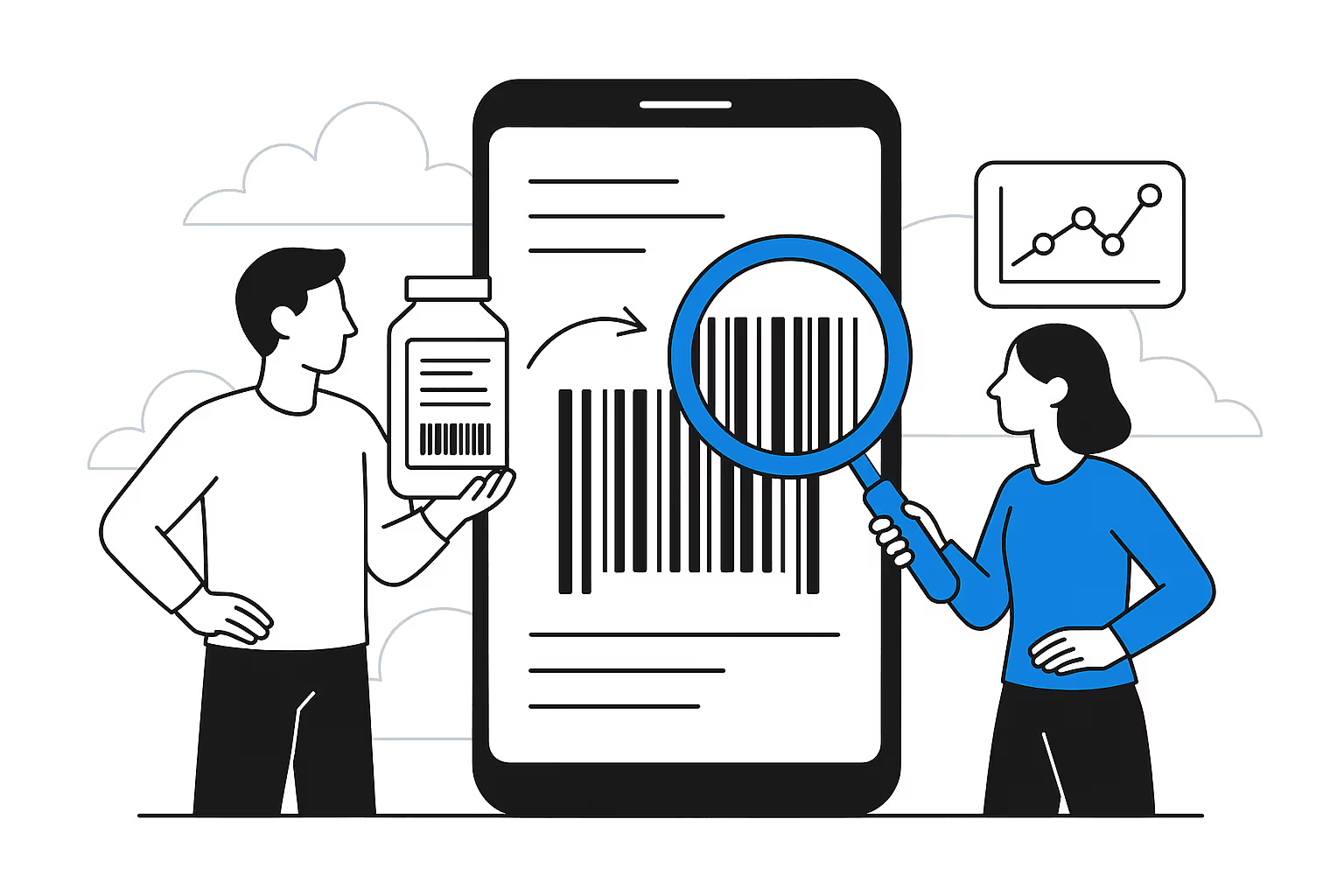
AI ingredient recognition by barcode
- The AI service processes up to 10 images in 2 minutes
- Recognition accuracy for composition is 80-95%
Discuss AI-native development: agent, repository, and...
Related solutions
Articles on the topic
- 30,000 merges a day: AI hits the software delivery bottleneck
- A Claude key in Git: GitHub blocks the push by default
- Four frontier labs: the edge lies in the system around the model
- AI accelerated releases. Now the system must withstand failures
- Inference determines the AI budget: three lessons from AWS's latest guides


