Development digitalization: how to adopt BIM, AI and data platforms to speed up construction and grow profit

How to adopt BIM, AI and data platforms to speed up construction, cut costs and raise profit.

  • What is digitalization in development
  • Why development digitalization became mandatory
  • Key technologies for development digitalization
  • Information modeling technologies (BIM)

Property development digitalization helps complete projects faster, control costs more accurately, and simplify management. But in practice, companies often implement isolated tools and fail to get results because they lack a systemic approach. We look at how property development digitalization works, which technologies actually deliver results, how to structure implementation step by step, and how it affects timelines, sales, and business value.

What is digitalization in development

  1. Development Digitalization - it is project management based on data rather than scattered spreadsheets and verbal agreements.

  2. The company collects information from every stage - from design to sales and operations - into a single system and uses it for fast, data-driven decisions.

  3. Data is updated as changes happen: managers see the current project status without delay and can make quick decisions if something goes off plan.

  4. In practice, this reduces errors, helps keep deadlines on track, and provides a more accurate view of project costs and profit.

Why development digitalization became mandatory

- Buyers expect more service.Customers do not want to waste time waiting or figure out the process offline.

They expect online booking, a transparent transaction, clear construction status, and personalized offers.

If this is not in place, they go to competitors. - Costs rise, margins fall.

Materials become more expensive, deadlines grow, and mistakes hit profits.

Digitalization helps reduce downtime, plan procurement more accurately, and cut rework, saving up to 25% of work time. - The state requires work under new rules. Since 2024, developers are required to use TIM at the design stage, and from 2025 - at the construction stage as well.

Otherwise, the organization will not be able to launch new projects or operate in the shared-equity housing segment. - There are not enough people.

The industry is facing a shortage of workers and engineers.

Property development digitalization reduces dependence on team size: automation takes over routine tasks, while equipment and digital tools speed up processes.

For example, robotics and exoskeletons increase output by 15-20%. According to analysts, as of Q1 2026, BIM is used by 47%of developers, and investment in technology continues to grow: 13% of companies invest more than 100 million rubles annually, and another 16% invest from 31 to 51 million.

At the same time, companies more often automate individual functions than build a comprehensive digital ecosystem.

This shows that the market is actively adopting digital tools, but a systematic approach is still lacking.

Key technologies for development digitalization

Digitalization combines several key technologies that solve different business tasks. Below are the main tools developers use today. Information modeling technologies (TIM / BIM) TIM (BIM) helps the developer work with the project as a single digital model. It includes not only the building geometry, but also information about materials, costs, work timelines, and equipment.

The model is used at every stage - from concept to operations. What the technology delivers in practice: - The developer produces project documentation faster because all sections are linked, so changes appear everywhere at once.

This reduces errors and eliminates rework. According to the National Research Moscow State University of Civil Engineering, design timelines can be reduced by up to 30%. - Budget control is easier because the system calculates work and material quantities automatically, making estimates more accurate. - Construction is easier to control because the team compares the actual state of the site with the model and quickly identifies deviations. - Handover to operations is easier because the management company

gets a ready-made base for equipment and maintenance.

Discuss your challenge with an architect

Artificial intelligence and predictive analytics AI in Development are used for specific tasks: counting money, forecasting risks, and supporting sales. How it is applied: - They manage pricing - the system analyzes demand, sales pace, and the market to recommend a price for each unit.

This way, the business increases revenue without slowing sales. - They forecast timelines and budget - AI uses data from past projects to show in advance where delays or overspending may occur. - They control construction - cameras and computer vision track progress, record violations, and help monitor material usage. - They increase conversion - the program analyzes customer behavior and suggests suitable apartment options.

Unified project platform Many developers use different systems: CRM, document management, and design software.

The problem is that they are often not connected to each other. Unified data platform solves this problem: it brings all information together in one place, showing the project as a whole. What changes: - the team sees up-to-date data without manual reconciliation; - metrics across projects can be compared; - decisions are made faster because data does not need to be gathered from different systems; - approval time is reduced.

An example is the Adept system, which covers the entire project lifecycle: from the investment idea to commissioning the asset. Or Project Lad: an AI-powered platform that helps plan schedules, manage finances, and forecast results based on data. Internet of Things and smart buildings IoT helps the developer manage the asset after commissioning.

Sensors collect data on resource consumption, system performance, and the condition of the building. The technology delivers two practical benefits: - Operating costs go down because the management company can see where resources are being lost and optimize them. According to surveys, 38% of developers report lower costs, and 46% report fewer incidents. - The property is easier to sell because apartments with smart features attract buyers and command higher prices. On average, such solutions increase appeal by 5-7%.

Robotization and construction automation Robots on the construction site help speed up work and reduce dependence on staff.

They do not fully replace people, but they reduce part of the workload and help cover labor shortages, which is especially important when there are not enough workers on site. Examples: - Exoskeletons support workers' arms during heavy tasks and increase output by about 15%. - Tracked lifts speed up work at height and raise productivity by up to 50%. - The powerful rebar-bending machine replaces several workstations and increases output by up to 200%. - A compact spider crane helps in difficult areas where standard equipment cannot fit. - Biometric access control records employees without queues and provides accurate tracking. Let's compare property development digitalization technologies by business impact:

TechnologyWhere it delivers resultsWhat the developer getsKey metrics
TIM / BIMDesign and constructionFewer errors, integrated project, accurate budgetDesign time reduced by up to 30%, fewer rework cycles
Artificial intelligenceSales and managementAccurate costs, schedule, and risk forecastsPayback in 6-12 months, 17% of solutions already use AI
Unified Project PlatformProject managementAll data in one place, faster decisions4-6x reduction in paperwork and approvals
Internet of Things (IoT)OperationsControl of resources and building conditionLower costs, 5-7% higher asset appeal
Construction automationConstructionFaster work, less dependence on peopleProductivity growth of up to 200%, timeline reduction by 1.5x

Discuss your challenge with an architect
How to implement digitalization in development: a step-by-step plan

According to RBC, CIS's construction digitalization market could grow several times by 2028 compared with 2025. This means digital technologies are becoming the standard way of working, but results come not from implementation alone, but from how the organization structures the process.

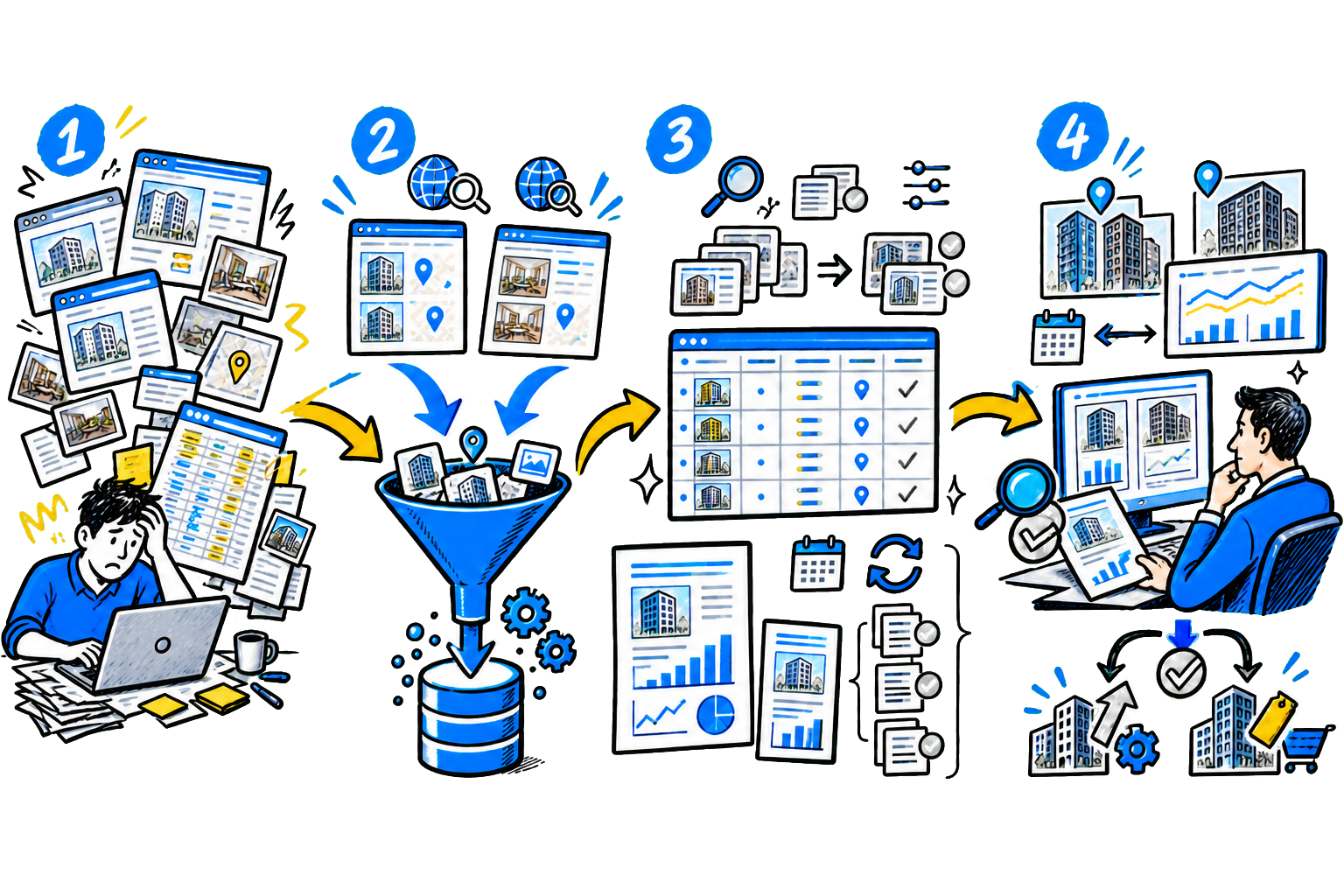
1. Understand how the project currently works

First, you need to assess the current situation: which systems are already in use, where data is lost or duplicated, how much time approvals take, and where the project is slowing down. This stage helps identify the real bottlenecks; otherwise, the company risks spending its budget automating processes that do not deliver results on their own.

2. Set specific goals

After the audit, it is important to define the desired outcome. Specific numbers are needed: shorten approval time, reduce rework, increase the share of online sales. Such goals help keep focus - any solution can be checked to see whether it delivers the needed effect. Without this, implementation turns into an endless process with no clear result.

3. Assign an owner

Property development digitalization does not work as an IT department task "in its spare time." You need someone who is accountable for the result and can influence processes across different departments. When there is a responsible person with authority, decisions are made faster and the team resists change less. If there is no such specialist, the project drags on and gradually loses priority.

4. Launch a pilot on one site

Choose one project and test the solution on it. It could be BIM, construction control, or a unified document management system. A pilot shows the real impact: how much time was saved, where problems arose, and what needs improvement. After that, scaling the solution is much easier and safer.

5. Bring in an integrator

Many companies try to implement tools on their own, but run into problems when integrating systems. The main failures happen at the seams between solutions: data does not sync, reports do not match, and processes break down. Integrator helps connect systems and set up data exchange - it already knows common errors and helps avoid them. As a result, the developer gets a working tool faster, rather than a set of disconnected programs.

6. Train the team and establish the rules

Even a high-quality system will not deliver results if employees do not understand how to use it. That is why training must be planned from the start. It is important not only to show the interface, but also to define the rules: who enters information and when, how approvals are handled, and which reports are generated. When the rules are clear, the system starts working reliably.

7. Evaluate the result and scale

After the pilot, the result must be compared with the goals: if timelines were reduced, costs fell, or sales grew - the solution can be scaled. Each next project is implemented faster because the team already understands the process. If the result is not achieved, it is better to refine the approach and repeat the pilot than to scale a model that does not work. Note that many developers lose money at the start.

Before 60-70% initiatives either fail to produce results or stop at the pilot stage: the problem is usually not the technology, but the approach. Where companies go wrong: - They try to automate processes that already work poorly. If there are no clear rules and ownership areas, the system only speeds up mistakes and increases failures in the first months. - They implement disconnected solutions.

They use CRM, document management, and construction tools separately, without connecting them. As a result, data is duplicated and reports are assembled manually with delays. - They ignore the construction site. They automate design and sales, but do not implement tools on site, even though that is where most costs are generated. Because of this, the impact of development digitalization remains limited. - They calculate the same metrics in different ways.

Different departments use different approaches to data, so the team spends time reconciling figures instead of managing the project. - They start with choosing solutions rather than defining processes. They try to implement tools without preparation instead of first putting data and governance in order. Important: when planning budgets, many organizations factor in only licenses and implementation.

But in practice, a significant share of problems comes from system integration. Up to 25-30% failures in digital solutions are directly tied to data exchange: mismatched reference data, delays, and logic errors, which increase support and further development costs.

If resources for integration are built in from the start and the system architecture is designed properly, the rollout time for new solutions can be reduced by 20-30% and budget overruns can be avoided. Digitalization in development delivers results when implemented step by step: first understand the processes, then set goals, test solutions, and only then scale. This approach reduces risk and makes it possible to genuinely cut timelines, costs, and errors in projects.

Case: "GK TOCHNO" - a single entry point and service showcase for contractors

Problem:for the company"GK TOCHNO"there were several separate services: HR document workflow, a tender platform, and internal systems. Users had to log in to each service separately.

Employees and contractors lost their logins and passwords and contacted support.

Connecting to the systems took a lot of time, especially for external contractors.

As a result, the company spent time on routine tasks: restoring access, explaining how to use the software, and manually exchanging documents. Solution: our experts unified access to all services - implemented SSO (single sign-on to systems) based on Keycloak: now an employee or contractor enters a login and password once and immediately gets access to all systems without re-authentication.

At the same time, the team launched a personal account with a service showcase - all work tools were brought together in one window so the user could quickly go to the needed service without searching or extra steps.

The portal was developed in three weeks, and two months after launch the SSO infrastructure was deployed, sign-in through Active Directory was configured, and the first service, MTS-Link, was connected. Result: -

The company moved contractor operations into a digital format and gave up paper document exchange. -

Contractors got a clear process: how to connect, where to go, and what to do next.

This reduced the time needed to start work on sites. -

Employees and contractors started logging into systems faster and no longer spent time resetting passwords, reducing the load on technical support. -

In addition, the project received industry recognition: the head of procurement digitalization at "GK TOCHNO"

Gvozdanny became a laureate of the Person of the Year award in design and digitalization.

How digitalization in development affects brand and valuation

Digitalization affects not only timelines and costs - it also changes how buyers and investors perceive the company. A developer with transparent processes and convenient services looks more manageable and predictable. Digital services build buyer trust. Customers choose not only an apartment, but also the experience of working with the developer. If they can reserve a unit online, track construction progress, and resolve issues through an app, the company looks more reliable.

Such tools speed up the deal and reduce hesitation - for business, this means higher revenue and steadier demand. This is why investor interest grows. Digitalization in development makes the business more transparent: leadership gets data faster, forecasts timelines and costs more accurately, and controls risks better. For an investor, this signals that the company is easier to manage and its performance is more predictable. In addition, digital solutions help scale the business.

When processes are standardized and digitized, the organization launches new projects faster and enters new regions without increasing management errors. Digitalization helps expand into new regions. If a developer has digital processes in place, it does not need to rebuild management from scratch in each region. The company uses common standards, centralizes procurement, and manages sales online. This reduces the cost of launching new projects and lowers risks.

As a result, the company scales faster, and the market values such a business higher. How a developer makes money from digital products Digitalization can bring separate revenue: some companies start selling their solutions to other developers or enter the IT services market. Example - Samolyot Group.

The company is developing its own digital platform and offering it to the market. The brand is valued at 40.2 billion rubles, and digital products make a significant contribution to that value. Additional revenue streams: - software license sales; - digital services for other developers; - solutions for managing smart buildings.

Discuss your challenge with an architect
Discuss the article: Digitalizing Property Development: How to Implement…

Send via: