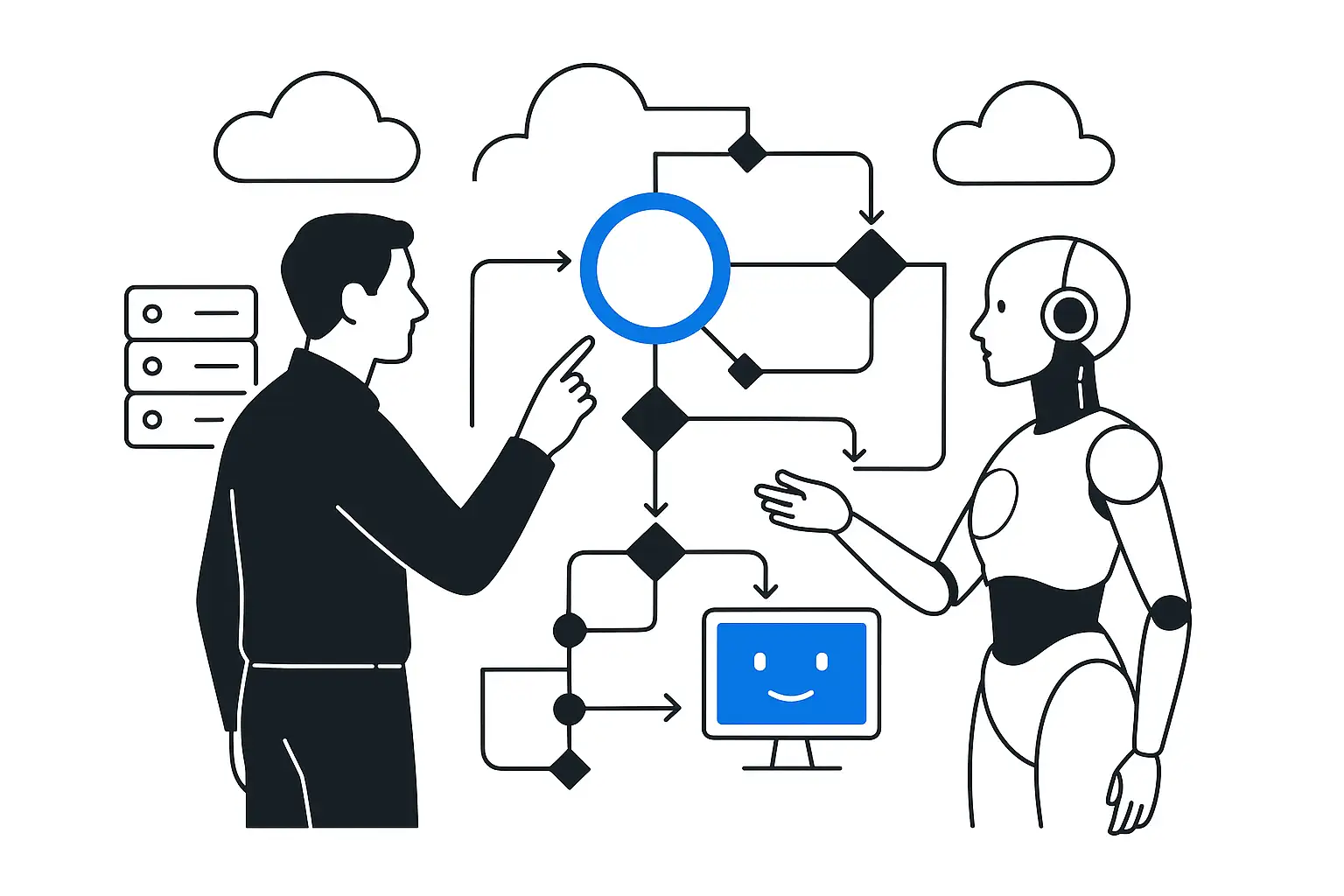
Formulate hypotheses on AI impact
For each driver, record H1-Hn of the form "If AI approach X is implemented, metric Y will improve by Z". Set effect ranges and risk factors to estimate the expected return realistically.

A step-by-step AI implementation plan focused on ROI, risks, data, platform and scaling solutions.
43% of CIS companies use AI. In 2024, they spent for its implementation $2 billion, what 39% higher at the 2023 level.
AI reduces costs and risks, increases business revenue, improves customer experience, and strengthens competitiveness.
A roadmap is a step-by-step plan AI implementation in businesscompany processes to increase profit, reduce costs and risks, improve customer experience, and strengthen competitive position. It helps connect AI projects to financial goals, minimize risks, and avoid "pointless pilots" that do not deliver returns. AI implementation principles:
| Principle | Essence | Business value |
|---|---|---|
| Only P&L anchors | Every solution has an owner and a monetary target backed by a calculation methodology | Projected financial outcome |
| Stage-gate funding | Funding is released by gates: idea → analysis → pilot → scale. "Pilots without impact" do not scale | Resource Savings |
| Data-as-a-Product | Each data mart has an owner, SLA / SLO, and quality checks | Fewer errors and faster deployment to production |
| Security & Compliance by design | Personal data / critical information infrastructure requirements and the GenAI policy are built into the architecture and processes | Eliminating fines and reputational losses |
| Measurability and pace | A/A to A/B, one hypothesis per test, regression suites, dashboards, monthly portfolio review | Better progress tracking and timely course correction |
The goal is to turn the idea of "we want AI" into a set of initiatives with financial impact, clear metrics, owners, and a go / no-go decision within 2-4 weeks.
Results: - Value map: how AI affects revenue, margin, OPEX / CapEx, and risk losses. - List of priority use cases (6-12 items) with an estimated effect (rubles / year), TTV (months), complexity. - Target KPIs and baseline levels, impact measurement methods: A/B, control groups. - CFO-style business case: NPV / ROI / Payback, resources, risks, dependencies. - Owners: business sponsor (P&L), product manager, DS / engineering, financial controller, compliance. "Rostelecom"estimatessavings of 5 billion rubles per year from AI-powered offer personalization.
Break revenue and costs down into controllable drivers. The more detailed the drivers, the more accurate the system.
At X5, the ML forecasting system accounts for about 200 factors: weather, elasticity, assortment.
For each driver, record H1-Hn of the form "If AI approach X is implemented, metric Y will improve by Z". Set effect ranges and risk factors to estimate the expected return realistically.
Build a "mini financial model" for each solution: - Impact in rubles per year = metric change × turnover / volume × gross margin (for revenue) or × cost rate (for OPEX / losses). - TTV: time to first measurable impact (months). - Implementation CAPEX / OPEX: licenses / cloud, team, integrations, support. - ROI / Payback / NPV at the company's discount rate.
- Document it baseline metrics before the pilot: MAPE, OOS, AHT, NPS, and failure rate. - Design experiment design: control / test, MDE, stabilization horizon, exclusion of seasonality, unit of randomization. - Align with CFO / risk "financial impact" - gross profit or revenue.
Link each solution to strategic goals business: market share, EBITDA margin, security, import independence. Add target KPI benchmarks: "-15% OPEX over 12 months" or "+2 pp NPS by Q4". Show precedents: this makes it easier to secure funding. At CIS Railways, the digital transformation programdelivered$2 billion in benefits from $1 billion in investments.
- Gate 1 (idea to analysis): approval of hypotheses, measurement methodology, and owners. - Gate 2 (analysis to pilot): approval of the budget, integration roadmap, and risk controls. - Gate 3 (pilot to scale): approval of success criteria, process readiness, and support.
The goal is to assess the maturity of the industry and the company. This lowers the risk of dead-end pilots and lost investment.
- Actual AI adoption. In CIS, the share of organizations using AI, grew with 20% in 2021 to 43% in 2024. Leaders are finance, ICT, higher education, and the fuel and energy sector - 66% organizations. - Lead technologists. According to the national 2024 industry readiness assessment, AI is used on average by 32% companies.
Top technologies - DSS (71%) and CV (69%). - Industry talent base. In CIS employees with AI expertise - 8,5% staff, of whom "specialized AI experts" - 0,8%. The highest concentration of AI specialists is in - 3,5%- in "Information and Communications".
Rate each dimension on a scale from 0 to 5 and set target thresholds for pilots / scale: 1. Data - quality, completeness, ownership, real-time availability. 2. Infrastructure - "sovereign" cloud or on-premises infrastructure, GPU / CPU, network perimeter, S3 / object storage, feature store. 3. Security - segmentation, encryption, SOC / SIEM, redundancy, compliance for critical systems. Security assessment is helped by IT infrastructure audit.
4. Regulation - compliance Federal Law GDPR and Federal Law 187-FZ, localization by Federal Law 242-FZ, contract base, risk assessment. 5. Personnel - data, ML, DevOps, and security specialists, upskilling plans. 6. MLOps / LLMOps processes - data / model versions, A/B testing, drift monitoring, canary releases, human-in-the-loop.
The goal is to build a shortlist of 6-12 solutions, estimating impact in rubles per year, TTV in months, and complexity across data, IT, legal, and owners.
This data is the basis for planning AI implementation.
3-5 quick wins with low complexity and a fast financial impact: F&R for part of the assortment / regions, an LLM assistant for operators without personal data. 2. 1-2 "anchors" with platform effects: a digital twin of key production, end-to-end personalization. 3. 2-3 studied a case with strict scale-up criteria: new LLM agents, advanced RAG analytics.
Define go / no-go criteria - Pilot KPI: MAPE, OOS, AHT, NPS, cycle time, failure rate. - Minimum impact: >= X million rubles per quarter in the pilot area. - Ready to scale: stable data, monitoring, support procedures, user training.
These criteria are the basis for the prioritization matrix.
Use them to divide all selected solutions into four groups: - High-High - "quick wins" - straight to pilot / scale. - High-Low - "anchors" - platform and data preparation, implementation in Q2-Q4. - Low-High - quick results, but with low monetary impact, that can be implemented selectively. - Low-Low - postpone / archive.
The goal is to define a workable data and integration bus topology that ensures the required data marts and features for the selected solutions, legal compliance, and readiness for industrial-scale deployment.
Results: - Ready-made data marts for the selected solutions - sales, inventory, service, production - with accountable owners. - Single roadmapintegrations between key systems - ERP, CRM, warehouses, call center, industrial control systems, and analytics. - Quality and availability rulesdata, defined SLA / SLO: when the data is ready and how accurate it is. - Compliance boundaries GDPR, 242-FZ, and 187-FZ: localization, access roles, masking. - Launch plan: who does what and by when so the cases can start without delays.
This stage helps accelerate the launch of AI pilots to 4-8 weeks by using ready-made data, reduce operational and penalty / reputational risks related to personal data / critical information infrastructure.
The goal is to select an AI platform aligned with CIS regulations, with fast TTV and a clear business case. The right choice reduces TCO and financial risks from technical failures.
Key criteria - LLM / GenAI stack and ready-made services - availability of enterprise LLM / API, multimodality, RAG support. - Data, integrations, and vectors - availability of managed databases, streaming, CDC, support for vector indexes for semantic search. - MLOps / LLMOps and collaboration tools. - Security, localization, compliance. - Economics and Performance - storage, streaming, and inference costs, 12-24 month TCO, hidden expenses. Typical architectures
| Type | Features | Pros | Risks |
|---|---|---|---|
| Sovereign cloud | Fast start, variable workload, lower CapEx | Out-of-the-box LLM / API, SDK, streaming / CDC, SLA | Network dependencies, DPIA / localization - addressed by choosing CIS data centers and contractual guarantees |
| On-premises infrastructure / private cloud | Critical information infrastructure / strict personal data flows, isolation, specialized hardware | Perimeter control, custom SLOs | Launch time / cost, responsibility for observability |
| Hybrid | Data on-premises, LLM inference in a sovereign cloud, and the CDC bus and data marts where SLA and security are easier to maintain | Flexible deployment, fast launch, and a balance of performance and security | Integration and security management complexity, rising TCO during scaling |
CIS platforms - Yandex Cloud(AI Studio / Foundation Models / DataSphere). A single AI services hub, integration SDK, speech, text, and image recognition services, YandexGPT LLM, and a playground for fast hypotheses. - Sber(GigaChat API / ML Space). Enterprise access to LLMs via API, with GigaChain SDK, pricing, and token monitoring.
ML Space is an end-to-end platform based on the Christofari and Christofari Neo supercomputers. Cloud and private options are available. - MTS Web Services/ MTS AI. Cloud AI and data services. The ecosystem is seeing domain-specific AI agents, such as Data Scout for automated documentation of corporate databases. - Cloud.ru ML Space. A full-cycle ML platform with environments, deployments, and a catalog. Available in cloud and private versions.
The goal is to create an AI governance model, hire and develop people, and launch teams without compliance or speed failures. A strong team reduces dependence on external vendors and speeds up payback.
- AI Director - AI portfolio, economic impact, standards. - AI Product Owner - case P&L metrics, hypotheses, experiments, TTV. - Data Scientist- modeling, evaluation, offline and online metrics. - ML / LLM Engineer - production services, latency, token cost, observability. - Data Engineer - pipelines, CDC, data quality, and data SLOs. - Platform Engineer - model CI / CD, feature store, drift monitoring. - Prompt Engineer - prompt architectures, guardrails, test boundaries for LLMs. - Data Steward / Data Owner - dictionaries, lineage, data agreements, access rights. - AI Risk & Compliance - DPIA, personal data / critical information infrastructure regulations, audits. Large retailers build dozens of teams around F&R: at Magnit, in the F&R projectinvolvedmore than 200 specialists.
- Hiring - for the "core" roles: PO, Senior DS / MLE, Platform. - Reskilling - operational and business roles: analysts, developers, call center specialists, LLM assistants, procurement specialists, planners. - Partners / vendors - for peaks: data annotation, CV labeling, integrations with legacy systems. 55% Russians want take AI training within the next 2-3 years - low barrier to learning. Order AI training for the entire team to align skill levels.
- Shortage of AI talent. Divide employees into core and co-sourcing, "grow" specialists through pair programming / code reviews, engage developer communities. - Key dependencies on specific people. Duplicate roles for critical services, rotate tasks every 3-4 months, use the method "bus-factor ≥ 2". - Burnout.
Set WIP limits, clear "release windows", rotating on-call shifts. - Compliance / personal data / critical information infrastructure. Run an early DPIA, involve Legal / InfoSec at Gate-1, and prepare templates for data and access agreements.
The goal is to choose a funding model and put cost controls in place so AI delivers a predictable financial effect, not "nice-looking pilots".
Results: - Portfolio financial model by case and overall: rNPV / ROI / Payback, taking into account risks, CapEx / OpEx, and monthly cash gaps. - TCO map: people, cloud / hardware, storage / networks, LLM tokens, licenses / software, integrations, 24x7 support. - Funding policy: stage-gate budget, "sandbox" limits, capitalization / outsourcing rules, internal chargeback scheme. - FinOps for GenAI: token / request limits, monitoring of "rubles per 1K tokens" and "rubles per case / dialog", optimization rules. - Go / no-go conditions for the pilot and scale: cost, SLA, and impact in rubles.
The goal is to identify likely risks and build countermeasures into processes so pilots and scaling work safely. This helps avoid fines, personal data leaks, and pilot failures caused by technical issues. Risk categories 1. Legal: lack of legal grounds, noncompliance with purposes or retention periods, insufficient localization, excessive processing of personal data. 2. Critical information infrastructure / information security: incorrect categorization, insufficient safeguards, unpreparedness for audits and reporting.
3. Model-based: AI hallucinations, bias and discrimination, drift, PII leaks through prompts or responses. 4. Data / quality: incompleteness / errors, DQ-SLO breaches, weak lineage / data contracts. 5. Vendors / outsourcing: unlawful transfer of personal data, no SLA for localization / incident response. 6. Operational: no DPO / responsible owners, incident response "on paper", shortage of information security staff.
The goal is to establish baseline metrics, set up experiments correctly, and turn AI gains into financial value.
Results: - Metrics map: tree "P&L -> business metrics -> process metrics -> model / data quality". - Baseline levels and targets for each metric, plus the calculation method. - Designexperiments: A/A, A/B, sample size, MDE, duration, seasonality.
- Financial linkage: formulas for converting metrics into rubles - gross profit, savings, and prevented losses. - Dashboards and the procedure: what is reviewed, by whom, and when; go / no-go criteria.
KPI examples for typical solutions - Retail (F&R): MAPE (down), OOS (down), write-offs (down), turnover (up), gross profit in rubles (up). - Call center / telecom (LLM assistant): AHT (down), auto-processing share (up), CSAT/NPS (up), savings in rubles (up). - Industry / energy sector (predictive maintenance): unplanned downtime (down), incidents (down), output / energy intensity (up), losses in rubles (down). - Bank / fintech (anti-fraud): Recall at fixed Precision, error cost in rubles, avoided losses in rubles.
Goal. Create a managed AI roadmap, link AI initiatives to business metrics, and achieve a fast path to operating profit. Step 1: Strategic alignment with P&L What we did: - Held a working session with top management. - Linked AI project goals to financial metrics: revenue growth, lower OPEX, and reduced losses. Outcome: - 9 potential use cases: from ML demand forecasting to an LLM assistant in the call center. - Potential impact: +640 million rubles in gross profit per year.
Step 2: Maturity and infrastructure assessment What was checked: - Data quality and completeness. - Presence of AI capabilities in IT and the business. - Compliance with Federal Law No. GDPR and 187-FZ. Outcome: - Maturity - 3.2 out of 5. - Data for key data marts is available with a delay of < 24 hours. - The MLOps team needs strengthening.
Step 3: Prioritizing use cases What we did: - Calculated the impact in rubles, TTV, complexity, and risks. - Built a priority matrix. Conclusion: The pilot included 3 cases: - ML demand forecasting by region. - Promotion personalization in CRM. - LLM assistant for operators.
Step 4: Financial models and scaling criteria Calculation example for case 1: - Out-of-stock reduction by 2 pp. - Revenue +1.4% -> an increase of 390 million rubles per year. - Costs - 85 million rubles (CAPEX + OPEX). - Payback - 7 months. Go / no-go criteria: - ROI > 100%. - Model stability > 3 months. - Operator NPS > +10 pp.
Step 5: Architecture and platform Selection: Hybrid model: data - on-premises, inference - through a CIS cloud. Platform: - ML: Yandex Cloud + DataSphere. - LLM: GigaChat API + custom models. Step 6: Team The team includes: - AI Product Owner, Data Scientist, ML Engineer, Data Steward, Risk & Compliance. - 6 business analysts trained up to junior DS level. - A 6-month contractor to implement pipelines and integration.
Step 7: Financing Stage-gate budget model: - Gate 1: up to 5 million rubles for hypothesis analysis. - Gate 2: up to 25 million rubles for the pilot. - Gate 3: scale only if rNPV ≥ 0. Step 8: Pilot launch Duration: 10 weeks. What we checked: - MAPE, OOS, savings, model response speed. - Test design: A/B by region. - Dashboards - weekly.
Step 9: Scaling and governance Impact after 4 months: - Gross profit growth: 127 million rubles. - OOS reduction: -2.1 pp. - Savings from manual processing: -22% AHT in the contact center. - Launch of the second solution portfolio.