Workflow
We pin down the role, action, data and decision within the process.

How to choose AI, cloud, data, API, RPA, IoT and low-code for your business process, KPIs, security and total cost of ownership.
Selection map
Technology delivers impact when it changes workflow, KPIs and cost of ownership, not just when it appears on a tool list.
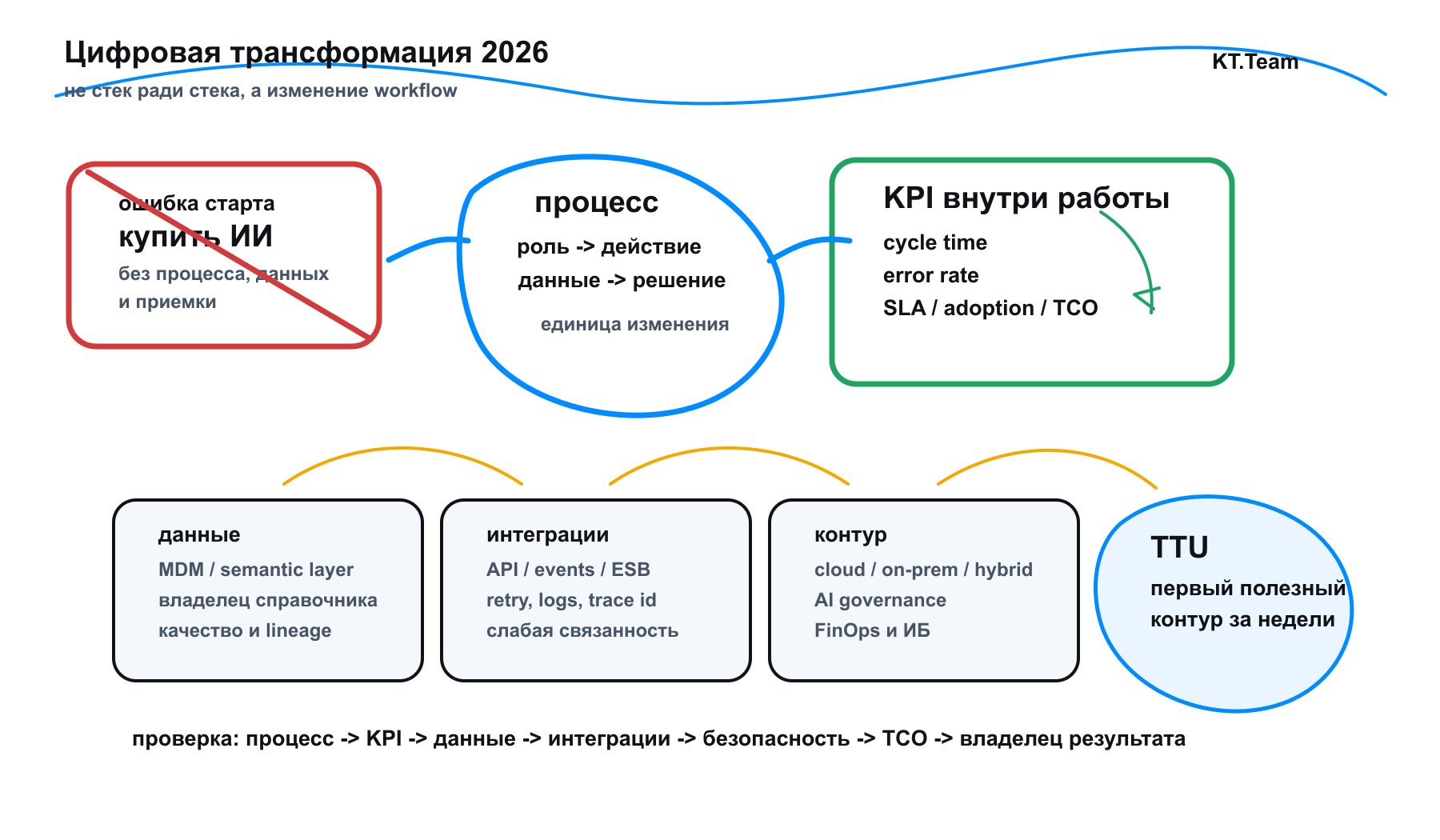
We pin down the role, action, data and decision within the process.
We look at cycle time, error rate, SLA, adoption and TCO.
We pick AI, cloud, API, BI or RPA only after checking data and security.
The first useful loop must reach real use quickly.
19.07.2026 Digital transformation technologies do not work like a shopping catalog. AI, cloud, BI, RPA, IoT, API, or low-code deliver results only when chosen for a specific business process, metric, and constraints: data, security, integrations, total cost of ownership, and the owner of the outcome. In 2026, the main question is no longer whether a company has digital tools. It almost always does.
The question is different:
The digital transformation market has grown tougher on promises. In its CIO Agenda 2026, Gartner writes that 94% of CIOs expect substantial changes to plans and outcomes over the next 24 months, but only 48% of digital initiatives meet or exceed their business goals. That is a good filter for any technology: it must withstand not a presentation, but a change in conditions.
In its 2025 AI study, McKinsey records that 88% already use AI regularly in at least one business function, but scaling remains a challenge: roughly a third of companies have started to scale their AI programs. One strong driver of results is a fundamental redesign of the workflow, not the mere fact of using a model.
| Market shift | What This Means for Business | What to check before implementation |
|---|---|---|
| AI has gone mainstream | A pilot is easy to launch, hard to scale to production impact | Is there a process owner, eval, answer quality control and human validation |
| Growth of agentic AI | The model not only answers but also executes steps in systems | Rights, action log, rollback, limits and tool control |
| Data and semantics became the core | AI, BI and automation depend on the quality of reference data and the meaning of fields | MDM, data owner, lineage, unified KPI definitions |
| Clouds have grown more complex | The workload is chosen by economics, risk, latency and compliance | FinOps, data residency, fault tolerance, exit cost |
| Security became part of the product | AI and integrations widen the attack surface | ISO/IEC 42001 or a similar AI management system, NIST AI RMF, security architecture |
It is easier to choose technology in reverse order:
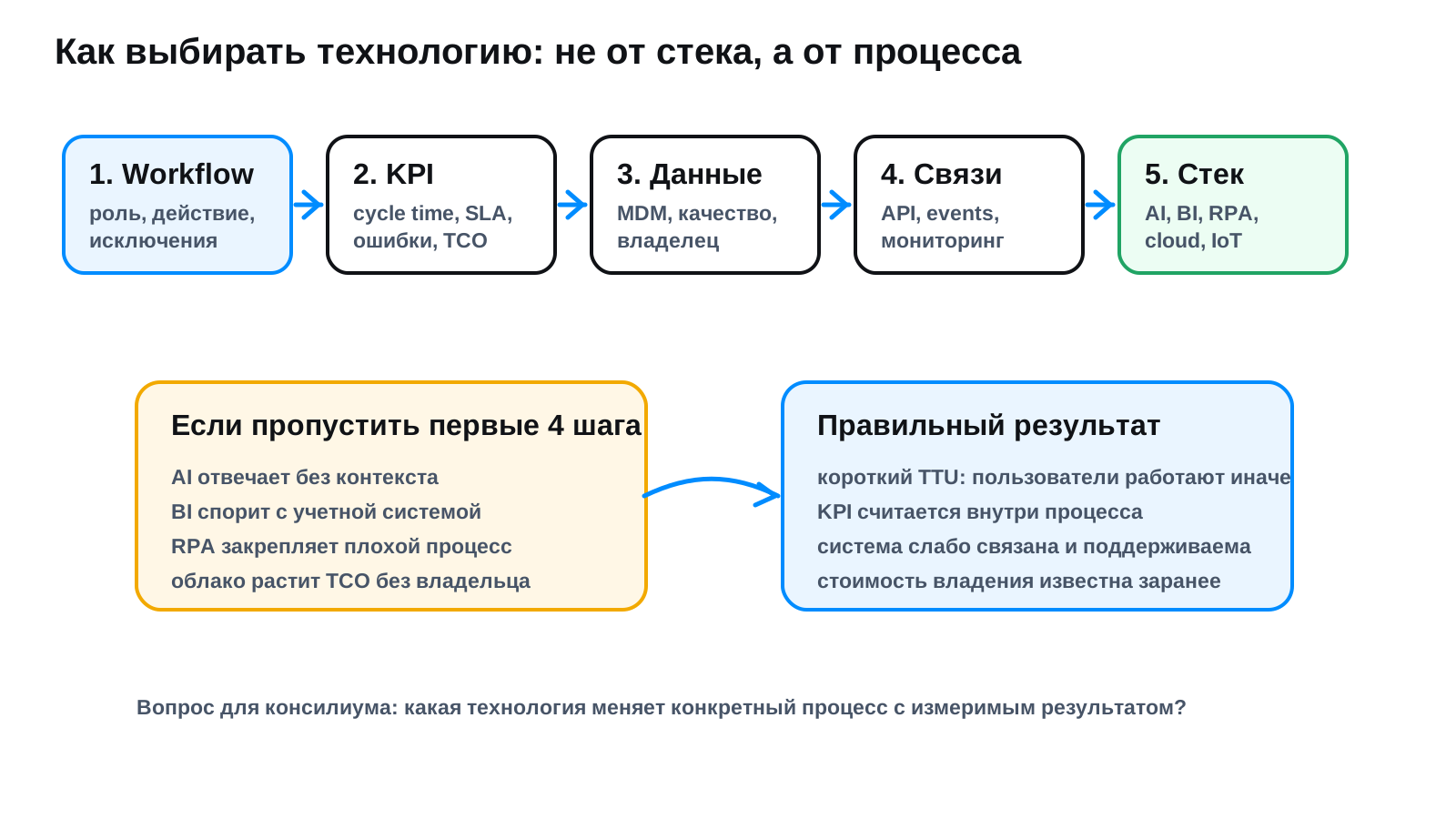
Below is not a technology ranking but an applicability map. In mature transformation, environments often connect: an AI agent takes context from a knowledge base, acts through an API, writes the result to ERP, and BI shows the process metric.
| Environment | When to adopt | What to check | Typical risk |
|---|---|---|---|
| AI agents and RAG | You need to speed up work with documents, tickets, code, analytics or knowledge | Source of truth, eval, tool permissions, action log | The agent answers confidently, but without grounding or quality control |
| Data governance, MDM, semantic layer | Different departments calculate one KPI differently or reference data diverges | Data owner, master system, quality rules, lineage | Pretty BI on dirty data |
| API, ESB, event-driven integration | Systems must exchange statuses, orders, stock and documents | API contracts, events, idempotency, retry, monitoring | Point-to-point connections turn into a brittle monolith |
| Hybrid cloud and platform engineering | Delivery speed is needed, but there are requirements for data, cost or fault tolerance | Workload placement, FinOps, SRE, redundancy | Cloud purchased, but costs and accountability stayed unmanageable |
| BI and decision intelligence | A manager needs a picture of the process, not on-demand data dumps | Shared metric definitions, report owners, data refresh | The dashboard lives apart from the decisions in the process |
| RPA and workflow automation | The process is stable, rules are clear, manual entry repeats | Exception rate, data source, ownership of the bot | Automation cements a bad process |
| IoT and edge | You need real events from equipment, warehouse, transport or point of sale | Sensor reliability, network, latency, edge processing | Data is collected but does not lead to action |
| Low-code/no-code | You need fast internal workflows and forms with clear guardrails | Rights, integrations, lifecycle, who maintains the app | Shadow IT with no security or architecture oversight |
| Cybersecurity, observability, AI governance | Changes must be safe and provable | SLO, audit, DLP, model risk, incident process | Security is added after the pilot, and production stalls |
| Blockchain / distributed ledger | Participants need a shared immutable ledger without a single trusted owner | Whether decentralization is truly needed | Blockchain is used where a plain log and a signature would be enough |
SMART is useful as a basic goal check, but it is not enough for digital transformation. Technology must be evaluated through a process matrix.
| Criterion | Question | Good sign |
|---|---|---|
| Process | Where exactly does the user's work change? | There is a BPMN or a short workflow description: who does what and which data they use |
| KPI | Which metric changes? | Cycle time, error rate, SLA, cost per transaction, adoption, revenue leakage |
| Data | Which data is needed and who owns it? | Master systems, reference-data owners and quality rules are named |
| Integrations | Which systems must exchange data? | There are API/events contracts, monitoring, redelivery and a failure model |
| Security | Which data is sensitive? | Access rights, audit, personal data, action log and security requirements are defined before the pilot |
| TCO | What will support cost a year from now? | It counts development, operations, changes, licenses, cloud, downtime and vendor lock-in risk |
| TTU | When will users actually start working differently? | There is a short first loop of useful use, not just a project delivery date |
Five SMART questions to ask before buying any system (ERP, CRM, WMS, etc.): what task the tool will solve; how to know the goal has been achieved; how realistic it is to reach the expected results; why implementation is needed right now; how long integration will take and when the first impact will appear. If you cannot answer any of these questions, it is too early to buy.
| Error | What it looks like | What to do instead |
|---|---|---|
| Started with the tool | "We need AI / BI / low-code", but no process is named | Start with the workflow and KPI, then pick the technology |
| Automated the chaos | RPA or low-code repeats manual exceptions | First remove excess branches and assign a process owner |
| No data owner | Reports contradict each other, AI gets conflicting context | Assign a master data owner and quality rules |
| No integration architecture | Every new system connects directly to every other | Introduce API/events/ESB where it reduces coupling |
| The pilot does not measure acceptance | The team shows demos but does not track success rate and errors | Build an eval set, acceptance criteria and result measurement |
| Security comes at the end | Security blocks the production launch | Factor in security, personal data, audit and model risk before choosing a platform |
| They do not count total cost of ownership | They compare the price of a license or a token | Count the process TCO: operations, changes, errors and support cost |
For KT.Team, digital transformation is not about deploying the maximum number of tools.
The unit of change is a specific workflow.
We look at where the process loses time, money, quality or control, then assemble a loosely coupled environment: data, integrations, interface, AI or automation exactly where it changes how work runs.
This matches our overall approach: a small strong team, short TTU, loose coupling, and clear ownership of the business result.
If a process is well served by an API and a decent reference book, AI is not needed.
If AI is needed, it must have grounding, permissions, an action log and a clear cost of the result.
If 1C is needed, it should remain part of the landscape, not turn into a monolith that holds back all business changes. In practice, it looks like this.
For one client, we built an AI platform where the agent performs accounting operations according to procedures and works with systems through API or MCP without changes to the accounting stack, while every action leaves a verifiable audit trail - the same combination of grounding, permissions, and action logs (project breakdown).
For a distributor, we automated orders in Odoo and reduced order processing time by 85 percent, launching a working version in four months (project breakdown). You can assess which technologies your process needs on the page for digital transformation consulting.
Read more on the topic - CIS's digital transformation, strategy, and market about the national project, government support, and the first step for business, as well as related solutions AI for business and integrations.
FAQ
For most companies what matters is not a single technology but the combination: data, integrations, AI or automation inside a specific process. If the data is poor and systems are not connected, even a strong AI model will deliver weak results.
When the process is already documented, data exists, the result-quality criterion is clear and success rate can be measured. Without these conditions, first build the data and acceptance environment.
RPA fits stable rules and repetitive operations. AI agents are more useful where there is variability, documents, language, context and a need to make a decision. Often they work together: RPA handles the rigid step while AI prepares the data or classifies the exception.
Cost depends on the load profile, data requirements, fault tolerance, licenses, networks and operations team. For variable load the cloud is often rational; for steady high load and strict data requirements, private/on-prem or hybrid can be more cost-effective.
For KT.Team the working benchmark is a short TTU: the first useful loop must reach real use within weeks, not turn into a long program with no feedback.
Verification date: 19.07.2026