












Client
A large company in distribution and retail. It operates in two key areas: wholesale supply to external retail chains and sales through its own retail stores. The business spans multiple segments, with a broad product range and complex logistics.
Starting situation
The project to accelerate B2B order processing grew out of a successful partnership. Together with the client, we identified the long order placement cycle and defined the project goals: reduce order processing time, minimize manual work, and improve operational transparency.
Main challenges at the start:
The company spends resources on manual operations instead of focusing on important strategic tasks. Order errors lead to customer loss, warehouse staff often stop work to recount goods, and logistics and the customer cannot see data on goods movement.
- Customer orders come in from everywhere: by phone, messenger apps, email, and paper forms. Information gets lost, and work is duplicated.
- Manual data collection: managers spend a lot of time calling customers and warehouses to clarify details and check product availability. All documents (invoices, delivery notes) are created manually in the existing accounting systems.
- Long fulfillment time: the full cycle, from receiving the customer's request to shipping the goods, takes up to 6 weeks. This frustrates customers.
- Costly inventory tracking: due to inaccurate real-time stock tracking, the company performs a full warehouse inventory 4 times a year.
What we did: solution and results
The KT.Team implemented a centralized order management system (OMS) based on Odoo. Together with the client, we agreed to launch an MVP covering the key business process: order placement and handoff to the warehouse for picking and shipping.
We built the first working version based on requirements defined together with the client's IT leadership. Even at this stage, the system was put into real use and made it possible to:
- After the OMS launch, processing an order request took 5 days, including stock checks, invoice generation, and warehouse handoff. This metric covers processing within the system; before the project, the full cycle through shipping could take up to 6 weeks.
- Improve process transparency and control. After launch, every order follows a single standard workflow from placement to shipping. All orders are recorded in the system and visible to the manager. This helped remove bottlenecks, prevent lost orders, and reduce the risk of communication failures.
- Reduce the manual workload on employees. The number of routine tasks has decreased: calls, stock rechecks, and copying information into documents. Sales and warehouse teams now work through the system: orders are automatically passed from managers to warehouse staff. This reduced the workload on employees and lowered the risk of errors.
Development process
We launched the MVP in 4 months. Over the next 3 months, we refined the system together with managers and the warehouse.
Implementation stages
- MVP development (November 2024 - March 2025), the first working version of the system. We set up integration with the warehouse management system and the basic order flow, from entry to handoff to the warehouse.
- MVP launch and tuning (March - June 2025). We launched and tested the MVP on real orders. We collected feedback from managers and the warehouse and improved the functionality.
- The OMS foundation was completed in June 2025. The system monitors statuses and errors and is ready for further development.
Review a similar project with an architect
How the solution works
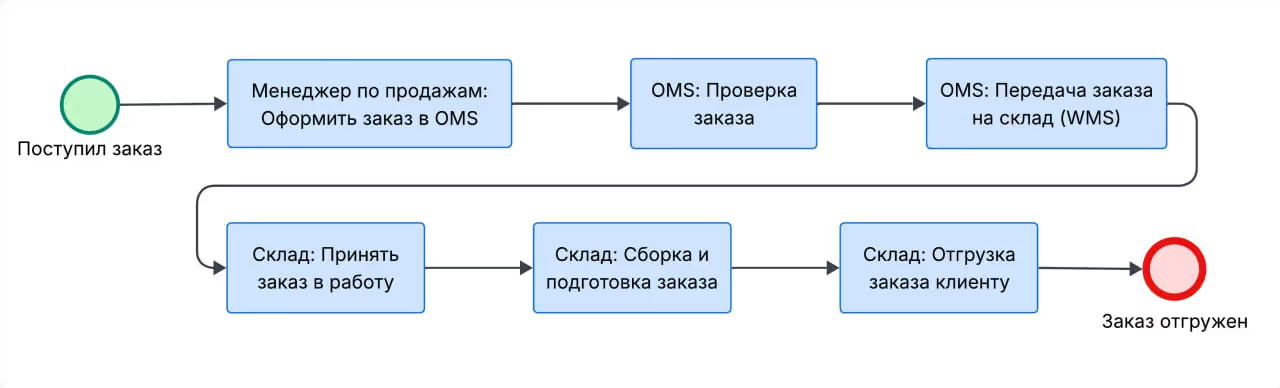
The order management system is integrated with the client's WMS environment. It automates the entire processing cycle, from order entry by the manager to shipping from the warehouse.
The system performs several key functions:
Order entry and shipping process
Technologies and approaches we used:
We used Odoo with customizations in Python and REST API, which made it possible to integrate quickly with the client's accounting systems and minimize time to production.
- Order entry through a single interface. The sales manager enters the order directly in the system through the portal, without calls, messages, or manual data entry. All information is stored and tracked centrally.
- Automatic processing and handoff to the warehouse. After an order is placed, it moves through built-in processing logic and is sent to the WMS. No additional staff involvement is required.
- End-to-end execution control. The entire chain, from request to shipping, runs in one process. This eliminates information loss between departments, reduces errors, and improves execution transparency.
Solution benefits and capabilities
- All departments see the order the same way, so the team works with up-to-date data. The system prevents information loss and duplicate documents.
- Odoo enables work rules to be configured for the company's logistics and sales, with users participating in the review of employee workflows.
- Customer portals, automatic supplier orders, and reports are connected as modules. If needed, adjustments may be required, but the system architecture makes this fast and cost-effective.
- The system can be easily connected to CRM, BI tools, or marketplaces.
What challenges we faced
At the start, we discussed the project only with the company's IT leadership. Our experts immediately suggested involving managers and the warehouse to account for all the nuances of their work, but due to organizational specifics that was not possible right away. This became possible only after the MVP launch, and the system was quickly adapted further to real-world workflows.
Project manager's comment
"The secret to success is involving future system users from the start. By understanding how their work is actually organized, we quickly configured the OMS to fit their needs. The system now makes order processing more transparent and manageable."
Next steps
After launching the first process area, the team outlined further system development. These were plans at the time the project was described; their completion is not claimed here.
- A customer portal for placing orders and viewing statuses.
- Bringing logistics, finance, and management into a single process.
- A shift from four full inventories per year to one, provided operational inventory records are sufficiently accurate; the achieved result for this metric was not documented.
How to apply this approach to your process
For an Odoo implementation, we first define the process area, data owners, integrations, and measurable outcome. The first launch timeline depends on these boundaries and system readiness.