Logistics automation in 2026: how TMS, WMS, EDI and AI cut costs and speed up delivery

How logistics automation reduces errors, speeds up delivery and helps control warehouses, transport and supply chains.

  • What logistics automation is and which processes it covers
  • When a business needs automation
  • Which logistics processes are automated
  • Receiving and shipping: less manual work and fewer errors

Customers need fast delivery and accurate order data, while businesses need lower costs and better logistics efficiency. That is why companies implement TMS, WMS, EDI, and other digital solutions that help manage supply, warehouse operations, and transport. Here is how logistics automation works, which processes are automated first, and which technologies help companies grow faster and better control supply chains.

What logistics automation is and which processes it covers

Logistics automation helps businesses process shipments faster, reduce errors, and control costs without constant manual work. Instead of spreadsheets, calls, and message threads, employees work in one system that collects data, shows stock levels, plans routes, and tracks shipments. The main goal of automation - remove manual steps where they slow work down or cause errors. Specialists do not spend time moving data between services or checking statuses manually.

They see up-to-date information and make decisions faster. Logistics automation includes four areas:

AreaDirect business value
Transport logistics means routing based on traffic, capacity, and deadlines, cargo tracking, and automatic document generation.Reduces fuel and transport costs, cuts delays, speeds up order processing, and eases the burden on dispatchers.
Warehouse logistics means controlling storage, picking, and stock with scanners and RFID tags, and accurately showing where each item is located.Eliminates picking errors, speeds up shipping, reduces losses from stock mix-ups and expired goods, and provides transparent inventory tracking.
Inventory management means analyzing demand, identifying fast-moving items, and replenishing stock on time without extremes.Removes slow-moving inventory and shortages, lowers storage costs, and simplifies purchasing planning.
Supply chain management means the system connects suppliers, warehouses, transport, and stores, and highlights delays and bottlenecks.Simplifies supply monitoring, speeds up data exchange, helps respond to disruptions instantly, and makes processes transparent.

Discuss your challenge with an architect

  1. When a business needs automation Logistics automation is not only for large companies. As orders grow, manual management starts slowing down processes even in mid-sized businesses. This is especially noticeable in retail, e-commerce, manufacturing, and distribution. Below are seven signs that your current software can no longer handle the growing workload:
  2. Orders are regularly delayed, and customers complain about delivery.
  3. Logistics costs are growing faster than revenue. 3.
  1. The warehouse constantly swings between surplus and shortage.
  2. Employees manually transfer data between spreadsheets and systems.
  3. Errors in addresses, documents, and stock levels happen too often.
  4. Dispatchers spend a lot of time on calls and status checks.
  5. The business does not see the full picture of shipments and inventory.

Which logistics processes are automated

Organizations first automate receiving, warehousing, routing, delivery, and quality control - these are the processes that most often create delays and unnecessary costs.

Receiving and shipping: less manual work and fewer errors

In many companies, employees still manually reconcile delivery notes, check item quantities, and enter data into accounting systems. As a result, errors appear in SKUs, addresses, and documents, and receiving takes a long time. Automation eliminates double data entry. The system receives information from the supplier, compares it with the order, and immediately shows discrepancies. Documents are generated automatically and, without re-entering data, are sent to accounting and the warehouse system.

As a result, the organization: - receives and ships goods faster; - reduces errors; - lowers returns and mispicks; - reduces the workload on warehouse staff. On average, companies reduce receiving time by 40-60%, when they remove manual reconciliation and move documents into electronic format.

Routes and delivery: the system automatically reroutes trips

Manual route planning works poorly when there are many deliveries. Dispatchers cannot keep up with traffic, order rescheduling, and vehicle utilization. As a result, vehicles travel extra kilometers and deliveries run late. Automation solves this problem through dynamic routing. The system builds a route based on delivery time, road conditions, trip constraints, and vehicle load. If conditions change, the system recalculates the route.

Result: - less empty mileage; - lower fuel costs; - more deliveries per shift; - fewer delays. According to studies, dynamic routing helps businesses reduce mileage by 15–25% and increase on-time deliveries by 34%.

Warehouse: faster picking and more accurate inventory

In the warehouse, staff often waste time searching for items and manually checking stock. The larger the assortment, the higher the risk of picking errors. WMS systems help automate storage and order picking. An employee receives a route and sees where the required item is stored. Scanners and RFID tags make it easy to check stock quickly and avoid mix-ups.

As a result of automation: - employees pick orders faster; - the warehouse tracks stock more accurately; - inventory counts happen without stopping operations; - the number of shipping errors drops significantly. Some companies also use warehouse robots that bring racks to employees and reduce the time spent moving around the warehouse.

Last mile: the recipient tracks delivery status

The final stage of delivery shapes the customer's overall impression of the company. If the buyer does not know where the courier is or when the order will arrive, support requests increase. Logistics automation helps keep the customer informed without operator involvement. The system sends notifications, shows order status, and gives the exact delivery time. If the buyer cannot accept the order, they can reschedule delivery themselves.

Here is what the business gets: - fewer failed deliveries; - lower load on the call center; - fewer repeat trips; - higher customer loyalty. Companies that provide online order tracking receive fewer complaints even when there are delays, because the customer understands the situation in advance.

Quality control: fewer disputes and returns

Cargo damage and disputes are often handled manually: employees look for documents, call drivers, and check delivery statuses. This takes time and creates extra load on support. With automation, the business records every delivery stage automatically. The courier takes photos of the cargo during loading and unloading through a mobile app, and the system saves the time, geolocation, and order status. If a problem occurs, the manager immediately receives an alert and contacts the customer.

As a result: - fewer disputes; - faster claims handling; - fewer returns; - easier control of carrier performance.

What to automate first

First, identify the areas where the company most often loses time and money. As a rule, automation pays off fastest in: - receiving and shipping; - routing and delivery; - warehouse picking; - last-mile delivery; - quality control.

If you start with these processes, the business will see results faster: lower costs, reduce errors, and speed up delivery. Tip:connect CRM system and TMS platform to automated incident handling.

For example, if TMS detects a delivery delay, cargo damage, or route deviation, the system automatically sends the customer a notification, explains the situation, and offers compensation - a discount, bonus, or free delivery. At the same time, CRM saves the case history and creates a task for the manager if the customer needs further contact.

Key logistics automation technologies

Automation is not a single program but a set of solutions for transport, warehousing, delivery, and accounting. Companies implement them gradually: first they address the most problematic areas, then they connect processes into one system. Let's look more closely at the technologies used today in logistics and supply chains.

TMS systems: control of shipments and routes

TMS helps manage delivery and transport. The system builds routes, assigns orders to vehicles, and shows trip status online. Dispatchers do not need to call drivers manually or check where the cargo is. The system also shows route deviations, delays, and delivery changes. What the business gets: - less empty mileage; - lower fuel costs; - less manual work for dispatchers; - faster delivery processing.

The CIS TMS market continues to grow: retail and manufacturing companies are increasingly moving to local solutions instead of manual transport management.

WMS: order in the warehouse and accurate inventory tracking

WMS controls goods storage and speeds up warehouse operations. The system shows employees where to place items and where to pick them from when assembling an order. The software tracks stock, monitors expiration dates, and reduces shipping errors. All stock data is updated automatically. WMS implementation results: - faster order picking; - less mispicks; - more accurate stock tracking; - easier inventory counts.

When a company connects WMS with ERP and TMS, the warehouse, transport, and accounting teams exchange data without manual input.

AI: accurate demand forecasting and automated planning

According to Strategy Partners, 45% of logistics market companies plan to implement AI-based tools in the next 2-3 years. Algorithms analyze sales, seasonality, and vehicle utilization, helping decisions be made faster. For example, the system can show in advance: - which products will run out soon; - where excess stock will appear; - which routes create unnecessary costs; - where delivery delays occur.

Result: less stock shortages, lower volumes of slow-moving inventory, more accurate purchasing, and lower storage costs.

IoT sensors: cargo and vehicle monitoring

With IoT sensors the company tracks cargo and vehicle condition in real time. The system receives data on temperature, humidity, shocks, fuel consumption, and vehicle operation.

This is relevant for food, medicines, and cargo that must not be transported outside the required temperature range. What the company gets: - less cargo loss; - faster response to issues; - lower repair costs; - easier carrier oversight.

Warehouse robots: faster picking without expanding headcount

Warehouse robots speed up work without increasing staff. They move racks, sort orders, and help pick items faster. Employees spend less time walking around the warehouse and focus only on picking and checking orders. Benefits of automation: - faster order processing; - less downtime; - higher warehouse productivity; - easier to operate as workload grows.

Electronic document exchange: less paper and manual entry

EDI helps prepare transport documents faster and avoid data loss. The driver, sender, and receiver sign documents electronically, and the information is reflected in the system instantly. EDI automates: - invoices, service acts, and transport waybills; - document exchange between companies; - document storage.

Results for the company: fewer paperwork errors, faster trip closure, easier audits and recordkeeping, and lower costs for paper documents. Important: from September 1, 2026, the electronic format for transport documents will become mandatory for all participants in freight transportation in CIS.

Blockchain: transparent supply control

Blockchain records delivery stages so the data cannot be changed after the fact. The system stores information about loading, delivery, and handoff in a shared database. Smart contracts automatically trigger payment as soon as the cargo is delivered and verified, without calls or manual approvals.

The technology also integrates easily with IoT sensors that track humidity, temperature, and shocks in transit, and records this data in a secure registry. The business gets: - supply visibility; - fewer delivery disputes; - easier cargo history checks; - faster payment approval.

How to Choose a Logistics System: 7 Questions Before Launch

There is no universal solution: one company may only need a simple cloud TMS, while another needs a TMS, WMS, and ERP stack with dozens of integrations. However, many make the same mistake: they buy an expensive system with a large set of features they never use. To avoid wasting budget, answer the following questions before choosing a platform.

Discuss your challenge with an architect

1. How many orders do you process? If you handle 50 orders a day, a cloud TMS is enough. At 50 to 500 orders, you need integration with the warehouse and accounting system. Above 500 orders, it is better to build a single platform for warehouse, transport, and analytics right away. Do not buy all modules at once - first test the system in one warehouse or region. 2. What kind of cargo do you transport? The type of cargo determines the system's functions. For food and medicines, temperature control is essential.

For e-commerce, fast item tracking and sorting. For construction materials and equipment, routing that takes weight and dimensions into account. If a tool does not account for cargo specifics, it will not solve your real problems. 3. Which systems are already in use at the company? If you already use 1C or ERP, choose a platform with ready-made integration. Building data exchange from scratch takes months and costs a lot.

If you do not yet have infrastructure, it is easier to start with a cloud-based SaaS solutions. 4. Where are the warehouses and customers located? For urban delivery, GPS tracking and dynamic routing are important. For long-distance transport, idle-time and trip tracking matter. If you work with both your own fleet and contractors, the software should automatically distribute orders between them. 5. What budget do you have? Cloud solutions are a good fit for small and mid-sized businesses.

Large companies with multiple warehouses and a fleet need more complex projects with integrations and support. Consider not only the license cost, but also launch, training, and support expenses. 6. Who will support the system? Check in advance: - whether 24/7 support is available; - whether the vendor trains employees; - how quickly failures are resolved; - whether updates are released. After launch, support affects the result no less than the system itself. 7.

Are your processes ready for automation? Before launch, describe current processes, identify weak points, and set specific goals. For example: speed up order picking or reduce delivery errors.

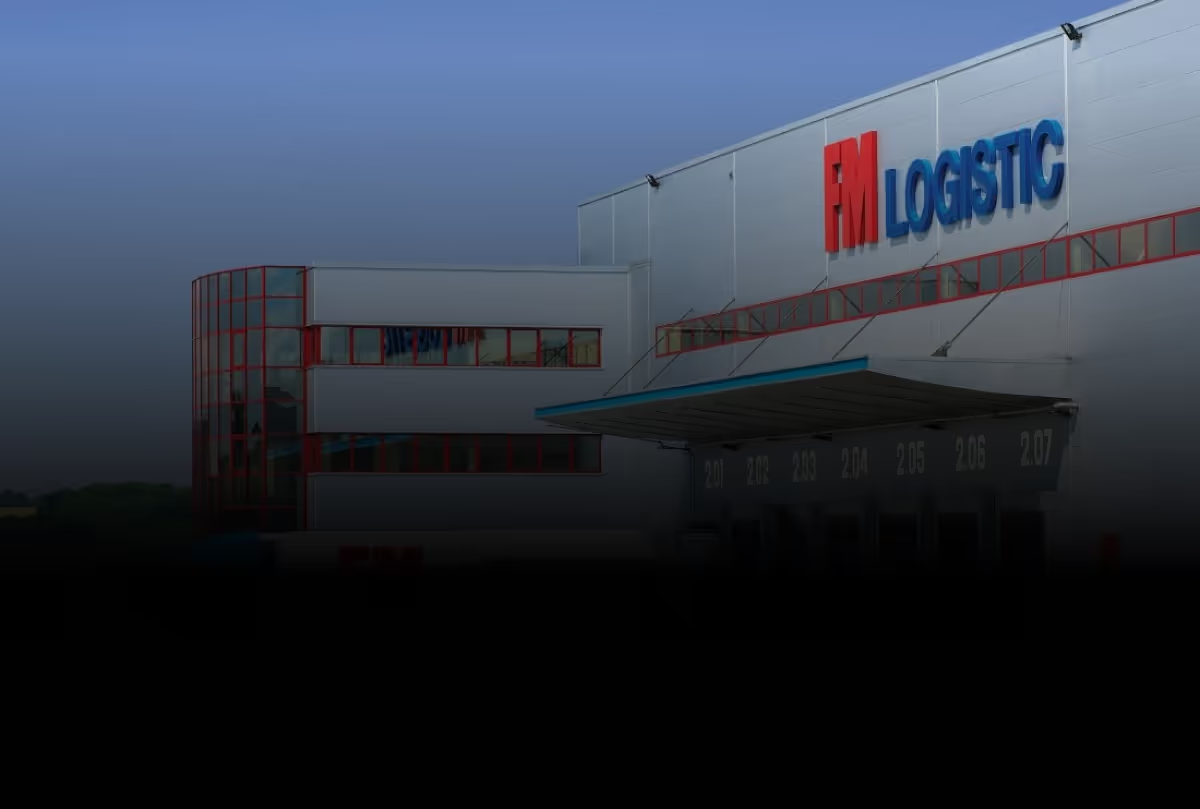
Case Study: STD "Petrovich" - Comprehensive Automation of a Distribution Center

Situation:As Petrovich's volumes and assortment started to grow rapidly, the company had to redesign its warehouse and transport processes to avoid losing speed and service quality. The chain set a clear goal: to increase the distribution center's capacity fivefold in five years, without expanding staff or raising warehouse logistics costs.

In addition, it was necessary to handle the complex specifics of DIY products: oversized cargo, outdoor storage, and sharp seasonal demand spikes. Solution: in 2024, Petrovich launched a comprehensive logistics automation program that included a transition to TMS system, rollout of WMS and implementation of YMS within a single platform.

Experts implemented the Yard Management module to speed up vehicle operations on the warehouse grounds:

  • vehicle receiving
  • gate arrival
  • loading
  • unloading

They also refined processes for outdoor storage areas, where weather directly affects operation speed and goods movement. Results: - The warehouse began processing inbound and outbound shipments faster even during peak periods. - Loading and unloading zones became more efficient thanks to Yard Management. - The company gained a foundation for further logistics scaling and IT system development.

After the project launch, Petrovich continued developing its logistics architecture: it built a program of 55 IT projects and began creating an order management platform.

Discuss your challenge with an architect

Discuss the article: Logistics Automation in 2026: How...

Send via: