











Solutions

Integrating 1C through a bus: methods and security

1C integration methods - OData, HTTP services, exchange plans, and the n8n/Datareon bus: when to use each, how to secure them, and what happens to the cost of change.

Our clients

Clients and partners

Capital Group
FSK Group
SMLT
Tochno
Dogma
Sber City
FM Logistic
Danone
+10clients · View cases →

Why 1C integration is a discipline of its own

  1. 1C configurations almost never work out of the box: every company customizes catalogs, documents, and processing tools for its own processes, so the data structure in each 1C system is unique.

  2. At the same time, 1C releases updates regularly: fields are renamed, and directories are split and merged.

  3. The rule follows: any integration tied to the internal structure of a specific configuration breaks with the next update.

  4. The architect's job is to choose an interface that survives releases and a transport layer that does not multiply point-to-point links.

  5. Below are three ways to expose data from 1C and the rule for how to combine them.
Method 1. OData: standard interface, fast start

  1. 1C:Enterprise starting with version 8.3.5 can expose a standard REST interface over OData: read, create, update, and delete data via HTTP requests, with responses in XML or JSON.

  2. The interface is enabled in the web server publication settings - no code is needed on the 1C side, so this is the fastest way to connect 1C to a bus or external system.

  3. Speed is OData's strength and also its risk: by default, it is easy to expose more externally than the task requires.

  4. Access rights must be configured; this is not optional.

OData publication security: the essential minimum

Method 2. 1C HTTP services: a narrow contract for the task

An HTTP service is a method that the developer defines in the 1C configuration

For a specific operation: "return warehouse stock"

, "accept order", "confirm shipment"

Only this method is exposed externally, not the data model. The security mechanism here is stronger than in OData: the contract is narrow and versioned, input is validated by service code before it is written to the database, and the service user's permissions are limited to a single operation. The result is a predictable cost of change: as long as the method contract remains stable, configuration updates do not break consumers. The tradeoff is development on the 1C side, so the initial start is more expensive than with OData.

Method 3. Exchange plans: bulk data on a schedule

  1. For large volumes and offline scenarios, 1C has built-in exchange plans and scheduled exchange (EnterpriseData format, data conversion rules).

  2. This is how directories and documents are synchronized between 1C nodes and how data sets are exported on schedule: overnight item master sync, transfer of documents for a period.

  3. The limitation is symmetrical: this is a batch mechanism.

  4. For real-time events - order status, stock reservation - it is not suitable; here you need OData or HTTP services on top of the bus.

Map out your integration landscape

How to choose a method: comparison

MethodWhen to adoptSecurityChange cost
ODataFast start, read and write of standard objectsMedium: object scope restriction, a service user, and HTTPS are requiredMedium: a change in object structure in a release may alter interface responses
1C HTTP servicesSpecific operations with validation and custom logicHigh: only the required method is exposed, with a versioned contractLow: the contract is fixed, while internals can change freely
Exchange plansBulk data on a schedule, exchange between 1C nodesHigh: exchange stays inside the environment, nothing is published externallyMedium: conversion rules are adjusted for releases
Any method + busMore than two systems in the environment, or growth plannedThe bus adds monitoring, message history, and access control in one placeLow: an 1C update changes one adapter on the busSelection rule: the interface is determined by the task (standard objects - OData, critical operations - HTTP services, bulk data - exchange plans), while with multiple systems the transport is always the same - a bus.

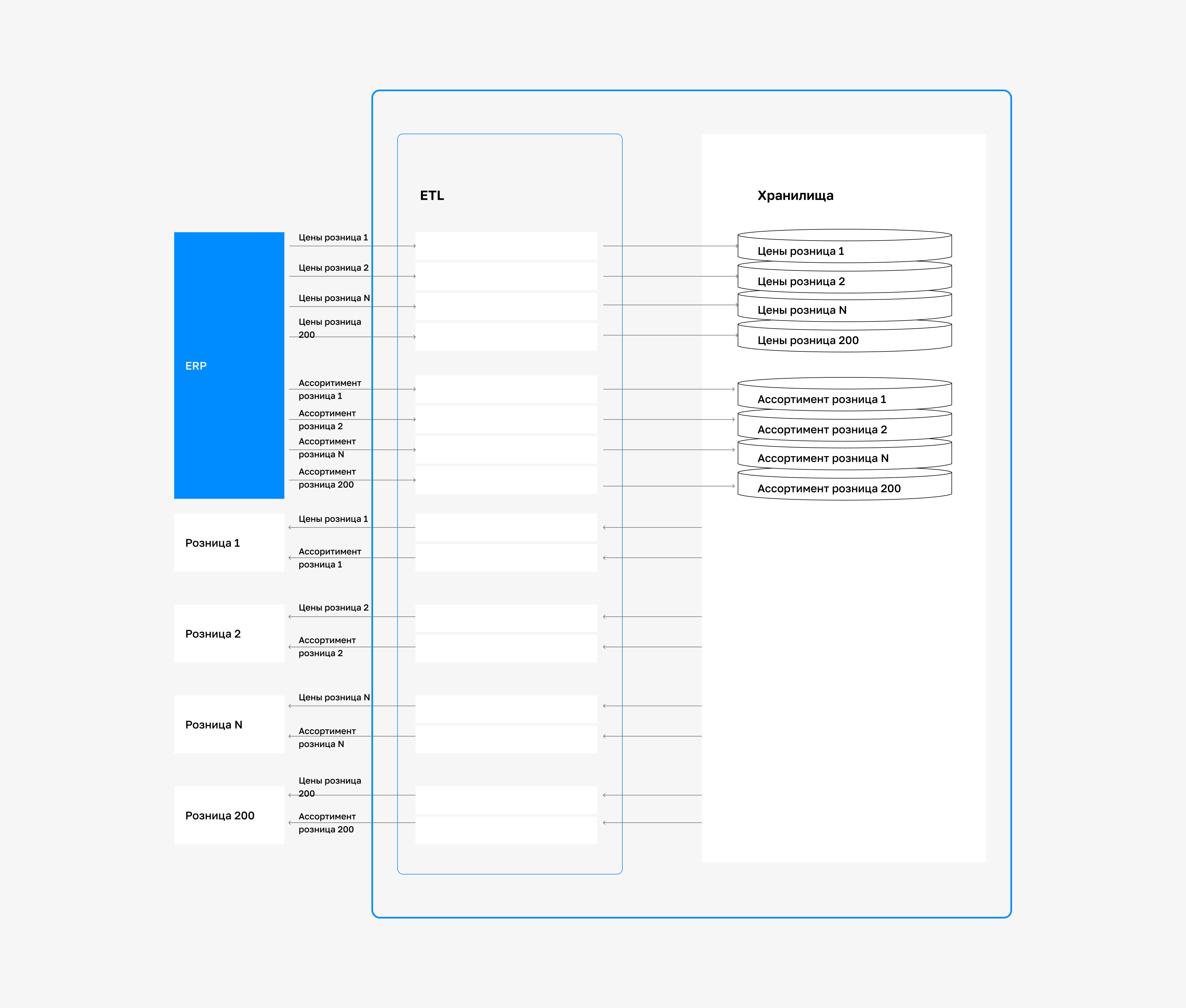
1C integration environment via bus

1C exposes data

ODatastandard objects
HTTP servicesNarrow operations
Exchange plansscheduled batches

Bus (n8n / Datareon)

Queues and retriesdelivery guarantee
Idempotencyno duplicates on retries
Transformation and monitoringRecipient format, history

Consumers

CRM, WMS, websiteoperating systems
BI / DWHanalytics
MarketplacesPrices, stock, orders
1C delivers data once using any of three methods. Redelivery, format conversion, and monitoring live on the bus, not in 1C code.

Transport: a bus instead of point to point

The interface answers the question of how to extract data from 1C, while the transport answers how to deliver it to everyone who needs it. If there are more than two systems, direct integrations multiply point-to-point links, and every 1C update triggers a cascade of changes. A bus (in our projects, n8n for lightweight scenarios and Datareon for the enterprise 1C landscape) breaks this dependency: 1C sends the data once, the bus stores messages, retries delivery after failures, drops duplicates, and transforms the format for each recipient.

Loose coupling - according to DORA, one of the predictors of delivery speed and stability - stops being a slogan and becomes a property of the system landscape.

Proven at scale

Cases

1C integration use cases via bus

Read all

Project estimation

We will estimate your 1C integration

We will review the configuration and environment, choose the interface (OData, HTTP services, or exchange plans) and transport, and estimate timeline and cost.

  • environment and configuration audit
  • choosing an interface and a bus
  • pilot flow in production
Discuss a Project

Discuss the solution: 1C integration through a bus: methods and...

Send via: