Orders
An order from the marketplace is created in 1C as a Customer Order: picking by handheld scanner scan (WMS on 1C) -> the "Packed" status is sent to the marketplace -> label printing -> tracking number for DBS/realFBS.

Two-way exchange between your 1C and Ozon, Wildberries, Yandex Market, and Megamarket: orders, stock, prices, statuses, and returns flow through an integration layer, not a boxed solution built for one configuration.
Our clients













1C marketplace integration is automated two-way data exchange between your 1C system (UT, ERP, UNF, 1C:Retail) and Ozon, Wildberries, Yandex Market, and Megamarket: orders arrive in 1C as a Customer Order with the To Fulfill status, stock and prices are sent to the marketplaces on schedule (for FBS, via a scheduled job, estimated by integrators at every 5-10 minutes), item master data is matched to product cards, and statuses and returns are synchronized without manual exports.
KT.Team builds this as an integration layer between 1C and all marketplaces, not as a boxed module for one configuration: 13 years of enterprise integration, an ESB bus with queuing and monitoring, a single product card for all channels - a new marketplace can be connected without reworking accounting.
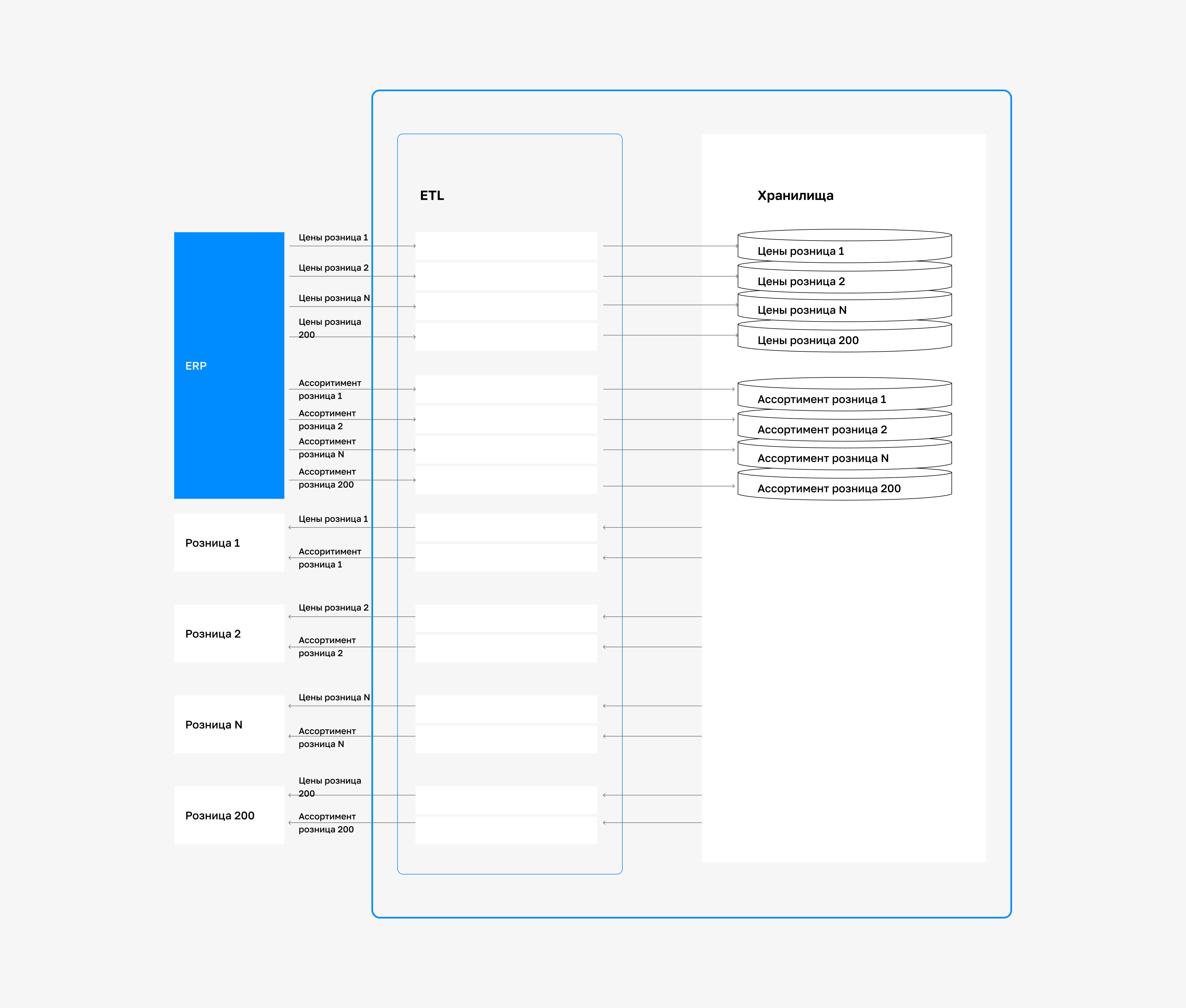
How data moves between 1C and marketplaces
Accounting system
Integration layer (ESB)
Marketplaces
An order from the marketplace is created in 1C as a Customer Order: picking by handheld scanner scan (WMS on 1C) -> the "Packed" status is sent to the marketplace -> label printing -> tracking number for DBS/realFBS.
Available stock = on hand - reserved - reserved by other channels. For FBS, stock is pushed to marketplaces by a scheduled job; there is an option to zero it out on a schedule.
Base and promotional prices are sent to marketplaces from 1C - without manual edits in each personal account.
Product cards are generated from 1C by mapping SKUs, barcodes, units, and packaging to each marketplace's requirements.
Order and processing statuses are synchronized both ways: 1C and the marketplace always see the same state.
Returns from marketplaces come into 1C; for FBO, the marketplace is responsible for storefront stock, while ERP handles supply planning and assembly.
We look at which 1C systems (UT/ERP/UNF/Retail), which marketplaces, which FBS/FBO/DBS schemes and volumes, and where boxed integration is no longer enough.
We match SKUs, barcodes, reference data, and units of measure against marketplace requirements at the master-data level, not manually for each item.
We launch the exchange on one marketplace or a group of SKUs, then verify orders, stock, and prices on live data.
We add marketplaces, prices, statuses, and returns through the same layer - without reworking accounting.
Logs, alerts, and adaptation to marketplace API changes: the exchange runs as a service, not a one-time setup.
Cases
FAQ
Scope audit (which 1C configurations - Trade Management, ERP, SMB Accounting, 1C:Retail, which marketplaces, FBS/FBO/DBS schemes, volumes) -> mapping of item master and reference data -> pilot on one marketplace -> connect the remaining flows -> monitoring and support. Exchange runs through marketplace APIs via an integration layer; for FBS, stock is sent by a scheduled job, according to integrators' estimates, every 5-10 minutes.
It depends on the number of marketplaces and the state of data in 1C. We can launch a pilot on one marketplace or a group of SKUs quickly; for comparison, in the Relief-Center case, we launched a PIM-to-marketplace publishing service in 2.5 months. We set the exact timeline after the scope audit.
Orders arrive in 1C as a Customer Order, stock is sent to marketplaces (real-time for FBS), prices and promotions go to marketplaces, item master and listings go through mapping, statuses are synchronized both ways, and returns come into 1C. Free stock is calculated as on hand minus reserved minus stock reserved by other channels.
Boxed solutions are one-sided: some work only with one marketplace, such as Ozon, while for Wildberries they often support only item mapping and stock export, without order automation (vendor estimate). According to integrators, marketplace APIs change every 3-4 months and break unsupported connectors. Multi-marketplace support, Wildberries orders, and resilience to API changes are provided by a supported integration layer, and a detailed breakdown of how to launch the exchange is in the blog. how to connect 1C with Wildberries, Ozon, and Yandex Market.
Yes. The layer is not tied to one 1C configuration or one marketplace: we build exchanges for Trade Management, ERP, SMB Accounting, and 1C:Retail with all major marketplaces and FBS, FBO, and DBS schemes through 1C integration via ESB. A new marketplace can be connected without reworking accounting.
We work on a fixed price for the agreed result, not by the hour: a guideline for a typical process is from 300,000 RUB over 1-2 weeks. We assess a multi-marketplace integration setup after an audit. More about the model - in the section pricing fundamentals.
Pricing and kickoff
We work on a fixed price for the agreed result, not by the hour: a guideline for a typical process is from 300,000 RUB over 1-2 weeks. We assess a multi-marketplace integration setup after reviewing the environment. More about the model - pricing fundamentals.
- 1C Marketplace Integration - solution overview: a node in the 1C hub when you need a high-level overview, not a transactional exchange launch. - Marketplace integration from the catalog and PIM side: listing publication and content, not 1C accounting data exchange. - PIM implementation: management of product listing content and master data. - 1C integration via ESB: OData and HTTP services: how 1C connects
to the integration layer. - 1C:Retail synchronization with marketplaces through the bus: an industry tool for retail. - PIM for marketplaces: a breakdown of listing content for marketplaces.