L10
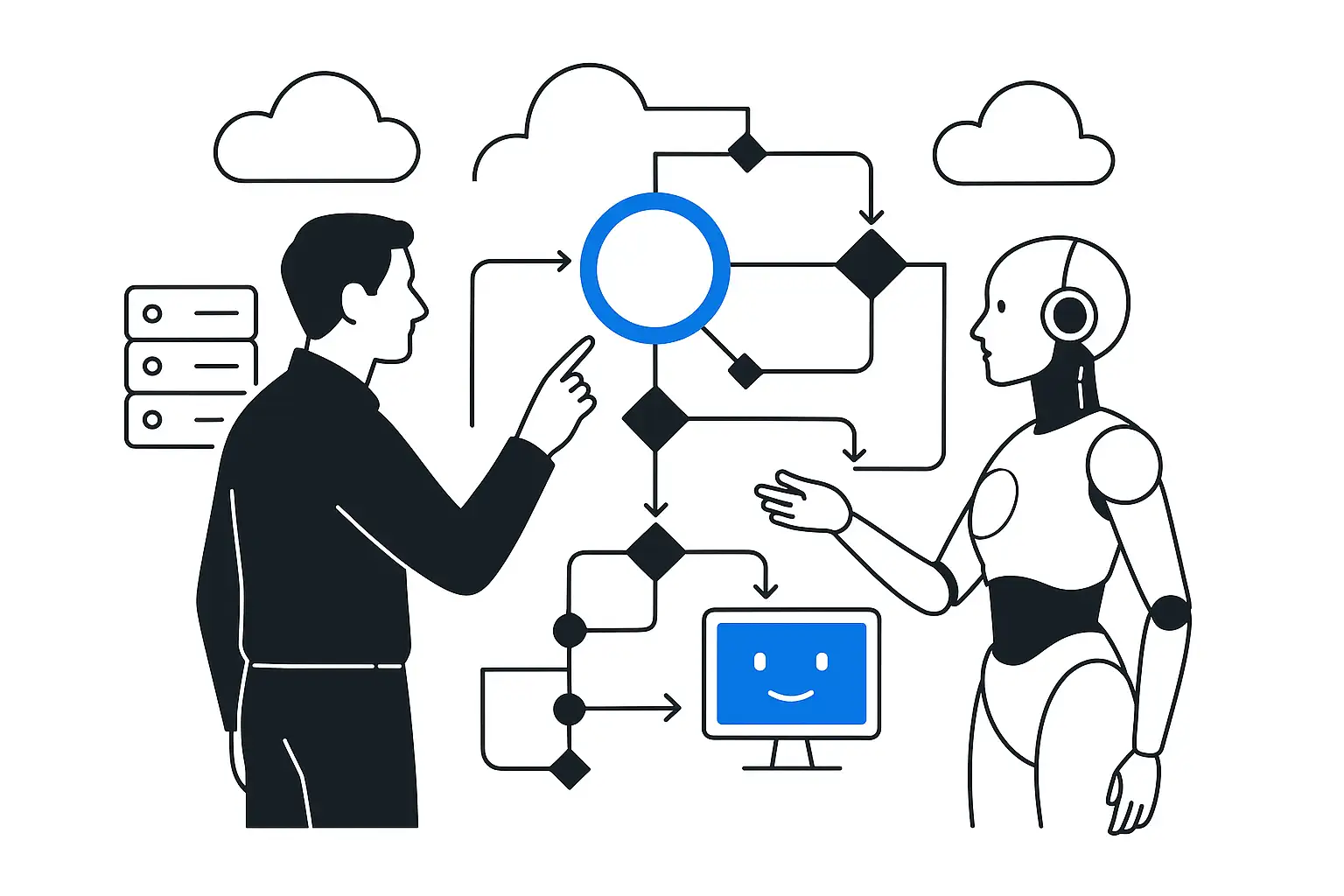
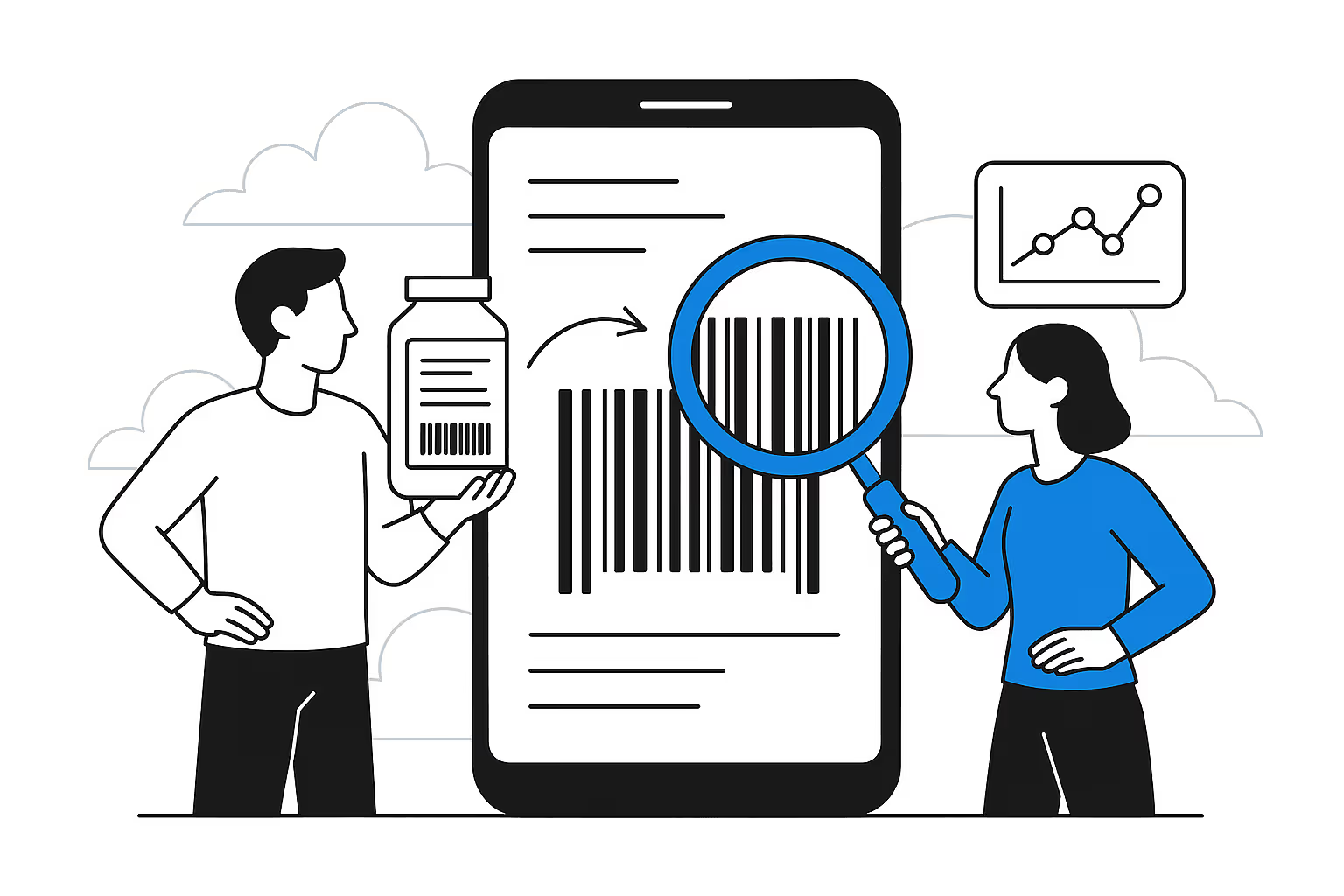
The client or PM has already described what to do and how to do it. This is the level of hands and a ready-made spec.

How KT.Team evaluates developers and project managers: L10-L60, TTU, workflow, client trust, and AI's role in modern development.
Assessment map
L10-L60 describes not a role or task size, but a level of trust: from hands on the spec to managing the project's goal and strategic value.
The client or PM has already described what to do and how to do it. This is the level of hands and a ready-made spec.
A developer carries value end-to-end: from meaning to production use.
The team or a strong engineer owns the workflow: hypotheses, feedback, and the new process state.
The PM builds trust from the project goal to initiatives drawn from the client's tactics and strategy.
Traditional developer evaluation often focused on stack, years of experience, task completion speed, and subjective seniority. In an AI-native environment, these signals quickly lose weight.
A Microsoft/GitHub study on Copilot showed a 55.8% speedup on a controlled task. Anthropic's Economic Index for development describes coding-agent sessions as a highly automatable class of work. DORA adds an important constraint: AI improves individual productivity, flow, and satisfaction, but without engineering fundamentals it can hurt delivery stability and throughput.
The evaluation takeaway is simple: AI speeds up hands, but it does not own the system.
If a person's value is to write pieces of code to someone else's spec, AI really does look like a threat.
If a person's value is to own the workflow, design loose coupling, assign tasks to agents, test hypotheses, and bring results into use, AI becomes a lever.
A level is not the same as task size. A large but clearly specified piece of work remains L10. A small but uncertain workflow can be higher.
The client or PM has already described what to do and often how to do it. Mockup, CRUD, repeat integration, bug fix, work from a detailed spec.
There is clear business value. The developer independently owns the intent, implementation, deployment, feedback, and follow-up until it is used.
The client delegates a problem or a new process state. The team opens the path through hypotheses, real cases, loose coupling, and feedback.
We define L30 epics ourselves and can adjust the goal based on usage facts, not just execute the original brief.
We propose a project ourselves from a clear tactical client need and take responsibility for the value sequence.
We see the client's strategic direction and propose projects that help implement that strategy.
From task to strategic value
L10
L20
L30
L40-L60
A developer at KT.Team is not a coder who just closes tasks.
This is an engineer who independently delivers business value by changing the workflow, uses AI as a core tool, communicates with the end user, and is accountable for the production result.
The minimally sufficient state under the policy is an L20 engineer at 4 points and DEVOPS at 4 points.
If someone is below that level, the development plan must show a clear path to it within at most 6 months. L20 requires end-to-end responsibility.
If value is split between front end and back end so that no one holds it in full, that is not yet mature value delivery. L30 requires more: the developer or team must turn the current state into hypotheses, cases, checks, readiness criteria, architectural decisions, and feedback on their own.
You cannot count something as L30 just because the PM called the work an epic.
The quality of execution for predictable technical tasks. This is the baseline, but not a long-term growth area.
Independent delivery of business value into use with fast user feedback.
Workflow leadership: the new process state, hypotheses, loose coupling, and team coordination.
The team is almost independent of an external infrastructure engineer within its area of responsibility.
Confidence in project execution quality and team growth: acceleration strategy, mentoring, and high standards.
AI is used as a core tool for design, implementation, requirements validation, and quality control.
The PM is evaluated through the state of the projects they manage. Their goal is not to be the busiest person in communications. The PM's core KPI in the policy has three parts: projects deliver maximum value to the client, relationships with the client's people become trusting, and the team is effective, loyal to the company, and growing. The PM's main metric is project state. PROJECT-LEVEL shows the L10-L60 trust level. MARGIN-CURRENT shows financial controllability.
TTU shows how quickly the target audience starts using the value. PROMISE shows whether commitments for timeline, budget, and goal are met. TEAM-MENTORING, MENTOR, and LEADERSHIP show whether the team is growing and whether the PM removes inefficiency before a crisis. RELATIONS and SALES show whether KT.Team is a formal contractor or a trusted partner that develops new projects.
This is not only our model. Abroad, developer accountability and evaluation are built on the same logic, and Amazon's official materials show this clearly.
- authored by KT.Team, but it aligns with international practice rather than conflicting with it. In the AWS article The New Unit of Software Delivery: The Workflow, Mark
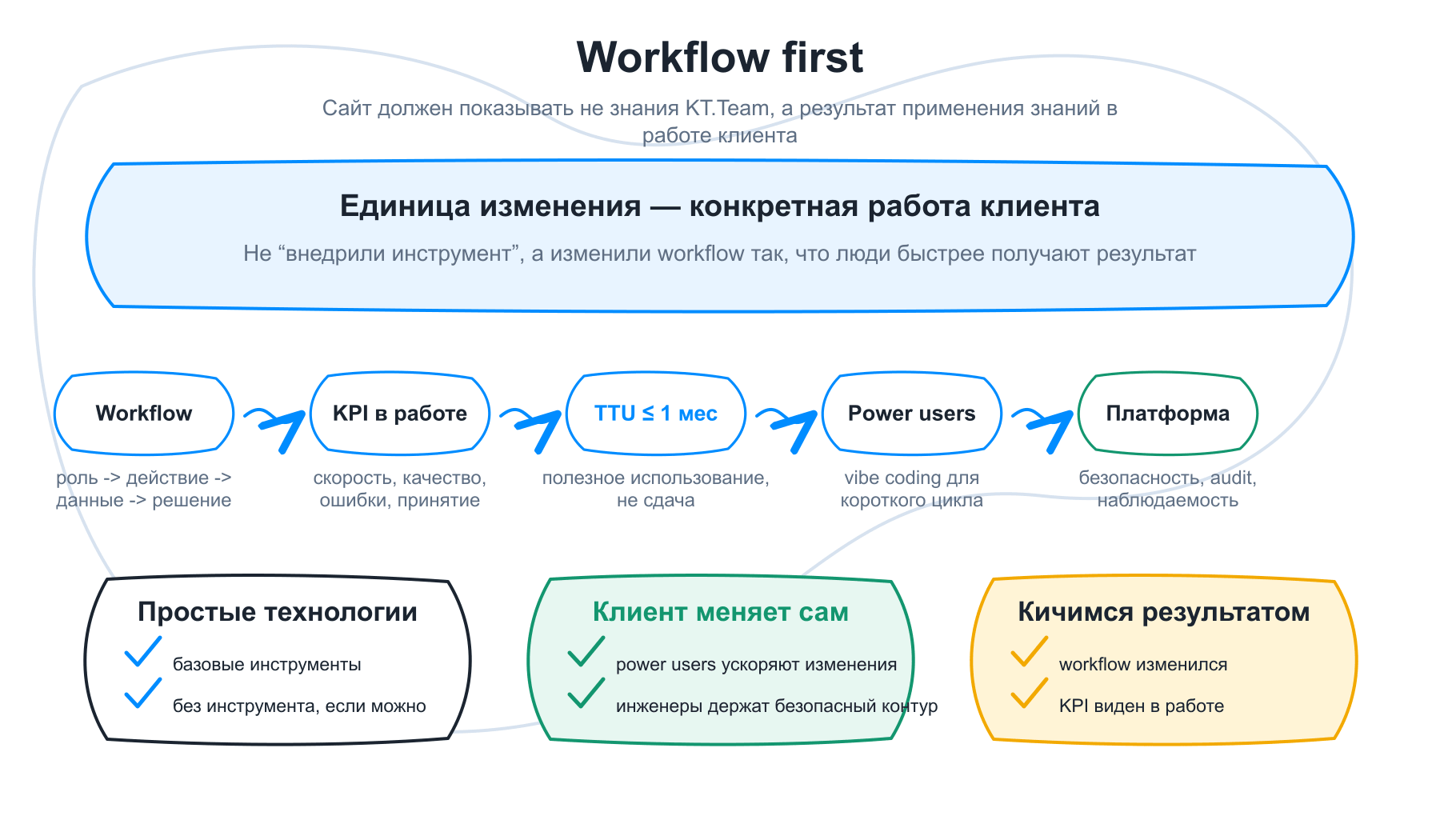
Schwartz writes that with agentic AI, the unit of development becomes the workflow: an end-to-end process with a business goal that can be specified, delivered, tested, and improved as a single whole.
This is almost a direct description of our L30: the workflow as the unit of outcome, not a screen, API, or user story. Amazon two-pizza teams are built around small autonomous teams and single-threaded ownership.
AWS's public description emphasizes that such teams own the full customer experience and the product or service lifecycle.
This is close to our end-to-end accountability requirement: L20 for value, L30 for workflow. Werner's recent piece
Vogels' 2026 piece on returning to two-pizza culture shows the same logic in an AI product team: a small team, autonomy, using the product from day one, and the ownership rule.
Separate delegated and sustained level: did the client grant L30, or did the team actually sustain L30 with facts?
Record not the release date, but the moment when the target audience began using the value in live operations.
Reduce unnecessary handoffs between business, PM, analyst, development, QA, and operations.
Keep decisions, correspondence, definition of done criteria, feedback, and usage facts in a form an LLM can read.
For a developer, the path is from value to workflow. For a PM, it is from task management to growing trust and the project goal.
L10-L60 and the workflow as the unit of outcome lead to one thing: a platform where each business process lives as a separate skill in the repository, with clear boundaries, access rights, tests, and observability. The developer assembles not a one-off enhancement, but a reusable skill. Then an authorized business user changes their own process independently - adjusting parameters, steps, and rules without waiting for a release from the contractor.
This is a direct extension of the separation we build into every layer: not "the system belongs to the developer"
The developer moves up the scale from code (L10) to workflow (L30) and to an environment where the business improves processes without them (L40+); the business stops being hostage to the development task queue.
Review date: 08.07.2026