
Context
The developer MVP integrates mortgage applications, contracts, statuses, action history, responsibility assignment, and document auto-generation. For business, this is deal workflow, not isolated screens.
The risk emerged at the UI-API boundary: a user might see a value in the interface, but the API contract doesn't confirm it. In contract workflows, this is dangerous because incomplete data can propagate and generate incorrect documents.
Business challenge
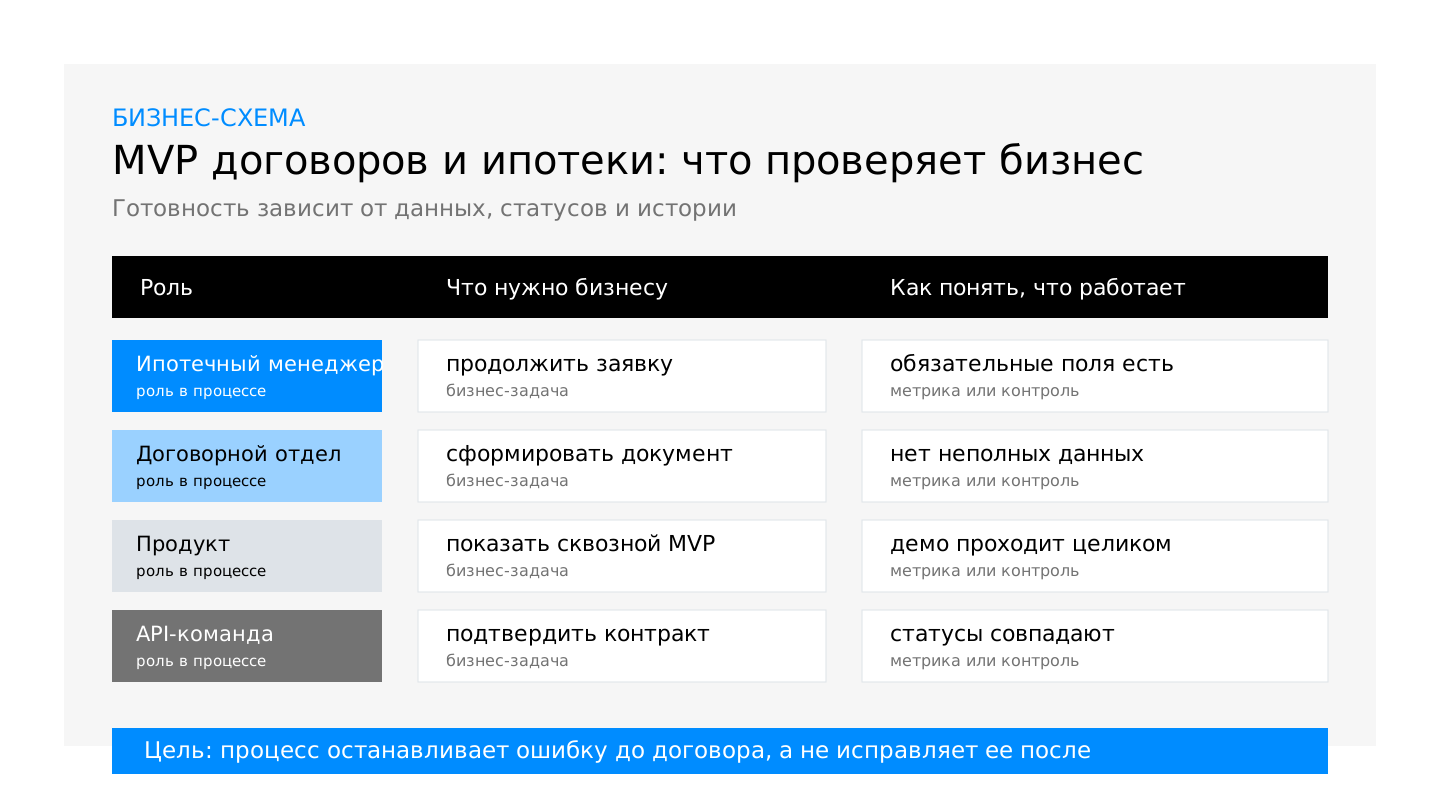
Mortgage managers need clarity on application viability. Contracts need complete data before document generation. Product owners need to show an MVP that reduces manual returns, not just showcase screens.
If statuses, required fields, and history diverge, teams waste time determining the source of truth: UI, API, application, contract, or action log.
Challenge
The task was to prepare a demo-ready scenario where required fields are validated before process continuation, and statuses and history align between the user interface and API integration.
Business goal – demonstrate an MVP that reduces returns, manual corrections, and incorrect document risks.
Review a similar project with an architect
Solution
The team identified required fields as a stop gate: if required values are missing from the API, the scenario must halt before errors reach the contract process.
Simultaneously, the team synchronized mortgage, contract, and history statuses so the demo shows the application flow as a single process.
- Identified discrepancies between UI and API for required fields.
- Mapped out mortgage, contract, executor, and history statuses.
- Prepared value arguments based on returns and manual effort reduction.
Metrics and business goals
For the contracts and mortgage MVP, metrics must demonstrate process readiness for business stakeholder discussions.
- required field completeness before proceeding to the next step;
- number of scenarios halted due to incomplete data;
- alignment of application, contract, and history statuses;
- number of returns for manual correction;
- demo scenario readiness: application → validation → contract → history.
Result
The MVP moved closer to demonstrating a cohesive deal process. A critical rule was made explicit: incomplete data must halt the scenario before errors propagate to documents or history.
For mortgage managers, it reduces application uncertainty; for contracts, it prevents incorrect documents; for product, it improves demo credibility.