Solutions

GDPR Compliance: ISPDn Protection Levels

We align ISPDn with GDPR using a threat model, PP-1119 protection levels, FSTEC Order No. 21 measures, and an operational framework.

Our clients

Clients and partners

Capital Group
FSK Group
SMLT
Tochno
Dogma
Sber City
FM Logistic
Danone
Relief Center
Pandora
GDPR Compliance: ISPDn Protection Levels
Saint-Gobain
Askona
FIX PRICE
Snezhnaia Koroleva
Muztorg
TVOE
Greenway
Polaris
Campari
Yandex
Lenta
International perfume and cosmetics brand
GDPR Compliance: ISPDn Protection Levels
RAEC
EKF
L'Etoile
Inventive Retail Group
4 levelsThe protection levels for personal data systems are set by CIS Government Resolution No. 1119 of 2012-11-01, from level 4 to level 1
3 typesResolution 1119 distinguishes three current threat types: those related to undocumented capabilities in system software, in application software, and those unrelated to them
20-500 million RUBturnover-based fine for a repeated personal data leak: 1-3% of annual revenue, but not less than 20 million and not more than 500 million RUB (Article 13.11, Part 15 of the Administrative Code)
15-20 million RUBfine for a legal entity for unlawful transfer of biometric personal data (Article 13.11, Part 17 of the Administrative Offenses Code)

Why paper compliance with GDPR no longer covers the risk

Ten years ago, GDPR compliance looked like a set of documents: processing policy, orders, list of storage locations, and an instruction log. Inspection came down to whether those papers existed and were signed. That model lasted as long as the cost of a mistake was comparable to compliance spending.

The cost is different now. A repeat breach turns the fine into a turnover-based penalty, a percentage of annual revenue with a floor of RUB 20 million. The operator must notify Roskomnadzor of the incident within 24 hours and report the investigation results within 72 hours. Meeting that deadline is only possible if you already know what data was stored where and who accessed it. A policy folder does not answer that question.

The practical gap is almost always the same: the company does not know its own personal data map. Personal data exists not only in the system everyone calls the personal data information system. It moves through integration exchanges, lands in analytics exports, gets copied into test environments, ends up in application logs and backups. Protection measures are selected for one system on the list, while the breach happens where the map never reached.

Path: from the personal data map to a working environment

PD map -> category -> threat model -> protection level -> measures -> perimeter

Inventory

Personal data mapwhich data, in which systems, where it comes from, and where it goes

Classification

Category of personal data and number of data subjectsspecial, biometric, publicly available, other; employees or external parties

Threats

Threat and Attacker Modeltype of current threats under PP-1119, actual access points

Level

Protection level UZ-4 to UZ-1established under Government Decree No. 1119 with written justification

Measures

Measure set under FSTEC Order No. 21Identification and authentication, access control, event logging, monitoring

Environment

Access, logs, exchanges, responseWhat works every day and is shown during an inspection
  • Failure 1 - no data map Measures are selected for the system people actually remember. Personal data in integrations, exports, test environments, and backups remains outside the protection perimeter
  • Failure 2 - the level was assigned by guesswork Set too low to save money - the measures do not meet the requirements; set too high for peace of mind - the budget goes to protection that was not needed
  • Failure 3 - the threat model was written for the document, not the system There are no contractors with access, no integration bus, and no analytics exports. The document exists, but the architecture described in it does not.
  • Failure 4 - measures are in place, but there are no logs There is nothing to show who accessed the data and when. There is no basis for the 24-hour notification or the 72-hour investigation report.
  • Failure 5 - the environment has gone stale A new service, integration, or AI agent appeared, personal data started flowing along a new route, but the threat model and measure set are still from last year
The sequence of steps is defined by GDPR and subordinate regulations. The exact set of measures depends on the assigned protection level and on your system architecture.

What determines the security level of a personal data system

The protection level is not chosen - it is determined by the input parameters set out in Government Decree No. 1119. Below are the parameters that must be fixed before discussing security controls.

Input parameterWhat we recordWhy this changes the security level
Personal data categorySpecial, biometric, publicly available, or other categoriesSpecial and biometric data require a stricter level, all else being equal
Number of data subjectsMore or fewer than 100,000 data subjects who are not the operator's employeesLarge-scale processing of third-party data raises the bar for the environment
Whose data is itOperator employees or external parties to the operatorCustomer and employee databases fall under different conditions
Current threat typeType 1, 2, or 3 under Resolution 1119, depending on the presence of undocumented capabilities in system or application softwareThe threat type is defined by the threat model, so it cannot be written after the protection tools have been selected

The practical meaning of the table: three of the four parameters are about data and processes, not technology. Until it is defined whose data is processed and in what volume, discussing specific protection tools is premature.

What exactly we do

The scope of work is assembled for your architecture. We come from the data engineering and integration side, which is usually the part of the environment that remains undocumented.

Personal data map by system

We review CRM, accounting systems, portals, storage, and integration exchanges and record where personal data is stored, where it comes from, where it goes, and who reads it. The map becomes data, not the knowledge of a single administrator.

A threat model matched to the real architecture

We describe threats and the attacker based on the environment that actually works: contractors with access, the integration bus, analytics exports, test environments, and mobile clients.

Justification of the protection level

We gather the PP-1119 input parameters - personal data category, number of data subjects, and type of current threats - and assign the level with a written justification, not by analogy with a neighboring company.

Access control and single sign-on

We implement an identity provider and SSO, roles, and an access matrix. Every user, including external contractors, gets a single entry point and an explicit set of permissions, and access revocation becomes a single action.

Logging of data access

We configure logs: who accessed which data and when, and what exports were sent outside. This trail supports both regulator inspections and incident notification within the first 24 hours.

Minimize personal data in exchanges and logs

We remove personal data from places where it is not needed: anonymization in integrations, masking in test environments, and cleanup of application logs. Data that is not in the system cannot leak.

Environment for LLMs and AI agents

If language models have appeared in the processes, requests to them go through LLM gateway with the data policy and log, not directly from the application to a third-party cloud.

Boundaries: What We Do Not Do

Map out your integration landscape

What each party is responsible for

System / layerScope of responsibility
Business process ownerDetermines which personal data the process needs and which events are considered unacceptable. Without that decision, there is nothing to benchmark the scope of protection against.
Customer's legal domainProcessing grounds, consents, the personal data processing policy, notification to Roskomnadzor about the start of processing, and data processing agreements.
The customer's information security and IT teamsOperates the environment every day: users and permissions, updates, incident response, and contractor oversight.
KT.TeamA map of personal data and data flows, a threat model tailored to the actual architecture, justification of the protection level, access segmentation and SSO, logging, and data minimization in exchanges.
Organization licensed by FSTEC of CISCertification of personal data systems and conformity assessment where required by the nature of the system or by contract terms.
Roskomnadzor and FSTEC of CISRegulator and methodology: requirements, measure set, oversight, and incident response.

The fine became revenue-based - the risk moved from the legal domain to engineering

As of May 30, 2025, amendments introduced by Law No. 420-FZ of 30.11.2024 apply to Article 13.11 of the Administrative Offenses Code. The fine for a breach depends on the number of affected data subjects, and a repeat violation turns the fine into a turnover-based penalty: 1% to 3% of annual revenue, but not less than RUB 20 million and not more than RUB 500 million (Part 15 of Article 13.11). Unlawful transfer of biometric personal data costs a legal entity from RUB 15 million to RUB 20 million (Part 17 of Article 13.11).

For business, this changes not the budget line, but the owner of the task. While the fine was fixed and moderate, the risk was handled legally - with documents and procedures. A revenue-based fine is tied to turnover, so it cannot be reserved for in advance, which means the question shifts to those responsible for architecture: where the data is physically stored, who has access to it, and what remains in the log if access falls into the wrong hands.

The deadlines reinforce the same shift. Roskomnadzor must be notified of an incident within 24 hours, and the results of the internal investigation must be reported within 72 hours. Reconstructing within a day what exactly was lost is only possible from a preconfigured log. If there is no log, the company gets a second violation on top of the first, this time for silence.


Cases

KT.Team cases: access and data boundaries

Read all

Bringing a personal data information system into compliance relies on two engineering essentials: controlled access and explicit data boundaries. Below are projects where we did exactly that, outside the scope of a dedicated GDPR project.

What this delivers in practice

In the single sign-on project for GK TOCHNO, access to related services for internal users took from three weeks to two months to approve, while external contractors had no accounts at all - exchanges were handled on paper and digitized afterward. We implemented Keycloak as the identity provider and the personal account as the single entry point. From the perspective of GDPR, this is the basic part of the perimeter: a clear account for everyone who reads data, and one controlled mechanism for issuing and revoking rights.

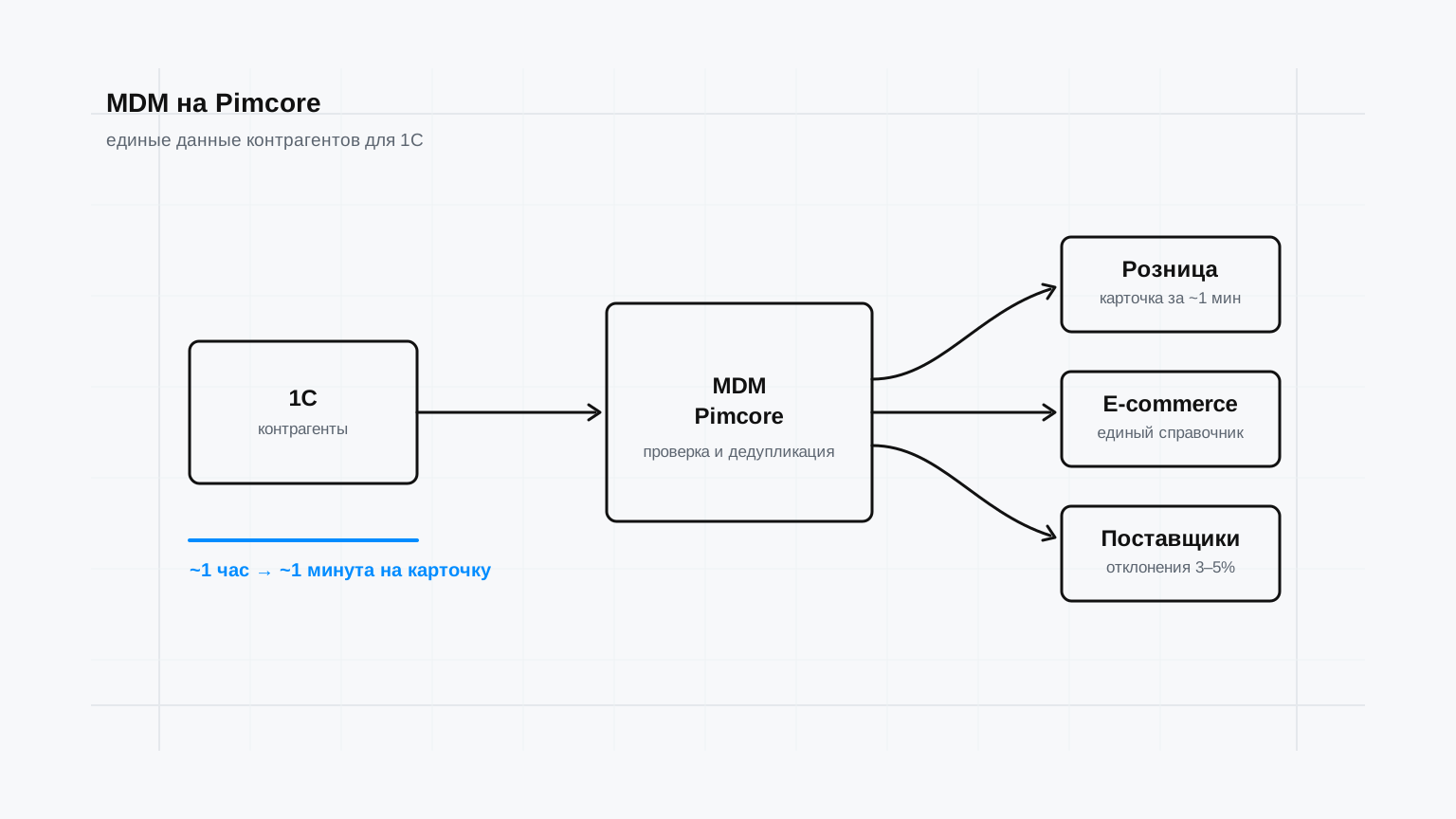
In the MDM project for Muztorg, the data boundary was defined at the task-setting stage. The case wording was: "Another boundary is personal data: for the historical load, we intentionally take only legal entities." This is a cheap and underrated move: data that you did not pull into the new perimeter does not need to be protected or explained to the regulator.

How we start

  1. 01

    Environment analysis

    We review systems, integrations, and contractors with access. The result is a draft personal data map and a list of places where the data ended up unexpectedly.

  2. 02

    Threat level and threat model

    We record the category of personal data, the number of data subjects, and the type of actual threats, establish the protection level with justification, and compare it with the measures in Order No. 21.

  3. 03

    Gap prioritization

    We break down the gap between required and actual into a short task list and sort it by risk, not by the order of the order's sections.

  4. 04

    Environment and handoff

    We implement access controls, logging, and data minimization, document procedures, and hand over the perimeter to the client's team together with diagrams and the decision log.

FAQ

FAQ on GDPR and personal data system security

How do you determine the protection level of personal data?

According to Government Decree of the CIS No. 1119 of 01.11.2012. The inputs are the category of personal data being processed, the number of data subjects, the indicator "employees or outsiders," and the type of actual threats taken from the threat model. There are four levels, from UZ-4 to UZ-1. The sequence matters: first the threat model, then the level, and only then the set of measures.

How does FSTEC Order No. 21 differ from Order No. 17?

FSTEC of CIS Order No. 21 of 18.02.2013 approves the scope and content of measures to ensure personal data security in personal data information systems. Order No. 17 of 11.02.2013 sets the requirements for protecting information not constituting a state secret in state information systems. If your personal data information system operates within a state information system, both documents apply.

Is certification of the personal data system required?

For government information systems, certification is required by GIS regulations. For commercial personal data systems, the issue is determined by the nature of the system and contract terms: public-sector customers and large enterprise clients often require it contractually. The certification itself is carried out by an organization licensed by FSTEC of CIS, and we prepare the perimeter for that process.

Our data is in the cloud and with contractors - who is responsible?

The controller's responsibility does not transfer together with the data. Processing on the contractor's side is formalized through a processing assignment, and protection requirements apply to that part of the environment. In practice, this means the personal data map must extend beyond the company perimeter and include everyone receiving data through integrations.

How long does it take?

A personal data map and a justified protection level are usually assembled in a few weeks - this is analytical work, not procurement. After that, the timeline depends on the gap between the required and actual state: access segmentation and logging are implemented much faster than rebuilding integrations where personal data is transmitted in plain text.

Can personal data be sent to a language model?

Not by default. Sending data to an external service is a separate legal act, and a prompt containing a fragment of a customer database involves not one data subject but thousands. The practical setup is a gateway that anonymizes data before sending and keeps logs; the architecture is covered in the article on AI agents and GDPR.

Where do you start if nothing has been done yet?

Start with the personal data map. It answers which systems are personal data information systems at all and almost always reveals two or three forgotten places: an analytics export, a test environment with a production database, or a log containing phone numbers.

KT.Team service

Bringing a personal data information system into GDPR compliance

We build the personal data map, a threat model tailored to your architecture, and a justified protection level, then close the gap through engineering: access control, logging, and minimizing personal data in exchanges and logs.

  • We start with a data map, not with buying security tools
  • Protection level - with written justification under Government Decree No. 1119
  • We hand over the environment to your team together with the operating procedures
Discuss compliance work ->

Sources

Discuss the solution: GDPR compliance: personal data protection and...

Send via: