Trigger
A call, a client question, or a new fact becomes a task.

AI
We adapt your site for AI search with complete facts, structure, FAQs, and schema so sales and marketing can update it without code or releases.
Product map
A customer question, a new offer, or an expert fact goes through brand context, checks, and publishing. The data returns in the next edit.
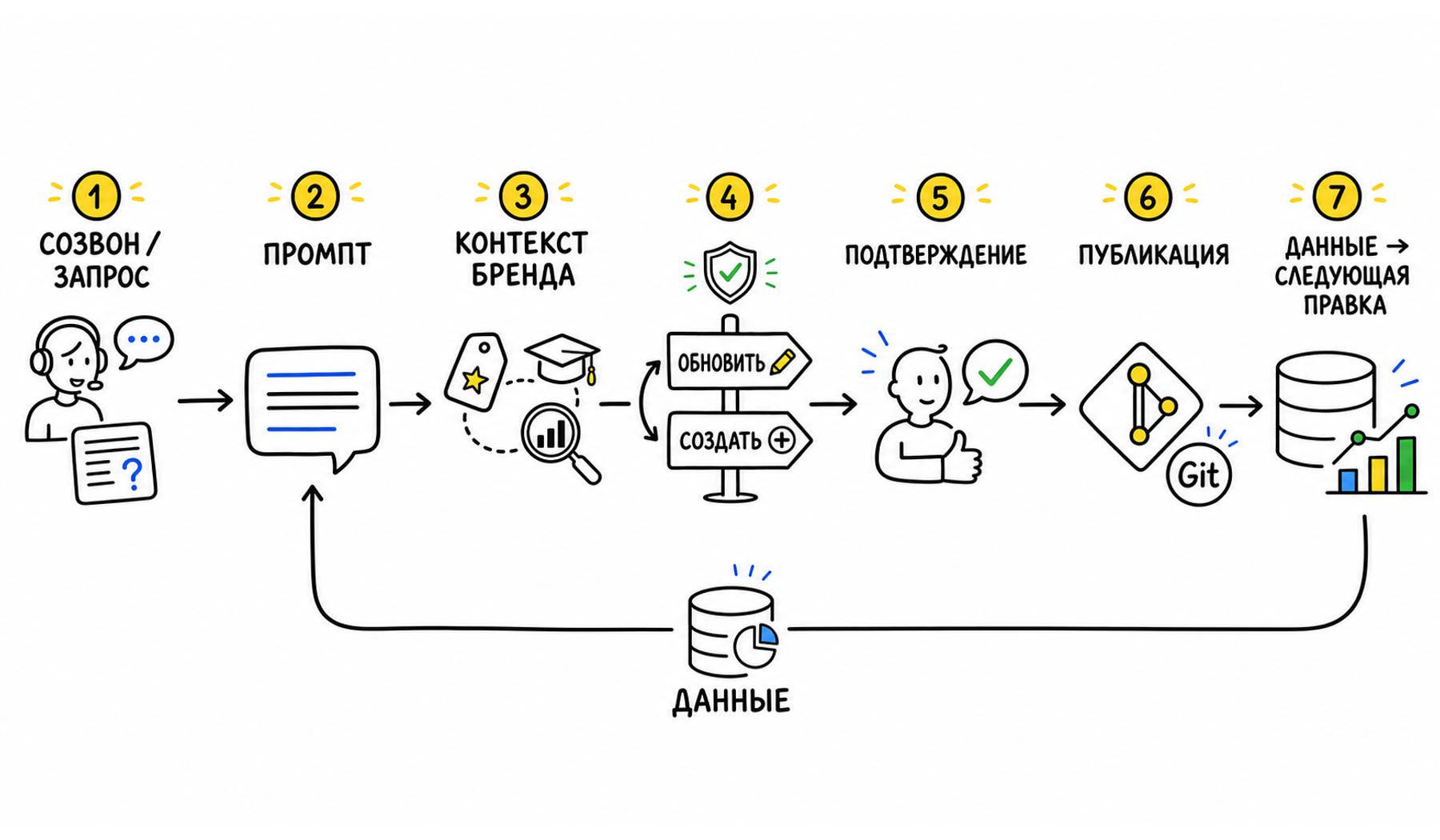
Scroll the diagram horizontally →
A call, a client question, or a new fact becomes a task.
The system decides whether to strengthen an existing strong page or create a new URL.
Facts, pricing, and publication are confirmed by the responsible employee.
Search, assistant answers, and inquiries feed into the next edit.
Our clients














When someone asks an AI model "who implements AI in manufacturing" or "who should I compare this contractor with," the model does not look at the site with human eyes. It takes the HTML, extracts the text and structure, and builds a short answer from them. What makes it in is whatever it can extract: headings, paragraphs, lists, tables, question-and-answer pairs, and Schema.org markup. Anything that exists only in animation, an image without a caption, a PDF presentation, or a script is almost invisible to it.
The uncomfortable takeaway is that completeness now matters more than polish. A page that plainly states the service scope, limitations, industry experience, workflow, and answers to common questions is quoted more readily than a polished five-screen landing page. The model needs a passage it can lift in full without getting it wrong.
The second factor is consistency. A brand is assembled from many sources at once: the website, directories, publications, reviews, and company profiles. If the wording differs, the answer will be averaged out and often wrong. That is why the work starts by making sure the facts on the site are complete, accurate, and consistent everywhere.
The third factor is speed. Facts go stale faster than the developer queue comes back around: the service scope changes, a new case appears, and sales keep answering the same question for the third month in a row. If every edit requires a release, the site always lags behind what the company can actually do.
Six things that make a page extractable. None of them are about decoration.
We put the service scope, constraints, industry experience, and workflow into the page text. What sits in a PDF, image, or presentation is almost invisible to the model.
One H1, honest H2s for real questions, short paragraphs, lists, and tables instead of a solid wall of text. Then the snippet can be quoted in full.
FAQ written in the wording people actually use. FAQPage schema is generated automatically from it, and generative systems cite such answers more readily than prose.
A Markdown version of each page, sitemap.xml, llms.txt, and the search index are built during the build process, not maintained manually, so they stay in sync with the site.
The meaning arrives in the server's first response. If the content appears only after JavaScript, some crawlers simply will not see it.
One page per question, links between sections, and consistent wording across the site, case studies, and external company profiles.
What happens between “needs fixing” and a quoted answer
Trigger
Assembly
Checks
Publish
Indexing
Result
Agent checked
The answer is assembled from the current policy and commercial terms. A new URL is not needed: the service page covers the question, and a separate address would split search signals.
Suggested action
Update the service page, add two FAQ questions, and publish after approval
After approval: Git to site, Markdown, and schema · version saved
Trace: who changed what, which checks passed, and when it was published
Before, any website edit required a chain of five people: marketer, copywriter, designer, frontend developer, and programmer. Now I manage the site myself and spend 5-15 minutes a day on it.
We look at what is currently available to machines: fact completeness, structure, markup, edit speed, and what external sources say about the company.
We move the site or part of it into structured records and blocks, then connect the build, automated checks, and Git versioning.
We add what is missing for the answer: service list, limitations, industry experience, and FAQ tailored to real search phrasing.
We teach sales and marketing to make edits in plain language and show the point where engineering help is needed.
We connect analytics and inquiries, then repeat measurements across a group of prompts to the models, not based on a single random answer.
Fixed start
Audit -> one section -> measurement
We review what neural networks and search crawlers can currently extract from the site, rebuild one commercial section according to these rules, and teach the team to make edits independently. We assess a full site migration, redesign, and work with external sources after an audit. A guide to pricing and terms is on the payment model page.
FAQ
Prepare the site for a reader that is not a person but a generative system: complete facts in the text, clear structure, a Q&A block, Schema.org markup, and machine-readable page copies. The goal is for the model to extract and quote your answer, not invent it for you.
Technically, it is one job for content and the index, but with different outcomes. SEO competes for placement in the link list, while GEO aims to get a fragment of your page into the generated answer. The foundation is the same: accessible HTML, structure, completeness, and consistent facts.
No. The answer depends on the model, the wording of the question, index freshness, and the platform's internal experiments, so no one can guarantee it, including the platforms themselves. What can be controlled is the completeness, consistency, and accessibility of facts, and the result is measured by repeatability across a group of questions, not by a single screenshot. Full breakdown in the article Managing brand image in neural networks.
Completeness. The model extracts text and structure, not the impression of animation. A site with five beautiful screens loses to a page that plainly states the service scope, limitations, and answers to common questions. Design still matters for the people who arrive from the answer link.
It is not required and guarantees nothing on its own: it is a map of key pages for language models. We generate it automatically during the build because it is inexpensive. The completeness and structure of the pages themselves matter far more.
No. We start with an audit and one commercial section: we convert it into a structured format, add missing facts and FAQ items, and measure the results. After that, scope is decided by data, not by a blanket promise.
Whoever knows the answer: sales, marketing, or a subject-matter expert. The change is described in plain language, the system assembles it from ready-made blocks, runs checks, and shows the result before publishing. An engineer is needed for new integrations and platform development.
In three layers: technical readiness, meaning what the crawler and model actually extract from the page; visibility across a repeatable set of questions to the models; and standard analytics, meaning visits from search and assistants, inquiries, and their outcome in CRM. One model answer is not a metric.
We preserve the domain, active addresses, and canonical URLs, and merge pages with 301 redirects. At the same time, rankings also depend on demand, competitors, and algorithms, so we do not guarantee traffic preservation.