AI agents: what digital employees are, how they work, and why companies are adopting them at scale

How AI agents replace chatbots, which business tasks they solve, and how to choose a deployment platform.

  • What an AI agent is and how it differs from a chatbot
  • How AI agents evolved
  • Why is business investing in AI agents?
  • How an AI agent is built: architecture and system components

40% of requests in large companies are already handled by AI agents without human involvement. These are not chatbots that simply answer questions. AI agents plan, make decisions, and interact with systems like full-fledged digital employees. Here we explain what an AI agent is, how it works, what tasks it solves, and how a business can choose an implementation platform.

Discuss your challenge with an architect

What an AI agent is and how it differs from a chatbot

Many people still confuse chatbots and AI agents. A chatbot responds to user requests in a dialogue - you ask a question, it looks for the answer in a knowledge base, and returns it. It works according to predefined scenarios and does not act on its own. For example, a website support bot can tell you the delivery service number, but it will not call logistics to speed up your order. AI agent - is a "digital employee."

A program based on large language models _(LLMs)_ that sets goals on its own, builds a plan, and executes it through CRM, email, and databases. For example, you ask the agent to prepare a quarterly financial report - the system automatically gathers data from 1C and Excel, analyzes it, formats it according to your template, and sends the presentation by email.

How AI agents evolved

The first agent prototypes appeared several decades ago. These were expert systems that worked on an _"if-then"_ principle. For example, a system analyzed a patient's symptoms and made a diagnosis based on predefined rules. Such programs were useful, but they had a drawback - could not learn from new data and handled only a narrow range of tasks. The situation changed with the emergence of _machine learning_. Algorithms learned to recognize images, forecast demand, and detect anomalies in data.

However, they still could not act independently in complex environments. With the arrival of language models, systems began to _understand context and build logical action plans._ This made it possible to connect model intelligence with real tools - CRM, databases, and APIs. This is how modern AI agents appeared, capable of independently carrying out multi-step operations.

Why is business investing in AI agents?

Agents automate not one task, but an entire process - this lowers costs and increases profit. These systems work like virtual employees that do not just follow instructions, but independently plan and carry out multi-step operations, freeing teams from routine work and reducing operating costs.

Companies use agents to solve the following tasks: - Sales department automation - the agent can qualify leads, update CRM data, prepare personalized commercial offers, and remind managers about calls. - Financial analysis and reporting - automated data collection from different systems, consolidation, validation, and preparation of weekly reports for the CFO. - Customer support - agents solve complex multi-step problems (for example, step-by-step troubleshooting) instead of just looking up an answer in a knowledge base. - Logistics and Supply Management- autonomous supply monitoring, demand forecasting, and automatic supplier order creation when stock reaches a threshold level. - Marketing personalization - creating and launching hyper-personalized ad campaigns based on user behavior and preferences in real time. - Recruiting and HR - automated candidate sourcing, initial screening, scheduling interviews, and drafting offer letters. - Internal assistant - the agent prepares meeting agendas, summarizes long documents and minutes, and plans business trips. - Cybersecurity monitoring - continuous analysis of logs and network activity for anomalies, with automatic response to standard threats. According to RBC, the CIS AI market shows some of the highest growth rates in the world - 45% in 2025. This rapid growth is largely driven by the active development of the autonomous AI agent segment specifically.

The _financial sector_ has led adoption: Sber and T-Bank use agents to automatically analyze loan applications and detect fraud. The systems independently check customer documents, assess risks, and make preliminary decisions, speeding up application processing by 40%. The second key area is _retail and logistics_. Wildberries and Ozon use AI agents to manage inventory and optimize supply chains.

Agents continuously analyze demand, forecast sales, and automatically create orders for suppliers. The business reduces logistics costs by 15-20% and helps avoid overstocking warehouses.

How an AI agent is built: architecture and system components

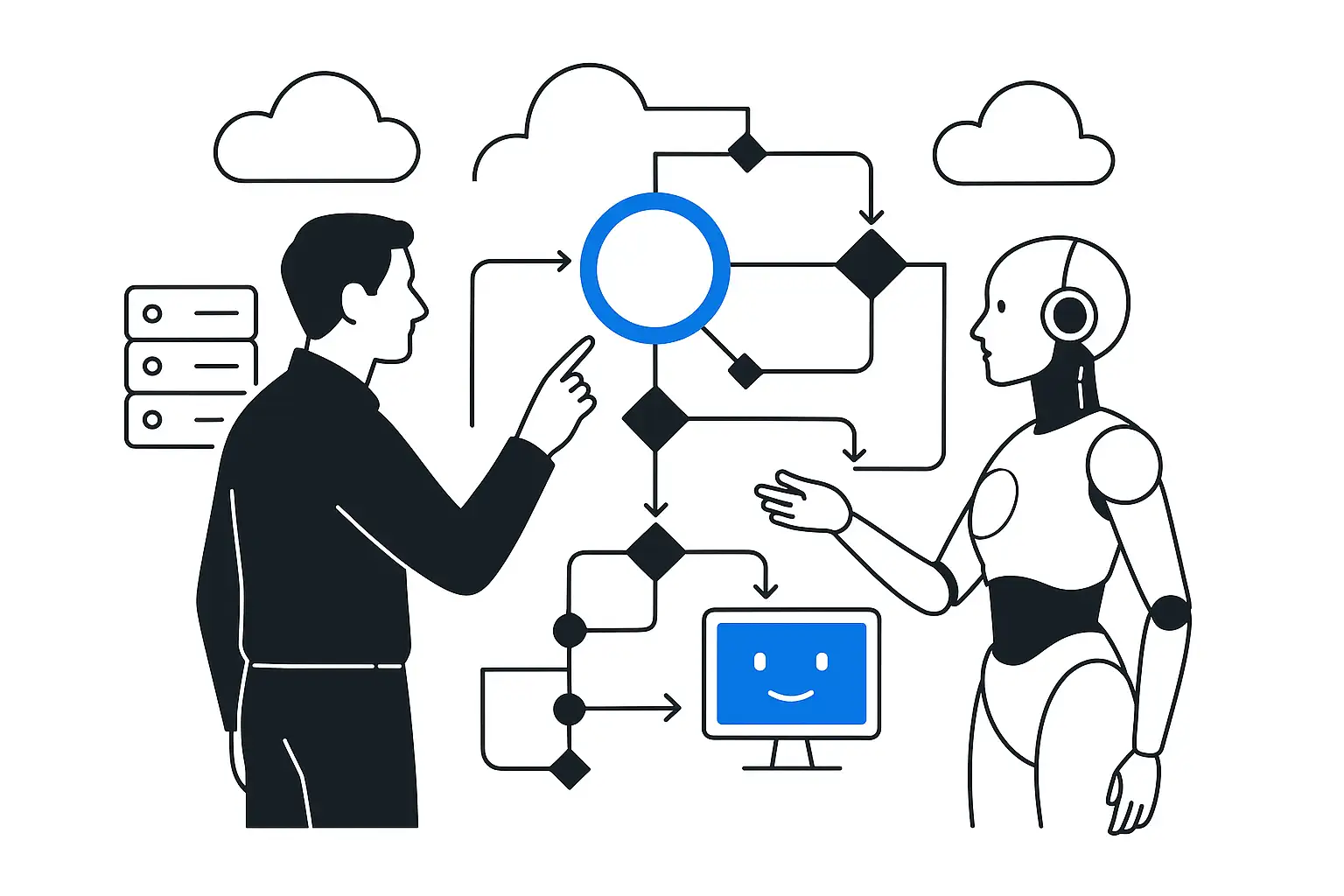
The architecture of an AI agent resembles a think-and-act cycle. The system does not just generate text - it perceives the environment, analyzes it, plans actions, and executes them using tools. This approach allows the agent to solve complex tasks independently, without constant human supervision.

Thinking: planning and problem-solving

At the core of any advanced AI agent is a large language model (LLM), such as _GigaChat or YandexGPT_. However, the model alone is not enough for autonomous operation. The agent's full reasoning is enabled by three interconnected processes: 1. Planning. The agent turns a general goal into specific, executable steps.

So, for the task "increase customer satisfaction," it creates a sequence: analyze the latest 1,000 reviews -> identify recurring issues -> propose an improvement plan for each identified shortcoming. 2. Task solving. At each stage, the system chooses the optimal action. If a CRM query does not return the needed data, the agent looks for the information in email or requests it from colleagues through the corporate messenger.

3. Reflection. The agent constantly checks results and adjusts its approach: if data is insufficient, it changes the plan — refining parameters and broadening the search.

Agent tools: how it interacts with the world

To affect the digital environment, an agent needs "hands and feet" - specialized tools. An LLM cannot send an email or update a CRM record on its own. But it can call the appropriate API to do so. Tools define the specific actions the agent can perform: - web search; - working with databases and CRM systems (for example, 1C or Salesforce); - sending emails and messenger notifications; - creating and analyzing documents, spreadsheets, and images; - executing code.

It is the combination of _LLM intelligence_ + _action tools_ that turns a language model into an autonomous agent capable of multi-step tasks, from planning to achieving the final result.

Types of AI Agents and Their Use in Business

AI agents can be classified by their level of autonomy and specialization. Choosing the right type depends on the specific business task. The table below shows the main types of AI agents and examples of their use in business.

Agent typeDescriptionUse Cases
ReactiveThey act on a stimulus-response basis, do not remember past experience, and do not plan ahead.An email spam filter, automatic assignment of CRM requests based on defined rules, a chatbot for password resets.
Model-based agentsThey take into account not only the current situation but also an internal world model, which allows them to operate with incomplete information.A virtual assistant that uses location data and user preferences; a logistics route simulator that predicts delays.
Goal-based agentsThey independently plan actions to achieve a clearly defined goal.A recommendation system in Netflix or Yandex Market that aims to maximize engagement and the likelihood of purchase.
Utility-based agentsThey choose not just any path to the goal, but the optimal one, maximizing the defined satisfaction metric.A trading bot on an exchange that maximizes profit while minimizing risk; a discount management system that balances margin and sales volume.
Learning-capable agentsThey continuously improve their work by adapting based on feedback and new experience.A self-driving car that learns to drive in different weather conditions; an adaptive cybersecurity system that learns new threats.
Multi-agent systemsMultiple agents interact and coordinate actions to solve complex tasks.Multiple agents in a warehouse: one tracks inventory, another manages loading, and a third coordinates them.

Analysts forecast, that by 2028 up to 80%companies will use agentic AI in their enterprise systems. This means that in the coming years, autonomous AI agents will become a standard business tool.

Discuss your challenge with an architect

AI agents in action: deployment results in CIS business

Practical examples best show the value of the technology - let's look at 3 real cases of agent deployment in CIS companies.

1. AI agent for recruitment automation at Sberbank

Task:each month, Sberbank HR specialists processed more than 5,000 resumes.

Manual screening took up 80% of working time, slowing hiring and increasing recruitment costs. Solution: the bank implemented AI agent based on _GigaChat_, which learned to: - Analyze resumes and compare candidates' experience with job requirements. - Assess compliance with professional standards. - Automatically coordinate dates and schedule interviews through the calendar.

The system works _24/7_ and processes requests without interruption. As a result, Sberbank: - Reduced application processing time from 5 days to 6 hours. - Increased the number of closed vacancies by 40%. - Cut recruitment costs by 35%. - Freed up 70% of recruiters' time for personal communication with candidates. - Improved selection quality through objective resume evaluation.

2. AI agent for sales department automation

Task: managers at ProfitStroy (a wholesale supplier for construction retail) spent 60% of their work time on routine tasks: calling the customer database, sending commercial offers, and maintaining the CRM.

This led to the loss of hot leads and a lower conversion rate at the initial contact stage. Solution: the expert team implemented AI agent for the sales team, which: - Automatically calls customers from the database and conducts an initial survey. - Detects interest through voice and keyword analysis. - Sends personalized proposals via email and messaging apps. - Updates lead statuses in CRM and schedules meetings for managers. - Generates campaign performance reports.

The agent was integrated with Asterisk (an open IP telephony platform) for calls and Bitrix24 for deal management. Results: - Increased lead-to-sale conversion by 35%. - Reduced request processing time from 2 hours to 15 minutes. - Lowered manager workload by 50%. - Increased total sales by 28% in one quarter. - Cut telemarketing costs by 65%.

The system works 24/7and processes up to 500requests per day, which allows the company to scale sales without increasing headcount.

3. AI agent for boosting retail sales

Task: The Domovoy chain (a retailer of home improvement and garden products) was losing customers at the product selection stage. Customers could not get quick advice outside business hours, and managers could not keep up with all requests from chats, phone calls, and social media. This reduced conversion and increased the number of abandoned carts on the website. Solution: the partner team implemented AI agent for retail, which works as a single entry point for all customer channels.

The system helps customers 24/7: - Advises on product specifications and selects compatible materials. - Checks product availability in warehouses and stores near the customer. - Calculates project cost and prepares an estimate. - Accepts and tracks order status through integration with 1C. - Reminds customers to buy related items. - Passes complex questions to live specialists with the full conversation history. Results: - Reduced manager workload by 45%. - Increased average order value by 18% through cross-sells. - Started handling 100% of inquiries even during peak load. - Reduced cart abandonment on the website by 32%. - Purchase conversion increased by 27%.

The system operates around the clock and processes up to 3000 requests per day, allowing the company to scale service without expanding the consultant team.

Criteria for choosing a platform to develop AI agents

When deciding to implement an agent, it is important to choose the _technology stack_ carefully. The platform affects launch speed and the agent's efficiency.

Below are the key criteria for evaluating platforms and frameworks (for example, Yandex DataSphere, GigaChat API, LangChain, LlamaIndex). Supported LLMs: the system should allow work not only with one provider _(for example, OpenAI)_ but also with CIS models _(GigaChat, YandexGPT)_ for flexibility and sovereignty compliance. Data security and isolation:make sure your process data is not used to train third-party models.

Look for platforms with _FSTEC certification_ and support for private deployments. - Prebuilt connectors to software: the availability of prebuilt connectors to popular CRM, ERP and to EDI systems will speed up integration many times over. - Monitoring and management tools: the platform should provide a dashboard for tracking agent actions, their performance, and error logging for rapid issue resolution. Pricing model: assess how you will pay - by the number of LLM requests, the number of agent actions, or through a subscription.

This directly affects total cost of ownership. Implementation risks Deploying AI agents involves certain challenges. If risks are not assessed in advance, you may face unexpected costs and delays.

RiskHow to minimize
Incompatibility with the existing IT infrastructureRequest test access from the vendor and verify integration with your CRM (for example, 1C or Bitrix24) in a test environment
Unpredictable scaling costsSign a contract with a fixed monthly fee for 10,000 agent operations instead of paying for each individual AI request
Employee resistanceShow in the demo how the agent creates reports on its own and saves 5 hours per week per employee.
Poor agent performanceLaunch an agent to automate just one process (for example, processing website inquiries) and assess conversion over 2 weeks
Data security issuesDeploy the solution on your own servers with data encryption and obtain FSTEK compliance certification

Who can help with implementation? Different specialists can be brought in to deploy an agent - the choice depends on task complexity and budget. - Platform vendor- the platform vendor’s development team knows the system best and helps set up the basic integration. - System integrators- large companies have experience with complex implementations.

They help connect the AI agent with other enterprise systems. Internal IT team - if the company has strong developers, they can implement the platform on their own. This saves budget, but it takes time to learn the technology.

FAQ

FAQ

What is an AI agent?

An AI agent is a program that does more than answer questions: it sets goals, plans steps, and carries out tasks using digital tools. For example, it can gather data, create a report, and email it without human involvement.

How does an AI agent differ from a regular chatbot?

A chatbot follows predefined scripts and answers questions. An AI agent acts independently: it can analyze data, make decisions, and use external systems (CRM, email, databases).

Where are AI agents used in business?

In sales, support, logistics, finance, marketing, and HR. For example, they automate request processing, generate reports, manage inventory, search for candidates, and advise customers 24/7.

Which AI models are used in agents?

CIS (GigaChat, YandexGPT) and foreign ones, if needed. The model must understand the request, build a plan, and interact with APIs - without this, the agent will not be able to perform tasks.

How long does it take to deploy an AI agent?

A pilot project for one specific process can take 1 to 3 months. Full-scale deployment and integration across several departments takes six months or more.

How much does it cost to implement an AI agent?

The cost depends on the tasks and the platform. A simple agent that automates one process, such as handling website requests, can cost from 200,000 rubles. A solution for end-to-end department automation with CRM and other system integrations starts from 800,000 rubles.

{{cta}}

Discuss article: AI agents — who are digital employees,…

Send via: