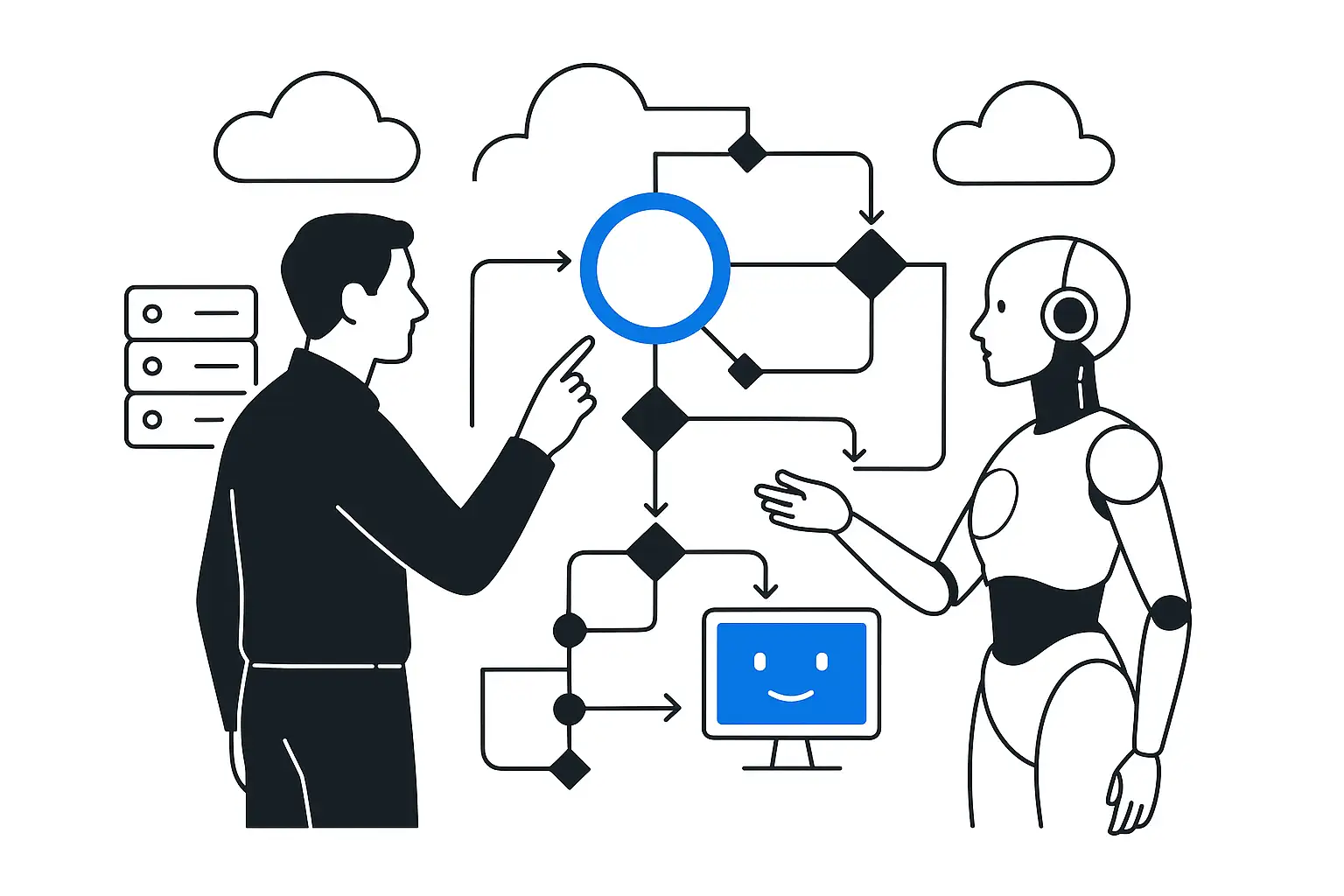
Start not with choosing an AI model, but with analyzing your processes
Look at where employees lose the most time and where mistakes are costly.

How to build an AI assistant for business, launch an MVP, integrate it with CRM, and scale it into an enterprise system.
59% of CIS companies are ready to delegate tasks to AI, but only a few implement it effectively. The reason is not knowing where to start or how to measure results. We explain why a business needs its own AI assistant, what tasks it solves, how to choose a development approach, and how to avoid common mistakes at the start. We will show the path from MVP to a scalable system and review a logistics company case where AI increased tender activity 7x.
In-house AI assistant helps companies _work faster and use fewer resources._ Unlike generic chatbots, it solves specific business tasks: answers employee questions, supports HR, processes documents, assists customers, and works with data. Companies see real impact not when they simply automate old processes, but when they _rethink them around AI capabilities_.
This approach delivers a noticeable result in profit and work quality. Those who limit themselves to isolated improvements usually see only a small effect. How AI assistants evolved The first bots worked by rigid rules: they reacted to keywords, did not understand the meaning of the request, and did not take context into account. Examples such as _ELIZA or early chatbots_ in support services could only imitate conversation and were suitable for simple tasks. Modern AI assistants work differently.
They understand what the user actually wants, take context into account, learn from past interactions, and can perform actions: search for information, fill out forms, prepare documents, and trigger processes. The assistant stops being a "talking form" and becomes a working tool.
What an AI assistant does in a company The assistant's main task- take over routine work and operate without breaks, helping the business avoid spending time and money on repetitive tasks. An AI assistant can: - Support employees. Answer questions about company policies, vacations, payments, and benefits.
Receive requests and create tickets for IT or HR without human involvement. - Handle customer requests. Answer common questions 24/7, help choose a product, take orders and bookings, and hand off complex cases to managers. - Work with documents.Find the needed data in contracts, prepare template-based reports, and check documents for errors and inconsistencies. - Store and retrieve knowledge. - quickly find current information in internal databases: about products, policies, past projects, and decisions. - Analyze data.Process large volumes of information, find patterns, and build forecasts for sales, service load, or demand. - Help manage tasks and projects.Track deadlines, remind people about due dates, update task statuses, and help teams stay focused. Important: companies that get the best results do not use AI to cut headcount.
They change employees' roles. People spend less time on repetitive actions and more time making decisions, analyzing, and managing processes.
Look at where employees lose the most time and where mistakes are costly.
Find one specific task that can be solved quickly and measurably, and start with it.
Good starter examples - answers to common questions from new employees or help with leave requests.
A narrow focus helps you get results fast, prove value to the business, and simplify the next step of development. Let's look at this with a concrete example. Suppose you are a distributor supplying electronic components to hundreds of small manufacturing companies.
Do your managers spend most of the day on the same tasks:
Sales don't grow because there simply isn't enough time for them.
This is what AI assistant preparation looks like in this case:
You look at incoming requests and see that customers most often ask: _"When will item X be delivered?"_. That is the task you take on. The MVP goal is for the assistant to answer such questions on its own by pulling data from the accounting system (1C or similar). The metric is simple: within three months, move to the assistant 40% such requests and free up managers to work with new clients.
For the assistant to answer correctly, it must be given the right information: - Conversations - export conversations from email and messengers where managers have already answered questions about delivery dates. - Knowledge - clean up catalogs, price lists, and logistics terms documents. - Up-to-date data - set up access to stock levels and order statuses through the CRM or ERP API. Without this, the assistant will guess instead of helping.
The project will not take off if only IT is involved. You need: - a business-side product owner, for example the commercial director; - a strong sales manager who knows all common customer questions; - a developer and a data specialist who will implement the technical part.
You do not force customers and employees to learn a new interface. The assistant answers where the questions already happen: in Telegram and in the internal corporate chat. Important! Do not try to teach the assistant to negotiate or sell. Start with the most frequent and most time-consuming routine work. Talk directly to the team and find out which questions they get dozens of times a day, which data they have to look up in different systems every time, and where in the process they most often get stuck.
This is exactly where AI will deliver the fastest and most noticeable impact.
1. Define the goal and metrics - decide exactly what you want to improve: reduce support response time, ease the load on HR, cut down managers' manual work. Without numbers, you will not know whether the project worked. 2. Collect and clean up the data- the assistant learns from what you give it. Prepare: email and chat conversations with common questions; instructions, policies, product descriptions; order databases, reference data, catalogs.
3. Assemble the team- assign a product owner from the business, involve process experts, and add technical specialists. Without business involvement, the assistant will be "smart" but useless. 4. Plan the entry points- place the assistant where people already work: in messengers, on the portal, in CRM. The less friction, the greater the value.
Once you understand what task the AI assistant should solve, the next question is how exactly to build it. There is no universal option here. The choice depends on budget, timeline, the flexibility you need, and whether the team has technical expertise in-house. Let's compare the approaches to building an AI assistant:
| Criterion | Ready-made low-code / no-code platforms | Customization via API and frameworks | Full in-house development |
|---|---|---|---|
| Speed of launch | Launch in days or weeks. Work through visual builders. | Launch in a few weeks or a couple of months. The team uses ready-made models via API. | They take months or years. The team builds everything from scratch. |
| Costs | Low at the start, usually subscription-based. Costs increase as you scale. | Medium: API costs plus developer work. The expenses are easy to calculate. | Very high: team, infrastructure, support. |
| Flexibility and control | Limited by the platform's capabilities. | They give high control and allow deep embedding into business processes. | They provide full control over logic, data, and architecture. |
| Team requirements | An understanding of the processes and business logic is enough. | You need developers who understand how LLMs and RAG work. | You need strong ML engineers, a data science team, and serious computing power. |
| When it fits | For a quick start, pilots, FAQ bots, and routine tasks. | For assistants that work closely with internal systems. | For tasks where security, autonomy, and unique algorithms matter. |
What CIS companies choose in practice According to the Higher School of Economics, 59% CIS companies are already ready to delegate tasks to AI, but few know how to work with it at a deep level. For this reason, business rarely jumps straight into complex custom development. More often, companies start with ready-made solutions or models available through API.
Mid-sized businesses usually choose ready-madecloud servicesandlow-code platforms.This approach makes it possible to launch a pilot quickly, test the hypothesis, and see the effect without hiring an expensive team. Solutions based on _Yandex Cloud AI or Sber AI_ are well suited for this, as they provide ready-made infrastructure and CIS language support.
Large companies with strong IT departments are more likely to go further - configure assistants throughAPI, use YandexGPT or GigaChat and embed them into their processes. Full in-house development is chosen less often, mainly where data cannot be sent to an external environment or where custom algorithms are needed.
Why agentic AI is the next step A regular assistant answers questions. Agentic AI goes further and acts on its own. It can create a Jira task, send an email to a customer through CRM, or compile a report in Google Sheets. Such assistants cover not one step, but an entire chain. This is where business gets the greatest benefit, because it removes manual work from multi-step processes.
You cannot make an AI assistant perfect from the start. The practical approach is to move step by step: launch a simple version, test it in real work, collect data, and improve it. The sooner the assistant starts interacting with users, the faster you will understand where it truly helps and where it gets in the way. Core principle - launch a useful version first instead of spending months trying to account for everything.
Stage 1. Define the logic and scenarios At this stage, you decide how the assistant thinks and where it goes for answers. This is the foundation of the entire system. Write out conversation scenarios.Identify the key questions users will ask most often and think through the answers.
People phrase the same request in different ways: "Where is my order?", "When will you deliver it?", "What is the status of 12345?" Your task is to account for all scenarios in advance and define clear response logic, instead of hoping the model will figure it out on its own. Define integration points. Decide which systems the assistant will work with: - CRM or ERP to retrieve order statuses; - a knowledge base to answer internal questions; - a calendar or task tracker to create tasks or reminders.
Draw a simple diagram: where the assistant gets data and where it sends the result. Build in search over your own data (RAG).For the assistant to answer accurately, it must search for information in your documents instead of inventing answers. To do this, you: - store instructions and files in a separate repository; - configure search across them; - give the model a rule to answer only based on the data it finds.
This reduces the number of errors and "hallucinations." Define roles.Even a small project requires clear ownership: - a business-side owner defines the task and accepts the result; - a process expert checks the answer logic; - a developer sets up integrations and the interface; - a data specialist helps the model work with information. If these roles are not in-house, it is easier to bring in a contractor with a ready-made team. Stage 2.
Implement, train, and validate Configure the model.You define communication rules and constraints through clear instructions. If needed, you fine-tune the model on your own conversations and documents so it speaks the business language and follows internal rules. Build the backend and the interface. Developers configure the request-handling logic and connect databases and accounting systems.
The user interface is kept simple and familiar, in a messenger, on a portal, or in CRM. Test- test the assistant before launch: - ask common questions and check answer accuracy; - try nonsensical and provocative prompts; - verify that it does not reveal extra data; - see how it behaves under concurrent requests. The more issues you find here, the fewer problems you will have in the pilot. Stage 3. Launch the pilot and collect data Do not roll out the assistant to everyone at once.
Give it to a limited group - one department or one customer group. Collect feedback right inside the dialogue.Add a simple answer rating and the option to leave a comment. Users rarely write long feedback, but they quickly leave a reaction. Analyze real conversations. Watch for: - which questions the assistant did not understand; - where it answered inaccurately; - where users immediately switch to a human.
These spots show what to improve first. Refine and update it.Refine scenarios, add new question phrasing, expand the knowledge base, and clarify the model instructions. Repeat this cycle until the assistant consistently meets the required metrics. Stage 4.
Scale and monitor quality. When the pilot shows stable results, bring in the rest of the users. Expand gradually. Roll the assistant out department by department or region by region to control load and quality. Track not only the technology, but also the value. Track: - the share of requests the assistant resolves on its own; - average response time; - user satisfaction; - reduced load on employees. Assign an owner.The assistant does not work on its own.
Someone has to: - update the data; - review reports; - plan improvements; - decide which tasks to add next. This role is usually taken by the product owner on the business side.
Situation:"Vostochny Transit" provides freight transport across the CIS Far East and regularly participates in electronic tenders. Here are the problems the company faced: 1. Tenders were going by -employees manually monitored the platforms and managed to prepare bids for only 10-15% of suitable tenders. The rest were simply ignored, even if the terms looked favorable. 2. Preparing the bid took too much time -a manager spent 3-4 hours on a single proposal with pricing calculations.
As a result, participating in small and mid-sized tenders did not pay off in terms of time. 3. The price depended on subjective decisions -managers relied on personal experience and intuition rather than statistics from past deals. Sometimes the company overpriced and lost, sometimes it underpriced and won with minimal margin. Solution:the partner team implemented AI assistant for the procurement department, which took over routine work with tenders.
It tracks suitable tenders on the platforms on its own, analyzes terms, matches relevant past deals, calculates a price based on bid and win history, and drafts a commercial proposal.
An employee joins only at the final stage to check the calculations and make the final decision. Results: - Tender activity increased 7x. The team began reviewing and submitting 100-140 tenders per month instead of the previous 15-20. - Time per application dropped by several times. Preparing a full proposal now takes 15-25 minutes instead of 3-4 hours. - Pricing became more accurate and stable. The assistant calculates cost based on a database of 500+ past bids and winning procedures.
There were fewer errors, and proposals became more competitive. - The team shifted its focus. Employees stopped manually monitoring platforms and filling out forms. They began analyzing complex tenders and working with large contracts. - The number of wins increased. In one quarter, the number of tenders won grew by 40%. This directly increased order volume without expanding headcount.