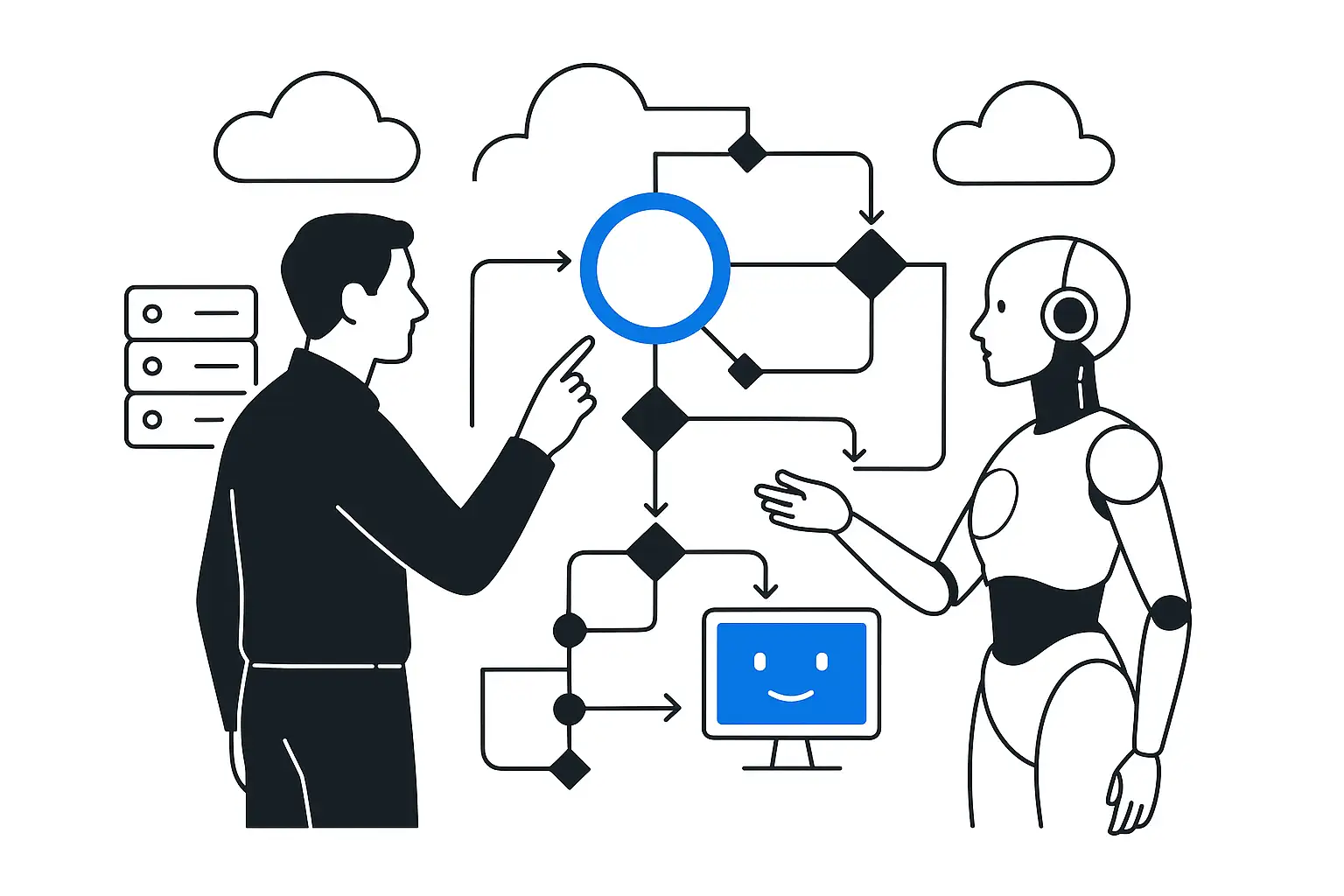
A corporate AI agent is not a single program, but a set of modules, which together bring the task to completion. Understanding these layers shows, where cost and impact arise, which specialists to involve, and which risks to address in the pilot. Input/output channels - Chat - widgets on the website / in the app, integration with the corporate portal/service desk. - Telephony + ASR/TTS for online conversations and IVR scenarios.
Speech recognition and synthesis are built into the system, half-duplex/full-duplex. Orchestrator and planner The orchestrator manages the agent's logic: plans steps, selects tools, and supervises task execution. This reduces errors when integrating with corporate systems and speeds up the request-response cycle.
Tools and function registries These are actions: "check order status", "create a ticket", "issue an invoice", "search the knowledge base", "run an SQL/HTTP query". In Yandex AI Studio there are ready-made tools and the ability to add custom ones via MCP Hub - connecting external APIs/systems. Scenarios can be assembled using visual Workflows.
Knowledge and RAG layer RAG- is an AI framework that improves LLM responses by adding information from external knowledge bases during response generation. The agent retrieves fragments from the corporate knowledge base - documents, procedures, SKU catalogs - ranks them, and inserts them into the LLM context. Memory preserves the history of interaction with the customer, improving personalization and response speed. Types include: - Short-term - the history of the current conversation.
The agent compresses and summarizes it, using context windows. - Long-term - customer profiles, preferences, facts. This data is stored in external storage / a vector database. The agent adds it to the prompt when needed.
Integrations with corporate systems The agent system is connected to: - CRM - for creating/updating leads and cases, checking statuses, initiating returns, and closing FAQ requests; - ERP,WMS,TMS - for working with stock, prices, documents, reservations, and transfers; - marketplaces and e-commerce - for access to item cards, prices, stock levels, order statuses, and review responses; - payment system - for processing returns, generating payment links, and changing transaction statuses; - delivery and tracking- for calculating cost and lead times, printing labels, tracking parcels, and changing delivery details; - EDI- for sending and signing documents, creating records and approval workflows; - email, calendar - for creating meeting slots, reminders, and mailings; - HR/recruiting - for pre-screening, interview scheduling, and updating candidate statuses.
Quality policies and guardrails - Response policy - when the agent must clarify, decline, or escalate the issue: low confidence in the answer, no source available, or personal data risk. - Action constraints - which tools are available to the agent, with what permissions, and for which inputs: allow/deny lists, parameter validation. - Secure connections to systems. All external services connect through a single MCP Hub, which eliminates ad hoc integrations and reduces the risk of data leaks.
For business, this means reliable agent operation and protection of corporate information. - Content and behavioral filters - rules for disallowed content, prompt normalization, and link/fact verification before replying. - RAG limitations. The agent responds only from corporate sources, with citations or document links. - Audit and logging - log prompts, tools, and decisions. Required for investigations and quality control.
Observability and evaluation - Agent step tracing - who requested what, which tool was called, input/output, time, and error code. - Quality metrics: self-service share, accuracy/usefulness of answers based on expert labeling, escalation rate, P50/P95 latency, quality of RAG retrievals. - A/B experiments and control groups - measure impact by service cost, average handling time, loyalty, and customer satisfaction metrics. - Incident postmortem procedures - who reviews logs, how quickly rules/prompts are fixed, and how rollback is handled. - Evaluation of action chains. Evaluation covers not only the text, but also the solution "path": plan -> tools -> verification.
Cost control - Token price and model routing. This is the system's key driver. - Routing by complexity: simple requests -> compact model; complex/critical -> Pro/flagship. - Caching and deduplication: repeated RAG responses and vector queries - from cache. - Pre-filtering in RAG: aggressive filtering/ranking before the LLM reduces tokens in the context. - Billing metrics: cost per conversation and successful resolution, impact on savings. - Technical limits: rate limiting by user/organization, tool timeouts, and limits on the number of plan iterations.
Discuss your challenge with an architect