Digitalization was supposed to make business life easier, but in practice it created new chaos:
- sales data
- advertising
- about customers accumulate in dozens of systems
- disparate files

Why a company needs an EDW, how it unifies data from different systems and helps make management decisions faster.
Digitalization was supposed to make business life easier, but in practice it created new chaos:
There is more and more information, and less and less time to process it.
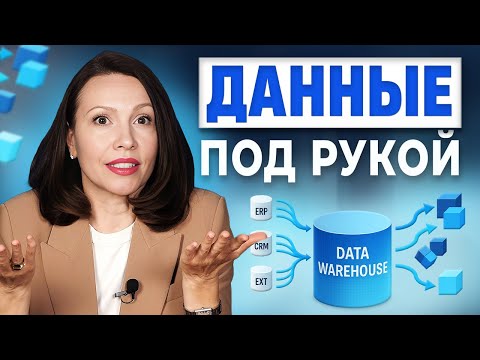
An Enterprise Data Warehouse (EDW) helps regain control: it collects, cleans, and organizes data from different sources - CRM, 1C, Excel, websites, and advertising.
Enterprise Data Warehouse (hereinafter - EDW) can without exaggeration be called the information core of the business.
The warehouse performs several important functions: -
Collecting information from different systems. EDW makes it possible to combine data from CRM, 1C, EXCEL, and other important sources. -
Reliable, centralized data storage.
Information is stored in one place, protected, and always available. - Bringing order to the database.
The warehouse removes duplicate documents, corrects errors, and keeps information clean and consistent. - Automated reporting.
This warehouse function saves a great deal of time. - Decision support.
With complete and up-to-date information, company leadership can act quickly and effectively. -
Convenient management of data access.
The warehouse automatically grants users rights to view, edit, and perform other actions with documents. EDWmakes it possible to filter, group, and analyze information.
This is crucial for business owners and project managers striving to make informed decisions.
EDW is a system that aggregates data from different sources, filters it, and prepares it for analysis. These sources include online stores, ERP, CRM, accounting software, social networks, and call centers.
As soon as information from the source systems enters the warehouse, it is automatically "filtered" and standardized for analysis. According to one of the creators of EDW, Bill Inmon,enterprise data warehouseserves as a "basis for making informed decisions." This is what sets the system apart from a regular information repository.
Understand building an EDW data warehouseeasier with examples.
Imagine a supermarket chain in which each location has its own sales system, accounting and customer database.
Tens or even hundreds of thousands of transactions happen every day.
Before the emergence of data warehouse for businessit used to take painfully long to collect and consolidate transaction data.
Thanks to the development and implementation of a data warehousetransaction data accumulates and is securely stored in a centralized warehouse.
Integrating data from websites, CRM, and ad campaigns into a single platform makes it possible to track the customer journey from a banner click to the target action. Benefits of EDW implementationare obvious even in the short term.
According to some consulting firms, including Oracle and SAP, implementing an EDW can reduce reporting costs by 10-30% while increasing conversion by 10-20%.
Let's look at this scenario using a showroom with an online store and retail sales.
Before the enterprise warehouse was integrated, online and offline sales were tracked separately, there was no unified advertising strategy and no audience segmentation.
Thanks to EDW implementation, in just a few months you can: -
Unify sales, customer and ad campaign statistics in a centralized database.
This makes it possible to see which ads drive sales and drop ineffective ones, reducing costs. -
The showroom sends promotions to specific segments, taking customer requests and interests into account. - As a result, sales increase and conversion rises. -
In general, EDW works simply: in the evening, data enters the database, and by morning analysts get a detailed view of sales, stock, and the effectiveness of each promotion. The importance of a centralized warehouse for business
One of the key Data Warehouse benefitsDataWarehouseis to create a single source of truth.What exactly does this give the business: -
Situations where marketers see one set of sales statistics and the finance team sees a completely different one are eliminated.
When different departments of a company work with the same information (statistics, reports), it eliminates inconsistent actions and their consequences. -
A centralized database reduces the time needed to prepare reports. Processes that previously took many hours or days are fully automated.
A company executive can get detailed statistics on revenue, top-selling products, and low conversion at any time. - Data visualization in business through EDW helps IT departments.
The latter are freed from manually collecting data and editing reporting documents thanks to a single source of information.
The benefits of an enterprise data warehouse do not rule out problems during implementation. This is a major company-wide transformation that goes far beyond a typical technical project. EDW risks can be purely technical or caused by human factors. It is impossible to be certain that digital business transformation will fit within budget and be warmly received by all company employees.
Let's review the most likely risks of EDW integration and ways to prevent them:
| The Problem | Example | Prevention/Solution |
|---|---|---|
| Missed deadlines, budget overruns | The project was planned for 3 months but took 8 | Split into stages, assign owners |
| Employee dissatisfaction | Doubts about the accuracy of the new reporting | Training, engagement, and demonstrating value |
| Inaccurate calculations | Incorrectly calculated revenue distorts the entire picture | Repeated checks and deeper system testing are required |
| Data leakage, unauthorized access to the warehouse | An employee accidentally accessed confidential information | Flexible access rights, encryption |
| Unstable technical support | Only one employee in the company knows the storage system in detail. If they leave, technical support will stop. | Team training, procedures, backup access |
| Underestimating the importance of warehouse management (ETL) | Data is not cleaned ETL processes for the data warehouse handle this - algorithms responsible for transferring information from source systems into the corporate repository. | Implement ETL + automated quality control |
The benefits and strategic value of implementing an EDW Companies using EDW: - make decisions faster; - manage inventory, marketing, and assortment more accurately; - reduce analytics and manual labor costs; - strengthen their competitive position. A McKinsey study shows: data-driven companies make decisions 5-6 times faster and are less likely to fail product launches.
And as IDC expert Sergey Solovyov says: "Well-organized data storage is a fast start with minimal risk."