OpenRouter and Multimodel AI: Risks of One LLM Provider

OpenRouter serves 10 million developers. Learn why relying on one LLM can cost a quarter of migration—and how a multimodel gateway solves it in a day.

  • How a “wrapper” became infrastructure
  • The problem for companies: the model is hard-coded
  • How the routing layer works
  • What this means for CIS companies

Trigger

  1. In the podcast Latent Space OpenRouter co-founder Alex

  2. Atallah explains how a service once dismissed as “just a wrapper” became a neutral routing layer for more than 10 million developers.

  3. The practical takeaway for the company in this story is that the “best model” chosen at the outset becomes outdated before the project reaches production.

  4. That is why the architecture should include a layer that lets you change models in a day.

How a “wrapper” became infrastructure

  1. OpenRouter emerged during the first wave of open models. In February 2023, Meta released Llama. A month later, researchers

  2. Stanford fine-tuned Alpaca on it and, according to them, spent less than $600.

  3. That autumn, Mistral 7B was released. Each model had its own pricing, limits, API format, and weaknesses.

  4. Atallah and his team bet that developers need a single entry point to all models.

  5. It does not need twenty keys from twenty providers. In 2023, this niche was considered small.

  6. Today, one model writes code in a product, a second cheaply classifies requests, and a third analyzes long documents. Anjney Midha of AMP and host swyx discuss OpenRouter as critical infrastructure, although it performs a mundane task: accepting a request, choosing a provider, making the call, and issuing the bill.

  7. Product reliability depends precisely on this unglamorous work.

The problem for companies: the model is hard-coded

  1. Most enterprise AI pilots that come to us follow the same pattern.

  2. The team chose a model, embedded a specific provider’s SDK in twenty places, tailored the prompts to its quirks, and went live.

  3. Six months later, one of three things happens: a model appears that is 3–5 times cheaper at the same quality, the provider changes its terms, or the security team bans sending personal data outside the perimeter.

  4. Migration takes a quarter because the model has become intertwined with the business logic.

  5. This directly increases TTU (time to use, the time to reach a useful result).

  6. While the team rewrites the integration, the business gets no results.

  7. If AI does not improve the metric, management shuts it down, cuts the budget, and parts ways with the people who championed the project.

How the routing layer works

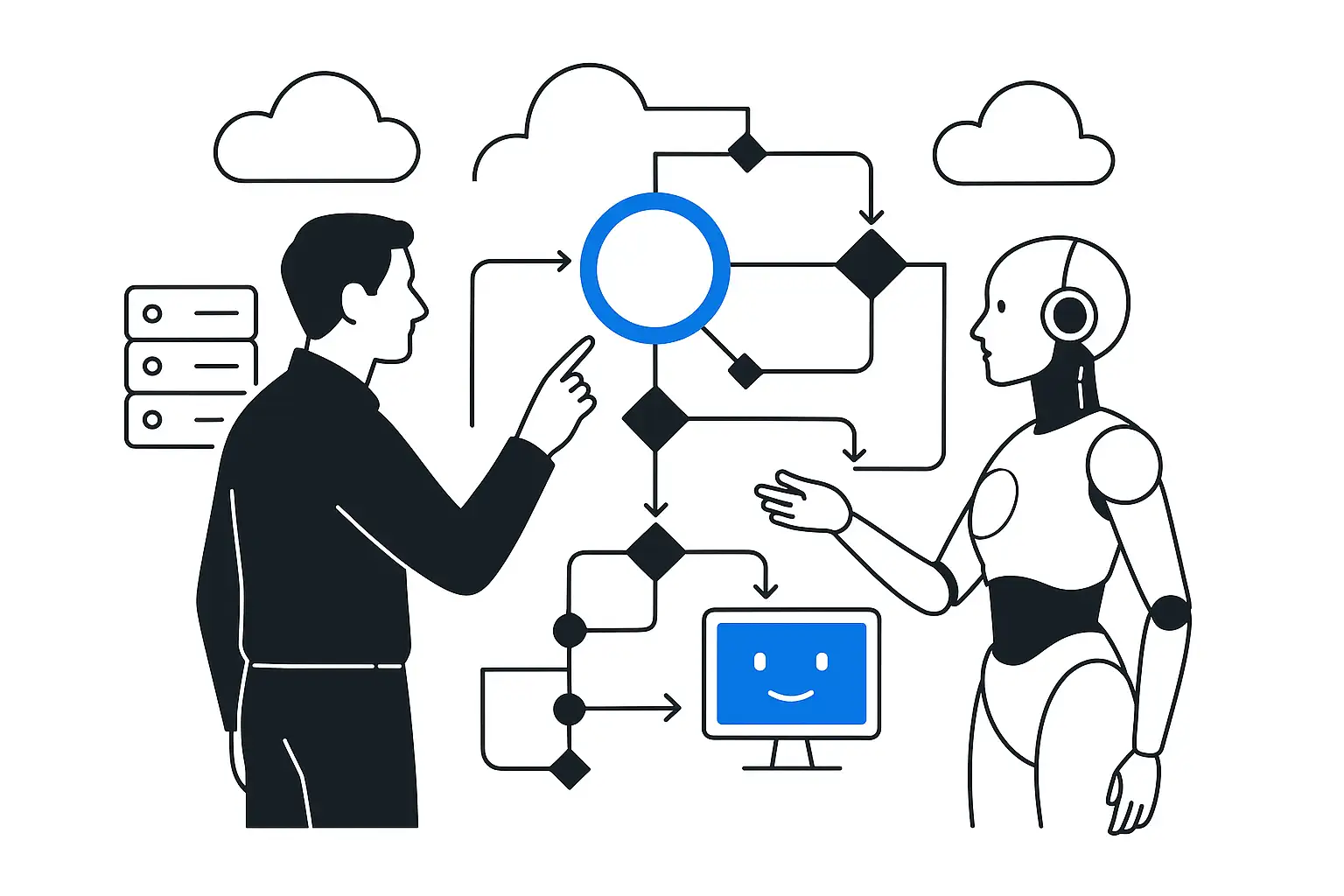
### A unified interface The application calls a single API, usually OpenAI-compatible, and passes the model name as a parameter.

To change the model, an engineer updates the configuration without touching the code. Prompts, response schemas, and quality tests are stored separately from the provider. ###

Policies and fallback routes The layer defines rules for which model handles each task type, what to do after a timeout or 429 error, and when to switch to a backup provider.

The economics are built on these rules

Suppose an expensive model handles 10% of complex requests while a cheaper one processes the remaining 90%.

The average cost per request then drops several times over, while quality is preserved where it matters most.

The exact savings depend on the difference in model prices and the share of complex tasks, so they should be measured on your own traffic. ### Accounting, limits, and security

All traffic passes through one point, making it easy to track tokens by team, set budget limits, mask personal data, and log requests for audits.

Without such a layer, the security team sees only a zoo of keys in environment variables.

Assess where AI can deliver impact in your process

What this means for CIS companies

  1. A CIS company needs multimodel AI even more than a Silicon Valley startup does.

  2. By law, some data must remain within the internal perimeter, so companies need Sber GigaChat, YandexGPT, or open Qwen and Llama models on their own servers.

  3. For tasks involving no sensitive data, Anthropic Claude, OpenAI, or Google Gemini may be more cost-effective, if they are legally accessible.

  4. Regulators and providers change the rules more often than a company can spend its annual budget.

  5. If a product is tied to a single provider, the team must repeat the migration after every such change.

  6. An off-the-shelf cloud router such as OpenRouter usually does not meet the needs of an enterprise environment in CIS because of data storage and payment requirements.

  7. An in-house gateway with the same logic solves the problem.

How we build it

  1. At KT.Team, the LLM & Security Gateway addresses this challenge.

  2. Applications use this gateway to access any model through a unified API.

  3. The gateway routes requests by task type, switches to backup providers, masks data, and counts tokens.

  4. RAG pipelines for corporate documents and MCP servers run on top of it.

  5. Through MCP, the model accesses data from 1C, Pimcore, or Akeneo as tools, so each new model does not require a separate integration.

  6. Events between systems are transmitted through Apache Kafka or Datareon, as in a conventional integration architecture.

  7. In storefronts and PIM, we use this approach to generate product card descriptions, facets, and catalog taxonomy.

  8. A cheaper model handles bulk labeling, a more capable one writes complex formulations, and the pipeline stays unchanged when switching to a new model.

  9. The user sees a simple “Generate” button.

  10. To keep it working after a model, provider, or regulatory change, engineers do work that is invisible from the outside.

Verdict

In three years, OpenRouter turned a “wrapper” into infrastructure for 10 million developers: its founders correctly bet that models would change faster than products. I would advise any executive launching AI in a company to ask the contractor one question: how many days will it take to switch to another model? If the answer is measured in quarters, you are buying provider dependency. The practical answer is one configuration line and a regression test run.

Source

OpenRouter: from Seed to Stripe - with OpenRouter’s Alex Atallah & AMP’s Anjney Midha, the Latent Space podcast (swyx). The material belongs to its authors and is used here for quotation and analysis.

Discuss the article: OpenRouter and multimodel AI: why…

Enter your email or phone number so we can get back to you.

Send via: