An Agent in Production: Everything Around the Model Is the Hard Part

Postman, 40 million developers, and agent payments: what keeps an agent running in production and why the prompt is not the main factor.

  • The occasion: three AWS analyses of the same topic
  • Postman: the product itself proved to be the hardest part
  • The agent pays: money without a human in the loop
  • The common denominator: control lives outside the model

The occasion: three AWS analyses of the same topic

In September 2026, AWS published three analyses of agents in production.

The first explains how Postman integrated Agent Mode into a product used by 40 million developers.

The second describes how BlockRun and Incarna use Amazon Bedrock AgentCore payments so agents can pay for services themselves.

The third is a monthly overview of Bedrock, AgentCore, and Strands, where AWS sets out its strategic bet:

  • the builder should have a choice at every level
  • that is, the model
  • runtime environment
  • tooling

All three texts reach the same conclusion.

An agent in a production system relies on product integration and constraints enforced by the infrastructure.

Model quality and prompt wording play a secondary role.

The sources contain few figures, but the conclusions are clear

For a leader deciding where to invest the AI budget, they are more useful than any benchmark.

Postman: the product itself proved to be the hardest part

  1. The Postman team expected the main challenges to involve model quality and prompt design.

  2. According to the authors, the main challenges arose when integrating the agent into a mature product.

  3. Over the years, it has accumulated assumptions designed for a human behind the interface, a broad feature surface, and specialized concepts. The mechanism is clear.

  4. A person sees a screen, buttons, and prompts, while an agent needs explicit operations described structurally.

  5. If half of the product logic exists in the user's head and the order of clicks, the agent can barely access it. Postman covers API testing, documentation, search, and implementation, and the team must expose each of these areas to the agent separately. The demo shows what the model can do.

  6. A service for 40 million people must ensure that the agent acts predictably, with clear permissions, across every part of the product. That difference is engineering.

The agent pays: money without a human in the loop

The second analysis focuses on a situation that is often overlooked

During the task, the agent purchases:

  • model call
  • API response
  • access to web content
  • another agent's work

The purchases are small, sometimes fractions of a cent, frequent, and made within a work cycle when no one is available to approve them. AgentCore payments gives agents a controlled way to pay on demand.

The infrastructure enforces spending limits.

You can ask the model in a prompt not to spend more than a specified amount, but such a request guarantees nothing.

An infrastructure limit works like a fuse: overspending is blocked before the money is spent. Using this approach, Incarna allowed its agents to pay BlockRun for inference, separately for each call.

For businesses, this is the pay-per-inference model: costs are tied to actual usage and can be calculated per unit of output.

The common denominator: control lives outside the model

In both cases, the decisive elements lie outside the language model: - describing product capabilities in a form the agent can understand; - permissions and limits enforced by the infrastructure; - tracking the cost of every action; - the ability to change the model without rewriting everything else. AWS confirms the last point in its roundup: the choice of model, runtime environment, and tools should be independent. This is basic engineering hygiene.

Models change faster than the products built around them, and tying a product to one model eventually becomes technical debt.

Assess where AI can deliver impact in your process

How this is addressed technically

  1. At KT.Team, we build such architectures using one consistent pattern.

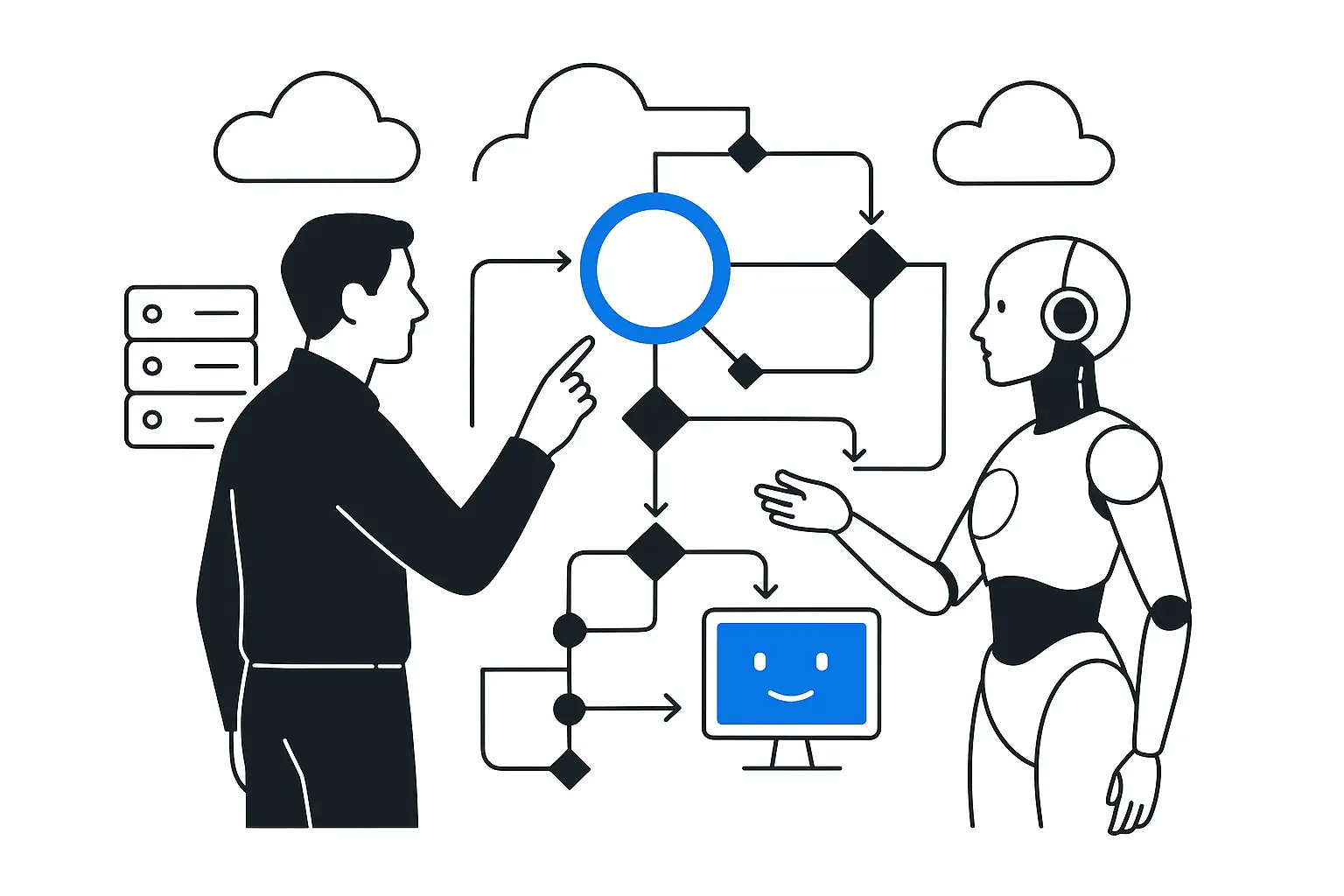
  2. The agent accesses product capabilities through MCP: each operation is described as a tool with a clear contract and permissions.

  3. An LLM & Security Gateway sits between the agent and the models.

  4. It provides unified tracking of tokens and costs, filters data sent outside, and lets you change providers through configuration: Anthropic Claude, OpenAI, Google Gemini, Sber GigaChat, YandexGPT, Qwen, Llama.

  5. When the agent needs events from accounting systems (1C, Bitrix, Odoo), they are delivered through a bus to Apache Kafka or MuleSoft.

  6. The agent works with live data, not a snapshot from a week ago.

  7. That is AI-native integration: preparing the product and data for machines to work with them.

  8. The result looks simple when everything works.

  9. Behind this simplicity are interface audits, a permissions system, and cost tracking, while model selection occupies a modest place on the work list.

What this means for the budget

Anyone planning an agent launch should budget for three items that are usually forgotten: preparing the product and data for machine access, a permissions and limits boundary, and tracking the cost per unit of output. Without them, the agent remains a demo: impressive in a presentation but unable to move the metric. The project is shut down, and the people who sold it internally leave with it. A hypothesis worth testing on your own data is that most of the project timeline will go to integration, while model selection will take a small share.

Postman describes its own experience in exactly these terms.

Verdict

An agent becomes a service when it has an agent-readable product, infrastructure constraints, and a bill for every action. With good architecture, the model can be changed through configuration, while a product the agent cannot understand may take months to rebuild. Invest in what remains after the model changes.

Sources

- Postman and AWS, “How Postman runs Agent Mode for 40 million developers on Amazon Bedrock,” AWS Machine Learning Blog: https://aws.amazon.com/blogs/machine-learning/how-postman-runs-agent-mode-for-40-million-developers-on-amazon-bedrock/ - AWS, “Pay-per-inference for AI agents: How BlockRun and Incarna use Amazon Bedrock AgentCore payments”: https://aws.amazon.com/blogs/machine-learning/pay-per-inference-for-ai-agents-how-blockrun-and-incarna-use-amazon-bedrock-agentcore-payments/ - AWS, “ICYMI: What landed for AI builders in September 2026”: https://aws.amazon.com/blogs/machine-learning/icymi-what-landed-for-ai-builders-in-september-2026/

Discuss the article: AI Agent in Production: Beyond the Model…

Enter your email or phone number so we can get back to you.

Send via: