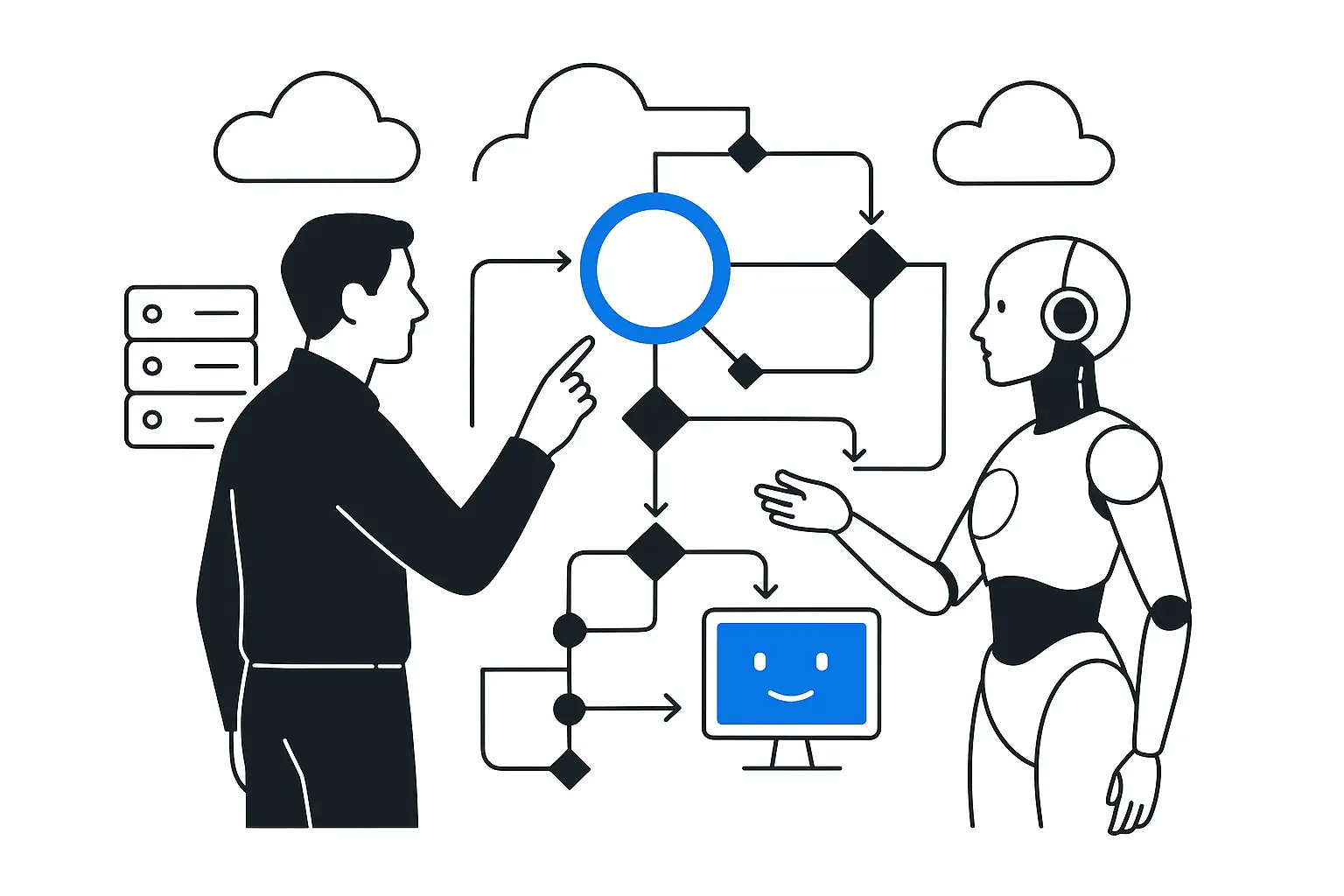
An agent operates through a sequence of steps
The model makes a plan, calls a tool, reads the response and decides what to do next.

The new crewai eval command shows where an agent failed. Why diagnostics matter more than features, and three questions to ask your supplier.
crewAI released version 1.15.28 of its Python framework for multi-agent systems.
The main addition is crewai eval, which reports where the model stopped.
Most other changes also concern diagnostics: developers should learn about a failure before the user does.
For a business, this is the boundary between a pilot and a working product. An agent whose failures nobody can locate does not reach production.
The model makes a plan, calls a tool, reads the response and decides what to do next.
A complex task may involve dozens of these steps.
When the chain breaks, an engineer faces hundreds of log lines and manually searches for where the model lost track. crewai eval analyses the chain and reports the stopping point.
The other changes address further causes of failure: - The context-window size comes from the LiteLLM catalogue. LiteLLM is an adapter library offering one interface to most model providers. Its catalogue records each model’s limits.
An incorrect limit causes the agent either to discard its own history or to fail when the context overflows.
The framework now retrieves the value from the shared catalogue, removing the need to configure it manually. - Flows retain human corrections after a pause. A Flow pauses an agent to await review. Previously, a reviewer’s correction could be lost after resumption and the reviewed output’s data types could break. Version 1.15.28 accepts the feedback and preserves the format. - A warning when no tools are available.
The framework warns if connected applications expose no platform tools to the agent.
Without a warning, it starts without tools and may invent answers. - Deployment.
The framework now explains deployment failures; the developers also fixed removal and lockfile checks.
ZIP deployments receive the new code, and local JSON files are read as UTF.
In production, it encounters malformed data, a slow partner API and a draft an employee edited before going to lunch.
An ordinary service returns an error in such cases.
An agent is more likely to answer confidently and incorrectly.
We call this a silent failure: monitoring remains green while the result is unusable.
We measure a tool’s value through TTU, time to use: time to the first useful result.
Failure-investigation time is part of that metric.
If an engineer spends half a day diagnosing every failure, a month later support consumes more hours than the agent saves.
The executive then closes the project and writes off its budget as an experiment.
The release suggests crewAI’s developers see the same problem and are prioritising these gaps.
Behind ‘the agent just works’
A framework update supplies none of these automatically; the team must build them. Tracing every step.
Model calls, tool calls, responses and decisions each need an ID, timestamp and cost. crewai eval addresses part of this within one framework. Companies usually have agents on different stacks, so tracing belongs in a shared system. A single access point for models.
Our LLM & Security Gateway sits between agents and providers:
The gateway stores model limits, logs calls, masks personal data and switches providers on failure.
The gateway handles context-window limits across all company agents, the issue crewAI addresses through the LiteLLM catalogue. Standardised tools.
We connect agent tools to 1C, PIM and ERP through MCP, the open protocol that gives models access to external systems.
At startup, the agent checks that every declared tool is available and refuses to run if the list is empty.
This is the same check introduced in crewAI, applied at the infrastructure level.
We use this pattern for product-description generation and catalogue taxonomy.
Every step is logged; an editor’s correction becomes a reference for checking subsequent runs.
Ask three questions when choosing a supplier or framework for an agent system. The answers indicate whether it can reach production.
Where can you see the step that failed, and how long will finding the cause take?
What happens to the reviewer’s correction: is it lost or used in the next run?
What happens if a tool fails to connect or respond within its time limit? If the answers are ‘we will check the logs’ and ‘that never happens’, you are buying a demo.
Release 1.15.28 has no headline-grabbing features; that is its value. Agent-framework developers are shifting from ‘what else can the model do?’ to ‘how quickly will we know it made a mistake?’ Businesses need the second answer. A team can fix a visible failure in hours and have the agent moving a metric next quarter. Without diagnostics, the agent may join the list of abandoned pilots.