Anthropic Dynamic Workflows: Code-Driven Agent Control

Anthropic introduced flows for orchestrating Claude agents with code. We examine the mechanism, parallel and pipeline primitives, and the pre-launch checklist.

  • What they showed in New York
  • Where companies lose budget on agents
  • How a flow works
  • Why this is about time to use

What they showed in New York

At AI Engineer NYC 2026, Anthropic engineers CJ Avilla and Harrison Stall presented dynamic workflows, or simply flows. This is a new mode for orchestrating Claude agents that Anthropic announced several days before the conference. Business takeaway: a multi-agent system pays off when it is driven by a prewritten workflow with checks and retries.

The number of agents has little impact on the result

Anthropic describes flows as “a new type of multi-agent orchestration for the most ambitious workloads.”

Flows run on top of Claude Managed Agents

In this service, Anthropic runs agents on its own infrastructure, so the client does not need to set up a runtime. Avilla and Stall examined flows at a workshop on the first day of the conference, so the demo was aimed at engineers who will build such systems themselves. Multi-agent systems have been discussed since 2023. The new development is that the model vendor itself has released a standard way to control agents.

Where companies lose budget on agents

  1. A typical pilot looks like this. The team writes a long prompt for the agent and gives it 40 steps.

  2. Around the thirtieth step, the agent goes off course, and no one can say where the failure began.

  3. The second option is called a “swarm”: a dozen agents freely exchange messages with one another.

  4. The token bill becomes unpredictable, and the entire result must be checked manually. In both cases, the process lacks a framework.

  5. The CFO sees the expenses but not the metric they improved.

  6. After a quarter, management usually shuts down such a pilot and labels its creator an AI-theater enthusiast.

How a flow works

A similar mechanism is already available in Claude Code as the Workflow tool, making the logic clear.

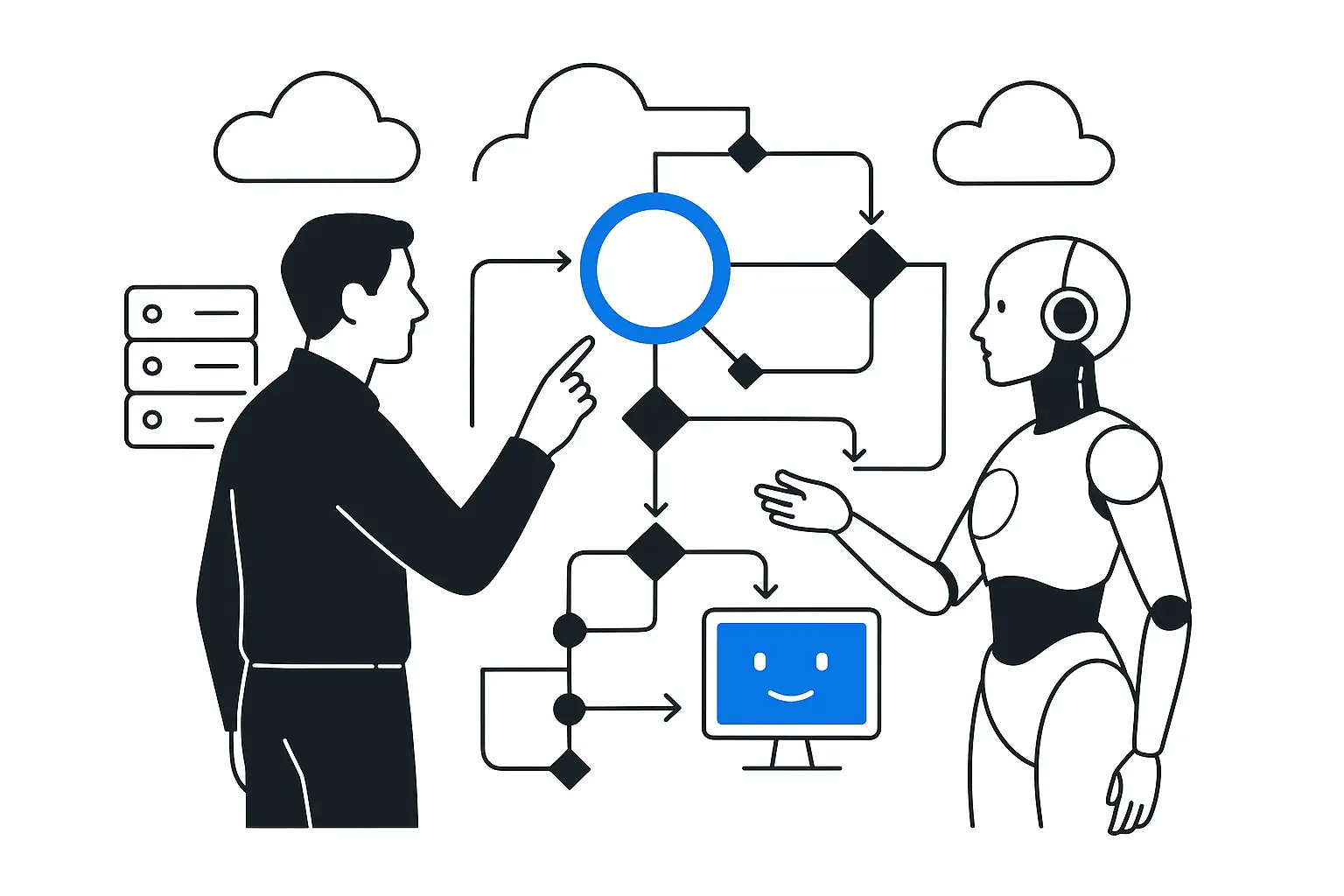
The developer defines the orchestrator in code: a script with a deterministic sequence of steps.

The model is used where judgment is required:

  • read
  • classify
  • write
  • find an error

The script is built from three primitives: - agent - a separate agent call with a task and response schema.

The orchestrator validates the response structure, so free-form text does not pass to the next step. - parallel - running several independent tasks simultaneously, such as checking ten files or ten product cards. - pipeline - pipeline: each item moves to the next stage as soon as it completes the previous one.

Checking the first finding begins while the others are still under review, so the pipeline does not sit idle waiting for the slowest item.

Two more details matter in production.

The first is resume: on restart, the orchestrator takes completed steps from the cache and reruns only the changed ones. A run that failed at step forty continues from step forty.

The second is budget

By default, Claude Code recommends keeping a workflow to 10 agents or fewer and starts orchestration only after the user explicitly agrees.

Anthropic itself thus shows that scaling agents costs money and that a person decides the scale.

Assess where AI can deliver impact in your process

Why this is about time to use

  1. TTU, time to use—the time it takes for a tool to start producing results.

  2. A deterministic skeleton reduces TTU because the result is repeatable.

  3. The same workflow can be measured, compared with manual work, and presented to management as a figure.

  4. Serious engineering lies behind the outwardly simple flow.

  5. To write it, the team breaks the process into steps, defines the input and output for each step, moves validation to a separate stage, and decides what counts as a defect.

  6. Most companies get stuck on exactly this work.

  7. Against this backdrop, choosing a model takes minutes.

Where we apply this pattern

  1. In KT.Team projects with Pimcore and Akeneo catalogs, product enrichment is designed as a pipeline from the outset.

  2. The first agent organizes items by taxonomy, the second writes product card copy, and the third builds filter facets; manual tag overrides from category managers are then applied.

  3. A separate checking agent compares the card text with the attributes in PIM.

  4. If the text says cotton but the attribute says polyester, the checker sends the card back for revision, and it never reaches the website. In integrations with 1C and ERP, agents receive data through MCP connectors and have no direct database access.

  5. All traffic to models passes through the LLM & Security Gateway: the gateway determines which fields leave the perimeter and logs every call. In a CIS environment, the same workflow works with GigaChat, YandexGPT, or Qwen: the orchestrator is not tied to a specific model.

  6. Our News Machine, which prepares content for this blog, follows the same structure: source collection, a signal pool, text synthesis, and quality gates.

  7. If the material lacks a strong signal, the gate rejects it and it is not published.

What to check before launching your flow

  1. The process is defined as a sequence of steps, each with an input and output schema.

  2. A separate agent performs the check against a measurable criterion.

  3. Limits are set for the number of agents and the cost of each run.

  4. After a failure, the run continues from the last successful step.

  5. It is known which data is sent to the model and where this is documented. If two of the five questions have no answer, flows will only accelerate token consumption.

Verdict

By releasing flows, Anthropic established a model in which code defines the order of steps, while the model provides judgment within each step. Companies that first describe their processes so a pipeline can execute them will gain an advantage: they will see measurable results within weeks. The rest will continue paying for a swarm of agents that exchanges messages impressively in the logs.

Discuss the article: Anthropic Dynamic Workflows: Agents…

Enter your email or phone number so we can get back to you.

Send via: